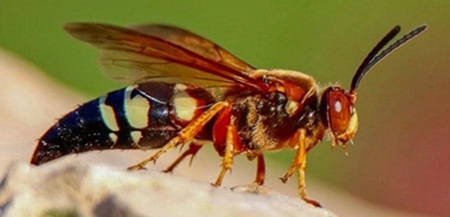
Photo of Eastern cicada-killer wasp courtesy of Timothy Gibb
In this issue:
Summer provides us with the opportunity to reflect on the magic of the estuary and marvel at its synchronized seasons of production and nourishment of aquatic life. Our fishes thrive in the summer as evidenced by the overwhelming presence of young-of-year. Week by week we see the growth of young river herring and striped bass as well as the arrival of young fishes from the sea to partake of the buffet the estuary offers.
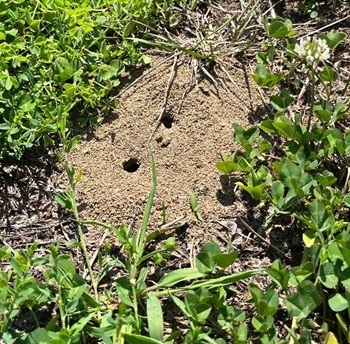
7/26 – Town of Poughkeepsie: In recent weeks as I walked my dog in a Dutchess County park, there has been a near constant hum over the multi-acre field. In the same field were hundreds of small piles of fresh dirt each with a small circular hole. The holes were escape routes for emerging periodical cicadas. The incessant hum came from swarms of cicada-killer wasps. The hum was the theme music of their ongoing drama.
Eastern cicada-killer wasps feed on periodical cicadas by paralyzing them with venom and then carry them off to the wasp’s den to feed the growing wasp larva. The wasps exert a measure of natural control on cicada populations, and as such, they may directly benefit the deciduous trees upon which the cicadas feed. These are gentle giants as far as humans are concerned: males cannot sting; the females will only if you step on or otherwise annoy them.
- Tom Lake
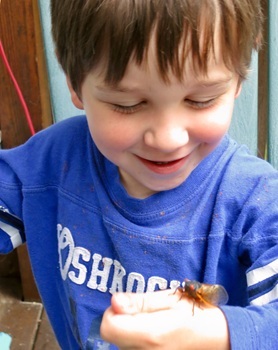
Photo of periodical cicada courtesy of Tom Lake
[Eastern cicada-killer wasp (Sphecius speciosus) is native to the Americas. Adult eastern cicada-killer is a large (50 mm), robust wasp, among the largest wasps in the eastern United States. Their unusual size gives them a uniquely fearsome appearance. They are reddish with black areas on their thoraxes (mid-body) and black to reddish brown abdominal segments that are marked with yellow-striped bands (Sciarappa 2004)].
[The term periodical cicada is commonly used to refer to any of the seven species of the insect genus Magicicada of eastern North America, the 13- and 17-year cicadas. They can get to 25-35 mm and are called periodical because nearly all individuals in a local population are developmentally synchronized and emerge in the same year. (Williams & Simon 1995)
[Note: One-inch equals 25.4 millimeters (mm). Tom Lake]
Photo of periodcial cicada emergence courtesy of Phyllis Lake
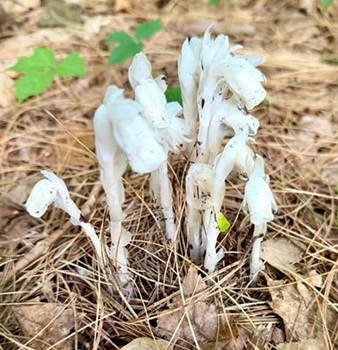
7/25 – Saratoga County, HRM 157: I was searching for a reported sora (rail) at Vischer Ferry Preserve on the Mohawk River this morning but found a “ghost plant” instead. The plant is better known as Indian pipe (Monotropa uniflora) but is often mistaken for a mushroom — they produce no chlorophyll. They obtain their energy indirectly from photo-synthetic plants by feeding off the mycelium of fungi, most commonly those in the family Russulacea that have mycorrhizal [symbiotic] relationships with, and are thereby nourished by, those plants.
- Katrina VanTassel
Photo of Indian pipe courtesy of Katrina Van Tassel
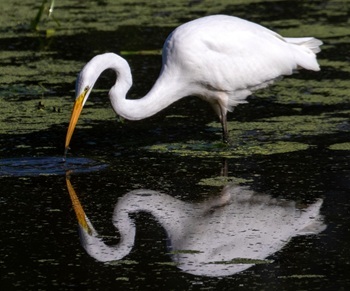
7/25 – Orange County, HRM 41: I came upon a great egret (post-breeding) today as it was marsh hunting at the 62-acre Edgar A. Mearns 6½ Station Road Marshlands Sanctuary in Goshen. It was the kind of day when their brilliant white plumage lit up the marsh.
- Matt Zeitler
Photo of great egret courtesy of Matt Zeitler
7/25 – Piermont Pier, HRM 25: Our City of Water Day at the Hudson River Field Station did not disappoint. The local community was out on the pier enjoying the sunshine, and everyone wanted to join our Lamont-Doherty Earth Observatory science team in the water to cool down and catch some fish.
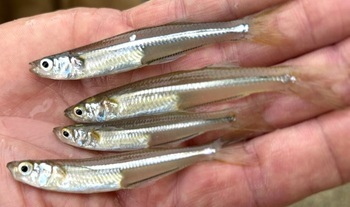
With the help of our enthusiastic participants, we managed ten hauls of our seine that included seven fish species. High count went to a staggering 2,049 Atlantic silverside, mostly young-of-the-year. In fact, young-of-year fishes dominated our entire catch among which were 178 striped bass, 49 blueback herring, 34 Atlantic menhaden, three 3 bluefish, mummichog, and hogchoker.
High count among the invertebrates was 200 moon jellyfish, as well as blue crabs (three male, one female), white-fingered mud crabs, and shore shrimp. The water temperature was 82 degrees Fahrenheit, the dissolved oxygen (DO) was 15.0 parts-per-million, and the salinity was 7.0 parts-per-thousand.
- Sarah Ortiz, Marisa Lynn Annunziato, Margie Turrin
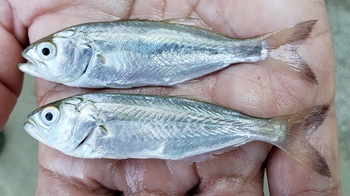
Photo of Atlantic silverside courtesy of Tom Lake
7/26 – Hudson River Watershed: Fish-of-the-Week for Week 337 is the Atlantic cutlassfish, Trichiurus lepturus (Linnaeus, 1758), number 219 (of 240) on our watershed list of fishes. If you would like a copy of our species list, e-mail - trlake7@aol.com.
The Atlantic cutlassfish is found worldwide in warm seas from Cape Cod to the Gulf of Mexico, from the Caribbean to Argentina, being altogether much more common south of Chesapeake Bay. They favor muddy bottoms of shallow coastal waters, often entering estuaries.
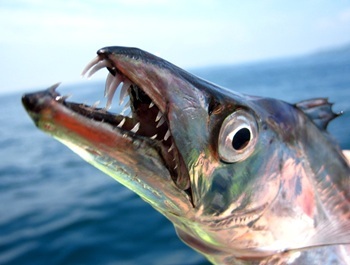
Atlantic cutlassfish are impressive: They are extremely elongated, strongly compressed with a “strap-like” body, a pointed head, large fang-like barbed teeth, and are uniformly bright and glistening silvery-steel blue. They have a dorsal fin that runs from its head to the tip of its long, filamentous, whip-like tail — they are frequently referred to in the literature as silverfish or hairtail. They can get to five-feet-long. Chesapeake Bay ichthyologists, where this fish is common, describe the Atlantic cutlassfish as a “voracious predator” (Murdy, et al. 1997). Adults feed mainly on fishes and occasionally on squid and crustaceans.
Atlantic cutlassfish is the only member of the snake mackerel family (Trichiuridae) documented for our watershed and they are designated as a temperate marine stray. Briggs and Waldman (2002) consider them rare in the New York Bight, with two old records from Gravesend Bay (Brooklyn) 1897 and 1901. There are also two more records, one from the East River (2001) and one from New York Harbor (2006). Both locations are now considered part of the extended watershed.
Trichiurus lepturus initially made it onto our Hudson River list of fishes by virtue of a single record (160 mm juvenile) from the estuary collected on August 19, 1985, at river mile 42 [Indian Point] by Normandeau Associates (Smith and Lake, American Museum Novitates,1990).
As children, this is the creature that we all thought was hiding under our beds at night.
-Tom Lake
Photo of Atlantic cutlassfish courtesy of Ryan Thoni
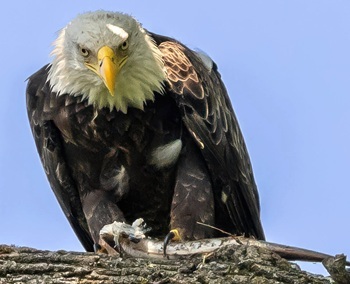
7/27 – Town of Poughkeepsie: We photographed the male from bald eagle nest NY62 today enjoying a river-caught American eel. The NY62 pair had a terrific 2026 (three fledglings) and is now at 33 nestlings in 25 years. The peace and serenity of this moment was a nice reward for both of us.
- Bob Rightmyer
Photo of bald eagle with American eel courtesy of Bob Rightmyer
7/27 – Yonkers, HRM 18: Our research and education team at the Sarah Lawrence Center for the Urban River at Beczak conducted nine high tide seine hauls with the enthusiastic support of students from the Oak Lane Childcare Center (Pre-K) in Chappaqua).
In true summer form, high count in our catch went to Atlantic silverside (335). mummichog was next with 65. Other fishes included young-of-year alewives, Atlantic menhaden, and striped bass. Moon jellyfish (16) was high count among invertebrates that also numbered blue crab (6).
The river was 78 degrees Fahrenheit, salinity was 10.0 parts-per-thousand, and dissolved oxygen (DO) was 11.6 parts-per-million.
- Christina Tobitsch, Jason Muller, Maya Rodriguez, James Cook
Photo of bluefish courtesy of Tom Lake
7/27 – Manhattan, HRM 1-2: Our Hudson River Park's River Project staff and Interns checked our research gear (pots and traps) that we deploy from floating docks on the south-side of Piers 26 and 40 in Hudson River Park for our ongoing Aquatic Ecology Survey.
Today’s fish catch included 20 oyster toadfish, from young-of-year to adult (20-240 mm), one blackfish-tautog (290 mm), and two northern pipefish (105-180 mm). Invertebrates included seven blue crabs (23-148 mm), mud crabs, hermit crabs, grass shrimp, and mud dog whelks.
- Rashel Coraballo, Luna Horsley
[Crab measurements (size) are calculated in millimeters (mm) point-to-point across their carapace. Tom Lake]
7/28 – Yonkers, HRM 18: Our research and education team at the Sarah Lawrence Center for the Urban River at Beczak conducted nine high tide seine hauls with students from the Yonkers YMCA (5–8 year-olds). The students were impressed, even amazed at the numbers and diversity of aquatic life we netted.
High count in our catch went to Atlantic silverside (293), a small, slim, silvery fish in from the sea. Other fishes included striped bass, mummichog, and alewife. Moon jellyfish (47) impressed as well, along with blue crabs. The river was 78 degrees Fahrenheit, salinity was 10.5 parts-per-thousand, and dissolved oxygen (DO) was 11.6 parts-per-million.
- Christina Tobitsch, Jason Muller, Maya Rodriguez, Logan Roman
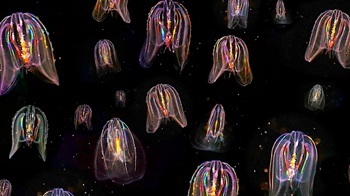
Photo of combjellies courtesy of Ryan Bolton
7/29 – Hudson River Watershed: Among indigenous peoples, full moons have long been labeled with fanciful yet meaningful names that are rooted in oral traditions, indigenous memories, and ethnographic accounts. Among Mohican people (Algonkian speakers) whose ancestral homeland lies wholly within the Hudson River watershed, the July full moon is known as the Honeybee Moon, Ãamowaawe Neepã in the Mohican dialect.
- Larry Madden, Stockbridge-Munsee Band of Mohican Indians
[Tribal translations of full moons pre-date colonization and generally reflect the seasonality of the lunar phase. Moon phases, in fact, were used by indigenous peoples as measurements of time. Tom Lake]
[The honey bee (Apis sp.) is native to Africa and Eurasia and were imported to North America in the early 1600s. The naming of the July full moon by Mohican people is likely a very early historic reference. While there are several species of honey bee in the Americas, the most common in the Hudson River Watershed is Apis cerana. Honey bee nest is used to describe colonies that house themselves in natural or artificial cavities or are hanging and exposed. The term honey bee hive is used to describe an artificial or human-made structure to house a honey bee nest (Seeley and Morse, 1978).
Among the Haudenosaunee (Iroquoian speakers), much of whose ancestral homeland lies within the Mohawk River Valley on the northern and western periphery of the Hudson River watershed, the July full moon is known as the Green Beans Moon, Orhótsheri Wenhnì:tare.
- Tom Lake
7/29 – Yonkers, HRM 18: Our research and education team at the Sarah Lawrence Center for the Urban River at Beczak conducted six high tide seine hauls for the staff, simply for the love of discovery.
While fewer in number (59), Atlantic silverside still dominated. Perhaps the most impressive fish were two young-of-year bluefish (135 mm). Blue crabs (to 110 mm) completed the catch. The river was 76 degrees Fahrenheit, salinity had risen to 12.0 parts-per-thousand, and dissolved oxygen (DO) had dropped a bit to 7.73 parts-per-million.
- Jason Muller, James Cook, Paul Renda
7/29 – Manhattan, HRM 1-2: Our Hudson River Park's River Project staff and Interns checked our research gear (pots and traps) that we deploy from floating docks on the south-side of Piers 26 and 40 in Hudson River Park for our ongoing Aquatic Ecology Survey.
Overnight our gear collected an amazing 55 oyster toadfish (20-250,mm), two blackfish-tautog (185-210 mm), one spot (190 mm), and one rock gunnel (55 mm). Invertebrates included blue crab (60-140 mm), mud crab, grass shrimp, mud dog whelk, blue mussel, hermit crab, and sea squirts.
- Hudy Weiss, Maren Piersol, Mirei Ueyama
7/30 – Yonkers, HRM 18: Our research and education team at the Sarah Lawrence Center for the Urban River at Beczak conducted ten high tide seine hauls with much appreciated assistance from students (mixed ages) from the Family Service Society of Yonkers.
Atlantic silverside (181), still present in numbers, was the only fish species today. Moon jellyfish continued their presence as well as blue crab and comb jellies. The river was 77 degrees Fahrenheit, salinity was 9.0 parts-per-thousand, and dissolved oxygen (DO) had dropped a bit to 7.7 parts-per-million.
- James Cook, Jason Muller, Christina Tobitsch
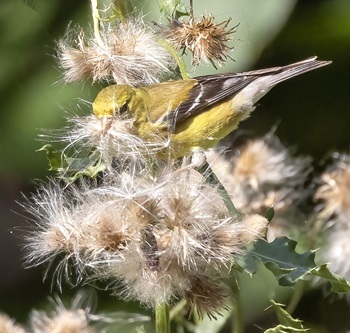
7/30 – Hudson River Watershed: American Goldfinches (Spinus tristis) breed much later than most North American songbirds, typically nesting in July and August. Ornithologists believe the timing has to do with the availability of suitable nesting materials and food for young at this time of year.
The American Goldfinch nest has three basic layers. The first layer, or foundation, consists of fibers, sticks and twigs that are lashed to the branches of a shrub or tree with spider silk. Rootlets and plant fibers form the second layer of the nest. Finally, the layer on which the eggs and chicks will rest consists of a soft, downy lining, usually the pappus (bristly, feathery seed appendage) that disperses the seeds of plants of the Aster family and others. When completed, a goldfinch nest is so compact that it can hold water.
American Goldfinches obtain food from the same fruit that they use for nesting purposes. The seeds of thistles, milkweed, and cattail that they harvest are eaten by the adults and fed to the chicks.
- Mary Holland
Photo of American goldfinch courtesy of Mary Holland
7/31 – Albany, HRM 145: Heavy summer rain has its greatest effect on the river when it occurs well up in the watershed, in this instance at the head of tide. The great influx of freshwater serves to dilute and push brackish water toward the sea.
Heading into this week, there had been just trace amounts of precipitation in the last 21 days. Then, on one day this week, there was nearly continuous rain, thunder, and lightning for more than ten hours — a veritable monsoon. Across three days, the Albany area had well over seven-inches of rain.
- National Weather Service
7/31 – Yonkers, HRM 18: Our research and education team at the Sarah Lawrence Center for the Urban River at Beczak conducted six high tide seine hauls today. As has been the case this week, 98% of the fish in our catch were Atlantic silverside. Moon jellyfish continued a strong showing (35) along with two blue crabs (65 mm). The river was 77 degrees Fahrenheit, salinity was 8.1 parts-per-thousand, and dissolved oxygen (DO) had dropped a bit to 6.8 parts-per-million.
- Jason Muller, Paul Renda
7/31 – Manhattan, HRM 1-2: Our Hudson River Park's River Project staff and Interns checked our research gear (pots and traps) that we deploy from floating docks on the south-side of Piers 26 and 40 in Hudson River Park for our ongoing Aquatic Ecology Survey. Due to some maintenance on Pier 26, only Pier 40 contributed to our data collection today.
Oyster toadfish (26), from young-of-year to adult, continued to dominate our catch (20-250 mm). We also found blackfish-tautog, spot (210 mm) and in perhaps a reprise, another rock gunnel (55 mm). Invertebrates included blue crab (85-105 mm), mud crab, hermit crab, mud dog whelk, oyster drill, sea squirt, grass shrimp, and another star bryozoan.
- Lawrence Brynes, Jade Murphy, James Laske, Mirei Ueyama
Science Saturday at Norrie Point Environmental Center
Join us for our monthly Science Saturday programs and explore Norrie Point. Check out our series by visiting the Hudson River website. Events are free and open to the public. Registration is not required. All programs meet at the Norrie Point Environmental Center, 256 Norrie Point Way, Staatsburg NY, 12580. Dress for the weather and being outside! Otherwise, no special equipment is needed.
Snapshot NY
The NYSDEC, in collaboration with the New York Cooperative Fish and Wildlife Research Unit at Cornell University, has launched Snapshot NY, a citizen science program that allows the public to participate in wildlife monitoring through the deployment of trail cameras. The project will help improve the way DEC monitors and manages more than a dozen wildlife species. For more information on Snapshot NY and how to participate, visit the Snapshot NY website.
Hudson River Lesson Plans
Explore our collection of Hudson River lesson plans, videos and online activities to support hands on investigations of the Hudson River in your classroom.
Hudson River: Striped Bass Cooperative Angler Program
You can share your fishing trip information and help biologists understand and manage our Hudson River striped bass fishery.
Here’s how it works: Fill out a logbook provided by us whenever you fish on the Hudson River (by boat or from shore). You can also use our survey123 app and record your trips using a smart phone or computer.
Record general location, time, gear used, what you caught (or if you didn’t catch anything) and return the logbook when you are done fishing for the season. You’ll receive an annual newsletter summarizing the information in addition to the latest news regarding regulations and the river. Whether you catch-and-release or take home a keeper, you can be part of the Cooperative Angler Program. Online logbook instructions (PDF).
Join today by contacting: hudsonangler@dec.ny.gov
- Jessica Best
Hudson River Miles
The Hudson is measured north from Hudson River Mile 0 at the Battery at the southern tip of Manhattan. The George Washington Bridge is at HRM 12, the Tappan Zee 28, Bear Mountain 47, Beacon-Newburgh 62, Mid-Hudson 75, Kingston-Rhinecliff 95, Rip Van Winkle 114, and the Federal Dam at Troy, the head of tidewater, at 153. The tidal section of the Hudson constitutes a bit less than half the total distance—315 miles—from Lake Tear of the Clouds to the Battery. Entries from points east and west in the watershed reference the corresponding river mile on the mainstem.
To Contribute Your Observations
The Hudson River Almanac is compiled and edited by Tom Lake and emailed weekly by DEC's Hudson River Estuary Program. Share your observations by e-mailing them to trlake7@aol.com.
Was this Newsletter Forwarded to You?
Subscribe today to DEC Delivers Hudson River Almanac topic for weekly natural history journal that covers the Hudson from the High Peaks of the Adirondacks to New York Harbor.
Helpful Resources
National Oceanic and Atmospheric Administration online tide and tidal current predictions are invaluable when planning Hudson River field trips. For real-time information on Hudson River tides, weather, and water conditions from sixteen monitoring stations, visit the Hudson River Environmental Conditions Observing System website.
DEC's Smartphone app for iPhone and Android is now available at New York Fishing, Hunting, and Wildlife App.
|