Photo of brown booby courtesy of Deborah Tracy Kral
In this issue:
This was a week of seldom seen fish and rarely seen seabirds. We also had a very good review of summer fish species in the estuary including marine strays. Young-of-year fish continued to dominate our catches.
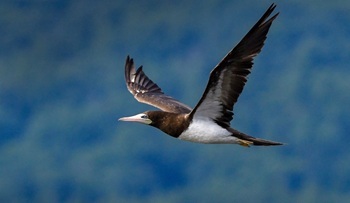
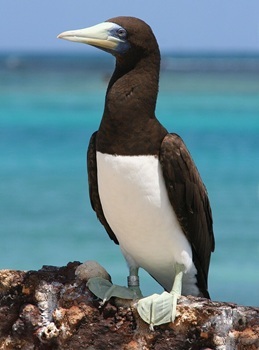
7/18 – Esopus Island, HRM 85: A brown booby (Sula leucogaster), a large seabird, was sighted today by the crew of the Hudson River Sloop Clearwater off Germantown (river mile 108). It was later relocated and photographed by Duncan Woolston perched on a navigational buoy at the north end of Esopus Island (river mile 85).
This brown booby was a new species for Dutchess County, although two previous Hudson River sightings were documented in the Hudson River Almanac. The first occurred in Orange County (river mile 55) on August 2019 and was reported by the Hudson Sloop Clearwater’s crew. That sighting appeared to be the first record for the species in the Hudson Valley and a first for Orange County. The second was sighted and photographed by Jim Yates at Esopus Meadows (river mile 87) in August 2021.
- Stan DeOrsey
[The brown booby, Sula leucogaster (Boddaert, 1783) is a large seabird in the booby and gannet family (Sulidae). While they are one of the most common and widespread species in the family across its range, in our area it is considered an accidental vagrant.
Brown booby are pantropical in the Atlantic and Caribbean regions, south to northern South America, and occasionally north to New England. Bull's Birds of New York State (1998) refers to the brown bobby as a “rare summer and fall visitor.”
The brown booby commutes and forages just off the deck over inshore waters. Flocks make spectacular plunge-dives taking small fish (mullets, mackerels, and anchovies), as well as squid and shrimp that gather in schools near the surface especially when they are driven upward by predators.
The brown booby’s Type Site is Cayenne in French Guiana. A holo-type specimen from Cayenne was first described to science by the French ornithologist Georges-Louis Leclerc in 1781. The word Sula in Norwegian translates as gannet.
The booby's head and upper body is covered in dark brown to blackish plumage, with the remainder being a contrasting white. The species also displays sexual dimorphism of the bare part colors, the males having a blue orbital ring, as opposed to the yellow orbital ring of the female.
Female boobies reach 31 inches in length, and their wingspans measure up to (4.9 feet). Male boobies reach about 30 inches in length with a 4.6 foot wingspan. Their beaks are quite sharp and contain jagged edges. They have short wings resulting in a fast flap rate with long, tapered tails.
Along with plunge-diving some adults practice klepto-parasitism, where they steal prey from other seabirds. Brown boobies have even been observed stealing prey from the normally even more piratical great frigatebirds. Although they are powerful and agile fliers, they are particularly clumsy in takeoffs and landings; they use strong winds and high perches to assist their takeoffs.
As a result of global warming, the brown booby has increasingly been moving further north both along the coast and inland, into seas formerly too cold for it (Harrison 1985). Tom Lake]
Photo of brown booby courtesy of Duncan Wright
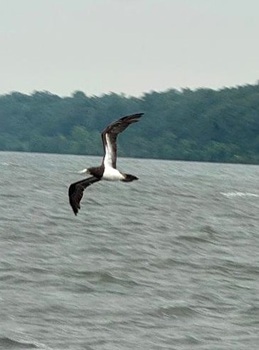
7/18 – Ulster County, HRM 102-92: The crew of the Hudson River Sloop Clearwater spotted the brown booby, almost certainly the same one as seen by others, as we came south in transit from Hudson headed to Kingston (river miles 102-92). The bird circled around the sloop and above the stormy gray river, captivating us with its elegant flight. It then continued south alongside the sloop to Saugerties where it perched on the bowsprit for almost half an hour, After a while it left but we spotted it again farther south, resting on a buoy close to the Kingston-Rhinecliff Bridge."
- Chloe Grey Smith
Photo of brown booby courtesy of Chloe Grey Smith
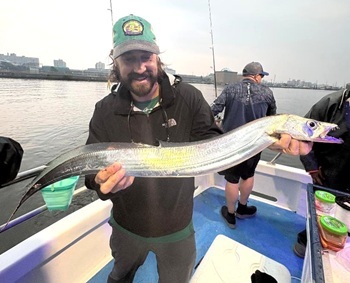
7/19 – Queens, New York City: We were in Jamaica Bay (Queens) collecting fish for the American Museum of Natural History’s Collection of Fishes. We were surprised when we caught an Atlantic cutlassfish (Trichiurus lepturus) considered somewhat common off the coast, but we had never heard of them in Jamaica Bay. Even the boat captain and deck hands said they had never seen one.
The fish was caught jigging with rod and reel on a spearing [Atlantic silverside] at 50-60 feet in a deep channel near the Rockaway Ferry building. The cutlassfish measured about 99 cm, making it a 3-year-old (Wojciechowsky, in Fritzsche 1978). With only a couple of them in the collection, we saved this one.
- Ryan Thoni
[Note: One-inch equals 25.4 millimeters (mm).
[The Jamaica Bay Wildlife Refuge (NYC) is part of the larger Jamaica Bay Unit, as is the Sandy Hook Unit (NJ), of the Gateway National Recreation Area. Geographically connected, both are important conduits for fish migration entering or leaving the greater Hudson River watershed. As such, they can be considered "sister estuaries" as either the beginning or the terminus of the watershed. They also play a role, via the Almanac, in documenting the estuary. Tom Lake]
Photo of Atlantic cutlassfish courtesy of Ryan Thoni
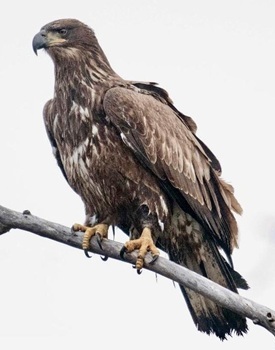
7/20 – Town of Wappinger, HRM 67: I monitor bald eagle nest NY459, dubbed “The Bridge Nest”, now in its eighth season. They have at least one fledgling this year and I spotted it near the nest tree. As I watched, the immature took off and within minutes was joined by both adults. The three of them flew around for a short while before one of the adults took off with the immature, possibly to go hunting in the nearby Wappinger Creek (blueback herring were still around).
- Judy Winter
Photo of NY459 Immature Bald Eagle courtesy of Judy Winter
7/20 – Manhattan, HRM 1-2: Our Hudson River Park's River Project staff and Interns checked our research gear (pots and traps) that we deploy from floating docks on the south-side of Piers 26 and 40 in Hudson River Park for our ongoing Park's Fish Ecology Survey.
Today’s fish catch included blackfish-tautog (237-325 mm), oyster toadfish (60-70 mm), a northern pipefish (175 mm), summer flounder (180-230 mm), and one rock gunnel (60 mm). Invertebrates included a blue crab (140 mm), mud crabs, grass shrimp, sea squirts, oyster drills, and mud dog whelks.
- Rashel Coraballo, Luna Horsley
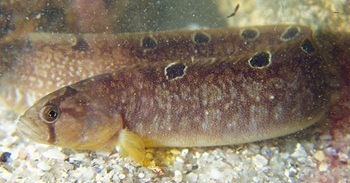
[Rock gunnel, also known as rock eel, Pholis gunnellus (Linnaeus, 1758), is the only member of the gunnel family (Phocidae) found in our watershed. Rock gunnel is found in the north Atlantic from Nova Scotia to Cape Cod. They have a slender, flexible, eel-like body and can get to 12 inches. Rock gunnel favor rocky bottoms along the inshore low tide reach (littoral zone) and are frequently found under rocks and in tide pools. Their most obvious field mark is 10-14 round, black-centered, pale-edged spots along their dorsal ridge. Tom Lake]
[Crab measurements (size) are calculated in millimeters (mm) point-to-point across their carapace. Tom Lake]
Photo of rock gunnel courtesy of Wilfried Bay
7/21 – Piermont Pier, HRM 25: Even though the clouds at the pier were ominous this morning, threatening rain, we were still surprised by the strength and violence of the storm when it arrived.
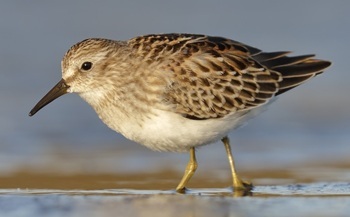
Our Lamont-Doherty Earth Observatory science summer interns had just started a seine haul when the thunder rolled in causing our retreat to shelter. It was only minutes until lightening followed and the rain came down in torrents. For several hours the storm crashed over us keeping us inside. One minute we looked out and to our delight there were several least sandpipers hopping through puddles in the pavement. Behind them facing due north were three Arctic terns standing firmly on the metal post cleats at the end of the pier.
- Margie Turrin
Photo of least sandpiper courtesy of John Cooper
7/21 – Yonkers, HRM 18: Our research and education team at the Sarah Lawrence Center for the Urban River at Beczak with eager assistance from the Blue Team of Yonkers High School interns made four low-tide seine hauls netting four fish species highlighted by two young–of-year Atlantic herring. Other fishes were summer flounder, mummichog, and white perch.
High count among invertebrates was grass shrimp (33), with sand shrimp, moon jellyfish, and blue crabs. The river was 76 degrees Fahrenheit, salinity was 12.0 parts-per-thousand, and the dissolved oxygen (DO) was 7.8 parts-per million.
- Katie Lamboy Roman, Katie Lamb
7/22 – Hudson River Watershed: Fish-of-the-Week for Week 376. We began this weekly feature in the Almanac on December 13, 2018, with the firm belief that every fish has a story to tell.
This week we have the northern puffer, Sphoeroides maculatus (Bloch & Schneider, 1801) species number 240 (of 240) on our watershed list of fishes. If you would like a copy of our list, e-mail - trlake7@aol.com.
Northern puffer has the distinction of holding the final spot (240) on our taxonomic list of Hudson River Watershed fishes. They are one of two members of the puffer family (Tetraodontidae) documented for our watershed (this family was formerly known as the Swellfishes). In our watershed, they are designated as a temperate marine stray and are found over sandy bottoms, around piers, and into estuaries from Newfoundland to Florida where they feed on small crustaceans such as shrimp and crabs. They can get to 14 inches, but most are less than ten. The other puffer is the smooth puffer Lagocephalus laevigatus (Linnaeus, 1766),designated as a tropical marine stray.
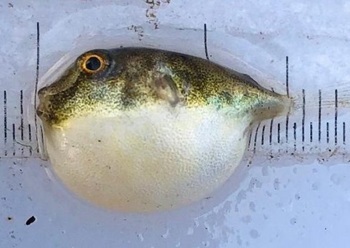
When agitated or feeling threatened, puffer fish can inflate themselves with air or water quickly assuming the shape of a tennis ball. C. Lavett Smith (1985) describes them as “a ball with a tail.” (Their genus, Sphaira, from Greek, translates as ball.) This phenomenon has earned them such colloquial names as swell toad, swellfish, balloonfish, blowfish, and in New England, always a source of quirky common names for marine life, sea squab.
When deflated, they are otherwise rather terete, tapered from pectoral region to a slender caudal peduncle, head blunt and pointed, mouth terminal and very small, scaleless, dusky greenish-olive dorsally, with no pelvic fins, and a stark white abdomen.
The most recent catch of a northern puffer occurred on July 14 from the Pier 4 Beach at Brooklyn Bridge Park on the East River. During a student seining program, Haley McClanahan and Chris Bowser caught a tiny northern puffer. Given the field estimate of size (8 mm), it was deemed a juvenile. Adults range from 70-100 mm (Breder and Clark 1947)
- Tom Lake
Photo of Northern puffer courtesy of ElizaBeth Streifeneder
7/22 – Manhattan, HRM 1-2: Our Hudson River Park's River Project staff and Interns checked our research gear (pots and traps) that we deploy from floating docks on the south-side of Piers 26 and 40 in Hudson River Park for our ongoing Park's Fish Ecology Survey.
Today our gear held blackfish-tautog (20-323 mm) and oyster toadfish (50-70 mm). Invertebrates included blue crabs (125-145 mm), mud crabs, grass shrimp, sand shrimp, mud dog whelks, blue mussels, and sea squirts.
- Arden Egerton, Kumarie Singh, Mirei Ueyuma, Paul West
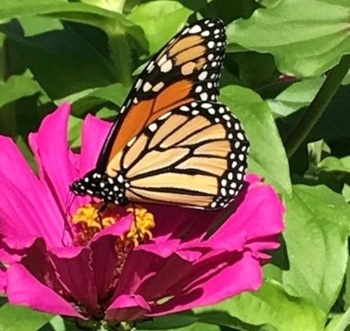
7/23 – Ulster County, HRM 78: Every June I wait eagerly (although often anxiously) for the return of the monarch butterfly (Danaus plexippus). I then search and find eggs by the last week in June. But not this year; I did not find any eggs until the middle of July.
From Mid-June to early July, I traveled to the Midwest and north to Canada. I saw almost no butterflies except for a few cabbage whites. It is my habit on these trips to take a quick visual survey of the butterflies I see along the way, fluttering between the roadside meridians or above the cornfields. But not this year.
Finally, back home on July 6, I found one monarch egg. Then I added four more on milkweed down the road toward New Paltz. On my way home I counted another fifteen. Finally, on July 11, a dozen monarch butterfly eggs graced the milkweed growing by my own back door. My anxiety was lifted. I can now relax into this summer's season and share the magic of the migrating monarch butterfly.
There will always be monarch butterflies because they hail from the tropics. The question is, will we see them in generations to come. Many things are causing the decline of insect populations: herbicides, drought, wildfire, habitat loss, genetically modified corn and soybeans, and much more. We may lose our populations of migrating monarch butterflies, but not this season. Perhaps not in my lifetime.
- Better Boomer
[Monarchs are native to North and South America locations where milkweed and suitable temperatures exist. The eastern North American monarch population is notable for its annual southward late-summer/autumn instinctive migration from the northern and central United States and southern Canada to Florida and Mexico. During the fall migration, monarchs cover thousands of miles, with a corresponding multi-generational return north in spring.
Monarchs travel between 1,200 and 2,800 miles or more from the northeast United States, and southeast Canada, both north and south on an annual basis, making long-distance journeys that are fraught with risks. This is a multi-generational migration, with individual monarchs only making part of the full journey. The population east of the Rocky Mountains attempts to migrate to the sanctuaries of the Monarch Butterfly Biosphere Reserve in the mountain forests in central Mexico, in the foothills of volcanoes where they find the right climate conditions to hibernate from the beginning of November to mid-March (Walker, et al. 2022, and other multiple sources). Tom Lake]
Photo of monarch courtesy of Mimi Baruch
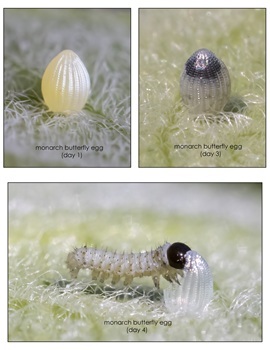
7/23 – Hudson River Watershed: Adult female monarchs lay between 300 and 500 eggs, each considerably smaller than a grain of rice. Many of the eggs are laid singly, often on the underside of the youngest leaves at the top of a young milkweed plant. As females lay their eggs, they secrete a small amount of glue that attaches the eggs directly to the leaf.
Each egg is formed inside the female prior to fertilization, including the hard outer shell, called the chorion, which protects the developing larva inside. The shell is lined with a layer of wax, which helps keep the egg from drying out. The eggs have tiny funnel-shaped openings at one end called micropyles. These holes penetrate all the way through the shell allowing sperm to enter since eggs form their hard shell before fertilization takes place. As the egg travels down the oviduct to be laid, sperm is released from the female’s internal storage organ (spermatheca) and enters through the micropyle, fertilizing the egg right before it is laid on a milkweed leaf.
Monarch eggs hatch about four days after they are laid, but the rate of development is temperature dependent, with individuals in warmer environments developing more rapidly. When laid, monarch eggs are white or light yellow, with the dark head of the developing larva visible near the top of the egg within 24 hours of hatching. Once the larva hatches, it immediately starts eating its first meal – the protein-rich eggshell it just exited from.
- Mary Holland
Photo of monarch eggs courtesy of Mary Holland
7/23 – Manhattan, HRM 1-2: Our Hudson River Park's River Project staff and Interns checked our research gear (pots and traps) that we deploy from floating docks on the south-side of Piers 26 and 40 in Hudson River Park for our ongoing Park's Fish Ecology Survey.
In addition to regular gear checking, we hauled up traps for a Science After Dark event celebrating Crab Week at the Park. Participants were able to observe the process of conducting the Fish Ecology Survey catching some exciting aquatic life including three fish species, blackfish-tautog (330 mm), spot (200 mm), and a 55 mm naked goby (Gobiosoma bosc ). Invertebrates collected included a blue crab (150 mm) and mud crabs, mud dog whelks, sea squirts, grass shrimp, and hermit crabs.
- Jade Murphy, Sierra Drury
7/24 – Yonkers, HRM 18: Our research and education team at the Sarah Lawrence Center for the Urban River at Beczak conducted 15 low tide seine hauls with Pre-College Hudson River Ecology Course high school students.
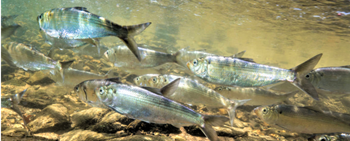
Our catch was impressive by any measure. High count among the usuals was Atlantic Menhaden (47), along with Atlantic silverside, striped bass, mummichog, and northern pipefish. Among some surprises was twenty young-of-year alewives (Alosa aestivalis), 60-70 millimeters (a river herring), as well as a lone crayfish.
The invertebrates were equally excellent with grass shrimp (36), moon jellyfish (16), blue crabs, and three soft-shelled clams. The river was 78 degrees Fahrenheit, salinity was 9.8 parts-per-thousand, and the dissolved oxygen (DO) was 8.7 parts-per million.
- Jason Muller, Christina Tobitsch
7/24 – Manhattan, HRM 1-2: Our Hudson River Park's River Project staff and Interns checked our research gear (pots and traps) that we deploy from floating docks on the south-side of Piers 26 and 40 in Hudson River Park for our ongoing Park's Fish Ecology Survey.
Today, the traps yielded four species of fish: oyster toadfish (200-280 mm), blackfish-tautog (225 mm), northern pipefish (70-230 mm), and one spot (190 mm). Invertebrates found at the trap site included blue crabs (75-85 mm), mud crabs, mud dog whelks, sea squirts, grass shrimp, hermit crabs, and blue mussels.
- Hudy Weiss, Jack Nelson, Jade Murphy, Lawrence Brynes
Photo of alewives courtesy of U.S. Fish and Wildlife Service
The Great Hudson River Fish Count is an annual event, sponsored by the DEC's Hudson River Estuary Program and the Hudson River National Estuarine Research Reserve. Each summer, organizations all along the Hudson River and New York Harbor participate at riverfront sites to collect, count, and catalog fish species. During the fish count, participating organizations encourage visitors to help collect fish using seine nets, minnow traps, or rods and reels. The fish are identified, counted, and released back into the river.
Join us on Saturday, August 1, 2026, for the 15th annual exploration of the Hudson River’s diverse fish community.
Participating public fish count locations from south to north:
Brooklyn: Brooklyn Bridge Park, Pier 4 Beach: 5 p.m. – 7 p.m. Brooklyn Bridge Park Conservancy
Manhattan: Hudson River Park, Pier 51: 11 a.m. – 3 p.m.
Rockland County: Piermont Pier, Hudson River Field Station, Piermont: 12 p.m. – 4 p.m. Lamont-Doherty Earth Observatory of Columbia University
Putnam County: Little Stony Point Beach in Hudson Highlands State Park, Cold Spring: 9 a.m. DEC Hudson River Estuary Program
Note: Meet on the beach
Dutchess County: Power House at Mills Norrie State Park, Staatsburg: 10 a.m. – 12 p.m. DEC Hudson River National Estuarine Research Reserve and Hudson River Estuary Program
Albany County: Peebles Island State Park, Cohoes: 9 a.m. – 3 p.m. DEC Region 4 Fisheries
Note: Display will be at the Second Street bridge
Join us on Sunday, August 2, 2026, 2;00 p.m. for a free Zoom presentation
The Esopus Munsee People: A Historical Overview
Join Ulster County Historian Eddie Moran for a free online program on The Esopus Munsee People: A Historical Overview. This presentation examines the history of the Esopus Munsee people in their ancestral homeland of what is now Ulster County, New York.
Drawing on documentary and archaeological evidence, Ulster County Historian Eddie Moran traces Esopus life before European colonization, the impacts of colonization, and the community's resilience through war, dispossession, and forced removal to Ontario, where many descendants continue to live today among the Six Nations of the Grand River.
The presentation is offered with gratitude for the guidance and perspectives shared by members of the federally recognized Lenape communities.
Time: Aug 2, 2026, 02:00 p.m. Eastern Time (US and Canada)
Join Zoom Meeting: https://ulstercountyny.zoom.us/j/86388672684
Meeting ID: 863 8867 2684
Science Saturday at Norrie Point Environmental Center
Join us for our monthly Science Saturday programs and explore Norrie Point. Check out our series by visiting the Hudson River website. Events are free and open to the public. Registration is not required. All programs meet at the Norrie Point Environmental Center, 256 Norrie Point Way, Staatsburg NY, 12580. Dress for the weather and being outside! Otherwise, no special equipment is needed.
Snapshot NY
The NYSDEC, in collaboration with the New York Cooperative Fish and Wildlife Research Unit at Cornell University, has launched Snapshot NY, a citizen science program that allows the public to participate in wildlife monitoring through the deployment of trail cameras. The project will help improve the way DEC monitors and manages more than a dozen wildlife species. For more information on Snapshot NY and how to participate, visit the Snapshot NY website.
Hudson River Lesson Plans
Explore our collection of Hudson River lesson plans, videos and online activities to support hands on investigations of the Hudson River in your classroom.
Hudson River: Striped Bass Cooperative Angler Program
You can share your fishing trip information and help biologists understand and manage our Hudson River striped bass fishery.
Here’s how it works: Fill out a logbook provided by us whenever you fish on the Hudson River (by boat or from shore). You can also use our survey123 app and record your trips using a smart phone or computer.
Record general location, time, gear used, what you caught (or if you didn’t catch anything) and return the logbook when you are done fishing for the season. You’ll receive an annual newsletter summarizing the information in addition to the latest news regarding regulations and the river. Whether you catch-and-release or take home a keeper, you can be part of the Cooperative Angler Program. Online logbook instructions (PDF).
Join today by contacting: hudsonangler@dec.ny.gov
- Jessica Best
Hudson River Miles
The Hudson is measured north from Hudson River Mile 0 at the Battery at the southern tip of Manhattan. The George Washington Bridge is at HRM 12, the Tappan Zee 28, Bear Mountain 47, Beacon-Newburgh 62, Mid-Hudson 75, Kingston-Rhinecliff 95, Rip Van Winkle 114, and the Federal Dam at Troy, the head of tidewater, at 153. The tidal section of the Hudson constitutes a bit less than half the total distance—315 miles—from Lake Tear of the Clouds to the Battery. Entries from points east and west in the watershed reference the corresponding river mile on the mainstem.
To Contribute Your Observations
The Hudson River Almanac is compiled and edited by Tom Lake and emailed weekly by DEC's Hudson River Estuary Program. Share your observations by e-mailing them to trlake7@aol.com.
Was this Newsletter Forwarded to You?
Subscribe today to DEC Delivers Hudson River Almanac topic for weekly natural history journal that covers the Hudson from the High Peaks of the Adirondacks to New York Harbor.
Helpful Resources
National Oceanic and Atmospheric Administration online tide and tidal current predictions are invaluable when planning Hudson River field trips. For real-time information on Hudson River tides, weather, and water conditions from sixteen monitoring stations, visit the Hudson River Environmental Conditions Observing System website.
DEC's Smartphone app for iPhone and Android is now available at New York Fishing, Hunting, and Wildlife App.
|