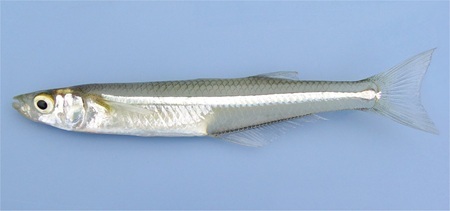
Photo of Atlantic silverside courtesy of Tom Lake
In this issue:
Summer can be a sleepy time for the Almanac, when highlights rarely carry exclamation points. We take special notice of tiny, rarely seen fishes, and watch for seasonal saltwater ocean life to creep in from the sea.
7/14 – Brooklyn, New York City: Despite a hot afternoon and the first hints of wildfire haze, we had an amazing session of East River exploration in Brooklyn Bridge Park at the Pier 4 Beach on the East River.
A group of excited students from the Delaware Nation in Oklahoma and the Visiting Lab at NYU made eleven hauls of our seine from the beach and were very impressed by the biodiversity of fish and crustaceans. The water was 75 degrees Fahrenheit, the salinity was 20 parts-per-thousand, and the dissolved oxygen was 8.3 parts-per-million.
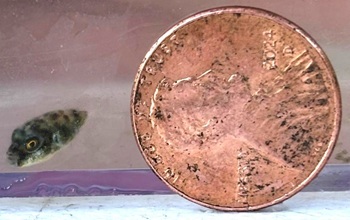
Among fishes, high count was Atlantic silverside (58), as well as 14 northern pipefish (possibly a record for us), 26 American eels, one each tautog, white perch, and striped bass, and the smallest northern puffer (Sphoeroides maculatus) we had ever seen. It was agitated by our net and responded by inflating (nicknamed the puffer fish), to a white ball smaller than a blueberry. It quickly deflated when put into a small tank.
Invertebrates in our catch included 20 shore shrimp, 6 sand shrimp, 4 each mud crabs and mud snails, oyster drill snail, a soft-shelled clam, and two long-clawed hermit crabs. In all, it was a great reminder to all that New York Harbor is a treasure of nature amid the metropolis.
- The Delaware Nation Youth Program, the Visiting Lab at NYU, Haley McClanahan, Chris Bowser
Photo of Northern puffer courtesy of Chris Bowser
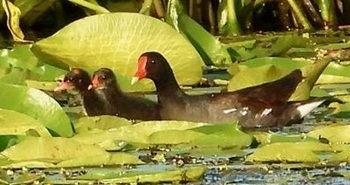
7/11 – Saratoga County, HRM 167: We had been watching adult common gallinule (Gallinula galeata) paddling through the wetland vegetation at Round Lake Preserve all spring. Today we found two of their young traveling with their mother.
- Katrina Van Tassel
[Common gallinule are blackish, chicken-like marsh bird, often found near cattails, never far from water. Often seen swimming, picking at the water's surface, or walking along the edge of aquatic vegetation. Thick legs and long toes are drab yellow. Adults have bright red bill with yellow tip, thin white side stripe, and some white under the tail. Immatures are paler and grayer than adults, lacking brightly colored bill. eBird]
Photo of common gallinule courtesy of Katrina Van Tassel
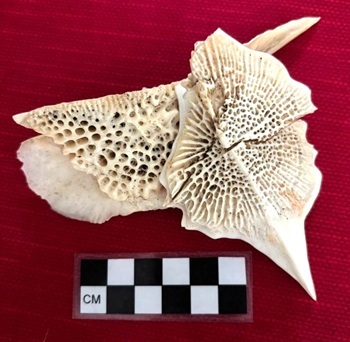
7/12 – Little Stony Point Preserve, HRM 55: Following a seining program several days ago, team member Tommy Jackson did some shallow water exploration, wading just off the beach in knee deep water. The river was usually clear from the little rain (runoff) and he spotted two sturgeon scutes (cartilaginous fish scale) lying on the sandy bottom. They were not fresh but rather weathered and water-worn. Our best guess is that they came from a disarticulated sturgeon (Acipenser sp.), possibly a long-ago victim of a boat strike.
- Tom Lake
[Sturgeon, in term of ancestry, are an ancient family of cartilaginous fishes (Acipenseridae). The earliest sturgeon fossils date from the Late Cretaceous having descended from those of the Early Jurassic period, 174 to 201 million years ago. Among the Mohican people, whose ancestral homeland lies wholly within the Hudson River Watershed, sturgeon are known as Kche Namaath. Tom Lake]
Photo of sturgeon scutes courtesy of Tommy Jackson
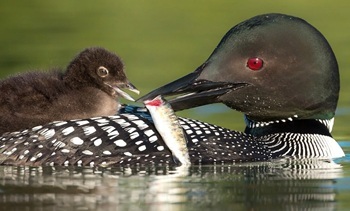
7/13 – Hudson River Watershed: Until they are about eight weeks old, common loon chicks (Gavia immer) are mostly dependent upon their parents for food. Aquatic insects, small fish and crayfish are provided by both parents, more often by the father when they are very young.
The chicks can be relentless beggars, pecking their parents next to their bill and the side of their head. The pictured chick is begging vocally, using a series of single notes which increase in intensity if food is not quickly presented. If the begging fails to produce results, it will continue until it ends with a whine and a wail.
- Mary Holland
[Loons are one of the iconic species in our watershed whose presence authenticates remnants of wildness. Along with eagles, coyotes, ravens, moose, bobcats, and black bears, the common loon rekindles remembrances of less contentious times.
The loon is beautifully described in John McPhee’s Survival of the Bark Canoe (1975), an ode to the Common Loon: “As a diver there is nothing like him. His wings close tight around his body, condensing everything – feathers, flesh – and he goes down like a powered stone, his big feet driving. He is known as the great northern diver.” Tom Lake]
Photo of common loon courtesy of Jess Findlay
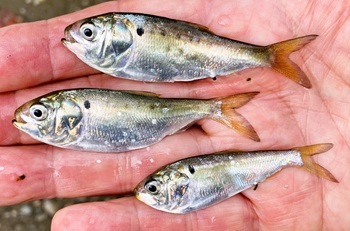
7/13 – Yonkers, HRM 13: Our research and education team at the Sarah Lawrence Center for the Urban River at Beczak hosted the Orchard School (grades 3-5) from Yonkers. With the student’s assistance, we made eight seine hauls collecting five species of fish including high count Atlantic silverside (55), bluefish, Atlantic menhaden, and striped bass. We also caught four blue crabs.
The water temperature was 76 degrees Fahrenheit, salinity was 13.1 parts-per-thousand, and the dissolved oxygen (DO) was 5.1 parts-per-million.
- Jason Muller, Maya Rodriguez, James Cook
Photo of Atlantic menhaden courtesy of Phyllis Lake
7/13 – Manhattan, HRM 1-2: Our Hudson River Park's River Project staff checked our research gear (pots and traps) that we deploy from floating docks on the south-side of Piers 26 and 40 in Hudson River Park for our ongoing Fish Ecology Survey.
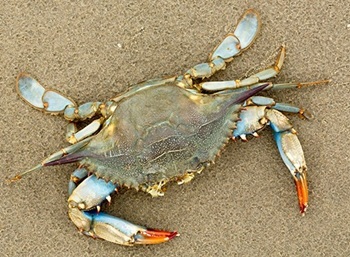
Today’s fish catch included nine blackfish-tautog (175-370 mm), five oyster toadfish (25-305 mm), and one northern pipefish (188 mm). Invertebrates included three blue crabs (30-150 mm), mud crabs, hermit crabs, grass shrimp, sea squirts, comb jellies, and mud dog whelks.
- Rashel Coraballo, Toland Kister
[Note: One-inch equals 25.4 millimeters (mm); crab measurements (size) are calculated in millimeters (mm) point-to-point across their carapace. Tom Lake]
Photo of blue crab courtesy of Sara Hart Morgan
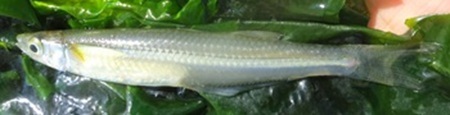
7/14 – Hudson River Watershed: Fish-of-the-Week for Week 375 is the Atlantic silverside, (Menidia menidia Linnaeus, 1766), number 127 (of 240) on our watershed list of fishes. If you would like a copy of our list, e-mail trlake7@aol.com.
By its abundance and reach, the Atlantic silverside is our “fish of summer” in the estuary. It is also one of four silverside species (Atherinidae) in our watershed. They are a widespread marine species that is found along the coast in bays and brackish water estuaries from the Gulf of Sant Lawrence to northeastern Florida. With a rather small mouth, they feed tiny crustaceans along sandy-bottom inshore shallows and can reach six-inches-long (150 millimeters).
Atlantic silverside are slender, elongate, terete in cross section, and somewhat slab-sided. They are greenish dorsally, white ventrally, with a well-defined bight silver band that runs from the base of the pectoral fin to the caudal peduncle. Their Type Site is Charleston (SC), where Swedish naturalist Carolus Linnaeus described a holotype of the species to science in 1766.
Atlantic silverside has long been a local folkloric fish along Hudson River tidewater. They were captured in nets, taken to the kitchen, and "fried to a crisp and eaten whole" (Mervin Roberts). In Robert Boyle’s 1969 classic, The Hudson River, he writes of silverside (known colloquially as spearing), being "fried in cooking oil and sold in restaurants as whitebait."
While Atlantic silverside is by far the most common, on occasion the incredibly similar inland silverside (M. beryllina) will show up (the two species are separated by dorsal fin placement (see C.L. Smith’s Inland Fishes of New York State 1985).
Most recently (December 9, 2017) Ben Jackson caught an inland silverside (68 mm) in a seine at Kowawese (river mile 59). The species identification was confirmed in our lab. The water was 41 degrees Fahrenheit, and the salinity was 1.0 parts-per-thousand. Even though silverside (Atlantic) were still being caught 40 miles downriver, the parameters of this occurrence were far outside its literature.
- Tom Lake
Photo of Atlantic silverside in sea lettuce courtesy of Tom Lake
7/14 – Yonkers, HRM 13: Our research and education team at the Sarah Lawrence Center for the Urban River at Beczak conducted eight high tide seine hauls today. High count among fishes was Atlantic silverside, along with bluefish and one blue crab.
The water temperature was 76 degrees Fahrenheit, salinity was 12.0 parts-per-thousand, and the dissolved oxygen (DO) was 5.0 parts-per-million.
- Jason Muller, Maya Rodriguez, Logan Roman
7/15 – Manhattan, HRM 1-2: Our Hudson River Park's River Project staff checked our research gear (pots and traps) that we deploy from floating docks on the south-side of Piers 26 and 40 in Hudson River Park for our ongoing Fish Ecology Survey.
Overnight our traps had collected three blackfish-tautog (225-320 mm), and fourteen oyster toadfish (70-260 mm). Invertebrates found in the vicinity of our gear included blue crab (60 mm), mud crab, grass shrimp, mud dog whelk, blue mussel, oyster drills, and sea squirts.
- Maren Piersol, Mirei Ueyuma, Arden Egerton
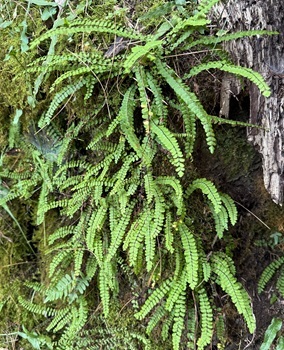
7/16 – Hudson River Watershed: There are certain species of ferns that thrive on limestone rock outcrops. They require alkaline, calcium-rich soils and are commonly found growing in rock crevices. Because these areas are quick-draining, these ferns commonly feature shallow creeping rhizomes for anchoring in rock crevices, drought-resistant waxy coatings, and smaller, divided fronds to prevent excess water loss. Among them are wall-rue (Asplenium ruta-muraria), purple-stem cliffbrake (Pellaea atropurpurea), walking fern (Asplenium rhizophyllum), and maidenhair spleenwort (Asplenium trichomanes).
- Mary Holland
Photo of maidenhair spleenwort courtesy of Mary Holland
7/17 – Saugerties, HRM 102: In mid-afternoon, for the second straight day, harbor seal 2-4-6, made an appearance heading downriver just off the Saugerties Lighthouse at the mouth of Esopus Creek. Yesterday, at a similar time, it was heading upriver.
This was day number 2,546 since the harbor seal (dubbed 2-4-6 from a tag it was given in 2019 by the Mystic Connecticut Aquarium Animal Rescue Center), first arrived in Esopus Creek.
- Patrick Landewe
[As a testament to a seal’s speed and agility, a visitor was convinced that he saw a “pack” of seals when it was just the one, 2-4-6, swimming, diving, and resurfacing in rapid succession. Patrick Landewe]
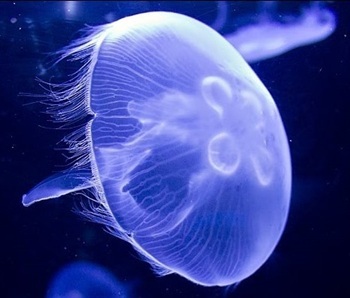
7/17 – Yonkers, HRM 13: Our research and education team at the Sarah Lawrence Center for the Urban River at Beczak conducted six seine hauls this morning. High count was no surprise, 94 Atlantic silverside (to 140 mm). High count among invertebrates was moon jellyfish (24).
The water temperature was 77 degrees Fahrenheit, salinity was 12.0 parts-per-thousand, and the dissolved oxygen (DO) was 5.5 parts-per-million.
- Jason Muller, Maya Rodriguez
Photo of moon jellyfish courtesy of Tim Heusin
7/17 – Manhattan, HRM 1-2: Our Hudson River Park's River Project staff checked our research gear (pots and traps) that we deploy from floating docks on the south-side of Piers 26 and 40 in Hudson River Park for our ongoing Fish Ecology Survey.
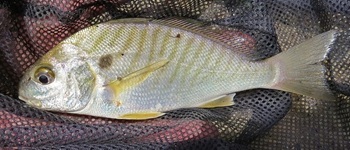
Today our gear yielded four species of fish: oyster toadfish (90-205 mm), blackfish-tautog (215-260 mm), a summer flounder (210 mm), and one spot (185 mm). Invertebrates included blue crab (130 mm), mud crab, mud dog whelk, oyster drill, sea squirt, grass shrimp, and comb jellies.
- James Laske, Jade Murphy, Maren Piersol, Arden Egerton, Kumarie Singh
Photo of spot courtesy of Maryland DNR
The Great Hudson River Fish Count is an annual event, sponsored by the DEC's Hudson River Estuary Program and the Hudson River National Estuarine Research Reserve. Each summer, organizations all along the Hudson River and New York Harbor participate at riverfront sites to collect, count, and catalog fish species. During the fish count, participating organizations encourage visitors to help collect fish using seine nets, minnow traps, or rods and reels. The fish are identified, counted, and released back into the river.
Join us on Saturday, August 1, 2026, for the 15th annual exploration of the Hudson River’s diverse fish community.
Participating public fish count locations from south to north:
Brooklyn: Brooklyn Bridge Park, Pier 4 Beach: 5 p.m. – 7 p.m. Brooklyn Bridge Park Conservancy
Manhattan: Hudson River Park, Pier 51: 11 a.m. – 3 p.m.
Rockland County: Piermont Pier, Hudson River Field Station, Piermont: 12 p.m. – 4 p.m. Lamont-Doherty Earth Observatory of Columbia University
Putnam County: Little Stony Point Beach in Hudson Highlands State Park, Cold Spring: 9 a.m. DEC Hudson River Estuary Program
Note: Meet on the beach
Dutchess County: Power House at Mills Norrie State Park, Staatsburg: 10 a.m. – 12 p.m. DEC Hudson River National Estuarine Research Reserve and Hudson River Estuary Program
Albany County: Peebles Island State Park, Cohoes: 9 a.m. – 3 p.m. DEC Region 4 Fisheries
Note: Display will be at the Second Street bridge
Science Saturday at Norrie Point Environmental Center
Join us for our monthly Science Saturday programs and explore Norrie Point. Check out our series by visiting the Hudson River website. Events are free and open to the public. Registration is not required. All programs meet at the Norrie Point Environmental Center, 256 Norrie Point Way, Staatsburg NY, 12580. Dress for the weather and being outside! Otherwise, no special equipment is needed.
Snapshot NY
The NYSDEC, in collaboration with the New York Cooperative Fish and Wildlife Research Unit at Cornell University, has launched Snapshot NY, a citizen science program that allows the public to participate in wildlife monitoring through the deployment of trail cameras. The project will help improve the way DEC monitors and manages more than a dozen wildlife species. For more information on Snapshot NY and how to participate, visit the Snapshot NY website.
Hudson River Lesson Plans
Explore our collection of Hudson River lesson plans, videos and online activities to support hands on investigations of the Hudson River in your classroom.
Hudson River: Striped Bass Cooperative Angler Program
You can share your fishing trip information and help biologists understand and manage our Hudson River striped bass fishery.
Here’s how it works: Fill out a logbook provided by us whenever you fish on the Hudson River (by boat or from shore). You can also use our survey123 app and record your trips using a smart phone or computer.
Record general location, time, gear used, what you caught (or if you didn’t catch anything) and return the logbook when you are done fishing for the season. You’ll receive an annual newsletter summarizing the information in addition to the latest news regarding regulations and the river. Whether you catch-and-release or take home a keeper, you can be part of the Cooperative Angler Program. Online logbook instructions (PDF).
Join today by contacting: hudsonangler@dec.ny.gov
- Jessica Best
Hudson River Miles
The Hudson is measured north from Hudson River Mile 0 at the Battery at the southern tip of Manhattan. The George Washington Bridge is at HRM 12, the Tappan Zee 28, Bear Mountain 47, Beacon-Newburgh 62, Mid-Hudson 75, Kingston-Rhinecliff 95, Rip Van Winkle 114, and the Federal Dam at Troy, the head of tidewater, at 153. The tidal section of the Hudson constitutes a bit less than half the total distance—315 miles—from Lake Tear of the Clouds to the Battery. Entries from points east and west in the watershed reference the corresponding river mile on the mainstem.
To Contribute Your Observations
The Hudson River Almanac is compiled and edited by Tom Lake and emailed weekly by DEC's Hudson River Estuary Program. Share your observations by e-mailing them to trlake7@aol.com.
Was this Newsletter Forwarded to You?
Subscribe today to DEC Delivers Hudson River Almanac topic for weekly natural history journal that covers the Hudson from the High Peaks of the Adirondacks to New York Harbor.
Helpful Resources
National Oceanic and Atmospheric Administration online tide and tidal current predictions are invaluable when planning Hudson River field trips. For real-time information on Hudson River tides, weather, and water conditions from sixteen monitoring stations, visit the Hudson River Environmental Conditions Observing System website.
DEC's Smartphone app for iPhone and Android is now available at New York Fishing, Hunting, and Wildlife App.
|