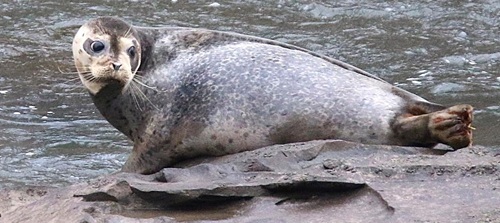
Photo of harbor seal courtesy of Jim Yates
In this issue:
Heart-rending, previously unknown, anecdotes from 9-11 are still surfacing. This week we recount another made especially poignant since elementary school students were at the heart of the story, making it a long-remembered moment.
We also have an in-the-moment, ongoing saga of a marine mammal that has chosen a Hudson River tributary, 109 miles from the sea, as its quasi-refuge for nearly eight years.
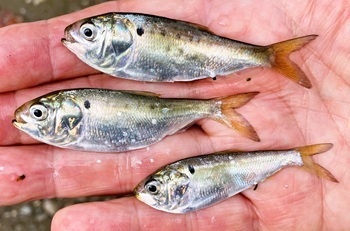
6/25 – Piermont Pier, HRM 25: Our weekly Lamont-Doherty’s Hudson River Field Station research and education staff’s river sampling outing became quite exciting when our team ran into a massive school of young-of-year Atlantic menhaden (Brevoortia tyrannus). Just two hauls of our seine yielded an astonishing 943 fish and other aquatic life including 919 Atlantic menhaden (largely extrapolated), Atlantic silverside, bluefish, comb jellies, moon jellyfish, and a female blue crab. The water temperature was 77 degrees Fahrenheit, the salinity was 6.0 part-per-thousand, and the dissolved oxygen (DO) was 9.0 parts-per-million.
- Sarah Ortiz
Photo of Atlantic menhaden courtesy of Phyllis Lake
6/15 – Manhattan, HRM 1-2: Our Hudson River Park’s River Project staff and interns checked our research gear (pots and traps) that we deploy from floating docks on the south-side of Piers 26 and 40 in Hudson River Park for our ongoing Fish Ecology Survey. Fish species in the traps today included five oyster toadfish (40-270 mm), four tautog/blackfish (265-305 mm), and one summer flounder (200 mm).
- Siddhartha Hayes, Luna Horsley, Rashel Caraballo
[Note: One-inch equals 25.4 millimeters (mm). Tom Lake]
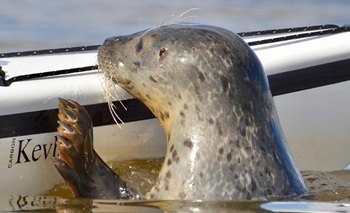
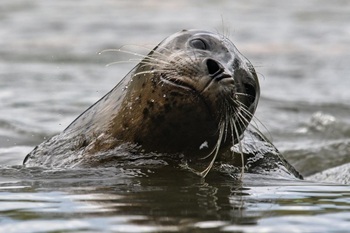
6/16 – Saugerties, HRM 102: Since 2018, the Hudson River Almanac with help from countless contributors have chronicled the extraordinary story of a harbor seal (Phoca vitulina), a marine mammal, that chose to adopt an inland freshwater tributary 109 miles from the sea. Since August 5, 2019, this ongoing attachment has surpassed 2,800 days, nearly eight years. In last week’s Almanac, we recalled Part One, the beginning, 2018-2021. This week, we present Part 2 of the seal’s history, 2022-2026, edited for space and as best as we know it.
Photo of Harbor seal courtesy of Michael Kalin
2022
- January 6. The harbor seal we know as 2-4-6, from a tag he carries, once again, disappeared from Esopus Creek. The Hudson River was beginning its onset of real winter; the ice had become thick and unbroken, both out in the river and in Esopus Creek. The seal had previously endured three winters of relatively modest-ice cover, but it looked as though winter 2022 would be a challenge.
- May 20. After 134 days of absence, Saugerties Lighthouse Keeper Patrick Landewe welcomed the seal back to Esopus Creek. We had no clue as to where he had been. Kim Durham of the Atlantic Marine Conservation Society noted that he was now four-years-old (male harbor seals can live 25 years or more), and thus he was a “pre-teen.” The seal may have traveled back to the sea feeling the urge to find companionship.
- October 2. Just after midday, the harbor seal made an appearance on the north side of the Saugerties Lighthouse. In barely a foot of water on an ebbing tide, he swam underneath a short bridge between the lighthouse and an adjacent island, a route he takes as long as the water is deep enough. He later resurfaced by the South Dike at the mouth of Esopus Creek.
2023
- January 7. The Esopus Creek harbor seal seemed to have, once again, moved on. Lighthouse Keeper Patrick Landewe last saw the seal 84 days ago on October 13 hauled out on a small rock island at low tide just upriver from the Saugerties Lighthouse. This April, the harbor seal, wherever he was, would be five-years-old.
- June 1. More than five months later, the harbor appeared to have resurfaced. Dorothy Varner took a photo of the harbor seal hauled-out on an Esopus Creek low-tide sandbar, one of the seal’s favorite resting spots. However, Dorothy’s photo did not show a white flipper tag (seals have been known to shed their tags).
- July 4. A neighbor alerted me that he had encountered a harbor seal in Esopus Creek along the stretch of tidewater from the Hudson River upstream to the dam. He was motoring up the creek in his dingy when he spotted the seal. The neighbor’s impression was that it was a “friendly seal,” as it cautiously approached within ten feet of his dingy.
- August 5. This was the 4th anniversary of the unprecedented attachment of a marine mammal, a male harbor seal, to the freshwater of Esopus Creek 109 miles from the sea. Guests at the lighthouse showed me photos of a seal following a stand-up paddle boarder. These were the same house guests that first reported seeing a seal in Esopus Creek in August 2019.
- November 11. After several sightings of the seal throughout August and early September, there had been no sightings of the harbor seal for at least a month. It seemed likely that the harbor seal may have left Esopus Creek once again.
2024
- May 26. With the coming of spring, we had hopes that the seal would be back from wherever he had spent the winter. As if on cue, recent sightings including a video-recorded sighting at the base of the dam at the head of tide in Esopus Creek, a common spot to find him, it appeared that the harbor seal had returned.
- August 1. While my family and I were staying at the Saugerties Lighthouse B&B, we saw a seal swimming and bobbing its head in Esopus Creek across from the dock at Ferry Street and near the marina (Argen Singh).
- August 5. Today was the 5th anniversary of the harbor seal’s unprecedented attachment to the freshwater of Esopus Creek, a Hudson River tributary. We have had a few seal sightings in the creek in recent days and this morning guests at the lighthouse showed me photos of a seal following a stand-up paddle boarder. These were the same house guests who first reported seeing a seal here in August 2019.
- September 22. As our Adirondack Mountain Club group paddled around the Saugerties Lighthouse in Esopus Creek, we stopped for lunch on a beach in the north cove. Out in the cove, the seal was swimming.
We called to him and he changed course and swam toward us. But a dog got into the water and began barking and the seal slowly moved away. As he was leaving, however, he did a little dance by spinning around and smacking the water. At first we thought it was cute, but no doubt he was telling the dog to stay away. We were all so thankful that we got a good glimpse of him (Jeanette Tully-Baker).
2025
- May 26. Guests of the Saugerties Lighthouse reported seeing a seal this afternoon while kayaking and canoeing near the waterfall at the head of tide on Esopus Creek. The seal swam away at first but them came back and stayed with them for a while. The behavior was consistent with the harbor seal that has frequented the tidal Esopus Creek since August 5, 2019, exhibiting much curiosity. I was now convinced that our resident seal is back for the summer season (Patrick Landewe).
2026
- June 11. My son, Cricket, reported seeing a seal this afternoon while swimming with classmates after school next to the Tidewater Center. Our neighbor also reported seeing the seal in late afternoon swimming by the Coast Guard station heading in the direction of the Saugerties Lighthouse.
- June 21. The harbor seal made many appearances this afternoon to the delight of people taking tours of the Saugerties Lighthouse. He just turned eight years-old, not yet approaching middle-age. Harbor seals typically live for 20-30 years in the wild, although some have been known to live longer under certain circumstances. This life-span is influenced by factors like habitat, diet, the presence of predators, and occasionally unfortunate interactions with us.
- Patrick Landewe
- June 21. Since the inception of the Esopus Creek odyssey, August 5, 2019, this was Day Number 2,877. For both the harbor seal (we suppose), and for those of us who have followed, documented and marveled at his exploits, this has been a monumental commitment and a rewarding experience. Throughout this saga, as the seal mysteriously disappeared and we despaired, I felt as though we were playing a part in the movie Lassie Come Home (1943).
- Tom Lake, Patrick Landewe
Photo of Harbor seal courtesy of Michael Kalin
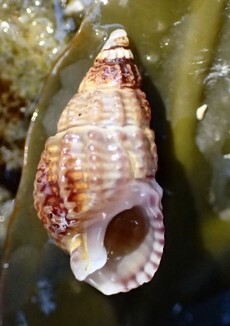
6/17 – Manhattan, HRM 1-2: Our Hudson River Park’s River Project staff and interns checked our research gear (pots and traps) that we deploy from floating docks on the south-side of Piers 26 and 40 in Hudson River Park for our ongoing Fish Ecology Survey. Fish species caught included five oyster toadfish (50-55 mm), one blackfish (270 mm) and a northern pipefish (200 mm). Among invertebrates, it should be noted that as the river gets warmer, eastern mud dog whelk eggs (Tritia obsoleta) were becoming increasingly abundant on the mesh of our traps and pots.
- Arden Egerton, Mirei Ueyama, Hudy Weiss, Avalon Daly, Sierra Drury
Photo of Eastern mud dog welk courtesy of INaturalist
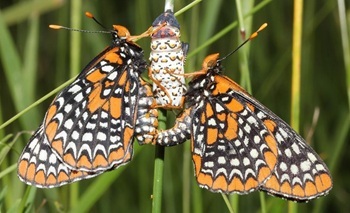
6/18 – Ulster County, HRM 102: Baltimore Checkerspots (Euphydryas phaeton) began emerging at Saugerties in early June, right on schedule, with my first sighting on June 8th. By June 16, I was seeing the first of several mated pairs of butterflies. The following afternoon, I noticed a female that had just emerged and was still clinging to her spent chrysalis. By 2:30 p.m. a male had coupled with her on the same perch, where they remained attached for the rest of the day and into the night. I checked on them at 10:00 p.m. with the aid of a flashlight, and they were still coupled. By the following morning, they were on the same perch but were no longer attached.
Over the next several days, I observed similar behavior from several additional pairs, mating in the afternoon hours and remaining attached into the night. On June 20th, I noticed a mated pair next to a spent chrysalis at 4:00 p.m. They were still attached at 7:00 a.m. the following morning, at least 15 hours later.
Female Baltimore checkerspots typically deposit several hundred eggs in a single cluster on the underside of a single host plant leaf, perhaps explaining the rather lengthy copulation process.
- Steve Chorvas
Photo of Eastern cherckerspot courtesy of Steve Chorvas
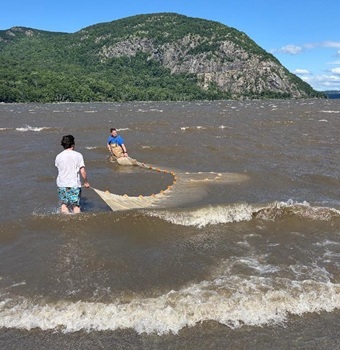
6/20– Little Stony Point, Preserve, HRM 55: It was Summer Solstice Eve. Unlike three days ago when the river was calm, today it was unreal, as raucous as I’ve seen this side of a Tropical Storm. We felt the wind when we left for the river and it only grew in intensity. A north wind was screaming down the river pushing the down tide. At the bottom of the trail, we got our first look: The white caps had white caps. The six-mile fetch down from Beacon had the river heaving with rollers. We estimated the wind at a near steady 30 mph with gusts to 35 (near gale, 32 to 38 mph). Without a hiking staff, the wind would have blown me over. The surf was coffee-double cream, teeming with tiny invertebrates, and white perch were having a buffet.
As expected, given the season, our catch was dominated by young-of-year fishes. High counts went to alewives, striped bass, and Atlantic menhaden. In lesser numbers were hogchoker (40 mm), blueback herring, bay anchovies, and spottail shiners. My favorite was the silvery young-of-year Atlantic menhaden, a big-headed herring with a lovely yellow tail (caudal fin).
Photo of Raucoous river courtesy of Tom Lake
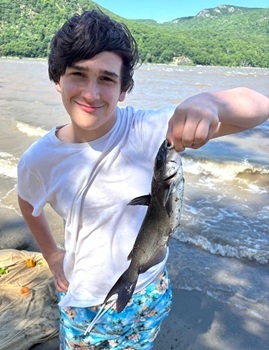
The most impressive fish to the audience of onlookers was a 16-inch channel catfish. The river was 71 degrees Fahrenheit and the salinity was still, as it was three days ago, 2.0 parts-per-thousand.
- Seth Dinitz, Tommy Jackson, Tom Lake
[We recalled the 2005 Summer Solstice: We were on the water in early morning setting our seine as the Solstice arrived. Memories of our catch have long faded, but a striking bird left us with a memory that has endured for its beauty and simplicity: A male Baltimore oriole came to the water’s edge, walked in a few feet, doused itself and then shook — an orange-and-black blur — like a bird in a paint mixer. Tom Lake]
[Note: One-inch equals 25.4 millimeters (mm). Tom Lake]
Photo of channel catfish courtesy of Tom Lake
6/20 – Yonkers, HRM 18: Our research and education team at the Sarah Lawrence Center for the Urban River at Beczak made twenty high-tide seine hauls today for the Yonkers Riverfront Kickoff Festival. It was a big day for moon jellyfish (Aurelia aurita), high count with 29. Among fishes, we caught white perch (to 200 mm), bay anchovy, and mummichog.
The river was 73 degrees Fahrenheit, salinity was 12.0 parts-per-thousand, and the dissolved oxygen (DO) was 7.0 parts-per-million.
- Jason Muller, Christina Tobitsch, Katie Lamb, James Cook, Logan Roman, Lyla Harrison duBoulay
6/21 – Hudson River Watershed: Today was the Summer Solstice. In the Northern Hemisphere, the North Pole is tilted 23 degrees toward the sun, and the sun travels its longest path across the sky. As a result, the day of the Summer Solstice has the most hours of daylight.
- Britannica
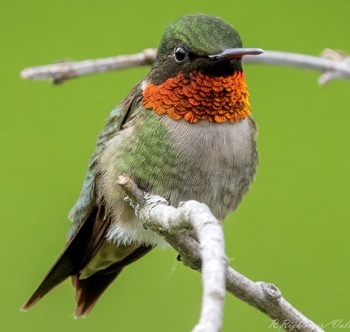
6/21 – Town of Wappinger: I awoke in the first moments of Summer to a deafening racket. A squadron of crows was mobbing a raptor in the woods just outside. I looked out the window and saw, juxtaposed, oblivious to the screeching, the serenity of ruby-throated hummingbirds perched or waiting their turn at their feeders.
- Tom Lake
Photo of ruby-throated hummingbird courtesy of Bob Rightmyer
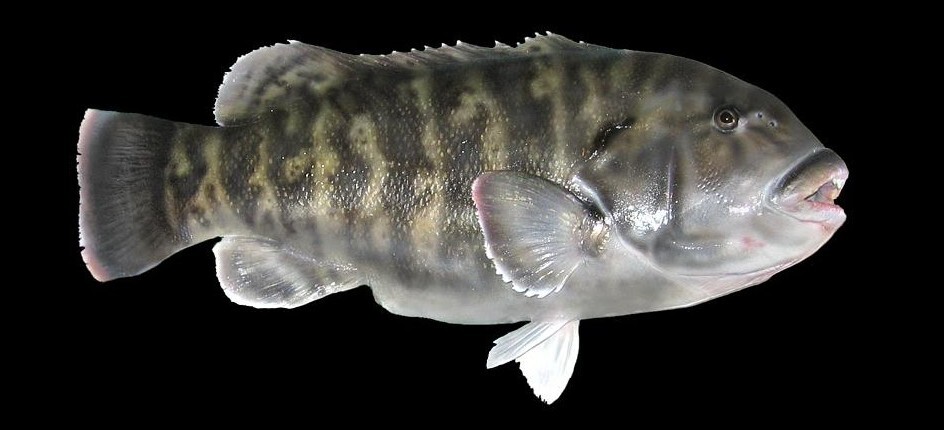
6/22 – Hudson River Watershed: Fish-of-the-Week for Week 371 is the Tautog, Tautoga onitis (Linnaeus, 1758), number 203 (of 240), on our Hudson River Watershed List of Fishes. If you would like a copy of our list, e-mail: trlake7@aol.com.
Tautog is one of two members of the Northern Wrasse family (Labridae), documented for our watershed. The other is the cunner (Tautogolabrus adspersus Walbaum, 1792). Both are permanent/seasonally resident marine species. While the tautog is a saltwater fish, it can enter low-salinity brackish water estuaries. Tautog was first described to science by Carl Linnaeus in 1758, but no Type Site was given. However, in 1815, Samuel Latham Mitchill, an American medical doctor and naturalist, described a tautog synonym (Labrus tautoga), with the holotype specimen location noted as Long Island.
Tautog are a rather common, bottom-dwelling fish of New York Harbor. NOAA calls them a “sturdy fish,” a very apt description. They are blocky-headed with a plump, elongated body, and serious molars used to crush shellfish. Adults can reach 35-inches and weigh 25 lbs. They are relatively long-lived with males getting to 34 years-old, and females 22 (Hildebrand and Schroeder 1928).
In the Western Atlantic, they are found from Halifax, Nova Scotia, to Charleston, South Carolina. The are usually found inshore on hard-bottom habitats. Among their favorite foods are shellfish, mussels, gastropods, and other mollusks and crustaceans which they find in abundance in near-shore rocky areas. In the spirit of “you are what you eat,” tautog, perhaps owing to their shellfish diet, are a sought-after food fish.
Blackfish is a colloquial name for tautog, especially among anglers fishing for dinner. I cannot recall ever hearing a fisherman calling them tautog. Occasionally you will hear “We are fishing for “taug” ... but rarely. Their common name, blackfish, refers to the adults as they attain a deep and mottled, sooty coal black, as they age.
Cunner is another name that you rarely hear among anglers. In the lower estuary into Raritan Bay, the East River, and Long Island you hear bergall. Same fish. Cunner are found in New England, Rhode Island and Massachusetts waters, but there you hear their version, chogie. Same fish, but a cultural synonym.
My favorite tautog story was born on 9-11 (September 11, 2001) at Croton Point Park in Westchester County, 33 miles upriver from Manhattan. Chris Letts and I had a class of 2nd graders from Coman Hills Elementary in Armonk preparing to help us seine the shallows at Mother’s Lap, a Croton Point inlet of the river at 09:02.54. The timing is precise because that was the exact moment when the attack on the World Trade Center commenced.
With our truck radios on, everyone knew what was happening except the students. Our job was to keep it that way. We faced the students upriver as a huge black smudge rose on the southern horizon. With the assistance of a class of 7-year-olds, we set our net in the warm (79 degree) salty water (10.8 parts-per-thousand).
Among the fish in our net were a dozen juvenile tautog (47-54 mm). Each blackfish told a story of its habitat: those caught in the beds of wild celery were a perfect camo-green match; those from the beds of water milfoil were a brighter green; those from the fringes of the light-and-dark sandy bottom, flecked with white oyster shells, were mottled brown with white specks.
Afterwards, the teachers were in a tizzy, but the 2nd graders’ innocence was still intact.
- Tom Lake
[Mother's Lap is a legendary beach at Croton Point, a colloquial name for a small, sheltered cove in Haverstraw Bay on the north-east end of Croton Point. When commercial fishing was in its heyday in the early-to-mid-twentieth century, fishermen knew they could find refuge from wind and tide in this little bay as their nets worked offshore. In that regard, it reminded them of the calm and solace of sitting in “mother’s lap.” Tom Lake]
Photo of tautog courtesy of Mike Kroessig
6/22 – Yonkers, HRM 18: Our research and education team at the Sarah Lawrence Center for the Urban River at Beczak made eight low-tide seine hauls today with invertebrates altogether as high count, led by grass shrimp (50), sand shrimp (24), and (10) blue crab (75 mm).
Our fish catch was likewise impressive with young-of-year Atlantic menhaden, bay anchovy, winter flounder (60 mm), summer flounder (75 mm), Atlantic silverside, and spotted hake (160 mm).The river 73 degrees Fahrenheit, salinity was 12.4 parts-per-thousand, and the dissolved oxygen (DO) was 6.3 parts-per-million
- Jason Muller, James Cook, Maya Rodriguez, Katie Lamb
[Crab measurements (size) are calculated in millimeters (mm) point-to-point across their carapace. Tom Lake]
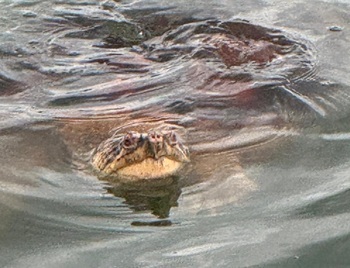
6/22 – Manhattan HRM 1-2: For two days, some of our staff were able to spot a common snapping turtle (Chelydra serpentina) swimming around the Pier 32 pile fields. The turtle carapace was approximately 20 inches-long. According to the NYSDEC, snapping turtle sightings are more common in June during egg-laying season.
- Rashel Caraballo
Photo of snapping turtle courtesy of Rashel Caraballo
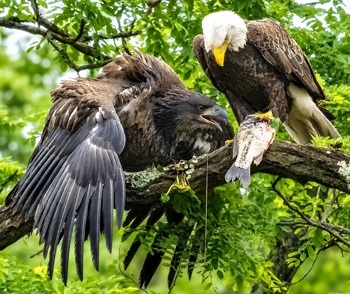
6/23 – Town of Poughkeepsie: The male of the pair at bald eagle nest NY62 brought a largemouth bass to the limb of a nearby locust today. A newly fledged and very intent immature quickly appeared and was eager for a share (or the entire fish).
- Bob Rightmyer
Photo of Bald eagle with largemouth bass courtesy of Bob Rightmyer
6/24 – Yonkers, HRM 18: Our research and education team at the Sarah Lawrence Center for the Urban River at Beczak made eight low-tide seine hauls today. We could sense the summer run of Atlantic silverside (10) was beginning. We had a dizzying mix of grass shrimp, sand shrimp, comb jellies, moon jellies, and blue crabs. There was another spotted hake (150 mm) as well. The river was 73 degrees Fahrenheit, salinity was 9.7 parts-per-thousand, and the dissolved oxygen (DO) was 8.5 parts-per-million.
- Jason Muller, James Cook, Maya Rodriguez, Logan Roman, Davidson Montiero
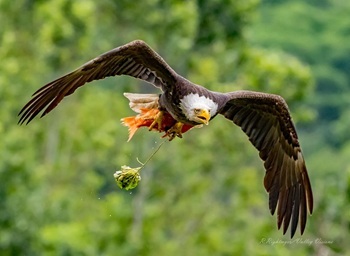
6/25 – Town of Poughkeepsie: One of the female from bald eagle nest NY62 came in from the river carrying a goldfish in its talon. There was evidence that the goldfish (Carassius auratus) had been taken among some shallow water vegetation as the adult carried not only the fish but a selection of aquatic vegetation as well. Throughout the year, including the ice of winter, goldfish from the river are a staple for the eagles.
Photo of Bald eagle with goldfish courtesy of Bob Rightmyer
6/26 – Yonkers, HRM 18: Our research and education team at the Sarah Lawrence Center for the Urban River at Beczak made eight low-tide seine hauls today. High counts went to grass shrimp (20) and sand shrimp (16). Among fishes were young-of-year bluefish and summer flounder (80 mm).The river was 72 degrees Fahrenheit, salinity was 9.0 parts-per-thousand, and the dissolved oxygen (DO) was 8.6 parts-per-million.
- Jason Muller, James Cook, Maya Rodriguez, Logan Roman, Davidson Montiero
Science Saturday at Norrie Point Environmental Center
Join us for our monthly Science Saturday programs and explore Norrie Point. Check out our series by visiting the Hudson River website. Events are free and open to the public. Registration is not required. All programs meet at the Norrie Point Environmental Center, 256 Norrie Point Way, Staatsburg NY, 12580. Dress for the weather and being outside! Otherwise, no special equipment is needed.
Snapshot NY
The NYSDEC, in collaboration with the New York Cooperative Fish and Wildlife Research Unit at Cornell University, has launched Snapshot NY, a citizen science program that allows the public to participate in wildlife monitoring through the deployment of trail cameras. The project will help improve the way DEC monitors and manages more than a dozen wildlife species. For more information on Snapshot NY and how to participate, visit the Snapshot NY website.
Hudson River Lesson Plans
Explore our collection of Hudson River lesson plans, videos and online activities to support hands on investigations of the Hudson River in your classroom.
Hudson River: Striped Bass Cooperative Angler Program
You can share your fishing trip information and help biologists understand and manage our Hudson River striped bass fishery.
Here’s how it works: Fill out a logbook provided by us whenever you fish on the Hudson River (by boat or from shore). You can also use our survey123 app and record your trips using a smart phone or computer.
Record general location, time, gear used, what you caught (or if you didn’t catch anything) and return the logbook when you are done fishing for the season. You’ll receive an annual newsletter summarizing the information in addition to the latest news regarding regulations and the river. Whether you catch-and-release or take home a keeper, you can be part of the Cooperative Angler Program. Online logbook instructions (PDF).
Join today by contacting: hudsonangler@dec.ny.gov
- Jessica Best
Hudson River Miles
The Hudson is measured north from Hudson River Mile 0 at the Battery at the southern tip of Manhattan. The George Washington Bridge is at HRM 12, the Tappan Zee 28, Bear Mountain 47, Beacon-Newburgh 62, Mid-Hudson 75, Kingston-Rhinecliff 95, Rip Van Winkle 114, and the Federal Dam at Troy, the head of tidewater, at 153. The tidal section of the Hudson constitutes a bit less than half the total distance—315 miles—from Lake Tear of the Clouds to the Battery. Entries from points east and west in the watershed reference the corresponding river mile on the mainstem.
To Contribute Your Observations
The Hudson River Almanac is compiled and edited by Tom Lake and emailed weekly by DEC's Hudson River Estuary Program. Share your observations by e-mailing them to trlake7@aol.com.
Was this Newsletter Forwarded to You?
Subscribe today to DEC Delivers Hudson River Almanac topic for weekly natural history journal that covers the Hudson from the High Peaks of the Adirondacks to New York Harbor.
Helpful Resources
National Oceanic and Atmospheric Administration online tide and tidal current predictions are invaluable when planning Hudson River field trips. For real-time information on Hudson River tides, weather, and water conditions from sixteen monitoring stations, visit the Hudson River Environmental Conditions Observing System website.
DEC's Smartphone app for iPhone and Android is now available at New York Fishing, Hunting, and Wildlife App.
|