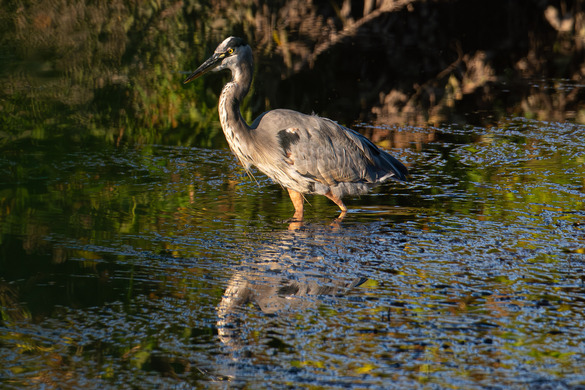
Photo of bald eagle courtesy of Bob Rightmyer
In this issue:
It is that magical time of the year that features rebirth, when our river is loaded with incredible numbers of young-of-year fish, the forests have been renovated in green, and the skies are filled with fledgling birds all testing their new equipment and trying to emulate the adults.
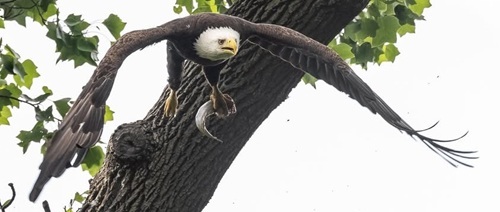
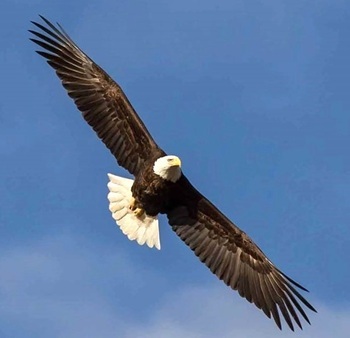
6/9 – Town of Poughkeepsie: On Day 83 following its hatch, Bob Rightmyer reported that one of the three nestlings in bald eagle nest NY62 had fledged. Experience with banding nestlings suggests it was a male (males are often first out, but the females catch up quickly). After that first instinctive, yet brave step, the nestling-turned fledgling looks off to glide overhead spreading his impressive wings the size of ironing boards (for those who remember).
- Tom Lake
Photo of bald eagle couretsy of Bob Rightmyer
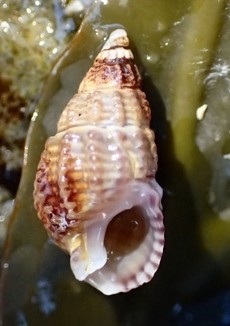
(From last week) 5/30 – Brooklyn, New York City: The Brooklyn Bridge Park Conservancy’s contribution to the 10th World Fish Migration Day found 200 of us on the beach to help us seine the East River, making 25 hauls with two nets. High counts went to eastern mud snails (23) and grass shrimp (22). Among fishes were three American eels, countless young-of-year Atlantic silverside, and two pollock (110 mm).
The water temperature was 60 degrees Fahrenheit, salinity was 24.0 parts-per-thousand (ocean salinity at this latitude is 32-35 ppt), and the dissolved oxygen (DO) was 7.0 parts-per-million.
- Lena Goings, Jacob Wolfson, Brooklyn Bridge Park Conservancy staff, interns and volunteers
Photo of Eastern mud snail courtesy of iNaturalist
6/4 – Town of Poughkeepsie: The male from bald eagle nest NY62 came in from the river today with a channel catfish. The species (Ictalurus punctatus) is a common all-season catch for eagles possibly for reasons of abundance, being a broad user of the water column especially inshore shallows and has a rather sluggish countenance.
- Bob Rightmyer
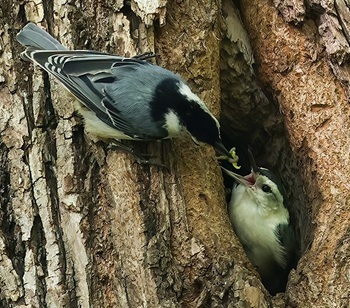
6/5 – Hudson River Watershed: White-breasted nuthatches remain paired year-round, with courtship behavior starting at the end of winter. A nest site is selected — usually a natural cavity or an old woodpecker hole — and the female builds a nest inside the cavity. Once eggs are laid, only the female incubates them. At this stage, the male only enters the nest to feed the female and does so roughly seven times an hour. Occasionally, the incubating female comes to the cavity opening to receive her meal of insects. This routine continues throughout the two-week incubation period.
- Mary Holland
Photo of white-breasted nuthatch courtesy of Mary Holland
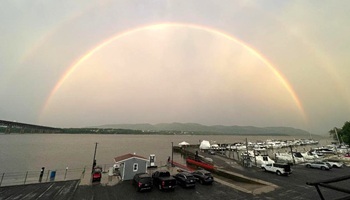
6/6 – Newburgh, HRM 61: In the late afternoon, the view from the western end of the Beacon-Newburgh Bridge was spectacular. Just minutes later, a thunderstorm moved through and I was completely unprepared for the rainbow which resulted. It was breathtaking, a complete double-arched rainbow from the foot of the bridge south to Garrison. I had never seen one so complete. If Albert Bierstadt, a German-American painter of the Hudson River School, had painted the scene, it could not have been more spectacular.
- Dave Taft
Photo of rainbow courtesy of Dave Taft
6/7 – Hudson River Watershed: Fish-of-the-Week for Week 370 is the Atlantic salmon, Salmo salar Linnaeus, 1758, number 99 (of 240), on our Hudson River Watershed List of Fishes. If you would like a copy of our list, e-mail: trlake7@aol.com.
Atlantic salmon is one of ten members of the trout family (Salmonidae), plus two hybrids, in our watershed. Among the ten species, Atlantic salmon, brook trout, and lake trout are native. As a species, Salmo salar is a legendary gamefish in northern regions of North America and Northern Europe. In the wild they are known to get to 60-inches and weigh 100 lbs.
How do we define native vs. introduced? In the instance of our watershed, the benchmark for this bifurcation is the early 17th century. If a species was here when the first Europeans arrived, it was almost certainly native. If it was not, it was likely introduced later and thus nonnative. A complication to this dichotomy is that our knowledge of the dynamics between fishes and the river does not extend much further back than the arrival of Europeans.
The Hudson River has been open to the sea in various formats since the end of the Ice Age. Across those millennia, dynamic changes in Hudson River geology, ecology, and hydrology affecting freshwater flow, saltwater intrusion, salinity, water temperature, overall water chemistry, gradient, and other tidewater vagaries have likely affected choices made by fishes, including Atlantic salmon, from long term to short, to stay absent.
The native range of the Atlantic salmon includes the temperate and arctic zones of the Atlantic Ocean’s northern hemisphere. In the Western Atlantic, it is native to drainages from northern Quebec, Canada, to Connecticut and New York. The Atlantic salmon has a long legacy with anglers in the UK, Ireland, and Northern Europe.
They are an Amphihaline species, spending most of its life in freshwater but equally adaptive to marine waters (Page and Burr 2011) where they feed on squid, shrimp, and fish. New York State angling regulation for the landlocked form of Salmo salar require a 15" minimum size, no more than three per-day, with no closed season. The New York State angling record for Salmo salar (1997) is 24 lb.15 oz.
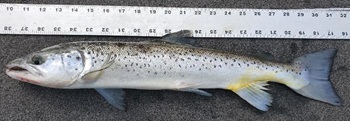
Photo of Atlantic salmon courtesy of Chris Palmer
The Hudson River Atlantic salmon story is long and complex; the best analysis, at the time, was written by A. Nelson Cheney of the New York Fisheries, Game and Forest Commission in his The Hudson River as a Salmon Stream presented before the National Fisheries Congress in January 1898.
Cheney’s assertion is that the Hudson River was never a salmon stream except for occasional strays. But he does allow for them to have shown up on occasion as wanderers into the estuary from New England rivers such as the Connecticut and Thames. Cheney’s contention achieves some credibility, however, when you consider the long term, poorly understood, effects from changes in ecology and hydrology to the Hudson River.
The story has its origin with Henry Hudson’s voyage up the river in September 1609, as told by Robert Juet, Master’s Mate of the Halfmoon. Juet wrote in the ship’s log for September 3, 1609, “So wee weighed and went in and rode in five fathoms [30 feet], oze ground, and saw many Salmons, and Mullets and Rays very great.” [“...mullets and rays very great?”]
For September 15, Juet noted “Wee ran up into the river, twentie leagues, passing by high mountains [Hudson Highlands?]. Wee had a very good depth at thirteene fathoms [78 feet], and great stores of Salmon in the river.” Yet, despite these and other mentions of salmon during the voyage, there is no record of any salmon being taken by the Dutch while the Halfmoon was in the river.
As a result of what some consider thin evidence of salmon, Juet’s contention has, ever since, suffered from serious skepticism. In analyzing Juet’s observations, did he see other fish, salmon look-a-likes, that were unfamiliar to him, such as striped bass or weakfish (Cynoscion regalis), often referred to as sea trout? Yet, there is some reason to consider that he may have seen Atlantic salmon. Salmo salar is a fall spawner and therefore Hudson and his crew could have seen adult salmon in the river in September. Juet knew Atlantic salmon behavior from his European home waters.
Their Type Site is listed as “The Seas of Europe,” a very broad and imprecise expanse. It is likely that the holotype specimen used by Swedish naturalist and explorer Carolus Linnaeus to describe the Atlantic salmon to science in 1758 (Systema Naturae) was a commercial catch from the sea off Northern Europe.
As a student, my introduction to the prospect of Hudson River Atlantic salmon was cloaked in folklore and mystery, much like visualizing the ramblings of Native people through our forests and plying our waters. Inevitably, the facts have been tinged with remorse that if salmon ever were in the estuary, they were no longer here due to degraded water quality. Regardless, there has always been a great deal of public misunderstanding of the river, in the realm of cause and effect.
Two of the most convincing reasons why we do not have a flourishing population today is the apparent lack of suitable spawning substrate in the freshwater reach of the watershed. Young salmon (parr) require cool summer waters and will not do well if the water temperate exceeds 68 degrees Fahrenheit for more than a couple weeks. Recent summers in the estuary typically exceed that value for at almost four months. Incompatible hydrology and the effects of climate change have had Atlantic salmon retreating to New England waters where tributaries to the sea have a steeper, cooler gradient.
There were several 19th century attempts, even one 18th century consideration, to introduce immature salmon to the Hudson River. The idea of stocking of Atlantic salmon was first promulgated in 1771 in Albany by John, the Earl of Dunnmore. There is no record that this idea was ever acted upon.
As of 1890 (Cheney), 3,486,000 Atlantic salmon fry (young-of-year capable of feeding themselves), from the Penobscot River in Maine were supplied by the United States Fish Commission. All stockings, after some brief success, eventually succumb to ecological constraints or illegal commercial harvesting.
In his Biological Survey of the Lower Hudson Watershed (1937), J.R. Greeley found a 1931 record of a 15 lb. Atlantic salmon caught by a Port Ewen shad fisherman. More recent Atlantic salmon appearances include April 2004, when an angler caught an Atlantic Salmon in the tidewater reach of Rondout Creek, Ulster County, 99 miles from the sea. The fish was a female, 27¾" long and weighed 7.0 lbs.
Another occurred on May 16, 2020. Chris Palmer and David Fenner were striped bass fishing in the Hudson River just below the Newburgh-Beacon Bridge, 68 miles from the sea, when they netted a fish swimming alongside their boat. They thought it was a brown trout (21.5-inches-long), so they released it.
Chris Palmer was curious enough, however, to send a photo (see accompanying photo) to Tim Wildman (Connecticut Department of Environmental Protection) who immediately recognized the fish as a male Atlantic salmon. It was a hatchery-reared fish that had passed downstream in the Naugatuck River past Kinneytown Dam, into Long Island Sound, and then made the short journey (175 miles) down the coast to the Hudson River. The Hudson River has been open to the sea for no less than 10,000 years. That time depth alone can make improbables, possible.
- Tom Lake
[For a very good read, see W. M. Shearer’s The Atlantic Salmon: Natural History, Exploitation and Future Management (1992)].
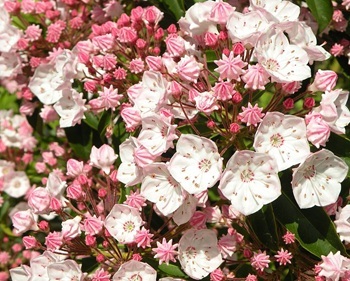
6/8 – Putnam County, HRM 55: Taking a break from driving, my wife, Debbie and I stopped at Fahnestock State Park to stretch our legs on a short hike along a park trail. We came upon masses of mountain laurel (Kalmia latifolia) in full bloom as we entered the forest — it was peak season for this spectacular species. A blue-grey gnatcatcher darted in and out of view as American redstarts called from higher up in the canopy.
- Dave Taft
Photo of mountain laurel courtesy of Doug McGrady
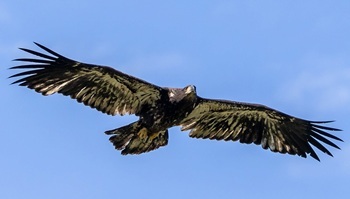
6/8 – Bronx, New York City: We were traveling down the Hutchinson River Parkway toward Orchard Beach on our way back from a family outing when we looked up in time to see a large dark bird cross into view overhead. The bird banked once or twice, idly riding thermals on a warm sunny day. The unmistakable white head and tail left no doubt that we'd seen an adult bald eagle. How rare these sighting once were especially near New York City, but now how regular they have become over the years.
- Dave Taft
Photo of bald eagle courtesy of Bob Rightmyer
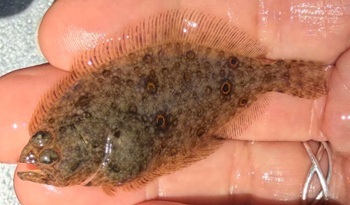
6/9 – Piermont Pier, HRM 25: This morning, our Lamont Doherty’s Hudson River Field Station research and education staff hosted 25 Education Explore America students for a morning of seining and water quality testing.
The Hudson River held many surprises for the students. After four hauls of our seine, they stood next to an impressive array of estuarine life, including American eel elvers, male mummichogs, Atlantic silverside, northern pipefish, white perch, striped bass, and a summer flounder (60 millimeters). Among invertebrates, we collected 30 blue crabs (11 male,19 female), mud crabs, shore shrimp, and moon jellyfish. The salinity was 8.0 parts-per-thousand, and the water temperature was 71 degrees Fahrenheit.
-Sarah Ortiz
[Note: One-inch equals 25.4 millimeters (mm). Tom Lake]
Photo of summer flounder courtesy of Sarah Ortiz
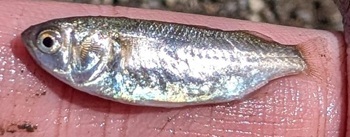
6/9 – Yonkers, HRM 18: During a morning seine haul, our research and education team at the Sarah Lawrence Center for the Urban River at Beczak caught a young-of-year fish (35 mm) that had us puzzled. Our best guess was a mullet (Mugil sp.) but beyond that we were not sure. We contacted Dr. Bob Schmidt, a dependable expert and resource for puzzling fishes. Bob concurred that it was a mullet, but since we have two mullet species in the river — white mullet (Mugil curema), and striped mullet (M. cephalus) — any conclusions might be speculative.
- Jason Muller
[The two species of mullet are very similar and at a pre-juvenile size, without a fish-in-hand (we lost this one), using a dichotomous key for meristics was not feasible. However, as a possible tiebreaker, we reflected on decades of seining in the lower estuary where young-of-year striped mullet have been caught at a 2:1 ratio to white mullet. At this size, a striped mullet would not show evidence of stripes, making identification even trickier.
Today’s mullet mystery seemed like a replay. A decade ago (May 2016), we seined the lower reach of Ossining’s Sing Sing Brook (river mile 33) in concert with a water quality study by Gareth Hougham. There we got into a school of young-of-year pre-juvenile striped mullet (22 mm), silvery, sans stripes. Not conclusive but very suggestive. Tom Lake]
Photo of striped mullet courtesy of Jason Muller
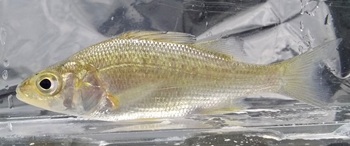
6/10 – Esopus Meadows, HRM 87: Our Hudson River Sloop Clearwater's Tideline Education Program culminated three days with students at our Esopus Meadows Environmental Education Center making ten hauls of our seine and catching an excellent assemblage of the fish in the river at Esopus Meadows.
High count among seven fish species was an impressive 70 white perch ranging in size from 40-110 mm, mostly netted in the shallows on a falling tide. Others included three striped bass (60-130 mm), tessellated darter, a dozen banded killifish, pumpkinseed sunfish, and the stars of the catch, three hogchokers (30-50 mm).
- Eli Schloss
Photo of white perch courtesy of Tom Lake
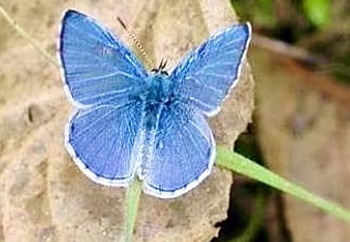
6/10 – Beacon, HRM 61: I spent the afternoon searching for monarch butterflies along the trails at Scenic Hudson’s Long Dock Park finding nary a one. It doesn’t seem too early. As compensation, at various points along the way, I was joined by several lovely spring azure blue butterflies.
- Tom Lake
Photo of spring blue azure courtesy of Michael Murphy
6/11 – Esopus Meadows, HRM 87: For the last day of the spring season, the Hudson River Sloop Clearwater's Tideline Education Program hosted students from Mill Road Intermediate School (IS) in Red Hook at our Esopus Meadows Environmental Education Center.
We had hopes as high as the tide, which left us barely any beach. The students were eager anglers, if only to cool off in the water. While our catch was light despite 13 hauls of our seine, it defined the season. We caught three banded killifish, residents of this freshwater reach of the river, and two young-of-year striped bass (50-70 mm), born just two months ago and now beginning their long migration to the sea where they will spend the next four years before returning to be a part of the spawning population.
- Eli Schloss
6/11 – Yonkers, HRM 18: Over the last two days, our research and education team at the Sarah Lawrence Center for the Urban River at Beczak set out to see what was in the river off the Beczak Beach. Across a dozen seine hauls, with the water temperature settling in at about 70 degrees Fahrenheit, we had high expectations.
Blue crab, nearing their summer peak of young-of-season, was high count with 25. Smaller invertebrates were plentiful with 30 grass shrimp and sand shrimp, and one moon jellyfish. Among fishes we had our first three winter flounder of the season, as well as a young-of-year bluefish (always exciting). And the young-of-year bay anchovy run (10) was still strong.
The salinity averaged 9.8 parts-per-thousand, and the dissolved oxygen (DO) was 8.7 parts-per-million.
- Jason Muller, Katie Lamb, Liana Napier, Lyla Harrison duBoulay, James Cook
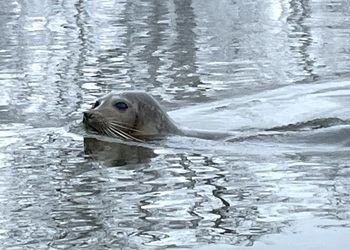
6/12 – Saugerties, HRM 102: April 2018, 2,690 days ago, a young harbor seal (Phoca vitulina) was rescued from Lower Goose Island, Harpswell, Maine. The circumstances surrounding its abandonment were unclear, although marine mammal experts from NOAA suspected the pup may have been a premature birth.
The young harbor seal was transported to the Mystic (Connecticut) Aquarium Animal Rescue Program where it was determined that the seal was a male. Long term medical rehabilitation followed. At its conclusion, a satellite tracker, as well as a white tag (2-4-6) was applied on its rear flipper before the seal was released as a yearling (one-year-old), at Charlestown, Rhode Island, on January 17, 2019.
His story was just beginning. Next week, we will provide an eight-year chronology highlighting the adventures of harbor seal number 2-4-6. Tom Lake, Patrick Landewe
Photo of harbor seal courtesy of Derek Brown
On April 8, 2026, the Albany County Supreme Court issued a decision that impacts DEC freshwater wetland regulations. In response, DEC has thoroughly evaluated the decision and its implications for freshwater wetlands permitting and enforcement programs in accordance with existing State law. DEC remains committed to the continued protection of wetlands and the numerous environmental and economic benefits they provide.
As a result of this decision, DEC is dedicated to upholding New York's Freshwater Wetland Act by maintaining regulatory protections for freshwater wetlands that remain jurisdictional. DEC will now require applications for projects that will impact Previously Mapped Freshwater Wetlands and/or wetlands of 12.4 acres or greater in size.
NYSDEC will host a virtual information webinar “Changes to Freshwater Wetland Regulations” on Tuesday, June 23 at 11:00 AM. This session will cover recent changes to freshwater wetland regulations.
What to expect:
- An overview of the jurisdictional determination process.
- Practical examples of when to request jurisdictional determination.
- Information on available freshwater wetland general permits.
We encourage attendees to submit questions during registration to ensure we address your interests effectively.
After the webinar, a recording will be posted on the Freshwater Wetland Jurisdictional Determination webpage for those who cannot attend.
Science Saturday at Norrie Point Environmental Center
Join us for our monthly Science Saturday programs and explore Norrie Point. Check out our series by visiting the Hudson River website. Events are free and open to the public. Registration is not required. All programs meet at the Norrie Point Environmental Center, 256 Norrie Point Way, Staatsburg NY, 12580. Dress for the weather and being outside! Otherwise, no special equipment is needed.
Saturday June 27, 10:00am to 12:00pm. Put on some waders and jump in the Hudson! Join us as we pull a seine net and discover what fish live in the Hudson. Equipment is provided. We will meet at Mills Mansion Staatsburg State Historic Site. Park at the carriage barn (signs will be posted) and DEC Staff will walk with attendees to the powerhouse (seining location). Please note that this program will require walking on rocky steps and uneven terrain. The powerhouse is a 10-minute/.25 mile walk from the parking area. More information (PDF).
Snapshot NY
The NYSDEC, in collaboration with the New York Cooperative Fish and Wildlife Research Unit at Cornell University, has launched Snapshot NY, a citizen science program that allows the public to participate in wildlife monitoring through the deployment of trail cameras. The project will help improve the way DEC monitors and manages more than a dozen wildlife species. For more information on Snapshot NY and how to participate, visit the Snapshot NY website.
Hudson River Lesson Plans
Explore our collection of Hudson River lesson plans, videos and online activities to support hands on investigations of the Hudson River in your classroom.
Hudson River: Striped Bass Cooperative Angler Program
You can share your fishing trip information and help biologists understand and manage our Hudson River striped bass fishery.
Here’s how it works: Fill out a logbook provided by us whenever you fish on the Hudson River (by boat or from shore). You can also use our survey123 app and record your trips using a smart phone or computer.
Record general location, time, gear used, what you caught (or if you didn’t catch anything) and return the logbook when you are done fishing for the season. You’ll receive an annual newsletter summarizing the information in addition to the latest news regarding regulations and the river. Whether you catch-and-release or take home a keeper, you can be part of the Cooperative Angler Program. Online logbook instructions (PDF).
Join today by contacting: hudsonangler@dec.ny.gov
- Jessica Best
Hudson River Miles
The Hudson is measured north from Hudson River Mile 0 at the Battery at the southern tip of Manhattan. The George Washington Bridge is at HRM 12, the Tappan Zee 28, Bear Mountain 47, Beacon-Newburgh 62, Mid-Hudson 75, Kingston-Rhinecliff 95, Rip Van Winkle 114, and the Federal Dam at Troy, the head of tidewater, at 153. The tidal section of the Hudson constitutes a bit less than half the total distance—315 miles—from Lake Tear of the Clouds to the Battery. Entries from points east and west in the watershed reference the corresponding river mile on the mainstem.
To Contribute Your Observations
The Hudson River Almanac is compiled and edited by Tom Lake and emailed weekly by DEC's Hudson River Estuary Program. Share your observations by e-mailing them to trlake7@aol.com.
Was this Newsletter Forwarded to You?
Subscribe today to DEC Delivers Hudson River Almanac topic for weekly natural history journal that covers the Hudson from the High Peaks of the Adirondacks to New York Harbor.
Helpful Resources
National Oceanic and Atmospheric Administration online tide and tidal current predictions are invaluable when planning Hudson River field trips. For real-time information on Hudson River tides, weather, and water conditions from sixteen monitoring stations, visit the Hudson River Environmental Conditions Observing System website.
DEC's Smartphone app for iPhone and Android is now available at New York Fishing, Hunting, and Wildlife App.
|