Photo of common loon courtesy of Mary Holland
In this issue:
The 10th annual World Fish Migration Day was a popular part of the week but had to share the spotlight with a first-time sighted bird, first-time caught fish, and an intimate look at the common loon.
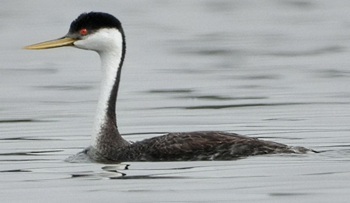
5/31 – Saratoga County, HRM167: An elegant western grebe (Aechmophorus occidentalis) visited Round Lake this week. I paddled my kayak around this morning keeping my distance from the bird, taking photos with a long-lens camera. The grebe was unexpectedly tolerant of a motor boat that passed by very close (the boat was traveling at a “no wake” zone). The bird was alert and watched but did not take flight.
- Jacquie Tinker
[The western grebe is a large, long-necked grebe (waterbird) with very long, thin, yellow bill, and a long, gray body with which it rides low in the water. It is the largest North American grebe and is widespread in western North America. The grebe dives for fish — often peers below the water before diving — mollusks, crabs, and amphibians, such as salamanders. Some smaller fish are impaled much like herons, with their bill, but others are grasped. Most are swallowed underwater, but some are brought to the surface, pinched, and swallowed.
[Western grebes breed on marshy lakes, saltwater bays, and open ocean in winter. They are "regularly" found along the coast when it ventures east. In checking New York State records, Saratoga is off the normal track (normal when found in the East). RW Dickerman]
[Western grebe is noteworthy to us because it does not usually go further east than Minnesota, according to All About Birds (John Hershey, Hudson-Mohawk Bird Club); this was also the first record of a western grebe for Saratoga County. Zach Schwartz-Weinstein, Hudson-Mohawk Bird Club]
Photo of Western grebe courtesy of Jacquie Tinker
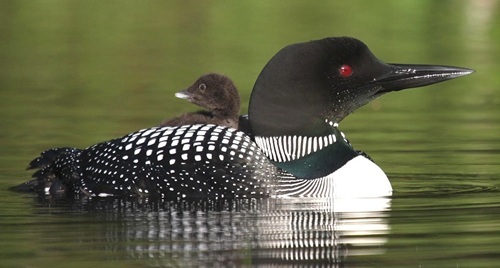
5/30 – Adirondack Mountains: I recently had the privilege of boating on a small glacial lake near the Hudson River headwaters, where I came upon a pair of nesting common loon. Often very shy water birds, this pair dove and popped up next to our boat and even swam under our kayaks looking like speeding torpedoes through the crystal clear water.
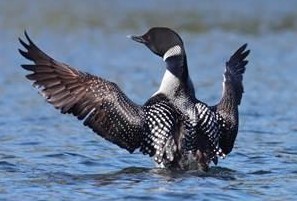
The loon’s striking black-and-white plumage, dark green head, purple neck band, and bright red eye, make this species special. We watched their antics diving, standing in the water, and flapping their wings while engaged in contortionist preening. Often staying submerged for a minute at a time, they can reemerge with just their head looking out like a periscope.
Full of native smelt, these pristine waters make a prime breeding ground for this fishing-loving water bird.
[There are two population of rainbow smelt (Osmerus mordax) in the watershed, an anadromous sea-run population in the estuary, and a landlocked population in the uplands (Kendall 1927)].
Loons typically lay just two large green eggs and when hatched, the “loon-lets” often ride on their mother’s back.
Most striking are the loon’s haunting calls, at times a piercing “Oh-Ah- EE,” and a lyrical tremolo best described as a laughing call. At a distance, it sounded lilting and magical; up close it sent reverberating echoes across the still waters. It was a wild and wonderful encounter with this amazing species.
- Mario Meier
[Author John McPhee’s ode to the common loon (Gavia immer) beautifully describes their behavior, including their four distinct calls, in his Survival of the Bark Canoe (1975). One of the most recognizable calls frequently heard in mating season, is the three-note yodel, repeated about ten seconds apart. This is a call of the male common loon and is usually a territorial warning.
Another is the wail, another haunting call that loons give back and forth to figure out each other’s location. It is frequently heard on the Hudson River at night during spring migration.
The fourth call of the loon is the hoot, a soft, short call given to keep in contact with each other. Parents might hoot to a chick, or one mate might hoot to another.
Writer William Barklow adds “There is perhaps no natural sound that more completely symbolizes the northern wilderness lake than the call of the loon.” “To most of us, the loon authenticates the wildness of the Adirondacks.”
“As a diver there is nothing like him. His wings close tight around his body, condensing everything – feathers, flesh – and he goes down like a powered stone, his big feet driving.” In Europe, they are called the “Great Northern Diver,” a name perfectly befitting this magnificent bird. Tom Lake]
Photo of common loon courtesy of Mario Meier
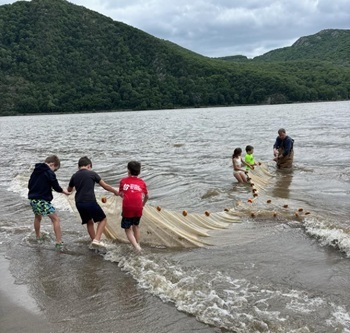
5/30 – Little Stony Point Preserve, HRM 55: For our contribution to the 10th World Fish Migration Day, 46 of us gathered on the beach in the throes of challenging weather at Little Stony Point Preserve (Hudson Highlands State Park). The wind and current were in concert heading to the sea — if it had been otherwise, the tide would have been untenable.
World Fish Migration Day is a global event observed to raise awareness for the need to restore and maintain environmental quality to waterways for migrating fishes. We had a varied group; one-third were exuberant young students including Kevin Singleton and his Cub Scouts from Putnam Valley.
Our program was a one day, one tide, snap-shot survey of what was home in the river. The challenge was a north wind blowing unimpeded down a five-mile fetch at a steady 25 mph, with gusts to 30-plus. Our 35-foot seine became a sail, and a difficult task for our young students who worked the net. It was exhausting. Communicating was impossible — our voices were being swept away in the wind — stories were left untold.
We fished the last of the down tide, and when we managed to wrestle the seine up on the sand, our catch was dominated by scores of young-of-year striped bass (75-92 mm) destined, eventually, for the sea 62 miles downriver. We also collected a foot-long American eel, white perch, spottail shiner, and a tiny (5.0 mm) male blue crab. Water temperature was 63 degrees Fahrenheit with no measurable salinity.
- Tom Lake, Seth Dinitz, Tommy Jackson
[Note: One-inch equals 25.4 millimeters (mm). Tom Lake]
Photo of World Migration Day courtesy of Tom Lake
5/30 – Piermont Pier, HRM 25: World Fish Migration Day arrived at Piermont with threatening skies and high winds driving breakers over the pier complementing a river full of life. Netting was a challenge, but we persisted with eight seine hauls. Each of them held “eel surprises” for our group including two immature yellow-phase American eels (220-370 mm) that wiggled into our nets and one tiny (yearling) glass eel that we found hidden in the net debris.
Other fishes included 48 mummichogs (31 female, 17 male), three small summer flounder, one winter flounder, an early young-of-year bluefish, bay anchovies, Atlantic silverside, striped bass, white perch (to 240 mm), young-of-year Atlantic menhaden, and our favorite, a young-of-winter Atlantic tomcod.
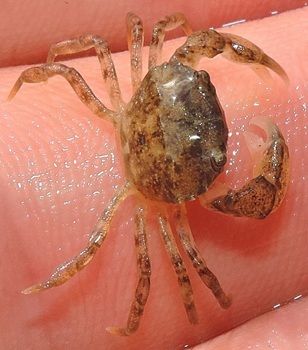
Along with the fish we had 83 small blue crabs, white-fingered mud crabs, and grass shrimp (some gravid). The salinity was 6.0 part-per-thousand, and the water temperature was 63 degrees Fahrenheit.
- Margie Turrin, Marisa Annunziato, Sarah Ortiz
Photo of white-fingered mud crab courtesy of Tom Lake
5/30 – Staten Island, New York City: As our contribution to the 10th annual World Fish Migration Day, the dedicated students from St. Clare’s School and other participating families went seining at Lemon Creek Park on the southeast shore of Staten Island. We netted at both the open shoreline of Princes Bay (Raritan Bay) and a small tidal pond that becomes landlocked at low tide.
On the Raritan Bay side, five hauls of our seine netted us six calico lady crabs (Ovalipes ocellatusa), 15 hermit crabs, 20 sand shrimp (Crangon sp.), three windowpane flounder (70-100 mm), and one juvenile spotted hake. The salinity was 25.0 part-per-thousand, and the water temp was 70 degrees Fahrenheit.
In the tidal pond, three hauls of our seine along with some dip netting, captured sand shrimp, calico lady crabs, mud dog whelks, Atlantic silversides, mummichogs, at least 50 four-spine sticklebacks (many young-of-year), and one American ‘glass’ eel. Salinity was a little higher than at the bay at 28.0 parts-per-thousand and the water temperature was also 70 degrees Fahrenheit.
Our event was a true partnership between the NYSDEC, NYCDEP, NOAA, with superb coordination by the Lamont Doherty Earth Observatory.
- Chris Bowser, Lyndsey Cooper, Carl Alderson, Rob Brauman
Photo of windowpane flounder courtesy of Chris Bowser
5/30 – Manhattan, HRM 6: As our contribution to the World Fish Migration Day, our Hudson River Sloop Clearwater's Tideline Education Program seined at Fort Washington (172nd Street), where the beach is 50-feet-long and eight-feet-wide from waterline to rip-rap. There were 50 participants that contributed by either donning waders or examining our catch. Our catch was small but interesting with young-of-year striped bass (100-120 ) — a fish that many believe is the bellwether species of the Hudson River — five Atlantic silverside, and a northern pipefish (120 mm).
- Eli Schloss
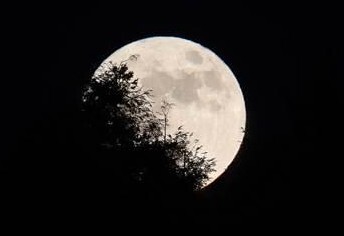
5/31 – Hudson River Watershed: Tonight we observed the second full moon of May, often referred to as a Blue Moon due to uncommon presence as a second full moon in a calendar month. The recognition of a Blue Moon is frequently seen as "traditional," but since no occurrences are known prior to 1937, it is better described as an invented tradition or "modern American folklore." The practice of designating the second full moon in a month as "blue" originated with amateur astronomer James Hugh Pruett in 1946. The designation of Blue Moon does not come from Native American lunar tradition, as is sometimes supposed (Hiscock, 2012].
- Tom Lake
Photo of strawberry moon courtesy of Mario Meier
5/31 – Adirondack Mountains: I watched the full “Strawberry Moon,” the second full moon of May, rise over an Adirondack Lake. The interim atmosphere enlarged the moon the horizon. The branches diffracted the light making the moon appear to have coronal flames.
- Mario Meier
[There are several versions of the origin of “Strawberry Moon,” from Northeast Native Americans to pop culture. As wild strawberries begin to ripen during early June, this year’s Blue Moon, bordering on that season, makes it an apt substitute. Tom Lake]
6/1 – Essex County: HRM 284: June is such an interesting time in spring. It is late in the season, but there are still neat things that one hears and appreciates well enough. Today I heard my first eastern bluebird in Minerva and heard and recognized the song of a mourning warbler. Both are great songs.
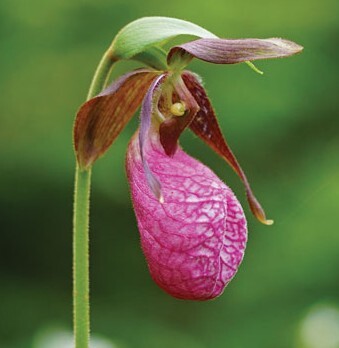
In the woods right now, out in full bloom, are is pink ladies-slipper, painted trillium, rose twisted-stalk, false Solomon’s-seal, and wild columbine. You name it – beautiful.
- Mike Corey
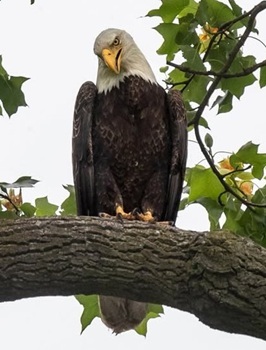
6/1 – Hook Mountain, HRM 31: Among the seven raptors today at the Hook Mountain Hawkwatch, bald eagle was high count with four. Turkey vulture was overall high count for the watch with eleven. The hawks were mainly finished for the season, but there was a singe bedraggled adult broad-winged hawk so at least some straggling birds can still be moving. And there was an osprey in addition to the bald eagles.
- Tom Fiore
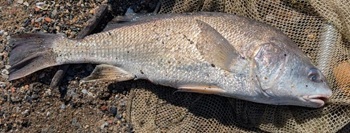
6/1 – Yonkers, HRM 18: This morning, our research and education team at the Sarah Lawrence Center for the Urban River at Beczak caught a gorgeous 26-inch freshwater drum (Aplodinotus grunniens). It was our first freshwater drum caught at the Beczak Center since we began keeping records in 2005.
- Jason Muller
Photo of freshwater drum courtesy of Jason Muller
6/1 – Hudson River Watershed: Unlike yellow lady’s slipper or showy lady’s slipper, or other orchids of the genus Cypripedium, pink lady’s slipper (Cypripedium acaule) does not have an opening at the top of its specialized petal/ pouch/slipper (labellum) through which pollinating insects can easily enter the flower. Instead, there is a concealed vertical slit running the length of the pouch.
Insects that are lured to this orchid by color or scent (it has no nectar) must be large enough and strong enough to push their way through the hairy margins of the slit. Bumble bees are about the only insects capable of this. Once inside the pouch, the bee discovers there is no nectar and attempts to exit, but the slit is no longer accessible due to the way it is constructed. The bee heads towards the light coming through two small openings at the top of the slipper and as it passes through one of these openings it brushes against the reproductive parts of the orchid and pollinates the flower.
For whatever reason, bumble bees aren’t frequent visitors of pink lady’s slippers (perhaps due to the false advertising — attractive smell, colorful flower but no nectar) and only about 5% of pink lady’s slippers are pollinated in any given year.
- Mary Holland
Photo of pink lady's slipper courtesy of Thomas Barnes
6/2 – Waterford, HRM 158: This morning I confirmed that we have three nestlings in bald eagle nest NY485. Two are large (normal) and one is quite small (likely hatched a day or more after the first two). They all seem fine at present, but I will keep an eye on them.
- Howard Stoner
[When there are multiple nestlings and one is considerably smaller (later hatch) we have concern for the smaller one’s access to food. The older, larger nestling(s), have an advantage that occasionally leads to the demise of the smaller nestling. Tom Lake]
6/2 – Town of Poughkeepsie: It was Day 82 for the three nestlings in bald eagle nest NY62. The nearly-adult size nestlings had taken over the nest leaving the adults to find refuge elsewhere. Today, the female found a resting perch in a tuliptree 150 feet away, their former nest tree (2011-2024. On average, bald eagle nestlings fledge 72-90 days after hatching, so we are creeping closer.
- Bob Rightmyer
[NY62.2026.May.BobR]
Photo of bald eagle courtesy of Bob Rightmyer
6/3 – Yonkers, HRM 18: The glass eel season ended this week as our research and education team at the Sarah Lawrence Center for the Urban River at Beczak pulled our fyke net out of the Beczak Tidemarsh. We finished the season with 2,027 glass eels. This is a bit below our 13-year average of 2,155 glass eels, and down from last year’s 4,020. Our sampling season ran from 3/2 – 6/3. On two days this week (6/2-6/3) we caught eight glass eels as well as an elver (juvenile eel), 42 grass shrimp, and a naked goby (Gobiosoma bosc).
The water temperature was 66 degrees Fahrenheit, the salinity was 9.0 parts-per-thousand, and the dissolved oxygen was 9.7 parts-per-million.
- Jason Muller, James Cook, Liana Napier, Lyla Harrison duBoulay, Katie Lamb
6/3 – Manhattan, HRM 1-2: Our Hudson River Park's River Project staff and CUNY Interns checked our research gear (pots and traps) that we deploy from floating docks on the south-side of Piers 26 and 40 in Hudson River Park for our ongoing Park's Fish Ecology Survey. Today, unsurprisingly, our gear had collected thirteen oyster toadfish (60-295 mm) — it is their season — as well as three blackfish-tautog (330-378 mm), and one northern pipefish (180 mm).
- Toland Kister, Beryl Kahn, Avalon Daly
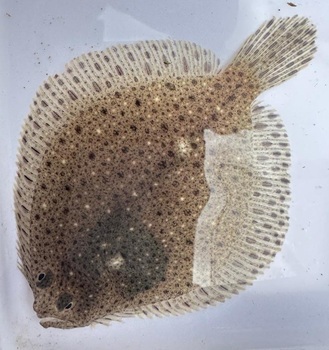
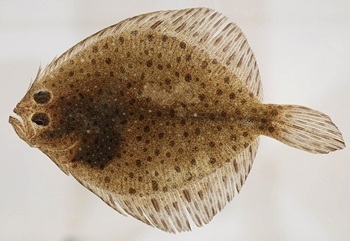
6/4 – Hudson River Watershed: Fish-of-the-Week for Week 369 is the windowpane flounder, Scophthalmus aquosus (Mitchill, 1815), number 230 (of 240) on our watershed list of fishes. If you would like a copy of our list, e-mail - trlake7@aol.com.
Windowpane is the only member of the Turbot family (Scophthalmidae) recorded for the estuary. Windowpane was re-categorized (taxonomically) from Bothidae (lefteyed flounder) to Scophthalmidae (Turbot) in 1945, although that change rarely appeared in literature until 2003 when ichthyologist Bruno Chanet finally articulated a reasonable set of characters and monophyla of Scophthalmidae, their present family association.
Regardless of family changes, windowpane is still a flatfish (Pleuronectoidei), and morphologically a left-eyed flounder. They are broadly ovate, much compressed, with the ocular-side [eye-side] greenish olive and, as their common name suggests, virtually translucent — a very thin flatfish.
Like other flounders, they are born with one eye on each side of their head, as with most fishes. As they grow from the larval to their juvenile stage, through a process called metamorphosis, one eye migrates to the opposite side of their head. As a result, windowpane lie on their right side with both eyes on their left side, facing skyward. The right side, or “blind” side, faces the bottom.
This odd arrangement of eyes is a wonderful example of evolutionary adaptation through natural selection and favored traits. As a further adaptation for concealment, the topside of most flounders can almost precisely mimic the substrate providing excellent camouflage from predators.
Windowpane are commonly found favoring inshore sandy shallows, from the Gulf of Saint Lawrence to northern Florida where they can get to 18-inches long. Bigelow and Schroeder in their Fishes of the Gulf of Maine (1953) refer to windowpane as “sand flounder.” Briggs and Waldman’s Marine Fishes of New York (2002) describe windowpane as “abundant” in the New York Bight. Smith and Lake (1990) define windowpane as a seasonal-resident marine species, found in the lower Hudson estuary from the Tappan Zee upriver to Haverstraw (river mile 35).
- Tom Lake
Photo of windowpane flounder courtesy of Barnegat Partnership
6/4 – Nutten Hook, HRM 124: Nutten Hook Tidal Wetlands Park is a hidden gem, with a historic ice house, a beautiful beach, and a pavilion for teachers and students. Today, our Hudson River Sloop Clearwater's Tideline Education Program hosted 4th grade students from Germantown. On our last seine haul of the day, on a falling tide, the students caught nine white perch (40-80 mm), five banded killifish, and a tessellated darter (40 mm).
- Eli Schloss
6/4 – Yonkers, HRM 18: Our research and education team at the Sarah Lawrence Center for the Urban River at Beczak conducted five seining programs this week, including two classes both held on 6/2 — Fieldston Ethical Culture School in the Bronx; 2nd graders from the Allen-Stevenson School in Manhattan — comprised of 39 seine hauls. One of the programs was our contribution to the World Fish Migration Day on 5/30.
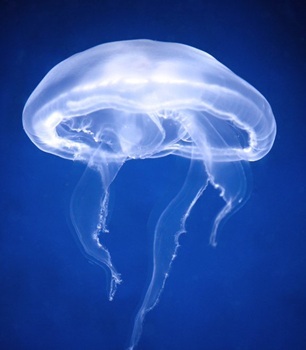
It was a week for an amazing array of aquatic life from a moon jellyfish to 55 mummichogs (to 130 mm). Other notables included an Atlantic tomcod, a young-of-year bluefish, striped bass (85-95 mm), banded killifish, white perch, bay anchovies, and blue crabs (15-50 mm).
Water quality averages included water temperature 67 degrees Fahrenheit, salinity was 9.0 parts-per-thousand, and the dissolved oxygen was 9.5 parts-per-million.
- Katie Lamboy Roman, Christina Tobitsch, Jason Muller, Katie Lamb, Liana Napier, Lyla Harrison duBoulay, James Cook
[Crab measurements (size) are calculated in millimeters (mm) point-to-point across their carapace. Tom Lake]
Photo of moon jellyfish courtesy of Tom Lake
6/5 – Esopus Meadows HRM 87: Three days this week our Hudson River Sloop Clearwater's Tideline Education Program hosted elementary school students at the Esopus Meadows Environmental Education Center. These included Mountain Laurel Waldorf School 2nd graders and Woodstock Elementary 3rd graders.
Our nets did well as we collected six native fish species among which were banded killifish, spottail shiner, white perch, tessellated darter, hogchoker (25 mm), and an American eel (170 mm). The latter kept escaping from our tank.
- Eli Schloss
6/5 – Manhattan, HRM 2.5: For the last week, Hudson River Park’s Gansevoort Peninsula has had an out of the ordinary visitor in our park, a beaver (specifically a North American beaver (Castor canadensis). This was the first-ever recorded sighting of a beaver in the park’s 400-acre estuarine sanctuary.
It has largely been observed on the south side of Gansevoort Peninsula where it has been most active during the evening, where it has been spotted munching on nearby vegetation and swimming in the waters off the shoreline. Park staff are keeping tabs on its presence and made sure to notify the NYSDEC about this sighting.
The sighting may require an update in defining beaver habitats. The first thing that came to mind was Manhattan Island 400+ years ago, when a beaver population found the inland freshwater habitat to their liking. Unfortunately, the Dutch liked beaver fur trimmed garments.
- Toland Kister, Tina Walsh, Siddhartha Hayes
Are you a natural resource professional or ecologist looking for recommendations of native plants and trees to plant on a restoration site? DEC and the New York Natural Heritage Program recently released a Species Selection Tool that provides a list of recommended native tree, shrub, and herbaceous plant species to improve habitats, increase biodiversity, and benefit wildlife across New York State. There are three steps to using this tool:
-
Enter your planting site location: Enter the address or click on the map to automatically generate expected site conditions of the property including soil and geology.
-
Review the site conditions: Review the site conditions generated by the tool. To change site conditions (such as the geology, elevation, soil drainage, or soil depth) click the drop-down arrows and choose the correct site feature.
-
Choose the type of natural community you want to plant: Below the map, select the button of the type (category) of natural community you would like to plant (forest, forested wetland, shrubland, grassland, emergent wetland, dunes, or barrens). Note that the option you can select based on your site conditions will be green buttons; the whited-out buttons are communities that are not suitable for planting at your site. On the new page, select the natural communities you are interested in including in the list.
The tool narrows down the species list, and provides information on each species, including height, lifespan, shade tolerance, and climate adaptability.
The new Species Selection Tool can assist natural resource professionals with finding native plants and trees suitable for their restoration site.
Science Saturday at Norrie Point Environmental Center
Join us for our monthly Science Saturday programs and explore Norrie Point. Check out our series by visiting the Hudson River website. Events are free and open to the public. Registration is not required. All programs meet at the Norrie Point Environmental Center, 256 Norrie Point Way, Staatsburg NY, 12580. Dress for the weather and being outside! Otherwise, no special equipment is needed.
Saturday June 27, 10:00am to 12:00pm. Put on some waders and jump in the Hudson! Join us as we pull a seine net and discover what fish live in the Hudson. Equipment is provided. We will meet at Mills Mansion Staatsburg State Historic Site. Park at the carriage barn (signs will be posted) and DEC Staff will walk with attendees to the powerhouse (seining location). Please note that this program will require walking on rocky steps and uneven terrain. The powerhouse is a 10-minute/.25 mile walk from the parking area. More information (PDF).
Snapshot NY
The NYSDEC, in collaboration with the New York Cooperative Fish and Wildlife Research Unit at Cornell University, has launched Snapshot NY, a citizen science program that allows the public to participate in wildlife monitoring through the deployment of trail cameras. The project will help improve the way DEC monitors and manages more than a dozen wildlife species. For more information on Snapshot NY and how to participate, visit the Snapshot NY website.
Hudson River Lesson Plans
Explore our collection of Hudson River lesson plans, videos and online activities to support hands on investigations of the Hudson River in your classroom.
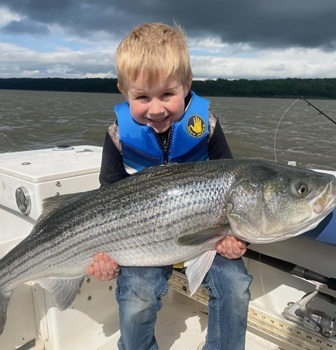
Hudson River: Striped Bass Cooperative Angler Program
You can share your fishing trip information and help biologists understand and manage our Hudson River striped bass fishery.
Here’s how it works: Fill out a logbook provided by us whenever you fish on the Hudson River (by boat or from shore). You can also use our survey123 app and record your trips using a smart phone or computer.
Record general location, time, gear used, what you caught (or if you didn’t catch anything) and return the logbook when you are done fishing for the season. You’ll receive an annual newsletter summarizing the information in addition to the latest news regarding regulations and the river. Whether you catch-and-release or take home a keeper, you can be part of the Cooperative Angler Program. Online logbook instructions (PDF).
Join today by contacting: hudsonangler@dec.ny.gov
- Jessica Best
Photo of DEC Angler Program courtesy of Jess Best
Hudson River Miles
The Hudson is measured north from Hudson River Mile 0 at the Battery at the southern tip of Manhattan. The George Washington Bridge is at HRM 12, the Tappan Zee 28, Bear Mountain 47, Beacon-Newburgh 62, Mid-Hudson 75, Kingston-Rhinecliff 95, Rip Van Winkle 114, and the Federal Dam at Troy, the head of tidewater, at 153. The tidal section of the Hudson constitutes a bit less than half the total distance—315 miles—from Lake Tear of the Clouds to the Battery. Entries from points east and west in the watershed reference the corresponding river mile on the mainstem.
To Contribute Your Observations
The Hudson River Almanac is compiled and edited by Tom Lake and emailed weekly by DEC's Hudson River Estuary Program. Share your observations by e-mailing them to trlake7@aol.com.
Was this Newsletter Forwarded to You?
Subscribe today to DEC Delivers Hudson River Almanac topic for weekly natural history journal that covers the Hudson from the High Peaks of the Adirondacks to New York Harbor.
Helpful Resources
National Oceanic and Atmospheric Administration online tide and tidal current predictions are invaluable when planning Hudson River field trips. For real-time information on Hudson River tides, weather, and water conditions from sixteen monitoring stations, visit the Hudson River Environmental Conditions Observing System website.
DEC's Smartphone app for iPhone and Android is now available at New York Fishing, Hunting, and Wildlife App.
|