Photo of white pelican courtesy of Alan Wells
In this issue:
The weather pin-balled this week from early spring to mid-summer, typical of the seasonal vagaries of the Hudson River watershed. An impressive number of migratory birds, from raptors to songbirds to aquatics were still arriving. One of the latter made an impression that earned it Highlight-of-the-Week.
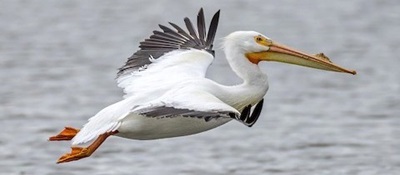
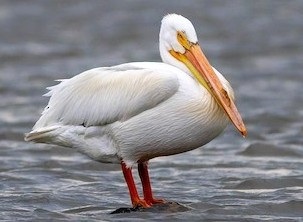
5/16 – Piermont Pier, HRM 25: It was nearly high tide on May 13 when I visited Piermont Pier and there was a strong southerly wind. I found the willet (Tringa semipalmata) that had been reported earlier in the day. The large shorebird was resting on a rock toward the east end of the breakwater. As I turned to leave, I spotted a massive American white pelican sitting on a rock at the other end of the breakwater. It seemed to appear out of nowhere. These two rarities were in addition to the black scoter that appeared the previous week and was still hanging around.
- Linda Pistolesi
[The American White pelican (Pelecanus erythrorhynchos) is a bird of the Great Plains up through central Canada. Every year or so, one or more turn up somewhere in the Northeast but they are a rare sighting along the estuary. Pelicans are strong flyers with the ability to soar at great heights, covering long distances. Their presence here generally occurs when blown off course either in migration or drawn here from the Great Lakes area by nor’easters. June 2013, there were several sightings along the river from Poughkeepsie to Piermont, possibly the same bird.
- Tom Lake
Photo of white pelican courtesy of Jeanne Cimorelli
5/16 – Yonkers, HRM 18: Students from Pace University recently visited the Sarah Lawrence Center for the Urban River at Beczak to partake in a lesson on Hudson River ecology and seine in our salt marsh.
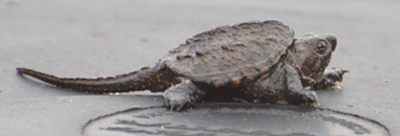
As we began to set our net out into the marsh, a tiny and unexpected visitor emerged from the tall marsh plants and swam right into the back of our net. It was a baby snapping turtle (Chelydra serpentina), its carapace size estimated at 40-50 mm (measured fore-to-aft across its carapace).
While the start of our river exploration was very exciting, our actual seine hauls were dismal. Over five hauls we caught just one striped bass. Our seining time was cut short as an approaching storm caused the water to get incredibly choppy, perhaps a contributing factor in our low fish catch. Student energy was still riding high even as wind and rain set in while they were using dichotomous keys to identify the striped bass. Water temperature was 58 degrees Fahrenheit, and the salinity measured 5.8 parts-per-thousand.
-Christina Tobitsch
[Note: One-inch equals 25.4 millimeters (mm). Tom Lake]
Photo of snapping turtle courtesy of Tom Lake
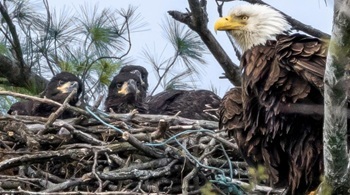
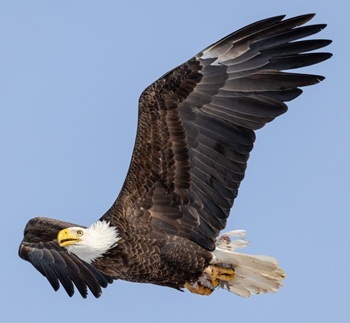
5/16 – Town of Poughkeepsie: My first thought when I saw bald eagle nest NY62 today was “full house.” When you line up three getting-larger-every-day nestlings and two adults, there is no leftover space. Even nests with just two rambunctious nestlings frequently necessitates that one or both adults spend much of the time perched on a nearby limb.
- Bob Rightmyer
Photo of bald eagle courtesy of Bob Rightmyer
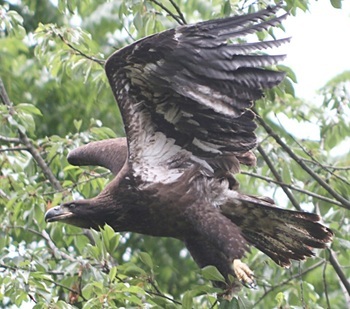
5/16 – Hook Mountain, HRM 31: Among the 44 north-migrating raptors today at the Hook Mountain Hawkwatch, broad-winged hawk was high count with 18. Bald eagle was next with ten.
The day must have been especially amenable to bald eagle movement. The eagles we know as locals are few in total pairs, and so with a double-digit passage of the big birds it was clear that this was a day for eagles to go. Some of these might have been ones that were in the deep-south and only now moving north, some as far as Canada, to spend the warm months where days are longer and the feeding will be plentiful.
Some of the eagles might not be breeding, or some possibly already had, and are moving away from nesting places on the Gulf, or in southernmost Florida. Among non-raptor migrants, turkey vulture was high count with 18.
- Tom Fiore
Photo of bald eagle courtesy of John Badura
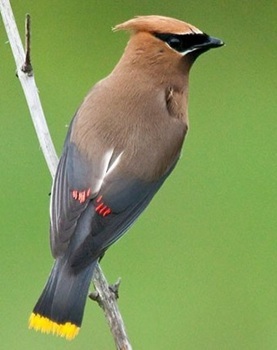
5/17 – Rockland County, HRM 25: Nine members of the Rockland Audubon Society visited the Lamont-Doherty Earth Observatory campus in Palisades for a four-hour bird walk starting at 6:30 a.m. By 8 a.m. we had observed no fewer than 215 cedar waxwings flying over in multiple flocks of 10-80 birds. Other highlights included blackburnian and Tennessee warblers, yellow-billed cuckoo, Swainsons’s thrush, orchard and Baltimore orioles, scarlet tanager, rose-breasted grosbeak, and eastern wood-pewee. In total, we identified 44 species.
- Linda Pistolesi
Photo of cedar waxwing courtesy of J B Churchill
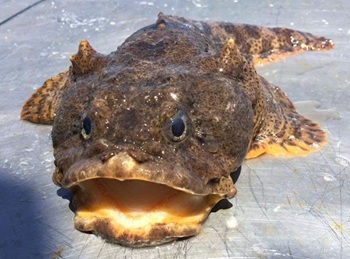
5/18 – Hudson River Watershed: Fish-of-the-Week for Week 367 is the oyster toadfish (Opsanus tau), number 114 (of 240) on our watershed list of fishes. If you would like a copy of our list, e-mail - trlake7@aol.com.
Oyster toadfish is the only member of its family, the toadfishes (Batrachoididae), documented for the Hudson River watershed. They are classified as a temperate marine stray, favoring salt water but completely adaptable to brackish areas of the lower salinity.
Oyster toadfish are yellowish with a pattern of brown oblique bars, complementing a generally unfinished look. As a possible adaptation for survival, toadfish have a venomous spine in the first ray of their dorsal fin (handle carefully). They can reach 17-inches in length and weigh 5 lbs.
Toadfish are ambush predators during the day as apex predators on oyster reefs where they remain buried up to their eyeballs in sand or hidden under structure. Their cryptic coloration make them well-camouflaged hiding in crevices on rocky/sandy/muddy substrates from where they lunge for passing prey.
They are found from Cape Cod, Massachusetts, to Florida, largely inhabiting inshore waters on rocky bottoms, reefs, and jetties. They are common in the waters around New York Harbor and the lower estuary where they set up shop on the bottom of the river and, with a huge mouth, strong jaws, and sharp teeth, they crush and feed on shellfish such as crabs, oysters, and other bivalves.
Although oyster toadfish is quite a handsome fish, it has never been treated well with its nomenclature. They are known colloquially as oyster cracker, oyster catcher, oyster toad, ugly toad, and bar dog. Oyster toadfish are so admired by anglers that, in less-enlightened times, they were lovingly dubbed the “mother-in-law” fish.
Well-preserved oyster toadfish bones have been found in excavated oyster middens on Dogan Point (river mile 40) in Westchester County (Claassen 1996), that radiocarbon dated (14C) to the Late Archaic (5,000 years ago). These data provide archaeological evidence suggesting that indigenous people (ancestral Lenni-Lenape) may have enjoyed eating oyster toadfish with their blue crabs and oysters.
There is one outlier to what is considered the tidewater comfort zone of the oyster toadfish. In the aftermath of Hurricane Sandy (October 2012), Chris Bowser came upon a dead adult oyster toadfish in freshwater on the beach at Norrie Point Environmental Education Center (river mile 85), fully 50 miles upriver from their minimally favored habitat.
- Tom Lake
Photo of oyster toadfish courtesy of Chesapeake Bay Program
5/19 – Beacon, HRM 61: It was a scorcher. The air finally settled on 96 degrees Fahrenheit, one degree short of the record high for the date. The tide was low and the river was relatively quiet at 68 degrees. The salinity barely recording a blip, suggesting what we call “background noise,” a reading coming from an upland terrestrial source.
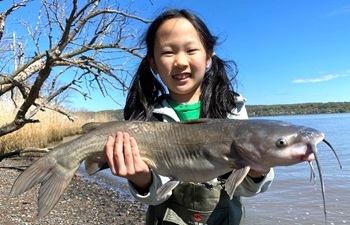
We made a few hauls of our seine with no surprises:, banded killifish, spottail shiner, and one (55 mm) yearling channel catfish (Ictalurus punctatus). On the path to the beach, we passed three Baltimore orioles, and then one more on our way out. It is their season.
- Tom Lake, A. Danforth
Photo of channel catfish courtesy of Illiana Park
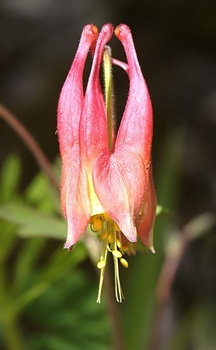
5/20 – Hudson River Watershed: Red columbine (Aquilegia canadensis), also called Columbine or American Columbine, is one of the first plants to provide nectar in the spring for long-tongued insects such as bumble bees and hawk moths, as well as hummingbirds. In fact, if you see Columbine in flower, it’s safe to assume that ruby-throated hummingbirds are returning from their wintering grounds, with both species having co-evolved.
Columbine is an outstanding source of energy for hummingbirds as its nectar, located at the tip of each of its tubular hollow spurs, contains roughly twice the sugar concentration of other North American columbine species. There are at least eight species of red columbine in the U.S., each with spurs of a slightly different shape and length. Although a co-evolved relationship between hummingbird bill length and corolla length in hummingbird-pollinated species has long been assumed, there is little evidence to support this.
- Mary Holland
Photo of red columbine courtesy of Mary Holland
5/20 – HRM 1-2: Our Hudson River Park's River Project staff and CUNY Interns checked our research gear (pots and traps) that we deploy from floating docks on the south-side of Piers 26 and 40 in Hudson River Park for our ongoing Park's Fish Ecology Survey.
Today’s catch included three oyster toadfish (195-240 mm), one blackfish-tautog (365 mm), and a collection of invertebrates including grass shrimp, mud crabs, oyster drills, amphipods, and mud dog whelks.
- Renee Mariner
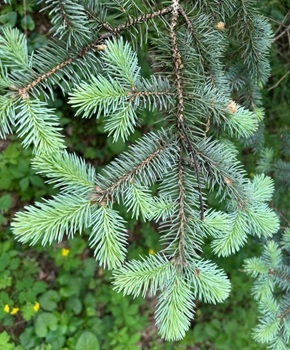
5/21 – Hudson River Watershed: On a walk through our Back Forty today, I came upon a blue spruce (Picea pungens) that was displaying some of its new spring growth — light green downy tips on each branch. Aldo Leopold coined the name “candle” to describe the terminal bud of conifers where “at its tip, burns the eternal flame that lights a path into the future” (1949). At the tip of the flame, at the tip of the bud, there is intense energy, but to the eye, total serenity. “A candle burning in a windless place” (Bhagavad Gita). You could contemplate that line for a very long while.
- Tom Lake
Photo of picea pungens courtesy of Tom Lake
5/21 – Town of Wappinger, HRM 67: I have been monitoring bald eagle nest NY459, dubbed “The Bridge Nest”, for its eight seasons. This spring I have been watching food being brought to the nest but no sign yet of nestlings. They built the nest so high I cannot get a good look.
I took a photo today of an adult carrying food to the nest, but the image was too indistinct to determine what it had in its talons. It was not a fish. Best guess was a small, chipmunk-size mammal. Barely a snack.
- Judy Winter
[Bald eagle nest NY459 is in its eighth season. In season one (2019), high winds from a severe thunderstorm (microburst) in spring destroyed the nest. The adult pair recovered quickly and by summer’s end they had built a new nest. For the next six seasons, they fledged two nesting each. Resiliency is at the core of eagles. Tom Lake]
5/21 – Yonkers, HRM 18: Our research and education team at the Sarah Lawrence Center for the Urban River at Beczak hosted students from school groups this week (5/19 - 5/21) as we monitored our fyke that we set in the Beczak Tidemarsh. Across three days we caught 25 glass eels, 44 grass shrimp (Palaemon sp.), and two blue crabs.
Also, during the week (5/18 - 5/21), we hosted students grades 1-3 from the Yonkers Montessori Academy, (pre-K) students from Eliza Corwin Frost School in Bronxville, and 8th grade students from Homestead School in Hurleyville) for four days of seining.
Across the four days and 44 hauls of our seine, we caught 21 (90-115 mm) yearling striped bass (Class of 2025), 14 (young-of-the-season) blue crabs (30 mm), and two “shoe-string American eels (115-140 mm). Other notable fishes included Atlantic silverside, mummichogs, white perch, bay anchovies, and one banded killifish.
The average water temperature was 65 degrees Fahrenheit, the salinity was 8.4 parts-per-thousand, and dissolved oxygen (DO) was 10.1 parts-per-million.
- Jason Muller, Christina Tobitsch, Liana Napier, Lyla Harrison duBoulay, Katie Lamboy Roman
[Crab measurements (size) are calculated in millimeters (mm) point-to-point across their carapace. Tom Lake]
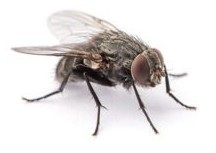
5/22 – Essex County, HRM 284: The blackflies have been out and thick in Minerva. I'm still raking leaves that dropped last fall and the blackflies have found this activity very appealing and have been painfully attentive. I have a netted-hat designed to keep them out, and I've been using it very studiously when outside.
- Mike Corey
[Black flies are biting insects in the family Simuliidae. They are small, humpbacked flies with short, multi-segmented antennae. The females are vicious biters that suck blood. They are sometimes confused with other biting flies referred to as no-see-ums. These minute, biting flies belong to the insect family Ceratopogonidae. Their common name refers to their size — so small that you don’t see or feel them until you’ve been bitten. Tom Lake]
Photo of black fly courtesy of Jannel James
5/22 – Town of Poughkeepsie: Based on the data we have compiled for bald eagle nest NY62, where three nestlings were hatched March 19, it is possible we could see the first fledge on May 29. This is supposition, however, based on averages that were established long ago for bald eagles fledglings.
To wit: Fledges occur, on average, 72-90 days after hatch. In the instance of NY62, that equates to May 29 to June 16. But the world of the averages has changed, and eagles, including new stresses from their increasing density in the Hudson Valley have also changed. Still, an 18-day range seems reasonable.
NY62 has another factor effecting their fledge date: three nestlings plus their sex might play a role. Pete Nye believes that males are the first to go. Females, reluctantly demure in taking that first steep, leave last. Then become hellions afterwards.
Photo of bald eagle courtesy of Tom Lake
5/22 – Hook Mountain, HRM 31: Among the 13 north-migrating raptors today at the Hook Mountain Hawkwatch, bald eagle was high count with four. For May 22, we had nice assortment of six migrant raptor species as well as the ongoing turkey vulture migratory-movement. In late May, and some days in early June, some migration is still a possibility, but the numbers are likely to be increasingly-sparse.
Today we crossed the 3,000 total migrants line for the season (3,030) comprised of 1,797 raptors and 1,233 vultures.
- Tom Fiore
Are you a natural resource professional or ecologist looking for recommendations of native plants and trees to plant on a restoration site? DEC and the New York Natural Heritage Program recently released a Species Selection Tool that provides a list of recommended native tree, shrub, and herbaceous plant species to improve habitats, increase biodiversity, and benefit wildlife across New York State. There are three steps to using this tool:
-
Enter your planting site location: Enter the address or click on the map to automatically generate expected site conditions of the property including soil and geology.
-
Review the site conditions: Review the site conditions generated by the tool. To change site conditions (such as the geology, elevation, soil drainage, or soil depth) click the drop-down arrows and choose the correct site feature.
-
Choose the type of natural community you want to plant: Below the map, select the button of the type (category) of natural community you would like to plant (forest, forested wetland, shrubland, grassland, emergent wetland, dunes, or barrens). Note that the option you can select based on your site conditions will be green buttons; the whited-out buttons are communities that are not suitable for planting at your site. On the new page, select the natural communities you are interested in including in the list.
The tool narrows down the species list, and provides information on each species, including height, lifespan, shade tolerance, and climate adaptability.
The new Species Selection Tool can assist natural resource professionals with finding native plants and trees suitable for their restoration site.
World Fish Migration Lower Hudson & Harbor Fish Count
Come fishing for free! All events are family friendly. Each spring the Hudson River is alive with migratory fish species that are drawn into the protective waters of the estuary as part of their spawning cycle.
2026 will be our 10th annual event!! Celebrate with us Saturday May 30! Please note a few of our partners will be hosting events on different dates so you will want to check carefully for your location date and time! More information on the Columbia University website.
Science Saturday at Norrie Point Environmental Center
Join us for our monthly Science Saturday programs and explore Norrie Point. Check out our series by visiting the Hudson River website. Events are free and open to the public. Registration is not required. All programs meet at the Norrie Point Environmental Center, 256 Norrie Point Way, Staatsburg NY, 12580. Dress for the weather and being outside! Otherwise, no special equipment is needed.
Saturday June 27, 10:00am to 12:00 noon. Put on some waders and jump in the Hudson! Join us as we pull a seine net and discover what fish live in the Hudson. Equipment is provided. We will meet at Mills Mansion Staatsburg State Historic Site. Park at the carriage barn (signs will be posted) and DEC Staff will walk with attendees to the powerhouse. (seining location). Please note that this program will require walking on rocky steps and uneven terrain. The powerhouse is a 10-minute/.25 mile walk from the parking area. Check out our website for more information.
Snapshot NY
The NYSDEC, in collaboration with the New York Cooperative Fish and Wildlife Research Unit at Cornell University, has launched Snapshot NY, a citizen science program that allows the public to participate in wildlife monitoring through the deployment of trail cameras. The project will help improve the way DEC monitors and manages more than a dozen wildlife species. For more information on Snapshot NY and how to participate, visit the Snapshot NY website.
Hudson River Lesson Plans
Explore our collection of Hudson River lesson plans, videos and online activities to support hands on investigations of the Hudson River in your classroom.
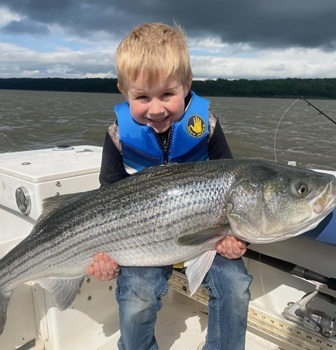
Hudson River: Striped Bass Cooperative Angler Program
You can share your fishing trip information and help biologists understand and manage our Hudson River striped bass fishery.
Here’s how it works: Fill out a logbook provided by us whenever you fish on the Hudson River (by boat or from shore). You can also use our survey123 app and record your trips using a smart phone or computer.
Record general location, time, gear used, what you caught (or if you didn’t catch anything) and return the logbook when you are done fishing for the season. You’ll receive an annual newsletter summarizing the information in addition to the latest news regarding regulations and the river. Whether you catch-and-release or take home a keeper, you can be part of the Cooperative Angler Program. Online logbook instructions (PDF).
Join today by contacting: hudsonangler@dec.ny.gov
- Jessica Best
Photo of DEC Angler Program courtesy of Jess Best
Hudson River Miles
The Hudson is measured north from Hudson River Mile 0 at the Battery at the southern tip of Manhattan. The George Washington Bridge is at HRM 12, the Tappan Zee 28, Bear Mountain 47, Beacon-Newburgh 62, Mid-Hudson 75, Kingston-Rhinecliff 95, Rip Van Winkle 114, and the Federal Dam at Troy, the head of tidewater, at 153. The tidal section of the Hudson constitutes a bit less than half the total distance—315 miles—from Lake Tear of the Clouds to the Battery. Entries from points east and west in the watershed reference the corresponding river mile on the mainstem.
To Contribute Your Observations
The Hudson River Almanac is compiled and edited by Tom Lake and emailed weekly by DEC's Hudson River Estuary Program. Share your observations by e-mailing them to trlake7@aol.com.
Was this Newsletter Forwarded to You?
Subscribe today to DEC Delivers Hudson River Almanac topic for weekly natural history journal that covers the Hudson from the High Peaks of the Adirondacks to New York Harbor.
Helpful Resources
National Oceanic and Atmospheric Administration online tide and tidal current predictions are invaluable when planning Hudson River field trips. For real-time information on Hudson River tides, weather, and water conditions from sixteen monitoring stations, visit the Hudson River Environmental Conditions Observing System website.
DEC's Smartphone app for iPhone and Android is now available at New York Fishing, Hunting, and Wildlife App.
|