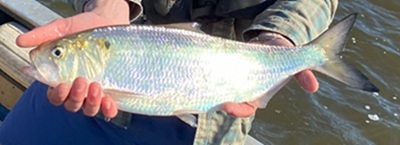
Photo of blueback herring courtesy of Zachary Randall
In this issue:
The ecology of the Hudson River watershed is such an incredible and complex mix of pure science and delightful whimsy. This week we consider ancient fishes that have come to us from the Triassic period 200 million years ago, to beautiful blue spring wildflowers cherished by Native people for their perceived homeopathic remedies.
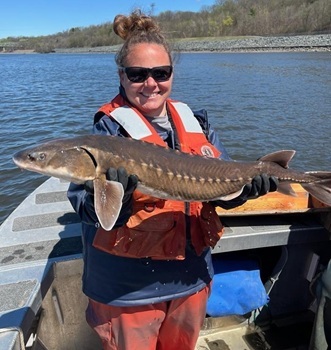
4/25 – Albany, HRM 145: Our DEC Region 3 Fisheries Unit used sampling gear (nets) in the Albany area to catch shortnose sturgeon (Acipenser brevirostrum) for contaminant analysis. We found and captured several of them since they are spawning this time of the year. Three of the sturgeon were recaptures — fish that had been previously tagged. All sampling was carried out under National Marine Fisheries Service permit # 20340.
Three recaptures:
Fish 1: Shortnose sturgeon (675 mm) originally tagged October 24, 2013, by DEC Fisheries. Recaptured April 14, 2026 (728 mm), near Albany. Free for 2 years and 7 months.
Fish 2: Shortnose sturgeon (705 mm) originally tagged south of Albany May 22,1996, by Mark Bain. Recaptured April 17, 2026 (793 mm) near Albany. Free for 28 years and 11 months.
Fish 3: Shortnose sturgeon (632 mm) originally tagged near Albany May 14, 1997, by Mark Bain. Recaptured April 16, 2026, near Albany (671 mm). Free for 26 years and 11 months.
The data that accompanies these recaptures sum up how much we do not know about age-in-growth for sturgeon, especially shortnose sturgeon. Their growth is so very slow. Being ocean travelers, free for 12-28 years, always begs the question, Where have you been? Where did you go?
- Amanda Higgs
[Note: One-inch equals 25.4 millimeters (mm). Tom Lake]
Photo of shortnose sturgeon courtesy of Amanda Higgs
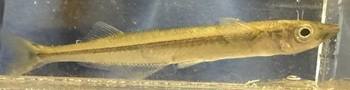
4/25 – Hudson River Watershed: Fish-of-the-Week for Week 364 is the northern brook silverside (Labidesthes sicculus) (Cope 1865), number 34 (of 237), on our Hudson River Watershed List of Fishes. If you would like a copy of our list, e-mail: trlake7@aol.com
The brook silverside is one of four members of its family Atherinopsidae (silversides) and the only strictly freshwater fish in its family. Hubbs and Lagler (1947) suggest since they are found in the Mohawk River, they are likely canal immigrants from the Great Lakes and Mississippi refugium.
Brook silverside differs from other silversides by a mid-lateral silvery band (stripe) tapering to an insertion at pectoral fin in advance of first dorsal fin (requires a close inspection!). They are dorsally pale green, have an elongated body, compressed (terete) in cross section, laterally transparent, peritoneum visible, and can get to 130 mm (Smith 1985).
The species is widely established, many as native, from the Saint Lawrence River to the Gulf Coast, including 27 states and Canada. Adults usually occur in open water near the surface of lakes, ponds, and quiet pools including weedy areas of streams and creeks. They feed on zooplankton, including copepods, and midge larvae.
Trautman (1981) notes that in their northern range, brook silverside favor the clear, cold waters of glacial lakes. It is likely their origin qualifies as peri-glacial, i.e., among the first fishes to enter the watershed following the Late Pleistocene retreat of the Laurentide Ice Sheet. Other peri-glacial species include brook trout, lake trout, northern pike, lake chub, brassy minnow, and pearl dace.
The Type Site of the brook silverside is Grosse Isle, Detroit River, MI, where noted paleontologist Edward Drinker Cope first described Labidesthes sicculus to science in 1865.
On April 22, 2026, Beacon High School students (Dutchess County) seining at the Norrie Point Environmental Education Center in Staatsburg, under the tutelage of educators Maija Niemisto, Emily Zheng, and Martice Smith, caught a brook silverside (76 mm), one of only a few ever caught there. This was an impressive catch given that it was an easily overlooked, single small fish in a netful of silvery chaos.
- Tom Lake
[Note: One-inch equals 25.4 millimeters (mm). Tom Lake]
Photo of brook silverside courtesy of Chris Bowser
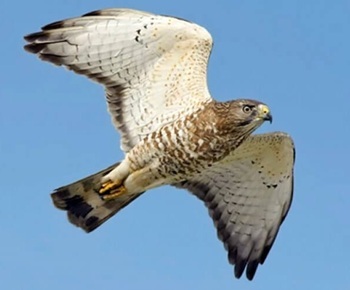
4/25 – Hook Mountain, HRM 31: Among the 539 north-migrating raptors today at the Hook Mountain Hawkwatch, broad-winged hawk was high count with 461. Sharp-shinned hawk was next with 41. We had some excellent views of the passing raptors in the midday hours when so many passed low. This was the best broad-winged hawk day this year (50% of the season’s totals). A merlin attacked our great horned owl decoy three times before giving up.
- Tom Fiore, Raimund Miller
Photo of broad-winged hawk courtesy of American Bird Conservancy
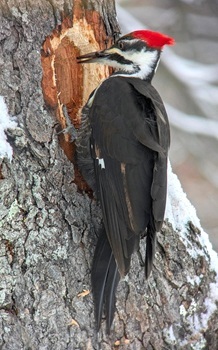
4/26 – Hudson River Watershed: This is time of year when woodpeckers are excavating nesting cavities. Once a woodpecker’s young are raised and have fledged, the entire family abandons the cavity, but its usefulness is far from over. As shelters, cavities are prime property for all kinds of animals — they are off the ground and thus easier to defend from predators and they provide protection from the elements.
Because woodpeckers typically excavate a new cavity every year and rarely reuse an old one, many species of birds, mammals, reptiles, amphibians and insects have access to ready-made homes. A multitude of species of wildlife rely on the holes left behind by woodpeckers for nesting, roosting, and shelter. Squirrels, owls, salamanders, wood ducks, bats, nuthatches, grey treefrogs, mergansers — animals incapable of making their own cavities — benefit from the weeks of work that woodpeckers devote to creating them.
- Mary Holland
Photo of pileated woodpecker courtesy of Richard Kurtz
4/26 – Greene County, HRM 132: This morning, fifteen enthusiast birders on our Hannacroix Creek Preserve (New Baltimore) field trip were greeted by an equally enthusiastic Louisiana Waterthrush singing away down in a babbling brook. Other highlights along the trail included purple finches, blue-headed vireo, rose-breasted grosbeak, hermit thrush, ruby-crowned kinglet, pileated woodpecker, a flyover broad-winged hawk, and half-a-zillion American goldfinches.
We continued down along the trail to the Hudson River where we added spotted sandpiper, northern yellow warbler, blue-winged warbler, gray catbird, bald eagle, and of course Baltimore oriole.
- Richard Guthrie
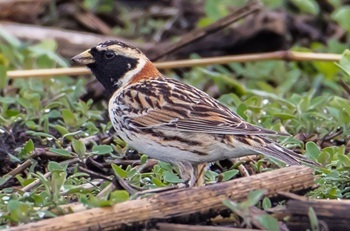
4/26 – Orange County, HRM 41: Finding a Lapland longspur (Calcarius lapponicus) in breeding plumage is not easy. You can travel during the breeding season to the Arctic tundra across North America, Europe, and Asia, or you can stay local and head out to the Black Dirt area of Orange County in mid-to-late April and try to get lucky.
Lapland longspur is among my very favorite species; I search for them all winter long and in April I try to see them in their fabulous breeding plumage. And I’ve had some success over the years, and this weekend I got lucky again and found a handful of Lapland longspurs associating with a flock of horned larks. Two of the birds were in beautiful breeding plumage. Unfortunately, on both days I never had the birds close enough for quality photos. Shown here is a Silas Wareham 2023 Black Dirt Lapland longspur photo in breeding plumage.
- Matt Zeitler
Photo of lapland longspur courtesy of Silas Wareham
4/26 – Waterford, HRM 158: Bald eagle nest NY485 in Peebles Island State Park at the junction of the Mohawk and Hudson rivers, has nestlings! Two days ago, we spotted one, then today, another. We are on the way!
- Howard Stoner
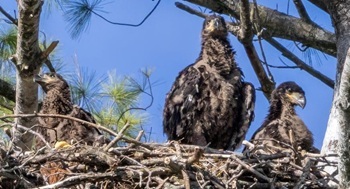
4/27 – Town of Poughkeepsie: The three 40-day-old nestlings in bald eagle nest NY62 look half-way ready to face the world.
- Bob Rightmyer
Photo of bald eagles courtesy of Bob Rightmyer
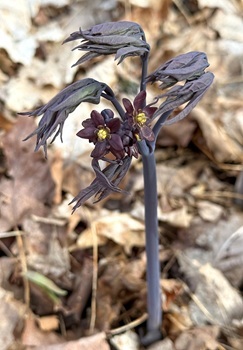
4/28 – Hudson River Watershed: Blue cohosh (Caulophyllum thalictroides), one of our early spring wildflowers, has diminutive flowers that open before its leaves fully expand. Like wild ginger, blue cohosh flowers are the color of rotting meat, which may account for the fact that flies are its main insect visitors. Flies tend to feed at a single flower until satiated, which is not conducive to cross-pollination, and thus most fertilization of blue cohosh is the result of self-pollination.
The fruit of blue cohosh is blue, and “cohosh” is from the Algonquian word meaning “rough,” which refers to the appearance of the plant’s roots. Native Americans treated a wide range of afflictions with blue cohosh, including gallstones, fevers, toothaches and rheumatism. The most common use of its rhizomes, or underground stems, was as an aid to speed and ease childbirth. In 1999, 64% of midwives that were surveyed reported using blue cohosh to treat women before or during childbirth. It is still used today, but less frequently.
- Mary Holland
Photo of blue cohosh courtesy of Mary Holland
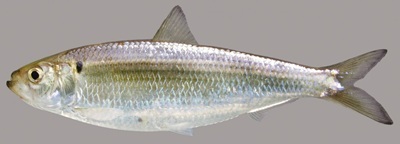
4/29 – Green Island, HRM 153: Hudson Shores Park is at the head of tide, 160 miles from the sea. Across eight miles upstream from Albany today, the river was littered with car-toppers ferrying striped bass anglers. It was two hours into the rising-tide and foot-long river herring were nosing up and splashing along the shore. I thought they were early-season alewives (Alosa pseudoharengus) but when I snatch-hooked a couple, I was surprised to see it was a blueback herring (A. aestivalis), announcing its late-spring arrival. The river was 57 degrees Fahrenheit, which seemed a bit early for spawning bluebacks.
The Hudson River Reach from the federal dam at Troy, 70 miles downriver to Hyde Park, is the domain of American shad each spring as they arrive from the sea to spawn. As a result, American shad frequently become accidental bycatch of recreational fishing, especially striped bass. While striped bass has both size and creel limits, all targeting and possession of American shad is totally prohibited.
If you catch an American shad, immediate action is required to successfully release the fish back into the river, both alive and frisky. All river herring species are sensitive to rough handling and will not survive your attempt at release without considerable care. Quickly set about, with wet hands, to retrieve your lure (if feasible). Even a well-released shad will do poorly otherwise with it jaws compromised. At a quick but efficient pace, most accidently-caught shad can be back in the river within a minute.
- Tom Lake
[American shad are managed through the Atlantic States Marine Fisheries Commission (ASMFC). After a coastal stock assessment in 2007 showed that many coastwide river populations remained far below historic abundance levels, as well as a Hudson River American shad population that was severely depleted, a complete closure of recreational and commercial fishing in the Hudson River was enacted in 2010. The most recent 2020 ASMFC stock assessment determined that the Hudson River population has remained depleted since 2010. NYSDEC]
Photo of American Shad courtesy of USF&W Service
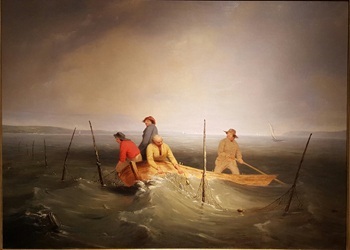
4/29 – Poughkeepsie, HRM 75: Last year I had the opportunity to discuss Hudson River fishes, especially American shad, with my students. I referenced Howard Breslin's novel Shad Run (1955), a tale of remembrances told seven years after the American Revolution (1788).
It tells of a time on the Hudson River in the “Town” of Poughkeepsie during the last years of the American Revolution when commercial shad fishers vied with the threat of British warships coming up the river. Despite immanent peril in the offing, the fishers drifted their gill nets. In Poughkeepsie, fishmongers loaded their wagons and walked the streets selling fresh American shad. These were uncertain and scary times.
I remember the students asking, “Did the people really do all that?” And there was the inevitable question, "What is a Shad?" After learning of the historic (and prehistoric) lore and incredible legend of the American Shad, the students’ Hudson River cultural icon had become a Unicorn.
- Tom Lake
Photo of shad fishers courtesy of Jasper Francis Cropsey
4/29 – Dutchess County, HRM 98.5: I did my weekly visit to the mouth of the Saw Kill (Bard College Campus) looking for migratory fishes. I did not need to look in the actual stream this time because a predator (or predators) had conveniently supplied me with specimens on the bank. I found the remains of the head of a smallmouth bass, a smear of alewife scales, and the head and tail of a white sucker. Predator candidates included bald eagle, otter, and mink. I also watched some alewives spawning.
- Bob Schmidt
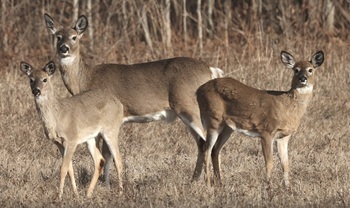
4/30 – Hudson River Watershed: White-tailed does, yearlings, and fawns (Odocoileus virginianus) are out grazing on the first green shoots of spring grass. While fawns are weaned around in 2-4 months of age, they remain with their mother through the fall and winter to learn foraging and survival skills. When males are a year to a year-and-a-half old they disperse, establishing new ranges as far away as twenty miles. Female yearlings often remain with their mother for up to two years, departing when she gives birth in the spring.
- Mary Holland
Photo of white-tailed deer courtesy of Mary Holland
4/30 – Yonkers, HRM 18: Our research and education team at the Sarah Lawrence Center for the Urban River at Beczak hosted students this week (April 28-29), from Yonkers High School and third-graders from the Riverdale, Bronx, Country School.
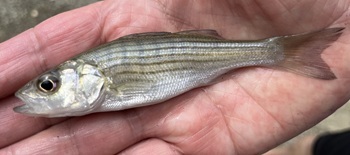
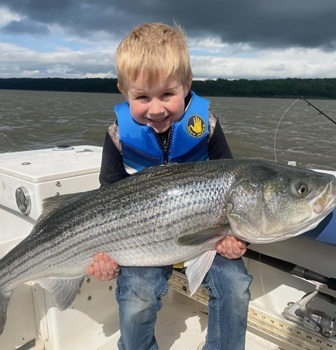
We made 36 seine hauls on our beach with the highlight being yearling striped bass (90-100 millimeters), giving us 53 for the season thus far (last year we caught 93 for the entire year; we average 250 per year). Other fishes included Atlantic silverside white perch, mummichog, with a few grass shrimp. Blue crabs (6) showed up as well (30-50 mm).
The water temperature averaged 55.6 degrees Fahrenheit, salinity was 6.5 parts-per-thousand, and dissolved oxygen (DO) averaged a healthy 10.5 parts-per-million.
- Jason Muller, Christina Tobitsch, Andrea Guttman, Suzy Schwimmer, Katie Lamboy Roman
[Crab measurements (size) are calculated in millimeters (mm) point-to-point across their carapace. Tom Lake]
Photo of striped bass courtesy of Tom Lake
5/1 – Hudson River Watershed: Among indigenous peoples, full moons have long been labeled with fanciful names that are rooted in oral traditions, indigenous memories, and ethnographic accounts. Among Mohican people, whose ancestral homeland lies wholly within the Hudson River watershed, the May full moon is known as the Planting Moon, Aʔkeʔaat Neepãʔuk in the Mohican dialect.
Tribal translations of full moons pre-date colonization and generally reflect the seasonality of the lunar phase. Moon phases, in fact, were used by indigenous people as measurements of time.
- Larry Madden, Stockbridge-Munsee Band of Mohican Indians
Among the Haudenosaunee (Iroquoian speakers), much of whose ancestral homeland lies within the Mohawk River Valley on the northern and western periphery of the Hudson River watershed, the May full moon is known as Tewayénthos Wenhnì:tare, also the Planting Moon
- Tom Lake
[There is much Native lore revolving around the planting of corn (Zea mays). Corn, or maize, was originally domesticated in Mexico by native peoples about 10,000 years ago. In many areas of the Americas, it has been a staple for survival of indigenous peoples.
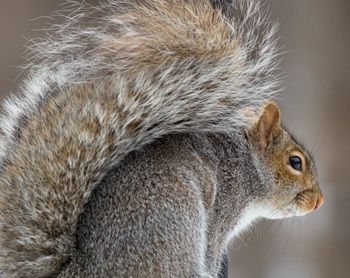
Oral tradition among many Midwest and Northeast tribes suggests that corn should be panted when the new leaves of the white oak are the size of a squirrel’s ear. But what is the size of a squirrels' ear? Scientist cannot leave such a question alone. We need to know.
For data gathering, I spent one spring driving around the Hudson Valley measuring the ears of road-killed eastern gray squirrels (Sciurus carolinensis). My sample size was 74 vehicle-flattened, albeit ears undamaged, gray squirrels. The average "ear size" was 20.6 millimeters, or 0.82 inches-long. During my research, one homeowner called the “authorities” on me; another concerned citizen came out and scolded me for “strange and no doubt illegal” behavior — among the risks and perils of being a scientist.
Then, we had to measure local oaks keeping an eye on the new leaves. This would apply to different oaks in different areas, but for us in the Hudson Valley, probably the white oak (Quercus alba). Soil temperature would seem to be an important factor that ties new oak leaf growth to planting corn. In most years, that occurs in early May.
The tracking process is called phenology, the study of nature through the appearance of seasonal phenomena, e.g. oak leaves. The word comes from the Greek word phaino, meaning “to appear,” or the Latin phenomenon, meaning “appearance, happening or display.” Tom Lake]
Photo of gray squirrel courtesy of John Badura
Come fishing for free! All events are family friendly. Each spring the Hudson River is alive with migratory fish species that are drawn into the protective waters of the estuary as part of their spawning cycle.
2026 will be our 10th annual event!! Celebrate with us Saturday May 30! Please note a few of our partners will be hosting events on different dates so you will want to check carefully for your location date and time! More information on the Columbia University website.
Science Saturday at Norrie Point Environmental Center
Join us for our monthly Science Saturday programs and explore Norrie Point. Check out our series by visiting the Hudson River website. Events are free and open to the public. Registration is not required. All programs meet at the Norrie Point Environmental Center, 256 Norrie Point Way, Staatsburg NY 12580. Dress for the weather and being outside! Otherwise, no special equipment is needed.
Snapshot NY
The NYSDEC, in collaboration with the New York Cooperative Fish and Wildlife Research Unit at Cornell University, has launched Snapshot NY, a citizen science program that allows the public to participate in wildlife monitoring through the deployment of trail cameras. The project will help improve the way DEC monitors and manages more than a dozen wildlife species. For more information on Snapshot NY and how to participate, visit the Snapshot NY website.
Hudson River Lesson Plans
Explore our collection of Hudson River lesson plans, videos and online activities to support hands on investigations of the Hudson River in your classroom.
Hudson River: Striped Bass Cooperative Angler Program
You can share your fishing trip information and help biologists understand and manage our Hudson River striped bass fishery.
Here’s how it works: Fill out a logbook provided by us whenever you fish on the Hudson River (by boat or from shore). You can also use our survey123 app and record your trips using a smart phone or computer.
Record general location, time, gear used, what you caught (or if you didn’t catch anything) and return the logbook when you are done fishing for the season. You’ll receive an annual newsletter summarizing the information in addition to the latest news regarding regulations and the river. Whether you catch-and-release or take home a keeper, you can be part of the Cooperative Angler Program. Online logbook instructions (PDF).
Join today by contacting: hudsonangler@dec.ny.gov
- Jessica Best
Photo of DEC Angler Program courtesy of Jess Best
Hudson River Miles
The Hudson is measured north from Hudson River Mile 0 at the Battery at the southern tip of Manhattan. The George Washington Bridge is at HRM 12, the Tappan Zee 28, Bear Mountain 47, Beacon-Newburgh 62, Mid-Hudson 75, Kingston-Rhinecliff 95, Rip Van Winkle 114, and the Federal Dam at Troy, the head of tidewater, at 153. The tidal section of the Hudson constitutes a bit less than half the total distance—315 miles—from Lake Tear of the Clouds to the Battery. Entries from points east and west in the watershed reference the corresponding river mile on the mainstem.
To Contribute Your Observations
The Hudson River Almanac is compiled and edited by Tom Lake and emailed weekly by DEC's Hudson River Estuary Program. Share your observations by e-mailing them to trlake7@aol.com.
Was this Newsletter Forwarded to You?
Subscribe today to DEC Delivers Hudson River Almanac topic for weekly natural history journal that covers the Hudson from the High Peaks of the Adirondacks to New York Harbor.
Helpful Resources
National Oceanic and Atmospheric Administration online tide and tidal current predictions are invaluable when planning Hudson River field trips. For real-time information on Hudson River tides, weather, and water conditions from sixteen monitoring stations, visit the Hudson River Environmental Conditions Observing System website.
DEC's Smartphone app for iPhone and Android is now available at New York Fishing, Hunting, and Wildlife App.
|