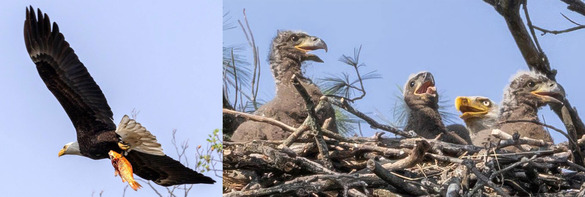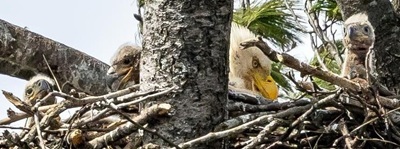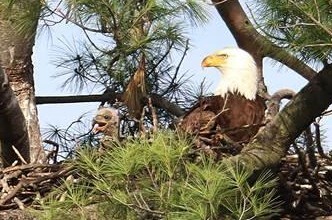
Left photo bald eagle carrying goldfish and Right photo three expectant bald eagle nestlings courtesy of Bob Rightmyer
In this issue:
Among the many themes of spring, colorful flowers, fishes in-from-the-sea to spawn, the greening of the forests, the music of songbirds, and much more, the one that often captures our heart is the presence of bald eagle nestlings, new life for a resilient species that not long ago was absent in our watershed.
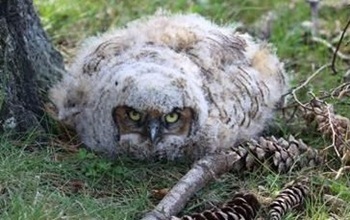
4/15 – Greene County: I was privileged to look into the “All-knowing” yellow eyes of a great horned owl fledgling (Bubo virginianus) today. It had tumbled out of an 80-foot white pine. Its feathers were well-formed, but the baby fluff still riffled in the breeze. Baby owls effectively clack their sharp shiny beaks to dissuade would be predators. Those staring yellow eyes indicated an awareness (intelligence?) and I had to smile when with a slow sideways slide of its eye lid winked at me.
- Mario Meier
Photo of great horned owl courtesy of Mario Meier
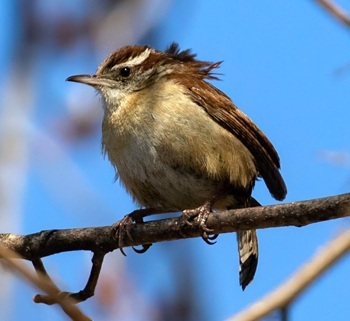
4/11 – Orange County, HRM 61: Carolina wren is a bird that seems to be everywhere in spring, but somehow I’m never able to get any photos. I got one this morning on the Newburgh Waterfront Trail.
- Matt Zeitler
Photo of Carolina wren courtesy of Matt Zeitler
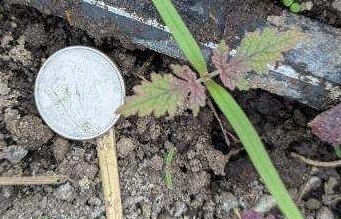
4/11 – Hudson River Watershed: I am a researcher at the University of Massachusetts at Amherst and am very interested in sightings of the invasive Japanese hops (Humulus scandens) in New York. It would be very helpful if Almanac readers encountering Japanese hop seedlings could take a picture (see attached), with a coin for reference, and send it to: noawilliams@umass.edu. Thank you.
- Noah Williams
Photo of Japanese hops courtesy of Noah Williams
4/12 – Putnam County, HRM 46.5: While the glimpses are few and getting less clear with the new leaves, it appeared that bald eagle nest NY527 at Manitou had at least one nestling.
- Scott Craven
4/12 – Hook Mountain, HRM 31: Among the 61 north-migrating raptors today at the Hook Mountain Hawkwatch, osprey was high count with 19. Bald eagles (8) and broad-winged hawks (5) were also flying today.
- Tom Fiore
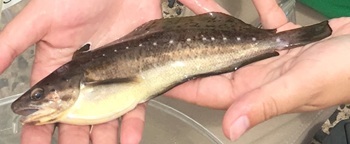
4/13 – Hudson River Watershed: Fish-of-the-Week for Week 362 is the spotted hake, (Urophycis regia ) Walbaum 1792, fish number 111 (of 240) on our Hudson River Watershed List of Fishes. If you would like a copy of our list, e-mail: trlake7@aol.com.
Spotted hake (Urophycis regia) is one of three Phycidae hakes, all designated as Temperate Marine Strays in the Hudson River Estuary. He others are red hake (U. chuss), and white hake (U. tenuis).
Spotted hake are fusiform, circular in cross section, and a colorful fish, brownish tinged with yellow, with dark spots and black-and-white “streaks” running laterally from their head to their pectoral fins. They range from Nova Scotia to Texas, can grow to 17-inches, spawn offshore, and move inshore in winter over much of that range. Juveniles spend part of their time in estuaries. They feed on fishes such as menhaden and other herring, as well as squid and various crustaceans.
The spotted hake resembles the other hakes in its habits but may be more of a fish eater. Specimens analyzed at Woods Hole, MA., contained alewives, menhaden, and squid. But like the other hakes, it also feeds on crustaceans on which the white and red hakes subsist.
Spotted hake join with Atlantic tomcod as a sometimes late winter, early spring catch by anglers in the lower estuary and around Manhattan. They are occasionally found upriver as far as river mile 18 (Yonkers). Recently, the Research and Education team at the Sarah Lawrence Center for the Urban River at Beczak came upon a spotted hake (75 mm). This is a relatively rare species for Beczak with ten caught since 2005, and the last in 2016.
- Tom Lake
[Note: One-inch equals 25.4 millimeters (mm). Tom Lake]
Photo of spotted hake courtesy of NOAA Fisheries
4/13 – Hudson River Estuary: Spring comes slowly to our watershed. Before more sophisticated ways of measuring the relationship between the river and the land were developed, the ancestral Algonkian people of the Hudson River Valley used bio-indicators in spring to alert them that it was time to ready the soil, sow their fields, and set their fish weirs. Maize would be planted a while later in May when the new oak leaves were the size of a squirrel’s ear.
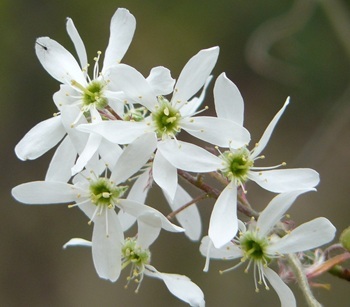
When most of the trees in the forest are yet to leaf out, the soft, hazy white glow of our native shadbush (Amelanchier sp.) blooms. There is an ecological timing between these events: Shadbush blooms when the soil warms in early April at the same time the river reaches a temperature that triggers the beginning of fish migration in from the sea to spawn. This procession proceeds from south to north in an orderly manner from magnolia to forsythia to shadbush to flowering dogwood, with lilac being the final signal that spring is ready for summer. This process is called phenology, the study of nature through the appearance of seasonal phenomena. The word comes from the Greek word phaino, meaning “to appear,” or the Latin phenomenon, meaning “appearance, happening or display.”
- Tom Lake
Photo of shadbush courtesy of Tom Lake
4/13 – Town of Poughkeepsie: The three 42-day-old nestlings in bald eagle nest NY62 were active today, discovering each new day in a solidly-built nest made of branches and twigs. With three nestlings, there is always the worry that two of them will get most of the adult’s attention and the third, especially if it hatched a day or so after the first two, might just waste away.
- Bob Rightmyer
4/14 – Minerva, HRM 284: Last night was our first warm one and the “audio” was great. There had been a little misty rain earlier that made things damp and spring peepers (Pseudacris crucifer) were in full voice in concert with scattered wood frogs. A barred owl pitched in, hooting out in the wood behind my house.
Since I saw my first brown creeper on 3/26, I've had firsts for song sparrow, eastern phoebe, mourning dove, and common loon a couple of days ago. Minerva Lake still had ice on more than half of its surface; I bet it's total iced out today. This morning, Freya and I heard a chipping sparrow.
Maple syruping ended ten days ago. I have not counted the jars, but I figure I made a gallon and a half, which would be a record year for me.
- Mike Corey
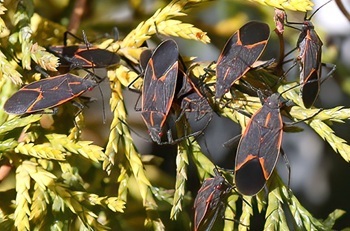
4/14 – Hudson River Watershed: With the warmer weather, adult boxelder bugs (Boisea trivittata) are emerging from hibernation and congregating on the sunny side of trees, buildings and rocks just as the buds on boxelder trees are starting to open. They suck sap from the leaves, tender twigs, and developing seeds of the tree they are named after with their piercing/sucking mouthparts, inflicting little damage to the trees.
In mid-July they move to female boxelders where they lay eggs in bark crevices, bright red juvenile boxelder nymphs hatch in a couple of weeks. Come fall, these nymphs congregate on the south sides of trees and buildings before settling into protected hibernacula such as attics, cellars and other protected areas.
- Mary Holland
[Boxelder (Acer negundo) is also known as ash-leaf maple. Acer is a genus of trees and shrubs commonly known as maples. Tom Lake]
Photo of boxelder nymphs courtesy of Mary Holland
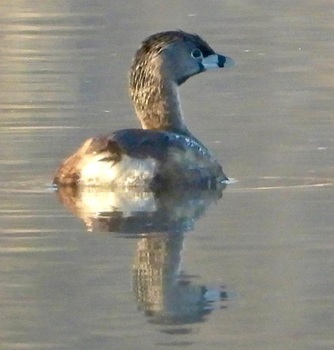
4/14 – Saratoga County, HRM 157: Its was a very good morning for birding at the Vischer Ferry Preserve. Highlights included pied-billed grebe and American wigeon.
- Katrina Van Tassel
Photo of pied-billed grebe courtesy of Katrina Van Tassel
4/15 – Town of Poughkeepsie: The female from bald eagle nest NY62 was showing off her three 43-day-old nestlings in the warm sun today.
- Bob Rightmyer
Photo of bald eagle nestlings courtesy of Bob Rightmyer
4/15 – Hook Mountain, HRM 31: Among the 53 north-migrating raptors today at the Hook Mountain Hawkwatch, broad-winged hawk was high count with 27. Osprey was next with eleven. In addition to turkey vultures (89), double-crested cormorants (30+), fish crows, common ravens, and blue jays, were among non-raptor migrants.
- Tom Fiore
4/15 – Dutchess County: Over the last 25 years, we have documented in detail the annual rhythms of the mated pair of bald eagles in nest NY62 (bald eagles mate for life). Their territory has spanned four nests in the towns of Wappinger and Poughkeepsie. They have become, metaphorically, part of the family for many of us. We cheer when they are on eggs, count the days until there is a hatch, and then keep close watch for the day the nestlings take that first step off the edge of the nest and become fledglings. In the early years (2000’s), when Hudson Valley bald eagle nests could be counted on one hand, we spent much time — many hours nearly every day — observing and documenting their behavior.
-Tom Lake, The Soul of NY62
4/15 – Dutchess County, HRM 98.5: I began my annual visits to the mouth of the Saw Kill (Bard College Campus) on April 15, a very warm day. I did not expect to see migratory fishes in the stream at this early date, but a small number of smallmouth bass were already present along with several large common carp. I also saw a small group of common mergansers and my first northern watersnake of the season.
While I saw no evidence of river herring in the Saw Kill, human activity along the Roeliff-Jansen Kill (river mile 111) and the Poesten Kill (river mile 151) suggested alewives had arrived from the sea.
- Bob Schmidt
[Smallmouth bass (Micropterus dolomieu) share a common lifeway with some other freshwater Hudson River fishes called potamodromy. Potamodromous species live much of their lives in larger water but migrate into smaller waters, tributaries in this instance, to spawn.]
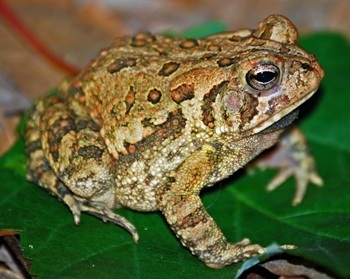
4/15 – Town of Esopus, HRM 88: The sound of trilling American toads filled the air at Louisa Pond, Shaupeneak Ridge.
- Peter Relson, Carol Anderson
Photo of American toad courtesy of Rick Roth
4/15 – Hook Mountain, HRM 31: Among the 112 north-migrating raptors today at the Hook Mountain Hawkwatch, broad-winged hawk was high count with 96. Osprey was next with eight.
- Tom Fiore, Raimund Miller
4/16 – Ulster County: The female in bald eagle nest NY142 was showing off her one-month nestling today.
- Mario Meier
Photo of NY142 bald eagle courtesy of Mario Meier
4/16 – Town of Poughkeepsie: The three 45-day-old nestlings in bald eagle nest NY62 eagerly awaited the arrival of a goldfish being carried in from the river by the adult male while the female watched over them.
- Bob Rightmyer
4/16 – Manhattan, HRM 1-2: Hudson River Park’s River Project staff and interns visited docks 26 and 40 in Hudson River Park today. The visit was to monitor and perform routine maintenance on our research gear (pots and traps) that we deploy from floating docks on the south-side of the piers as part of our ongoing Fish Ecology Survey.
Recent catches have been dominated by invertebrates; fish catches have been few. This week’s invertebrate catch included mud crabs, grass shrimp, sand shrimp, isopods, mud dog whelk, amphipods, and one marine leech. We did catch three fish, two northern pipefish (125-165 mm) and one juvenile spotted hake (65 mm).
- Toland Kister, Siddhartha Hayes, Renee Mariner
4/17 – Hyde Park, HRM 82: When I moved to Hyde Park in 2014, I received a bluebird box as a Christmas present. Today I discovered eastern bluebird eggs in the box for the twelfth consecutive year. Pretty good record for a novice.
- Art Filler
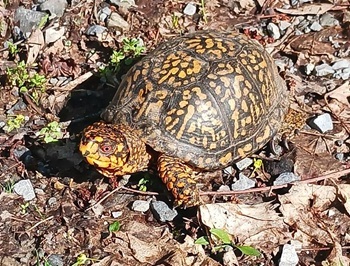
4/17 – Town of Wappinger, HRM 65: While visiting family in Wappinger Falls, I saw a beautiful box turtle moving slowly along the driveway. It was quite a coincidence since my niece just put up a "Turtle Crossing" sign to slow down the delivery drivers.
- Fingry
Photo of Eastern box turtle courtesy of Fingry
4/17 – Yonkers, HRM 18: Our research and education team at the Sarah Lawrence Center for the Urban River at Beczak, in checking our fyke net, discovered that the glass eel counts continued to drop this week from our four days of sampling. This likely signals that we are past our peak of the season since we have seen a large drop-off for two consecutive weeks. The water temperature averaged 54 degrees Fahrenheit, salinity averaged 6.6 parts-per-thousand, and the dissolved oxygen (DO) averaged a healthy 10.8 parts-per-million.
- Jason Muller, Vivian Marko Hilary Vidalakis Stella Sturgill
We also seined twice with light catches including our first program of the season with Ossining High School juniors and seniors. Across sixteen hauls of our seine, we netted two Atlantic silverside, one Atlantic herring (Clupea harengus), and one grass shrimp. Despite underwhelming results, spirits remained high among the students.
- Jason Muller, Stella Sturgill, Andrea Guttman
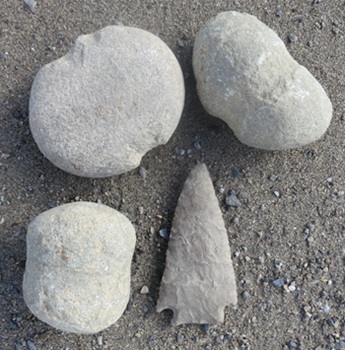
Photo of stone netsinkers courtesy of Tom Lake
[Seines are frequently mentioned in the Almanac relating to fisheries research and education. Seine is a French word, from the Latin sagëna, which means a fishing net designed to hang vertically in the water, the ends of which are drawn together to enclose fish. A seine is a net with a float line on top, a lead line on the bottom, and tight meshes in between.
Seines range in length from fifteen to six-hundred feet long, four-to-eight-feet in depth, and mesh size of ¼ to 2½-inches, or even larger for sturgeon, depending upon application. The longer seines must be set and hauled by a boat and crew. Shorter nets are used by educators, researchers, and bait dealers.
Stone netsinkers, artifacts from ancient contexts, found along the river provide evidence that seines and other nets were being used in the Hudson River for as long as our species has been here. It is believed that we brought the technology for using handmade, hand-knitted, nets to catch birds, fish, and turtles with us when we arrived here from all points at least 12,000 years ago. Tom Lake]
[New York State residents can use a seine in the Hudson River, not to exceed 36 square feet in area, to catch fish for education or bait for their own personal use. Using a larger seine requires a License to Collect and Possess (LCP) from the NYSDEC Special Licenses Unit. NYSDEC]
Science Saturday at Norrie Point Environmental Center
Join us for our monthly Science Saturday programs and explore Norrie Point. Check out our series by visiting the Hudson River website. Events are free and open to the public. Registration is not required. All programs meet at the Norrie Point Environmental Center, 256 Norrie Point Way, Staatsburg NY 12580. Dress for the weather and being outside! Otherwise, no special equipment is needed.
The upcoming Science Saturday programs are:
- Rebecca Houser, Education and Outreach Specialist, HREP and NEIWPCC
Snapshot NY
The NYSDEC, in collaboration with the New York Cooperative Fish and Wildlife Research Unit at Cornell University, has launched Snapshot NY, a citizen science program that allows the public to participate in wildlife monitoring through the deployment of trail cameras. The project will help improve the way DEC monitors and manages more than a dozen wildlife species. For more information on Snapshot NY and how to participate, visit the Snapshot NY website.
Hudson River Lesson Plans
Explore our collection of Hudson River lesson plans, videos and online activities to support hand on investigations of the Hudson River in your classroom.
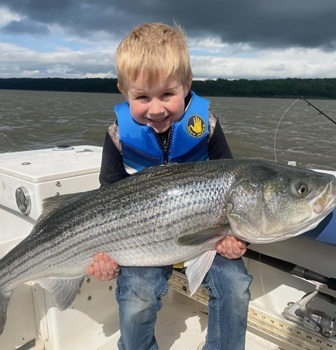
Hudson River: Striped Bass Cooperative Angler Program
You can share your fishing trip information and help biologists understand and manage our Hudson River striped bass fishery.
Here’s how it works: Fill out a logbook provided by us whenever you fish on the Hudson River (by boat or from shore). You can also use our survey123 app and record your trips using a smart phone or computer.
Record general location, time, gear used, what you caught (or if you didn’t catch anything) and return the logbook when you are done fishing for the season. You’ll receive an annual newsletter summarizing the information in addition to the latest news regarding regulations and the river. Whether you catch-and-release or take home a keeper, you can be part of the Cooperative Angler Program. Online logbook instructions (PDF)
Join today by contacting: hudsonangler@dec.ny.gov
- Jessica Best
Photo of DEC Angler Program courtesy of Jess Best
Hudson River Miles
The Hudson is measured north from Hudson River Mile 0 at the Battery at the southern tip of Manhattan. The George Washington Bridge is at HRM 12, the Tappan Zee 28, Bear Mountain 47, Beacon-Newburgh 62, Mid-Hudson 75, Kingston-Rhinecliff 95, Rip Van Winkle 114, and the Federal Dam at Troy, the head of tidewater, at 153. The tidal section of the Hudson constitutes a bit less than half the total distance—315 miles—from Lake Tear of the Clouds to the Battery. Entries from points east and west in the watershed reference the corresponding river mile on the mainstem.
To Contribute Your Observations
The Hudson River Almanac is compiled and edited by Tom Lake and emailed weekly by DEC's Hudson River Estuary Program. Share your observations by e-mailing them to trlake7@aol.com.
Was this Newsletter Forwarded to You?
Subscribe today to DEC Delivers Hudson River Almanac topic for weekly natural history journal that covers the Hudson from the High Peaks of the Adirondacks to New York Harbor.
Helpful Resources
National Oceanic and Atmospheric Administration online tide and tidal current predictions are invaluable when planning Hudson River field trips. For real-time information on Hudson River tides, weather, and water conditions from sixteen monitoring stations, visit the Hudson River Environmental Conditions Observing System website.
DEC's Smartphone app for iPhone and Android is now available at New York Fishing, Hunting, and Wildlife App.
|