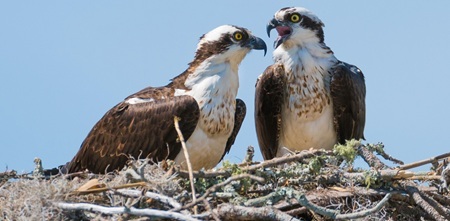
Photo of Osprey courtesy of Roy Smith
In this issue:
This was ice-out week in most places in the highlands of the watershed and the open water attracted many more waterfowl. Tiny fuzzy gray heads were beginning to appear in bald eagle nests. With extra mouths to feed, the adults continued to ferry fish in from the river.
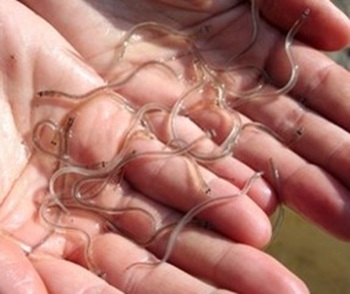
3/31 – Quassaick Creek, HRM 60: This was an afternoon that will live forever in our memory when we think of Hudson River glass eels and fyke nets. The story of this day was taken [in part] from the Hudson River Almanac Vol 23:
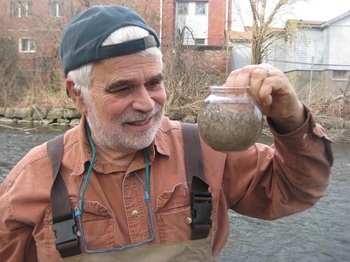
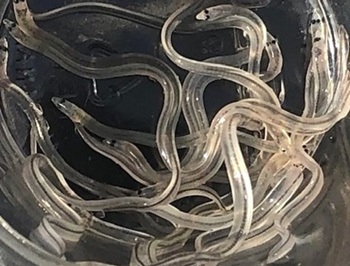
- How fortunes can turn. After the empty fyke net of yesterday, we found that the heft of today’s catch was difficult to lift or handle. As we peered into the throat of the net, we were stunned to see a huge writhing mass of glass eels — we had a fyke-full. It took the two of us nearly three hours to carefully clear, count, and release 6,004 glass eels and six elvers (yearling American eels). Today’s conditions mirrored yesterday’s — the water temperature was 53 degrees Fahrenheit (F) — but the gap in the upriver run had dramatically closed. Several members of the print media, reporters, and other onlookers, were there at the start sensing a story. However, halfway through our laborious count — into the third thousand — they had disappeared.
- Tom Lake, Hannah Ring
[At the time, this was the second highest number of glass eels for a single lift ever recorded for the program. The highest number, 8,067 glass eels, was recorded on April 20, 2013, in Hannacroix Creek (river mile 133) by Chris Bowser]
Photo of glass eels courtesy of Tom Lake
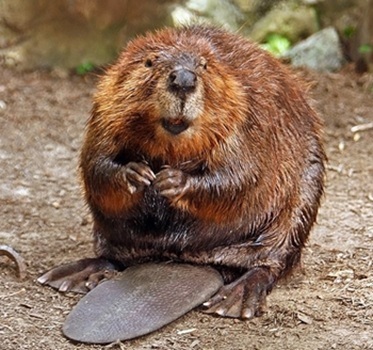
3/23 – Staatsburg, HRM 85: Driving slowly along the Enderkill marsh near Norrie Point, Dan Miller spotted a bald eagle on the far bank among the winter-flattened cattails. The eagle was feeding on a medium-sized beaver with special attention to the fat and gristle-filled tail. We’ve noticed a lot of beaver activity in the last few weeks, including more stream blockage and our younger willow trees coppiced down to stumps.
- Chris Bowser, Dan Miller
Photo of beaver courtesy of USF&W
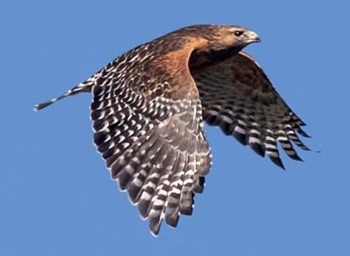
3/24 – Hook Mountain, HRM 31: The Hook Mountain Hawkwatch began its 2026 season today, our 56th, monitoring migrating birds from raptors to songbirds. Among the 14 north-migrating raptors today, Cooper’s hawk and red-shouldered hawk shared a high count with three each. The three red-shouldered hawks moved by on the south-east side and did not come very high above the horizon. One of two osprey came through higher and one of them carried a small fish.
Among non-raptor migrants, turkey vulture was high count for the watch with 68. Others were eastern bluebird, common raven (2), northern yellow-shafted flicker (5), and rusty blackbird (14).
- Tom Fiore
Photo of red-shouldered hawk courtesy of Bob Rightmyer
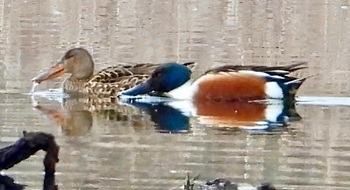
3/25 – Saratoga County, HRM 167: The lake opened today at the Round Lake Preserve and squadrons of birds came including three bald eagles, more than 100 ring-necked ducks, black ducks, wood ducks, and, out in deeper water a pair of northern shovelers.
- Katrina Van Tassel
Photo of Northern shoveler courtesy of Katrina Van Tassel
3/26 – Greene County: Just this week the ice finally melted on our small Catskill Mountain ponds and lakes. With it came the arrival of many duck species seen already for weeks farther down in the Hudson Valley.
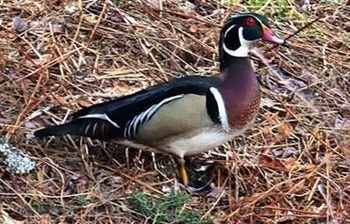
My favorite was the extremely timid wood duck (Aix sponsa), whose name translates, with good reason, to “bridal duck.” The pair that I spotted were swimming on a small historic ice pond. As I approached, hidden behind a bridge abutment, the ducks eased up the bank and froze to avoid detection. The male’s flamboyant, iridescent colors and brilliant red eye are strikingly beautiful. The more muted female with her distinctive white eye patch and blue wing accents has a gentle beauty all her own. The male was on high alert and stretched his neck high displaying his spotted tawny brown neck. I felt so privileged to silently observe this elusive gorgeous pair at close range before they took to the sky.
- Mario Meier
Photo of wood duck courtesy of Mario Meier
3/27 – Yonkers, HRM 18: Our research and education team at the Sarah Lawrence Center for the Urban River at Beczak checked our fyke net which we had set each overnight this week (March 24-27) in the Beczak Tidemarsh.
A surge of glass eels made its way upriver with a noticeable increase in counts. We went from a combined total of 44 glass eels last week up to 398 this week. This may have been in response to an increasing water temperature from 40 to 46 degrees Fahrenheit (F).
- Jason Muller, Nora Marx, Vivian Marko, Hamima Hossain, Audrey Mattison, Stella Sturgill
[We are careful to equate a surge in numbers with any single ecological factor, i.e. cause-and-effect, as glass eels often violate bio-logic. Tom Lake]
Photo of glass eels courtesy of Chris Bowser
3/27 – New York City: Our Randall's Island Park Alliance Staff had an exciting start to our sampling season. As a part of our regularly scheduled seining monitoring, we made a successful trial tow fifty-feet offshore in the Harlem River with our three-foot plankton net. The Harlem River was 45 degrees F, the salinity was 17.0 parts-per-thousand (ppt), and the dissolved oxygen (DO) was 11.48 parts-per-million (ppm).
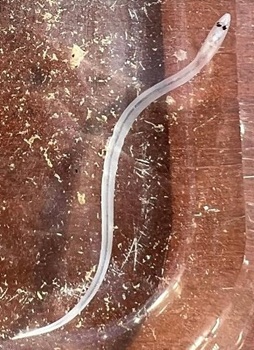
The exciting part of our day was the single “glass eel” (immature American eel, Anguilla rostrata, 65 millimeters) that we caught. It was the first one I had ever seen there.
- Alaina Pribis
Photo of glass eel courtey of Alaina Pribis
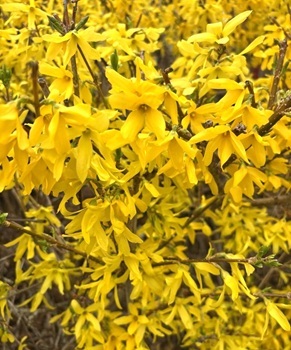
3/28 – Town of Wappinger: Among the many signs of spring, perhaps the most colorful is the arrival of bright yellow forsythia in bloom (Forsythia sp.). The genus is named after William Forsyth, an 18th century Scottish botanist. Our forsythia is non-native; most of the eleven forsythia species in the genus originate in Asia.
- Tom Lake
Photo of fosythia courtesy of Tom Lake
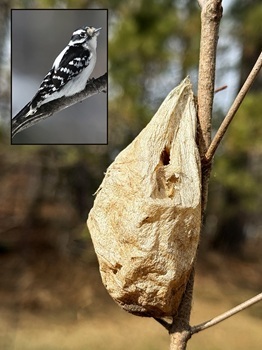
3/29 – Hudson River Watershed: Cecropia Moth, the largest moth species in North America, spends approximately ten months as pupae inside cocoons fortified with three layers of protection. These silk layers are tough enough to thwart most predators, but there are some birds present in winter that are equipped to reach the innermost chamber where the pupa resides.
Chief among them is the downy woodpecker, which is responsible for up to 90% of raided Cecropia cocoons. Other birds, including blue jays, both red and white-breasted nuthatches, ravens, and black-capped chickadee also prey on these pupae. Eastern gray squirrels, white-footed mice, and parasitic wasps are responsible as well for preventing these moths from reaching adulthood.
- Mary Holland
Photo of cecropia moth courtesy of Mary Holland
3/30 – Saugerties, HRM 102: I covered the Saugerties Lighthouse this week for the lighthouse keeper, Patrick Landewe. Patrick reported on the first of the osprey pair to return (March 26) to the Coast Guard Aids To Navigational Marker 93 at the mouth of Esopus Creek where they will build a nest. Today, the second of the pair returned and almost immediately began addressing the need for a new nest.
- Stewart Schuenemann
[Osprey have also returned to the Bear Mountain Bridge (River Mile 46). Scott Craven.]
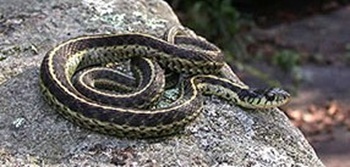
3/30 – Ulster County, HRM 86: At Shaupeneak Ridge Preserve (Esopus) our first-of-the-year garter snake (Thamnophis sp.) slithered amidst the dappled sunlight playing on the leaf-covered ground.
- Peter Relson, Carol Anderson
Photo of garter snake courtesy of JD Wilson
3/31 – Hook Mountain, HRM 31: Among the 27 north-migrating raptors today at the Hook Mountain Hawkwatch, red-shouldered hawk was high count with seven. Among non-raptor migrants, turkey vulture was high count for the watch with 195.
- Tom Fiore
4/1 – Hudson River Watershed: Among indigenous peoples, full moons have long been labeled with fanciful names that are rooted in oral traditions, indigenous memories, and ethnographic accounts. Among Mohican people, whose ancestral homeland lies wholly within the Hudson River watershed, the April full moon is known as the Grass and Geese Moon, Othkeethkwun wãak Pkwaaxowãpthowuk Neepãʔuk, in the Mohican dialect. Tribal translations of full moons pre-date colonization and generally reflect the seasonality of the lunar phase. Moon phases, in fact, were used by indigenous people as measurements of time.
- Larry Madden, Stockbridge-Munsee Band of Mohican Indians
Among the Haudenosaunee (Iroquoian speakers), much of whose ancestral homeland lies within the Mohawk River Valley on the northern and western periphery of the Hudson River watershed, the March full moon is known as the Thunder Moon (Ratiwé:ras Wenhnì:tare).
- Tom Lake
4/3 – Yonkers, HRM 18: Our research and education team at the Sarah Lawrence Center for the Urban River at Beczak checked our fyke net which we had set each overnight this week (March 28-April 3) in the Beczak Tidemarsh. The water temperature increased from 46 to 51 degrees F. Our fyke net also caught a yearling striped bass (100 mm), an Atlantic silverside (85 mm), and a dozen mummichogs (killifish).
- Jason Muller, Audrey Mattison, Stella Sturgill, Caleb Rudow, Daniel Basso Hamima Hossainm Nora Marx
Photo of glass eels courtesy of Chris Bowser
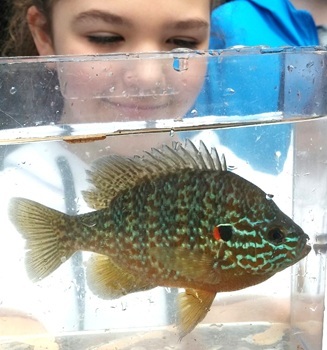
4/2 – Hudson River Watershed: Fish-of-the-Week for Week 360 is the pumpkinseed, Lepomis gibbosus (Linnaeus 1758), number 56 (of 240) on our watershed list of fishes. If you would like a copy of our list, e-mail: trlake7@aol.com.
Pumpkinseed is one of 13 members of the sunfish family (Centrarchidae). Among Mohican people, whose ancestral homeland lies wholly within the Hudson River watershed, the pumpkinseed is known as Mãakwan in the Mohican dialect.
While their origin is considered unknown, there is some 18th century historical evidence that suggests that pumpkinseed (and other sunfish) may have been native, or at least present in pre-colonial times, in Lake George, a water body closely adjacent to our watershed (Annual Report of the New York Fisheries, Game and Forest Commission 1896). Of the other twelve, six are introduced (e.g., bluegill); four are native (e.g., redbreast); and two are Mississippi refugium canal immigrants (e.g., Pomoxis sp.).
Lepomis gibbosus is the quintessential "panfish"; most are palm-size, less than ten-inches-long. Ichthyologist C. Lavett Smith (1985) calls the pumpkinseed “The most abundant and widespread species of sunfish in New York State” (1985). Among freshwater fishes, few are more colorful than the male pumpkinseed. Most sport color varieties of orange, green, yellow, and blue, with red tabs on their opercle and turquoise piping on their head.
Pumpkinseed are commonly found in vegetated lakes and ponds as well as quiet pools of creeks and small rivers where they feed on small fishes, various vertebrates as well as fish eggs. While pumpkinseed tend to favor the freshwater reach of the Hudson River estuary, in Europe, where they have been introduced, they can be found in estuaries with salinity to 18.2 parts-per-thousand (ppt).
The pumpkinseed Type Site is “The Carolinas,” the pre-colonial region that would later become North and South Carolina. A pumpkinseed type specimen (single fish) from this region was first described to science by Carl Linnaeus in 1758.
- Tom Lake
[As we are discussing the pumpkinseed as a possible native species, we should define the word “native,” as opposed to “introduced,” something we often cover with our students. Our state fish, the brook trout, along with northern pike and lake trout, are some of our first native species whose presence in the watershed dates to about 18,000 years ago.
The benchmark for this bifurcation is the early 17th century: If a species was here when the first Europeans arrived, it was almost certainly native. Of the 240 species of fish documented for the Hudson River watershed, 185 are considered native (0.77). Tom Lake]
Photo of pumpkinseed courtesy of Tom Lake
Science Saturday at Norrie Point Environmental Center
Join us for our monthly Science Saturday programs and explore Norrie Point. Check out our series by visiting the Hudson River website. Events are free and open to the public. Registration is not required. All programs meet at the Norrie Point Environmental Center, 256 Norrie Point Way, Staatsburg NY 12580. Dress for the weather and being outside! Otherwise, no special equipment is needed.
The upcoming Science Saturday programs are:
- Rebecca Houser, Education and Outreach Specialist, HREP and NEIWPCC
There are two opportunities to view the short film, The Nature of Nature: Biodiversity in the Hudson Valley, on the big screen this month. From high elevation forests to the globally rare freshwater tidal marshes along the Hudson estuary, The Nature of Nature captures the beautiful, the complex, the familiar, and the unknown…guided by the plants, animals, and people that call the Hudson Valley home. You can read an interview (PDF) about the filmmaking process in the article, “The Nature of Nature: Film delivers a moving ecological portrait of the Hudson Valley” in the current New York State Conservationist magazine.
EarthFest at the American Museum of Natural History
On Saturday, April 18, the film will have its New York City premiere at the American Museum of Natural History’s annual EarthFest event. The Nature of Nature will be on loop in the Hall of Biodiversity throughout the festival. For more details and a full schedule of the event’s offerings, visit Earth Day at the Museum: April 18, 2026 | AMNH. EarthFest is free for members or with museum admission.
Earth Day Celebration in Columbia County
On Sunday, April 19, Columbia Land Conservancy (CLC) and the Columbia County Climate Smart Task Force will cohost Earth Day events in Chatham. The recently completed Plan to Conserve Columbia County, an Estuary Grant-supported conservation plan, will be on display starting at noon at the CLC office. Across the street at the Crandell Theatre, a film festival will run from 1:00 to 3:00pm, featuring Farmscape Ecology, a local film by Jon Bowermaster, and The Nature of Nature: Biodiversity in the Hudson Valley, a local film by Flicker Filmworks and the DEC Hudson River Estuary Program. A panel discussion will follow. Full details are available on the Columbia County website.
Snapshot NY
The NYSDEC, in collaboration with the New York Cooperative Fish and Wildlife Research Unit at Cornell University, has launched Snapshot NY, a citizen science program that allows the public to participate in wildlife monitoring through the deployment of trail cameras. The project will help improve the way DEC monitors and manages more than a dozen wildlife species. For more information on Snapshot NY and how to participate, visit the Snapshot NY website.
Hudson River Lesson Plans
Explore our collection of Hudson River lesson plans, videos and online activities to support hand on investigations of the Hudson River in your classroom.
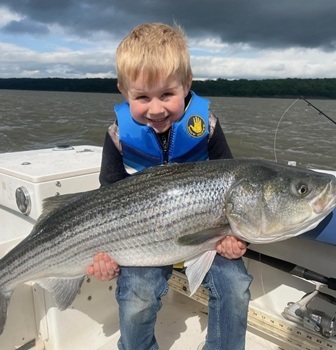
Hudson River: Striped Bass Cooperative Angler Program
You can share your fishing trip information and help biologists understand and manage our Hudson River striped bass fishery.
Here’s how it works: Fill out a logbook provided by us whenever you fish on the Hudson River (by boat or from shore). You can also use our survey123 app and record your trips using a smart phone or computer.
Record general location, time, gear used, what you caught (or if you didn’t catch anything) and return the logbook when you are done fishing for the season. You’ll receive an annual newsletter summarizing the information in addition to the latest news regarding regulations and the river. Whether you catch-and-release or take home a keeper, you can be part of the Cooperative Angler Program. Online logbook instructions (PDF)
Join today by contacting: hudsonangler@dec.ny.gov
- Jessica Best
Photo of DEC Angler Program courtesy of Jess Best
Hudson River Miles
The Hudson is measured north from Hudson River Mile 0 at the Battery at the southern tip of Manhattan. The George Washington Bridge is at HRM 12, the Tappan Zee 28, Bear Mountain 47, Beacon-Newburgh 62, Mid-Hudson 75, Kingston-Rhinecliff 95, Rip Van Winkle 114, and the Federal Dam at Troy, the head of tidewater, at 153. The tidal section of the Hudson constitutes a bit less than half the total distance—315 miles—from Lake Tear of the Clouds to the Battery. Entries from points east and west in the watershed reference the corresponding river mile on the mainstem.
To Contribute Your Observations
The Hudson River Almanac is compiled and edited by Tom Lake and emailed weekly by DEC's Hudson River Estuary Program. Share your observations by e-mailing them to trlake7@aol.com.
Was this Newsletter Forwarded to You?
Subscribe today to DEC Delivers Hudson River Almanac topic for weekly natural history journal that covers the Hudson from the High Peaks of the Adirondacks to New York Harbor.
Helpful Resources
National Oceanic and Atmospheric Administration online tide and tidal current predictions are invaluable when planning Hudson River field trips. For real-time information on Hudson River tides, weather, and water conditions from sixteen monitoring stations, visit the Hudson River Environmental Conditions Observing System website.
DEC's Smartphone app for iPhone and Android is now available at New York Fishing, Hunting, and Wildlife App.
|