Photo of black bears courtesy of Mary Holland
In this issue:
The first ever appearance of any species of wildlife in the watershed disserves proper mention. We had one this week. The adults of most of the bald eagle nests in the Hudson Valley are actively catering to their nestlings. Glass eels, in from the sea, have begun their two month migration surge upriver, through tidewater and on into the uplands.
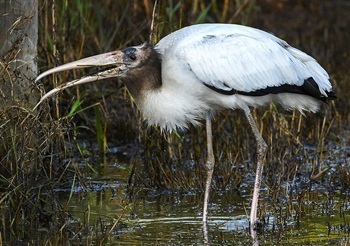
3/24 – Dutchess County, HRM 86: While birding today at the Mills Mansion Memorial State Park in Staatsburg, Eric Gross found and photographed a wood stork in a bay off the Hudson River.
This was apparently the first March wood stork record in the Northeast, where it is considered an Accidental Vagrant, and it was certainly the first record of a wood stork for Dutchess County.
The wood stork (Mycteria americana) is a large, long-legged, long-necked wading bird (family Ciconiidae) with a long, stout bill. It is normally found from the Southeast U.S. through South America. Its northern range in the U.S. has recently expanded to nesting in North Carolina. They are known to wander, sometimes great distances, especially after breeding.
– Stan DeOrsey
[Where do babies come from? The delivery of babies "via stork" is a near-universal story that sounds very similar no matter where you are. In most cases, the storks use their beaks to carry babies wrapped in a cloth sack, flying to the home of expecting parents to drop off the newborn. In some countries, they leave babies on the doorstep of their new home. In other countries, they're dropped down the chimney. (Emma Bryce 2018)]
Photo of wood stork courtey of Deborah Kral
3/21 – Waterford, HRM 158: The adults in bald eagle nest NY485, in Peebles Island State Park, have been sitting in their nest since March 13 awaiting an imminent hatch. NY485 was now in its ninth season. The first eight have been successful by any measure.
- Andrew Walters
3/21 – Ulster County: Bald eagle nest NY142 has had nestlings for two weeks as evidenced by regular food drops and the easy to observe feeding process. The parental changeover for incubation duties has been witnessed by nest watchers from across the river at Norrie Point. With warming weather, we should soon see small grey fluffy heads peeking over the nest rim. Will it be one, or more nestlings?
- Mario Meier
Photo of bald eagle courtesy of Mario Meier
3/21 – Poughkeepsie, HRM 75.5: This was the first check of our fyke net that we had set overnight in Fall Kill Creek. This also began our 19th season of monitoring the migration of immature America eels (“glass eels”) in from the sea. This annual spring run will last for the better part of two months as the eels begin the freshwater phase of their lives that may last 12-30 years before they return to the sea to spawn.
We dug deep into the cod end of the net and found three glass eels, one elver (yearling), and one juvenile banded killifish. The glass eels were fascinating with almost no pigment and still with lateral side-to-side flattening, an artifact of their larval “leptocephali” stage in the sea.
- Chris Bowser, Camille Seliquini, Paige Woodard
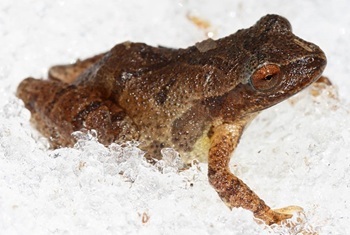
3/21 – Hudson River Watershed: Every spring, frog, toad, and salamander lovers await the first warm, rainy night in early spring in hopes of observing hordes of amphibians awakening from their winter hibernation and migrating from their upland hibernacula to wetlands to breed. For many in the Northeast the start of this migration began this week. Monday evening temperatures were warm, and it was raining lightly. Hundreds of blue-spotted salamanders, spotted salamanders, wood frogs, four-toed salamanders, eastern red-backed salamanders, spring peepers, and eastern newts were rescued from moving cars as they crossed roads to get to their breeding grounds.
- Mary Holland
Photo of spring peeper courtesy of Mary Holland
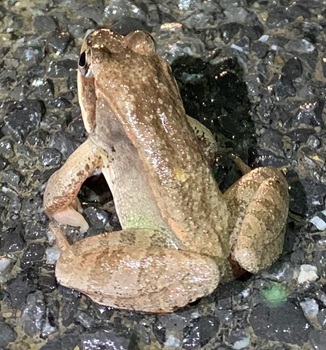
3/22 – Town of Esopus, HRM 90: There was a multitude of wood frogs (Lithobates sylvaticus) producing a boisterous chorus of quacks to accompany our walk along Martin Swedish Road in the Town of Esopus this evening.
- Peter Relson, Carol Anderson
Photo of wood frog courtesy of Peter Relson
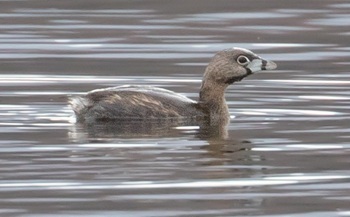
3/22 – Orange County, HRM 41: I photographed my first pied-billed grebe (Podilymbus podiceps) of the year this morning at Wickham Lake in the Town of Warwick.
- Matt Zeitler
Photo of pied-billed grebe courtesy of Matt Zeitler
3/22 – Bronx County, New York City: We recently received a query regarding an unusual fish that was sighted in the Bronx Zoo reach of the Bronx River more than a decade. The details on the what, where, and when were vague but we were able to search past volumes of the Hudson River Almanac and find it.
The date was September 18, 2008 (Vol. XV). Below is the Almanac entry we created [in part] regarding the fish.
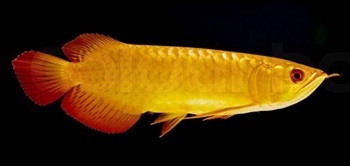
➤ In shallow water, just above the falls of the Bronx River on the grounds of the Bronx Zoo, a single large (16-20 inch) Asian arowana was swimming lazily with sunfish and others in the late afternoon sun. It appeared to be a red-tailed golden arowana (Scleropages aureus), native to northern Sumatra, Indonesia. The fish was likely released by a local aquarist when it grew too large. But where it was released and how it found its way to the zoo section of the river remains a mystery.
- Robert DeCandido
[Under other circumstances, we’d be inclined to consider adding the Asian arowana to our compilation of fish documented for the Hudson River watershed that currently lists 215 species [today it is 240]. However, this may be a one-time, exotic introduction that is isolated enough to warrant a special category of aquarium releases, highly unlikely to become established. However, as ichthyologist Bob Schmidt notes, “Ultimately, every aquarium fish in the universe can show up in the Hudson.” It is well worth mentioning that releasing these fish is a very bad idea. Tom Lake]
Photo of red-tailed arowana courtesy of Robyn Broyles
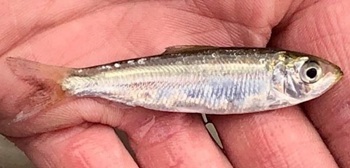
3/23 – Hudson River Estuary: James Boyle of the Atlantic States Marine Fisheries Commission (ASMFC) issued their third weekly report of the season for East Coast River Herring (blueback herring and alewives). These herring are primarily adults, returning, heading up the coast from their wintering waters. As river herring move north, many will pare off into the Hudson River while others will move on north into New England waters.
Last week we reported 19 alewives (Alosa pseudoharengus), first of the season, from Bride Brook, East Lyme, CT., as well as 10,585 blueback herring from the St. Stephen fish lift in the Santee River at St. Stephen, SC. This week the St. Stephen fish lift counted 23,865 blueback herring, but no additional alewives.
- Tom Lake
Photo of blueback herring courtesy of Chris Bowser
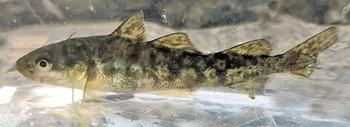
3/24 – Hudson River Watershed: Fish-of-the-Week for Week 359 is the Atlantic tomcod, (Microgadus tomcod Walbaum, 1792), number 107 (of 240) on our watershed list of fishes. If you would like a copy of our list, e-mail - trlake7@aol.com.
The Atlantic tomcod is an Arctic fish, one of three members of the Cods and Haddocks family (Gadidae) documented for our watershed. The others are the Atlantic cod (Gadus morhua) and the pollock (Pollachius virens), both designated as temperate marine strays. Bigelow and Schroder's Fishes of the Gulf of Maine (1953) cite the tomcod general range as “... northern Newfoundland to Virginia.”
Tomcod is designated as an anadromous species that lives in salt water as an adult but returns to freshwater to spawn. Its Type Site is described as “Long Island,” very appropriate given their lifetime journey from the estuary to the sea. It was there, in 1792, that Johann Julius Walbaum first described the Atlantic tomcod to science.
The tomcod body is elongated, their head small, and pelvic fins have a slightly elongated filament. They are olive green, brown, or yellow dorsally, paler ventrally, with dark mottling on sides and fins. Their body is nearly terete in cross section.
Tomcod mature within a year at 6-7-inches and can grow to 15-inches although in the Hudson River most are ten-inches or less. Their species name, Microgadus, alludes to their much smaller size as adults compared to the nearly identical Atlantic cod (Gadus morhua). Young-of-year, soon to be adult tomcod, are found in the lower estuary and East River in summer.
Unlike the herrings in the Hudson River that spawn in spring, tomcod is a late-fall and winter spawner, from November to February. In cold winters they spawn under the ice from the Hudson Highlands northward thus earning them the Dutch Colonial colloquialism “frost fish.”
Atlantic tomcod have a varied diet of small invertebrates. Among these are amphipods, isopods, Gammarus spp., and small mollusks. (Carroll, et al., 2024).
In winter, 50 years ago and earlier, tomcod was abundant enough so that some taverns in the lower river served fried tomcod as a snack with beer in lieu of peanuts. However, tomcod numbers in the river have been declining over the last few decades. Being a boreal species, climate change has been suggested as a possible cause.
- Tom Lake
Photo of Atlantic tomcod courtesy of Tom Lake
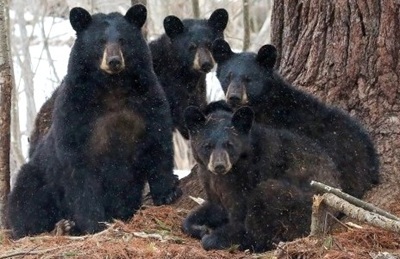
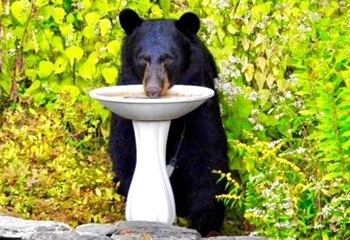
3/25 – Hudson River Watershed: Black bears (Ursus americanus) in the Northeast have begun emerging from hibernation, with males usually becoming active before females and their cubs. You might think that they would be ravenous upon waking from a 4-5 five-month period of no eating or drinking, but it takes two to three weeks for their metabolism to return to normal.
During this time of “walking hibernation” bears eat and drink much less than normal. Many have lost a significant amount of body fat, and they are sluggish with reduced appetites. When their appetite returns, black bears typically head for forested wetlands, beaver ponds, and along streams and riverbanks where tender new grasses, sedges and a variety of succulent plants can be found. Later, black bear young stay with their mother until they are nearly a year and a half old. In May or June of the year after their birth they disperse and she mates.
- Mary Holland
Photo of black bear courtesy of Linda Vandel
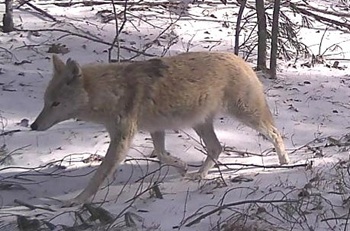
3/26 – Essex County: I was looking over some recent game-camera images from our land in Keene, and I saw two large Canids. One looked rather ordinary, but the other one looked more like a wolf than a coyote.
- Tom Fine
[It was the post-Colonial extinction of wolves in the Northeast that opened the door for coyotes (Canis latrans) to migrate here. As wolves lost ground to human development and hunters, western coyotes expanded east. Somewhere along the way, blood lines were mixed resulting in coyote-wolf hybrids (C. latrans x C. lupus). We coyote “fans” like to refer to them as “woyotes.”
The iconic coyote often looks unkempt and half-starved. Mark Twain’s first look at a sorry-looking coyote prompted him to call it “a living, breathing allegory of Want.” And Twain’s description itself was so vivid that it inspired the animator Chuck Jones to create that perennial failure known to cartoon-loving children everywhere, Wile E. Coyote of Road Runner fame. Tom Lake]
[Two separate teams of wildlife biologists with the Eastern Coyote Research consulting firm, studying the genes of coyotes in the Northeast, reported evidence that some that have for decades been thought of as coyotes, are in fact coyote-wolf hybrids. They hypothesize that western coyotes dispersing eastward north of the Great Lakes across Canada during the last century mated with wolves along the way, bringing wolf DNA along with them to the Northeast. Their findings may explain why coyotes in the east are generally larger than their western counterparts, that is, more wolf-like in size, and why they are so much more varied in coat color, as might be expected from a creature with a more diverse genome (Carol Kaesuk 2010].
Photo of coyote courtesy of Tom Fine
3/26 – Minerva, HRM 284: I’m keeping track of initial sightings and songs of spring birds. Our first red-winged blackbird arrived in this area of the Adirondacks on March 10, with larger flocks following. Yesterday (March 25) our first robin of the season showed up. Today, I heard the first woodcock sounds of the season (“peenting”). Shades of Aldo Leopold.
- Mike Corey
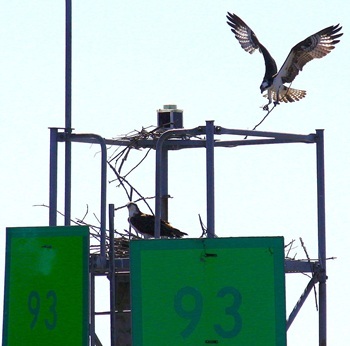
3/26 – Saugerties Lighthouse, HRM 102: At noon today, an osprey landed on the Coast Guard Aids To Navigational Marker 93 at the mouth of Esopus Creek. This is likely one member of the osprey pair that have built a nest on the channel marker since 2018. The other one usually arrives within a few days. In previous years, I noted the osprey’s first appearance about this same time, give or take a day or two (March 24-27).
- Patrick Landewe
Photo of osprey courtesy of Patrick Landewe
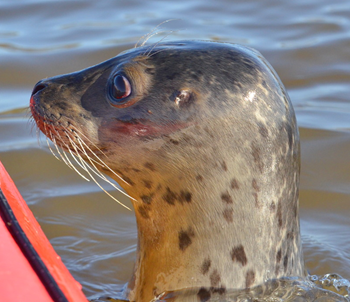
3/27 – Saugerties, HRM 102: It was approximately 2,429 days ago, August 5, 2019, that a young male harbor seal, a marine mammal, arrived at the mouth of Esopus Creek, 110 miles from the open sea. The seal carried a flipper tag with the number 2-4-6 having been banded at the Mystic Aquarium following a rescue at sea. The seal developed an attachment, a semi-residency, to the tidewater reach of Esopus Creek that has lasted more than six years. Our last sighting was August 5, 2025. On that day, 2-4-6, complete with his flipper tag, made an appearance on the north side of the Saugerties Lighthouse.
During this winter, Esopus Creek was frozen bank-to-bank, which would be a serious challenge for a harbor seal that needs an exit to haul out. The creek was locked-in with ice until recently, so there were no sightings. Now that we have open water, I am hopeful that he will make an appearance.
- Patrick Landewe
Photo of harbor seal courtesy of Michael Kalin
Science Saturday at Norrie Point Environmental Center
Join us for our monthly Science Saturday programs and explore Norrie Point. Check out our series by visiting the Hudson River website. Events are free and open to the public. Registration is not required. All programs meet at the Norrie Point Environmental Center, 256 Norrie Point Way, Staatsburg NY 12580. Dress for the weather and being outside! Otherwise, no special equipment is needed.
The upcoming Science Saturday programs are:
- Rebecca Houser, Education and Outreach Specialist, HREP and NEIWPCC
Snapshot NY
The NYSDEC, in collaboration with the New York Cooperative Fish and Wildlife Research Unit at Cornell University, has launched Snapshot NY, a citizen science program that allows the public to participate in wildlife monitoring through the deployment of trail cameras. The project will help improve the way DEC monitors and manages more than a dozen wildlife species. For more information on Snapshot NY and how to participate, visit the Snapshot NY website.
Hudson River Lesson Plans
Explore our collection of Hudson River lesson plans, videos and online activities to support hand on investigations of the Hudson River in your classroom.
Hudson River: Striped Bass Cooperative Angler Program
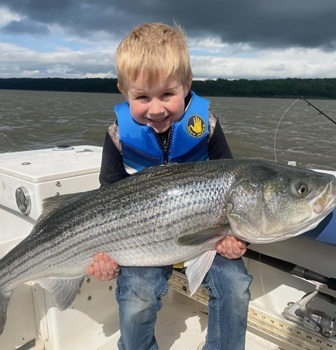
You can share your fishing trip information and help biologists understand and manage our Hudson River striped bass fishery.
Here’s how it works: Fill out a logbook provided by us whenever you fish on the Hudson River (by boat or from shore). You can also use our survey123 app and record your trips using a smart phone or computer.
Record general location, time, gear used, what you caught (or if you didn’t catch anything) and return the logbook when you are done fishing for the season. You’ll receive an annual newsletter summarizing the information in addition to the latest news regarding regulations and the river. Whether you catch-and-release or take home a keeper, you can be part of the Cooperative Angler Program. Online logbook instructions (PDF)
Join today by contacting: hudsonangler@dec.ny.gov
- Jessica Best
Photo of DEC Angler Program courtesy of Jess Best
Hudson River Miles
The Hudson is measured north from Hudson River Mile 0 at the Battery at the southern tip of Manhattan. The George Washington Bridge is at HRM 12, the Tappan Zee 28, Bear Mountain 47, Beacon-Newburgh 62, Mid-Hudson 75, Kingston-Rhinecliff 95, Rip Van Winkle 114, and the Federal Dam at Troy, the head of tidewater, at 153. The tidal section of the Hudson constitutes a bit less than half the total distance—315 miles—from Lake Tear of the Clouds to the Battery. Entries from points east and west in the watershed reference the corresponding river mile on the mainstem.
To Contribute Your Observations
The Hudson River Almanac is compiled and edited by Tom Lake and emailed weekly by DEC's Hudson River Estuary Program. Share your observations by e-mailing them to trlake7@aol.com.
Was this Newsletter Forwarded to You?
Subscribe today to DEC Delivers Hudson River Almanac topic for weekly natural history journal that covers the Hudson from the High Peaks of the Adirondacks to New York Harbor.
Helpful Resources
National Oceanic and Atmospheric Administration online tide and tidal current predictions are invaluable when planning Hudson River field trips. For real-time information on Hudson River tides, weather, and water conditions from sixteen monitoring stations, visit the Hudson River Environmental Conditions Observing System website.
DEC's Smartphone app for iPhone and Android is now available at New York Fishing, Hunting, and Wildlife App.
|