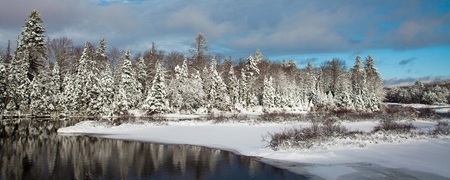
Photo of Winter in the Adirondacks courtesy of David Patterson
In this issue:
Last week’s Highlight told the story of an injured Bald Eagle whose future looked rather bleak. This week we received an update. In addition to the ever-present Bald Eagles, this week offered a look at two of our wild Canids.
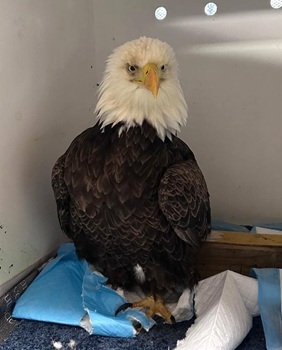
2/27 – Manhattan, HRM 10: Looking back to February 17, while patrolling the Hudson River just south of the George Washington Bridge, the New York City Police Department’s Harbor Unit officers spotted a bald eagle marooned on an ice floe in apparent distress. They rescued the eagle whereupon officers from DEC Region 2 transported it to The Raptor Trust, a wild bird rehabilitation center in Morris County, New Jersey.
The staff at The Raptor Trust, including Christopher Soucy and Cathy Malok, discovered that the adult male bald eagle had a blue NYSDEC leg band (W73). The eagle had been banded by DEC’s Pete Nye as a nestling at Stony Point, Rockland County, on May 21, 2008.
Update: Across the ensuing ten days following the rescue, W73 had been examined for a probable cause of its injuries including blood tests, toxicology tests, and x-rays. Thus far, none had provided conclusive answers. Today, however, the first positive news in ten days arrived from the staff at The Raptor Trust:
“We finally have him [W73] eating small meals, and he is stable enough to move upstairs still in the critical care area but looking better than he has so far. If he is strong enough we will do more blood work this week to see how the treatments we started are working. Sometimes we never know what caused them to go down and we must just concentrate on getting them back in the air. Cathy Malok”
Photo of bald eagle courtesy of Kristi Ward
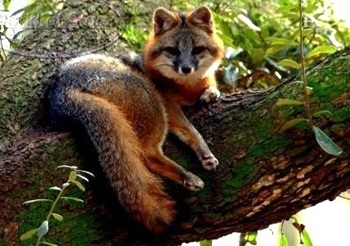
2/20 – Dutchess County, HRM 90: I have been waiting a long time to see a gray fox in the wild after all the places that I’ve been in the field. I had a very good look this morning at a first time visitor on my property in Milan, a gray fox (Urocyon cinereoargenteus). Truthfully, this was the first time I had ever seen one anywhere.
It was certainly a wonderful treat to watch the fox hunt for several minutes while I noted the field marks that distinguishes a gray fox from a red fox (Vulpes vulpes).
- Frank Margiotta
[In the taxonomic hierarchy, gray and red fox meet at the Family level (Canidae), dog-like carnivores, from Latin canis = dog. Canids are known colloquially as “dogs.” Gray fox, perhaps owing to its largely nocturnal habits, is less commonly seen as red fox. Gray fox is more of a forest dweller whereas red fox tends to be a mammal of open fields and farmlands. For these reasons, while they are competitors for forage, their preferences only overlap.
The gray fox is unique in that they are the only dog (canid) possessing an evolutionary physical adaptation to climb a tree, albeit not with the skill of an opossum. This adaptation of semi-retractable claws are specialized for climbing by providing an enhanced grip on tree bark. While this adaption allows the gray fox to hunt off the ground and raid bird nests, it is limited to lower branches that have some angle off vertical. Meanwhile, the red fox is earth-bound. Tom Lake]
Photo of gray fox courtesy of Paul Sunberg
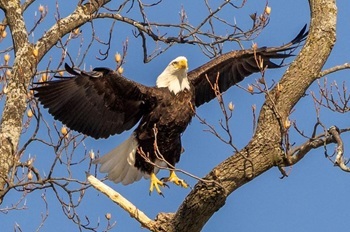
2/20 – Town of Poughkeepsie: Our best guess is that the adults at bald eagle nest NY62 began incubating eggs today (in 2025, they began on February 20). It is always a best guess because the process is complex including the shared responsibility by the adults (on average, the female covers the eggs 16 hours of the 24-hour day. The best indication of serious incubation is repetitive changeovers as the adults switch places. One will begin incubating while the other goes off to hunt.
On average, the incubation period runs for 32-35 days before a hatch. If our guess is correct, we may see hungry nestlings between March 21-24. We will know of a hatch when the adults begin to bring food to the nest for another mouth to feed. For this season, we will watch for the first indication of a hatch and then go back 32-35 days to see how accurate our prediction was.
- Bob Rightmyer
Photo of bald eagle courtesy of Bob Rightmyer
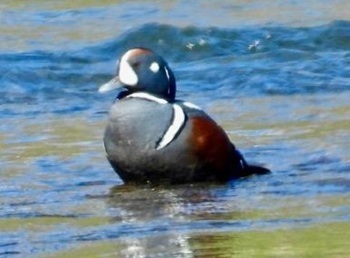
2/21 – Fort Edward, HRM 202: Alerted by a friend, I traveled to find a male harlequin duck below the dam at Fort Edward. However, I missed finding the male Barrow’s goldeneye reported to be nearby on the river.
- Katrina Van Tassel
[A male harlequin duck is a treat to see as one of the most handsome ducks. In the East, they are normally found in the ocean farther north. In the winter, some are seen off Long Island and along the Great Lakes, particularly near Niagara Falls preferring fast moving water and rocky shores. Previously, they were rarely found in New York; however, since the 1950s, sightings offshore have increased significantly. Stan DeOrsey]
Photo of harlequin duck courtesy of Katrina Van Tassel
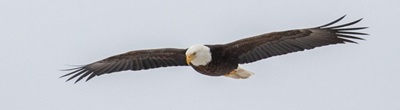
2/22 – Westchester County, HRM 35: I went afield from my usual haunt, Orange County, to visit Croton Point. Although the birds I found were totally expected for a winter’s day, the trip was made worthwhile as an adult bald eagle cruised low overhead displaying its trademark of “flying on flat wings.”
- Matt Zeitler
Photo of bald eagle courtesy of Matt Zeitler
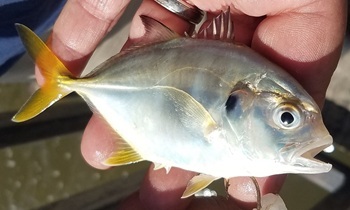
2/23 – Hudson River Watershed: Fish-of-the-Week for Week 355 is the crevalle jack, (Caranx hippos Linnaeus, 1766), number 176 (of 239), on our Hudson River Watershed List of Fishes. If you would like a copy of our list, e-mail: trlake7@aol.com.
The crevalle jack is one of six members of the jack family (Carangidae) documented for our watershed. Others include the round scad, Atlantic moonfish, lookdown, banded rudderfish, and permit. All six jacks are considered temperate marine strays. They are found in the western Atlantic from Nova Scotia to Uruguay.
The crevalle jack was the first species of its genus to be scientifically described and named and is the type species of the genus Caranx. Crevalle jack was described and named in 1766 by the famed Swedish taxonomist Carl Linnaeus, based on the holotype specimen of record taken off the coast of the Carolinas. (Smith-Vaniz, Carpenter, 2007).
Crevalle jack are the tiny, colorful jewels of the estuary having the undeniable look of a tropical fish. They are designed to escape predators by evasion rather than concealment. With a very narrow caudal peduncle, forked tail, a lean and streamlined body, they are structured for speed. Holding one carefully in your wet hand, they will work their tail back-and forth like a high-speed rudder.
Crevalle jack is one of my favorite Hudson River species for a variety of reasons: they grunt like a drum expelling air when held; they are a wonderful sport fish; they are incredibly handsome; and their pugnacious look suggests that they take no bother from any others. During late-summer and fall in the early 1980s, when desert plate-size crevalle jacks were common in the lower estuary, they made for an active light-tackle sport fishery. While they can get to be four-feet long and weigh sixty pounds, the average size encountered by anglers is considerably smaller. Their forage of choice is small fish, along with invertebrates such as prawns, shrimps, crabs, mollusks and cephalopods (e.g., squid).
Historically, J.R. Greeley’s A Biological Survey of the Lower Hudson Watershed (1937), refers to this species as the common jack and its presence as being rare. His survey caught one small crevalle jack in August 1936 in Haverstraw Bay. Greeley cites American ornithologist and field naturalist Edgar Mearns as having caught two in the Hudson Highlands, also in August of 1936. That is a slim record of a fish that has since become better known and seen more frequently by educators and fish people.
- Tom Lake
Photo of crevalle jack courtesy of Tom Lake
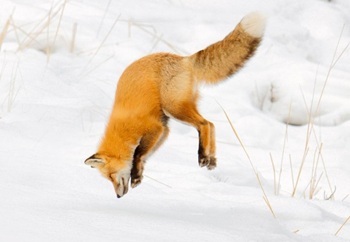
2/24 – Dutchess County, HRM 90: Just a few days after a first-time visit from a gray fox (see February 20), I had the good fortunate of watching a red fox hunting my field. This hunt was more methodical than that of the gray fox and turned out to be more successful as well. The red fox moved behind a tree, so I didn’t get a good look at the prey other than to see that it was taken from under the snow (field mouse, vole?).
This red fox was a beautiful specimen on the larger size and looked very healthy with a nice bushy tail. Its presence was good to see given what has been a challenging winter for wildlife.
- Fran Margiotta
Photo of red fox courtesy of Derby Dixon
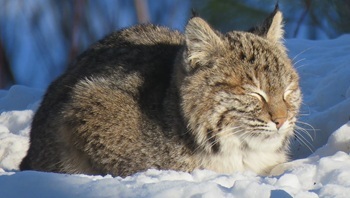
2/25 – Hudson River Watershed: From late February into March, bobcat mating is at its peak. It is the likeliest time to see two of these cats together, as they are largely solitary. After a few days of courtship (running, hunting and playing together), copulation takes place, lasting less than five minutes. Bobcats compensate for this brevity with frequency, mating up to 16 times in 24 hours. One might surmise that this could cause considerable fatigue and a cat nap might be necessary. During the day, in the winter, if the sun is out, Bobcats are known to sun themselves, gathering solar heat and at this time of year, perhaps a much-needed rest.
- Mary Holland
Photo of bobcat courtesy of Alfred Balch
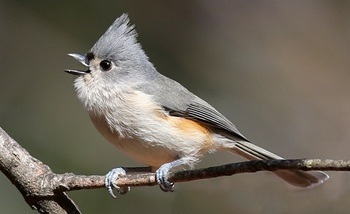
2/26 – Hudson River Watershed: The song of the tufted titmouse (Baeolophus bicolor) is a loud, clear, two-note phrase, repeated up to eleven times in succession: “Peter-Peter-Peter.” The song can be heard now even though snow and cold temperatures are still with us. While titmice may pair up any time of the year, the singing of the males is a vital part of establishing territory and courtship. Females occasionally sing but not as loud or as often as males.
The tufted titmouse’s song is familiar while its calls are more numerous and varied. Twelve different tufted titmouse calls have been identified. They range from the ‘chick-a-dee’ and ‘seet’ calls made in response to predators, to the hissing done by a female titmouse in a cavity, defending her nest.
- Mary Holland
[To hear both songs and calls of the Tufted Titmouse, go to https://www.allaboutbirds.org/guide/Tufted_Titmouse/sounds]
Photo of tufted titmouse courtesy of Mary Holland
Science Saturday at Norrie Pint Environmental Center
Join us for our monthly Science Saturday programs and explore Norrie Point. Check out our series by visiting our website. Events are free and open to the public. Registration is not required. All programs meet at the Norrie Point Environmental Center, 256 Norrie Point Way, Staatsburg NY 12580. Dress for the weather and being outside! Otherwise, no special equipment is needed.
The upcoming Science Saturday programs are:
- March 28, 10 am - 12 pm - Signs of Spring
- April 18, 10 am - 12 pm - Vernal Pool Exploration
- May 2, 10 am - 12 pm - I Love my Park Day
- Rebecca Houser, Education and Outreach Specialist, HREP and NEIWPCC
Amphibian Migrations & Road Crossings Program – 2026 Volunteer Trainings
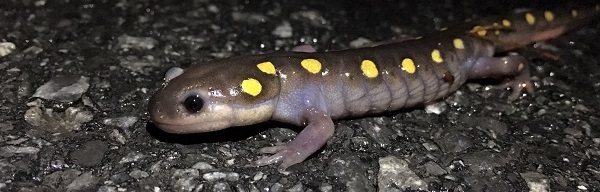
Join the DEC’s Hudson River Estuary Program and Cornell University to learn how to volunteer with the Amphibian Migrations & Road Crossings Project. Volunteers find locations where migrating salamanders and frogs cross roads on their way to vernal pools for breeding in late winter and early spring. They document weather, traffic, and species, and assist amphibians across the road safely. Trainings will be offered on the following dates:
In-person trainings are filling up, but interested volunteers can attend a program offered by an AM&RC Project Partner. Full details are available: 2026 Volunteer Trainings for the Amphibian Migrations & Road Crossings Project | Conservation Planning in the Hudson River Estuary Watershed.
Snapshot NY
The NYSDEC, in collaboration with the New York Cooperative Fish and Wildlife Research Unit at Cornell University, has launched Snapshot NY, a citizen science program that allows the public to participate in wildlife monitoring through the deployment of trail cameras. The project will help improve the way DEC monitors and manages more than a dozen wildlife species. For more information on Snapshot NY and how to participate, visit the Snapshot NY website.
Hudson River Lesson Plans
Explore our collection of Hudson River lesson plans, videos and online activities to support hand on investigations of the Hudson River in your classroom.
Hudson River Miles
The Hudson is measured north from Hudson River Mile 0 at the Battery at the southern tip of Manhattan. The George Washington Bridge is at HRM 12, the Tappan Zee 28, Bear Mountain 47, Beacon-Newburgh 62, Mid-Hudson 75, Kingston-Rhinecliff 95, Rip Van Winkle 114, and the Federal Dam at Troy, the head of tidewater, at 153. The tidal section of the Hudson constitutes a bit less than half the total distance—315 miles—from Lake Tear of the Clouds to the Battery. Entries from points east and west in the watershed reference the corresponding river mile on the mainstem.
To Contribute Your Observations
The Hudson River Almanac is compiled and edited by Tom Lake and emailed weekly by DEC's Hudson River Estuary Program. Share your observations by e-mailing them to trlake7@aol.com.
Was this Newsletter Forwarded to You?
Subscribe today to DEC Delivers Hudson River Almanac topic for weekly natural history journal that covers the Hudson from the High Peaks of the Adirondacks to New York Harbor.
Helpful Resources
National Oceanic and Atmospheric Administration online tide and tidal current predictions are invaluable when planning Hudson River field trips. For real-time information on Hudson River tides, weather, and water conditions from sixteen monitoring stations, visit the Hudson River Environmental Conditions Observing System website.
DEC's Smartphone app for iPhone and Android is now available at New York Fishing, Hunting, and Wildlife App.
|