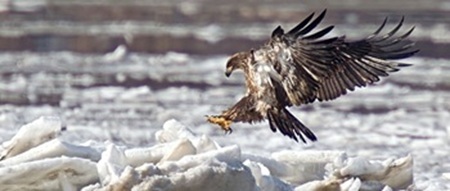
Photo of bald eagle courtesy of Dana Layton
In this issue:
A wonderful story unfolded this week beginning with a well-publicized rescue of a bald eagle in distress marooned on the Hudson River ice and the subsequent discovery of the eagle’s amazing origin.
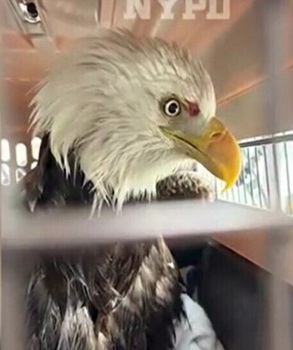
2/17 – Manhattan, HRM 10: While patrolling the Hudson River just south of the George Washington Bridge at 9:30 a.m. on February 17, the New York City Police Department’s Harbor Unit officers spotted a bald eagle, chortling loudly in apparent distress, on an ice floe. The eagle appeared to be bleeding from one wing and was unable to fly.
The Harbor Unit officers decided to attempt to rescue the federally protected eagle but first contacted the New York State DEC Region 2 to ask for permission. With permission granted, the Harbor Unit used a ”catch pole” to drop a loop over the eagle’s upper body and then with a tarp wrapped up the bird and brought it into their boat where it was placed in a cage.
With the bird safely secured, officers from DEC Region 2 transported the eagle to The Raptor Trust, a nonprofit wild bird rehabilitation center in Morris County, New Jersey for recovery.
- Tom Lake
[When the eagle reached The Raptor Trust, the staff, Christopher Soucy and Cathy Malok, discovered that the adult bald eagle was a male and had been banded. There was a blue NYSDEC band (W73) on its right leg and a U.S. Fish and Wildlife Service silver band (0679-01170) on the left.
The eagle had been banded by DEC’s Pete Nye as a nestling at Stony Point, Rockland County, on May 21, 2008 (along with its sister nestling W72). This spring, W73 will turn 18 years-old, Tom Lake]
[Probable cause of the eagle’s injuries is still unknown. Initial inspection, other than some blood on a wing, showed no overt evidence so far of trauma or signs of intraspecific aggression such as from an unattached male in a duel for air supremacy. X-rays are planned after which the full extent of the eagle’s injuries will be known as well as results from blood tests.
One thing that is likely true, if not for the presence of the dinner-table size ice floe, having been carried there by the down- tide from the Tappan Zee, the eagle might not have had a landing spot or even survived the ordeal. Tom Lake]
Photo of bald eagle courtesy of NYPD
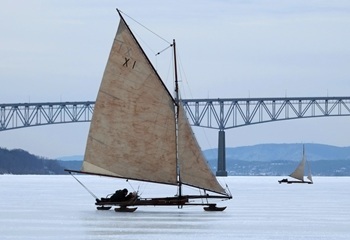
2/14 – Hudson River Estuary: The recent near-total freeze-over of Hudson River tidewater stirred up memories of ice-boating and other such on-the-ice activities. In the early 20th century, when the river would ice-over and commercial traffic would halt for the winter, the “last boat” of the season heading upriver would be announced in the newspaper.
Soon, automobiles would take over with races on the ice. Driving from one river town to the next was far easier on the ice than maneuvering over local roads. People would ice skate from town to town as well. Ice boating was legendary both competitive and pleasure boating. People would cut narrow slits in the ice, lower gill nets or hook-and-line, to catch fish for the market, including white perch, striped bass, and Atlantic tomcod. [Thanks to John Mylod for much of this data.]
- Tom Lake
Photo of ice boating courtesy of Brian Reed
2/7 – Tappan Zee, HRM 36: The ice in Haverstraw Bay between Bowline Park and Admiral’s Cove was very active today. Immatures were engaged in catching and carrying tomcod and then fending off other birds from stealing them. Meanwhile, the adults were still into courtship.
- Larry Weiss
2/14 – Westchester County, HRM 35: From the vantage on the north side beach at Croton Point, the ice rolls away in an unbroken plain as far as I can see—a snow-covered dance floor. I can squint a little against the glare from the snow and let the years roll back. It’s 1926 and two dimly seen figures are dropping a sled onto the ice from the Westchester County shore at Croton Point. A young Henry Gourdine and his partner Charlie Rohr are going to check their gill net set yesterday beneath the Hudson River ice.
The sled is no American Flyer, but a sturdy and oversized conveyance to haul the ice axes and saws, nets and poles, and a bag of gloves. Lots of gloves. Says Henry: “When we worked the net, ice balls would freeze into the knuckles of your fingers. When the lumps were the size of golf balls it was time for a dry pair.” With axe and ice saw they opened the hole and lifted the nets—square webbing, ten-foot square, framed on lattice sprouts. The catch was largely white perch, striped bass, and sturgeon. It was a hard risky way to make a day’s wages. “How much did you make for all that work?” I would ask Henry every time I heard the story. Henry’s answer, enigmatic and delivered with a grin, was unvarying. “As much money as the President of the United States”
- Christopher Letts
[In recent Almanac entries we have mentioned John Scardefield of New Hamburg, and his winter exploits out on the frozen river 32 miles upriver from Croton Point setting gill nets to catch fish for the market. Henry Gourdine’s patch was similar and so was his catch. Tom Lake]
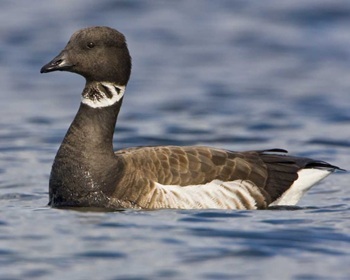
2/14 – Queens, New York City: Heavy snow and the extreme cold continued to take their toll. Unable to reach the short grasses at Floyd Bennett Field, several brant (Branta bernicla) had succumbed to the cold and lack of food. I removed a few to a less visited location where they might still serve as food for wildlife. Crossing the Marine Park-Gil Hodges Memorial Bridge, I could see that Jamaica Bay below me was frozen as solidly as any time I can recall in the last two decades.
Arriving at the Rockaways on the lee side of the Riis Park Bathhouse. Some construction had churned up just enough snow and ice to allow a few stems of grass to poke up amid a few square feet of open ground. A flock of 35 snow buntings flew through the headwinds joining 25 horned larks in the clearing. I can only feel grateful for whatever this tiny patch might afford them to eat.
- Dave Taft
[Legendary waterman Dery Bennett used to mark the seasons by noting how brant , a small species of goose, “arrive every October to winter at Sandy Hook (NJ) in the National Park Services Gateway National Recreation Area. Around Memorial Day, they would shove off for the Canadian Arctic where they would breed, fledge young, and then return to winter in the various locations of the Gateway National Recreation Area.” Tom Lake]
Photo of brant courtesy of Doug Wechsler
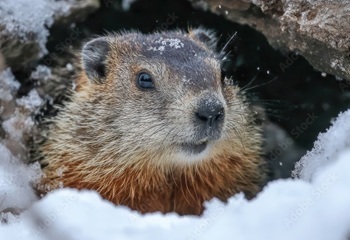
2/15 – Hudson River Watershed: Woodchucks (Marmota monax), also known as groundhogs, are celebrated with Groundhog Day (February 2) but that celebration goes unnoticed by both male and female woodchucks for they are still hibernating underground with hearts that are beating just four times a minute and body temperatures hovering around 40 degrees Fahrenheit (F).
Not until late February or early March do male woodchucks begin to stir and emerge from their burrows to defend their territory and to locate females. After their curiosity is satisfied, they go back to their dens and sleep until females awaken in late March or April, at which time mating takes place.
- Mary Holland
Photo of woodchuck courtesy of Joan Hermann
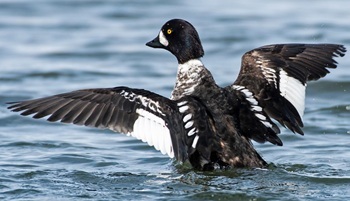
2/16 – Schuylerville, HRM 186: Within a large raft, a typical assemblage, of common goldeneye on the river at Hudson Crossing Park, I found an adult male Barrow’s goldeneye.
- Gregg Recer
[Barrow’s goldeneye (Bucephala islandica) is a striking diving duck of coastal harbors, mountain lakes, and large rivers, and are very similar to common goldeneye (B. clangula). Males are easiest to identify. They have more black on the back than common goldeneye, a steeper forehead, a downward-pointing spur on the side, and a crescent-shaped (not circular) white patch on the face. Barrow’s usually has a yellow bill, but common goldeneye can rarely show a dull yellowish bill.
Barrows are rather common in western U.S. and Canada, but much less common in the northeast. They are frequently found in mixed flocks with common goldeneye. eBird]
Photo of Barrow's goldeneye courtesy of Michel Bourque
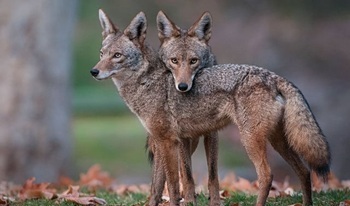
2/17 – Hudson River Watershed: For several weeks eastern coyotes have been engaged in courtship behavior—mutual scent marking, chasing each other, wrestling, and traveling together. They become increasingly vocal during this time as well, with lone females using “invitation howls” to attract mates and pairs engaging in howling duets. This will peak between late February and Marche after which mating takes place. This is the only time when male coyotes can produce sperm, and female coyotes have a two-to-five-day receptive period when they will allow mating to take place. Mated pairs become nearly inseparable during this time sleeping closely together.
- Mary Holland
Photo of coyote courtesy of Drew Wood
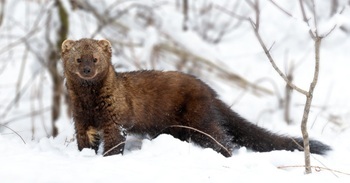
2/18 – Saugerties, HRM 102: It was a very cold, snow-covered scene on Vlykill Creek this morning. As the sun rose and began to warm black silhouettes in the east, a dark-furred fisher (Pekania pennanti) made its way along the frozen creek. The scene was both exhilarating as it was serene. This was my first winter fisher sighting in 54 years.
- Mary Alice Lindquist
Photo of fisher courtesy of Elaine Thompson
2/19 – Orange County, HRM 44-41: With a strong late winter sun and a bit of rain, It took just one day of above freezing air for the agricultural fields at the Black Dirt to begin to show small patches of green: the farmers’ cover crops were up looking for the sun. On some of the open green patches Lapland longspurs and snow buntings were foraging.
- Tom Lake
[The Black Dirt farmers’ winter cover crops are typically chosen for their hardiness and soil-improving qualities. Most growers in the region tend to plant winter rye and winter wheat because they’re excellent at preventing soil erosion and build organic matter. In many cases, these are used on their own or as part of a mix that may also include legumes such as hairy vetch or clovers (often crimson or red clover). These additional species help fix nitrogen and enhance overall soil fertility, which is especially beneficial in the rich, organic muck soils of the Black Dirt region. Tom Lake]
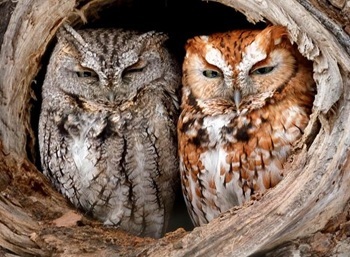
2/19 – Hudson River Watershed: The courtship of eastern screech-owl is underway and it’s prime time for hearing their delightful calls. In my opinion, the eastern screech-owl is not aptly named. They make a variety of sounds, including barks, hoots, squeals and an occasional screech, but the most common calls of both the male and female screech-owl is an even-pitched trill, or tremolo, and a shrill, descending whinny.
The trills are given at a single pitch and are used to advertise nest sites, for courting, when arriving at their nest cavity with food and for inducing fledging. They are important for maintaining pair and family contact, as well as for attracting mates. The whinny call is described as a quavering whistle, much like the whinny of a horse. It is often used for territorial defense. Whinny calls are most frequent throughout the nesting period as well as when the young disperse. Trill and whinny calls are given separately or together.
- Mary Holland
[You can hear both calls by going to Eastern Screech-Owl Overview, All About Birds, Cornell Lab of Ornithology. Mary Holland]
Photo of Eastern screech-owl courtesy of Daniel Jauvin
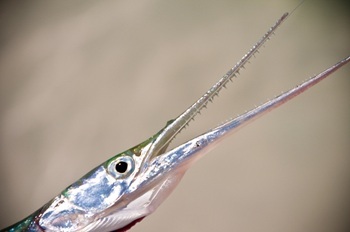
2/19 – Hudson River Watershed: In December 2018, we decided that a weekly Fish-of-the-Week would be a welcome feature to the Almanac during a rather fishless winter season. Our first Fish-of-the-Week, 353 weeks ago, one of my all-time favorites, was the Atlantic Needlefish.
In remembrance of fish Number 1, the Fish-of-the-Week for Week 354 is the Atlantic Needlefish (Strongylura marina Walbaum, 1792), number 115 (of 239) on our watershed list of fishes. If you would like a copy of our list, e-mail trlake7@aol.com.
Atlantic needlefish Is one of two members of the needlefishes family (Belonidae) documented for our watershed. The other is the houndfish (Tylosurus crocodilus). Their collective genus, Strongylura, comes from Latin strongylos = round, and their species trivial name marina, also from Latin as marinus = of the sea.
Although long thought of as a temperate-to-tropical marine species, needlefish have been re-thought of as a saltwater-to-freshwater species that has adapted to inshore brackish-to-fresh waters. Presently, in a compromise, Atlantic needlefish are designated as a seasonally resident marine species. In the western Atlantic, they are found in coastal and inshore waters from New England to South America.
Natural selection designed the Atlantic needlefish to be the consummate predator. They are long and slender (terete in cross section) line-of-sight feeders with more than 20% of their adult length taken up by slender tooth-studded jaws A ventrally-adjusted lateral-line allow needlefish to drift on the surface, hunt for prey, and still maintain an air-water interface. In the extreme, they can reach 44-inches and weigh five pounds, although the average is much less.
In the Hudson River, their favored prey is young-of-year fishes such as river herring. It is exciting to watch them stalk a school of small fish: They silently come along the surface, their dorsal topside barely in the water leaving a narrow wake behind, their eyes fixed on their target, their jaws at the ready—a torpedo heading to no good.
For a long while their presence in the Hudson River estuary had gone largely unnoticed. J.R. Greeley, in his A Biological Survey of the Lower Hudson Watershed (1937), considered needlefish to be rare. He noted that they spawn in salt water even though his survey found immature needlefish as far upriver as Ulster Park (river mile 87). In 1984, Steve Stanne and John Mylod caught a young-of-year Atlantic needlefish (50 mm) in a seine at Kingston Beach (river mile 92), and small needlefish are still regularly caught by DEC and Clearwater educators at Norrie Point and Esopus Meadows, strongly suggesting that they are spawning in the estuary.
Bigelow & Schroeder’s Fishes of the Gulf of Maine (1953) touches on three other Belonidae species in the North Atlantic, Tylosurus acus (keel-jawed needlefish), T. acu (Ajujon), and Alblennes hians (flat needlefish). Briggs and Waldman (2002) classify all three as rare in the New York Bight thus they do not qualify for our watershed list.
Smoked Atlantic needlefish are a delicious culinary delight. A notable oddity occurs when you cook them, which we often did while also steaming Atlantic blue crabs or planked American shad for public programs: their bones turn Kelly green [be sure to consult the NYSDOH advisories on fish consumption].
- Tom Lake
Photo of Atlantic needlefish courtesy of Tom Lake
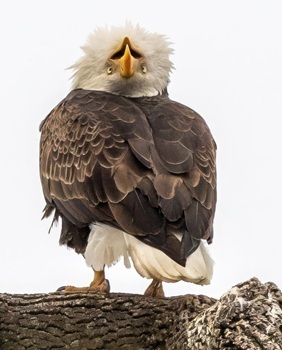
2/20 – Town of Poughkeepsie: The male at bald eagle nest NY62 put on a contortionist’s show today. The accompanying photo will have you thinking it was AI generated. But it is the real deal. He was perched on a limb of a tuliptree when an immature eagle approached from behind. His immediate reaction was to assess if it was a threat by the most expeditious way he knew. It seems to be true that you can never sneak up on a eagle.
- Bob Rightmyer
Photo of bald eagle courtesy of Bob Rightmyer
Science Saturday at Norrie Pint Environmental Center
Join us for our monthly Science Saturday programs and explore Norrie Point. Check out our series by visiting our website. Events are free and open to the public. Registration is not required.
The upcoming Science Saturday programs are:
- March 28, 10 am - 12 pm - Signs of Spring
- April 18, 10 am - 12 pm - Vernal Pool Exploration
- May 2, 10 am - 12 pm - I Love my Park Day
The Norrie Point Environmental Center is located at 256 Norrie Point Way, Staatsburg NY 12580
- Rebecca Houser, Education and Outreach Specialist, HREP and NEIWPCC
Amphibian Migrations & Road Crossings Program – 2026 Volunteer Trainings
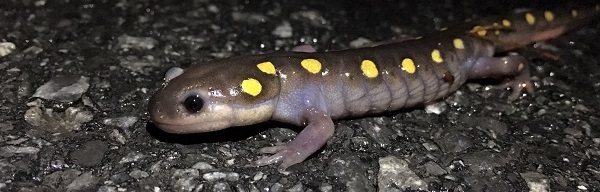
Join the DEC’s Hudson River Estuary Program and Cornell University to learn how to volunteer with the Amphibian Migrations & Road Crossings Project. Volunteers find locations where migrating salamanders and frogs cross roads on their way to vernal pools for breeding in late winter and early spring. They document weather, traffic, and species, and assist amphibians across the road safely. Trainings will be offered on the following dates:
In-person trainings are filling up, but interested volunteers can attend a program offered by an AM&RC Project Partner. Full details are available: 2026 Volunteer Trainings for the Amphibian Migrations & Road Crossings Project | Conservation Planning in the Hudson River Estuary Watershed.
Snapshot NY
The NYSDEC, in collaboration with the New York Cooperative Fish and Wildlife Research Unit at Cornell University, has launched Snapshot NY, a citizen science program that allows the public to participate in wildlife monitoring through the deployment of trail cameras. The project will help improve the way DEC monitors and manages more than a dozen wildlife species. For more information on Snapshot NY and how to participate, visit the Snapshot NY website.
Hudson River Lesson Plans
Explore our collection of Hudson River lesson plans, videos and online activities to support hand on investigations of the Hudson River in your classroom.
Hudson River Miles
The Hudson is measured north from Hudson River Mile 0 at the Battery at the southern tip of Manhattan. The George Washington Bridge is at HRM 12, the Tappan Zee 28, Bear Mountain 47, Beacon-Newburgh 62, Mid-Hudson 75, Kingston-Rhinecliff 95, Rip Van Winkle 114, and the Federal Dam at Troy, the head of tidewater, at 153. The tidal section of the Hudson constitutes a bit less than half the total distance—315 miles—from Lake Tear of the Clouds to the Battery. Entries from points east and west in the watershed reference the corresponding river mile on the mainstem.
To Contribute Your Observations
The Hudson River Almanac is compiled and edited by Tom Lake and emailed weekly by DEC's Hudson River Estuary Program. Share your observations by e-mailing them to trlake7@aol.com.
Was this Newsletter Forwarded to You?
Subscribe today to DEC Delivers Hudson River Almanac topic for weekly natural history journal that covers the Hudson from the High Peaks of the Adirondacks to New York Harbor.
Helpful Resources
National Oceanic and Atmospheric Administration online tide and tidal current predictions are invaluable when planning Hudson River field trips. For real-time information on Hudson River tides, weather, and water conditions from sixteen monitoring stations, visit the Hudson River Environmental Conditions Observing System website.
DEC's Smartphone app for iPhone and Android is now available at New York Fishing, Hunting, and Wildlife App.
|