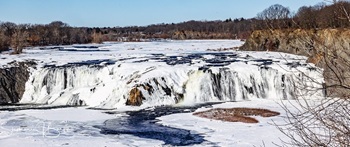
Photo of the falls at Cohoes courtesy of Tom Lake
In this issue:
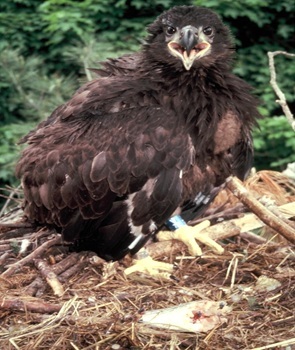
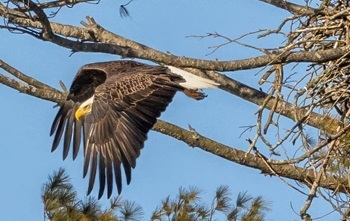
"To band a bird is to hold a ticket in a great lottery,” so wrote Aldo Leopold in A Sand County Almanac (1949). This week we had two examples of bald eagles, banded in the Hudson Valley 23-24 years ago, having returned from faraway places as though we had won the lottery.
2/8 – Verplanck, HRM 40: I recently came upon an adult bald eagle along the river at Verplanck that was sporting a blue leg band number V72. I recognized the band as those applied by DEC’s Pete Nye.
- Kim Gragert
[Pete Nye confirmed that V72 was a male and had been banded in a nest designated as NY62 in Dutchess County, the Town of Wappinger, in the spring of 2003. Our record of the day, May 27, 2003, was documented in the Hudson River Almanac (Vol. X).
“This was “Banding Day.” We found raccoon scat under the nest tree, so the predator guard that we had installed, a broad piece of sheet metal encircling the tree, had done its job. There was just one nestling, a big boy, and we estimated that he was nearly eight weeks old. The nest was seven feet in diameter and four feet deep. As we banded the nestling as V72, the adults flew low overhead, chortling loudly, not so threatening as insulted that we had invaded their nest.
Pete Nye, Tom Lake]”
Three weeks later (June 16), Day 77 since the nestling hatched, with instinctive trust, V72 took his first cautious step off the edge of the nest into a world he had only known from 90 feet up in a white pine. For at least a week, we had been spending the daylight hours watching the nest hoping to see the nestling fledge. The effort paid off.
It was just after first light on June 16 when V72 began its maiden flight coasting down from the nest tree. With no landing experience, the trip was predictably rocky. By chance or choice, he found a short blue spruce, a species of conifer known for its lack of suitably open branches. V72 bounced off as though he had run into wall. He in the grass, dazed, until he gathered his wits and then took off into the forest hoping for better fortune.
- Tom Lake
[Kim Gragert also reported a second bald eagle (V05) that had been banded by Pete Nye as a nestling in 2002 in the Delaware County Town of Tompkins. Tom Lake]
Photo of bald eagle courtesy of Tom Lake
2/6 – Ulster County: A consensus was reached by the NY142 bald eagle nest monitoring team of Bill Bollinger, Mario Meier, Dave Lindemann, and Dale Becker today that bird’s incubation had begun as of February 6. Our decision came after watching the female repeatedly hunker down very low in the nest (we could barely see the top of her head). Meanwhile, the male was frantically bringing additional sticks and twigs to the nest.
-Bill Bollinger
[Last year incubation began on February 5. Calculating the 32-35 day average interim period between laying and hatching, with another mouth to feed, we may see food being brought to the nest during March 8-11. The NY142 Nest Watchers]
2/7 – Saratoga County, HRM 157: Bald eagles were once again on display at the Falls at Cohoes. Under the ice, the Mohawk River was tumbling over into the long plunge pool where the water was extremely high and moving fast. There were several immature eagles that had found less raucous water on the flats, as well as a large flock of common goldeneyes.
- Katrina Van Tassell
Photo of bald eagle courtesy of Katrina VanTassell
2/7 – Tappan Zee, HRM 36: The ice in Haverstraw Bay between Bowline Park and Admiral’s Cove was very active today. Immatures were engaged in catching and carrying tomcod and then fending off other birds from stealing them. Meanwhile, the adults were still into courtship.
- Larry Weiss
Photof bald eagle couresy of Larry Weiss
2/2 – Town of Poughkeepsie: The adults in bald eagle nest NY62 seemed ready for the incubation season soon to come. The female was sitting on a small cup constructed from soft grass in the center of the nest where the eggs will be laid. The male, perched behind the female, seemed to loom in a protective posture.
- Bob Rightmyer
2/8 – Orange County, HRM 44-41: My goodness, it was a cold weekend! January 7, with the strong winds, may have been the coldest conditions I’ve ever been out birding. January 8 was cold as well, but with little wind. I started out in the Black Dirt Region and made my way to the Wallkill River National Wildlife Refuge’s Winding Waters Trail where I found plenty of Lapland longspur and snow bunting.
I began to think about the tundra swan (Cygnus columbianus) that had been reported in the area in recent days. I met up with Rick and MaryAnn Ronzoni, but we had poor luck locating the tundra swan. Heading home, I got a phone call from Rick and Mary-Ann—they had found the bird in a field off Onion Avenue. I went back and it was still there, and what a beauty it was.
- Matt Zeitler
[Tundra swans are often called America’s native swan. Their common name refers to their summer nesting range north of Hudson Bay in the Arctic tundra. They can usually be heard calling long before they are seen, which leads to another frequently used colloquial name, whistling swan. David Sibley remarks that distant flocks sound like “baying hounds.” Tundra swans are occasional visitors to the Hudson Valley during late winter-spring and fall migrations. Tom Lake]
Photo of tundra swan courtesy of Matt Zeitler
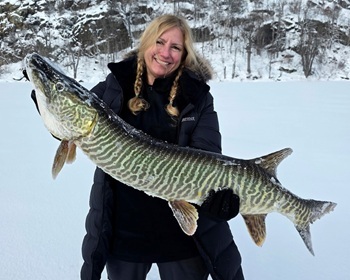
2/9 – Essex County, HRM 302: It was 15 degrees below zero when fishing guide Ryan Lorensen began drilling holes in a small lake located in the Indian River chain. The ice was more than a foot thick and buried beneath two feet of snow and slush. Lorenson had two anglers with him, one of which was Shannon Tierney-Addis. Ryan typically runs seven tip-ups per angler, the maximum number allowed, but that day he ran only half that number because the deep snow made getting between them an exhausting slog.
Early on, they landed a couple of small northern pike on shiners. As evening closed in, they were warming up inside Lorensen’s ice shanty when the spool on the nearest tip-up, set in ten-feet of water, began spinning. Tierney-Addis got to it first and set the hook. Whatever was on the other end peeled off fifty foot of line as she fought it with both hands. Tierney-Addis fought the fish to the hole half a dozen times, and each time it powered away, tearing thirty feet of line off the spool in seconds. Lorensen knew she had a giant tiger muskellunge.
Over the next ten minutes, with multiple attempts to grab the feisty fish, it always shook free and dug for the bottom. After a couple more short runs, the fish seemed to be tiring. By now, Lorensen’s arm was numb from repeatedly dunking in the ice-cold lake, but he finally managed to get a grip under the fish’s gill plate and hauled it onto the ice. In those frigid conditions, prolonged exposure can threaten the life of a fish. So, after a quick measurement—40 inches—and photos were taken, the fish was slid back into the hole.
- Steve Feathstone
Photo of tiger muskellunge courtesy of Steve Featherstone
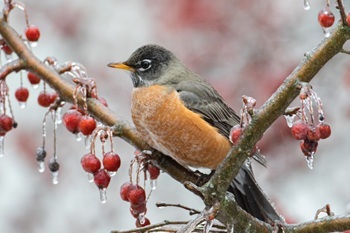
2/9 – Orange County, HRM 46: I woke up this morning—air temperature 15 degrees Fahrenheit (F)—to see a large flock of robins, thirty birds, gleaning what they could from our shrubs. They were not having much luck on the ground due to excessive snow cover, but they seem to be picking what they could from bare spots.
– Alan Groth
[Instinct meets Reality. In recent times, Nature has been getting a lesson in Climate Change. While some American robins winter here, most migrate. The migrants start to notice the lengthening days, less acute angle of the sun, and their bird brains, wired by many millennia of instinct, compute that spring is somewhat near. It seems the two-feet of snow and Arctic air temperatures slips past them. Using ground seed helps robins although they prefer dried fruit on shrubbery. Tom Lake]
Photo of American robin courtesy of Matt Zeitler
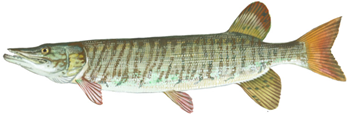
2/10 – Hudson River Watershed: Fish-of-the-Week for Week 353 is the tiger muskellunge. This is not a full species, but rather a hybrid (Esox lucius x E. masquinongy), a cross between a male northern pike and a female muskellunge. As such, the tiger muskellunge, also known as “norlunge,” does not have its own number on our checklist of Hudson River Watershed Fishes, but rather resides directly after the northern pike (number 87). Both the northern pike and the muskellunge are native species. However, the latter has not been documented for the watershed. If you would like a copy of our list, e-mail: trlake7@aol.com.
Tiger muskellunge have been introduced as a sportfish into many of New York's large lakes and rivers by the state Department of Environmental Conservation since the 1970s. Tiger muskellunge are hatched and raised at the DEC South Otselic hatchery in Chenango County and roughly 10,000 are stocked in the Hudson River watershed each year. Of those, 6,000 are stocked in the Mohawk River between Rome and Saint Johnsville. DEC used to stock the lower, eastern Mohawk River (1981-2011) but stopped due to lower than expected returns in subsequent sampling. Most Hudson River estuary records, particularly those near the Federal Dam at Troy, were likely from those stocked in the lower Mohawk (Jeff Loukmas, Scott Wells).
Tiger muskellunge are the “boss” of any water where they are found. They are large, fast, toothy, and relentless predators whose menu includes other fish, reptiles and amphibians, small mammals, and baby ducks. The New York State record size tiger muskellunge, caught by Brett Gofgosky in 1990, was 35 lb. 8 oz., from Sucker Tioughnioga River, Broome County (NYSDEC).
- Tom Lake
Photo of tiger muskellunge courtesy of Duane Raver
2/11 – Hudson River Watershed: Snowflakes form when water vapor converts directly to a solid around particles in the atmosphere, often around dust or pollen. As these ice crystals grow, they fall. Our recent snowstorms produced exquisitely delicate and complex stellar flakes, much lighter and more intricate than those we are used to. What factors determine the shape of a snowflake?
It is the temperature at which a crystal forms—and to a lesser extent the humidity of the air—that determines the basic shape of an ice crystal. Contrary to the belief that it can get too cold for snowflakes to form, snowflakes can form at any temperature if there is moisture in the air.
- Mary Holland
Photo of snowflakes courtesy of Mary Holland
2/12 – Town of Poughkeepsie: In preparation for the soon to begin nesting season when the adults at bald eagle nest NY62 will share incubation duties—on average, the female covers 16 of the 24-hour day—the adults seemed to be practicing in and out switch-overs.
- Bob Rightmyer
Photo of bald eagle courtesy of Bob Rightmyer
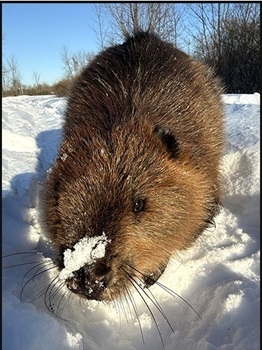
2/13 – Hudson River Watershed: More than a week of below-freezing weather, often near zero, presented many species with challenges. One might think that beavers are not affected by the frigid weather, as they are wintering inside a lodge that stays around 32 degrees F. even with sub-zero outside temperatures. However, if there is enough open water for a beaver to enter and exit its pond, the thought of fresh cambium in the middle of winter is something few beavers can resist.
Recently I came upon a beaver that had given in to this temptation—it left its lodge, swam to a very small opening near the bank of the pond and climbed out on land to have something other than the three-month-old, submerged pile of water-soaked branches next to its lodge to eat. This venture in nine degrees Fahrenheit provided me with not only an encounter with the cold-to-the-point-of-barely-moving beaver but also showed me what the trail of a beaver walking in a foot of snow looks like.
Much to my surprise, I also came upon beaver scat lying in the snow where the beaver had traveled. Beavers are known to only defecate outside of their lodge in the water, so that you rarely come upon scat, and when you do, it’s on the bottom of the pond near a dam or channel, where the beaver’s spent time excavating or building. To find it in the snow was a first for me. Trails, scat, and eye-to-eye with my favorite rodent in the middle of winter was an outing I shall not soon forget.
- Mary Holland
Photo of beaver courtesy of Mary Holland
Science Saturday at Norrie Pint Environmental Center
Join us for our monthly Science Saturday programs and explore Norrie Point. Check out our series by visiting our website. Events are free and open to the public. Registration is not required.
The upcoming Science Saturday programs are:
- February 21, 10 am -12 pm - Winter Mysteries
- March 28, 10 am - 12 pm - Signs of Spring
- April 18, 10 am - 12 pm - Vernal Pool Exploration
- May 2, 10 am - 12 pm - I Love my Park Day
The Norrie Point Environmental Center is located at 256 Norrie Point Way, Staatsburg NY 12580
- Rebecca Houser, Education and Outreach Specialist, HREP and NEIWPCC
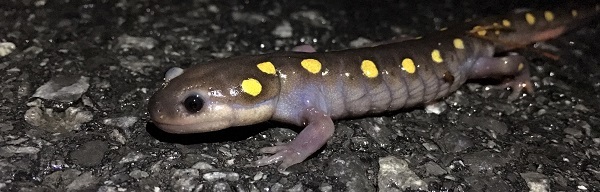
Amphibian Migrations & Road Crossings Program – 2026 Volunteer Trainings
Join the DEC’s Hudson River Estuary Program and Cornell University to learn how to volunteer with the Amphibian Migrations & Road Crossings Project. Volunteers find locations where migrating salamanders and frogs cross roads on their way to vernal pools for breeding in late winter and early spring. They document weather, traffic, and species, and assist amphibians across the road safely. Trainings will be offered on the following dates:
In-person trainings are filling up, but interested volunteers can join our Virtual Training on Tuesday, February 24 at 5:30-7:30pm or attend a program offered by an AM&RC Project Partner. Full details are available: 2026 Volunteer Trainings for the Amphibian Migrations & Road Crossings Project | Conservation Planning in the Hudson River Estuary Watershed.
Snapshot NY
The NYSDEC, in collaboration with the New York Cooperative Fish and Wildlife Research Unit at Cornell University, has launched Snapshot NY, a citizen science program that allows the public to participate in wildlife monitoring through the deployment of trail cameras. The project will help improve the way DEC monitors and manages more than a dozen wildlife species. For more information on Snapshot NY and how to participate, visit the Snapshot NY website.
Join DEC's Hudson River Estuary Management Program and the Hudson River National Estuarine Research Reserve’s - Free Virtual Winter Speaker Series!
Meet and learn from scientists, community leaders, and environmental educators who work at the intersection of research, education, and environmental and social justice. Engage in discussions about monitoring and research, field-based learning, and creating pathways to overcome barriers and challenges in the field of science and education. Visit our website for more information and to register.
The upcoming webinars are:
- February 25, 3:30-4:30 pm, Portrait of a Graduate: Environmental Education for Changing Guidelines by Emily Marcet
Hudson River Lesson Plans
Explore our collection of Hudson River lesson plans, videos and online activities to support hand on investigations of the Hudson River in your classroom.
Hudson River Miles
The Hudson is measured north from Hudson River Mile 0 at the Battery at the southern tip of Manhattan. The George Washington Bridge is at HRM 12, the Tappan Zee 28, Bear Mountain 47, Beacon-Newburgh 62, Mid-Hudson 75, Kingston-Rhinecliff 95, Rip Van Winkle 114, and the Federal Dam at Troy, the head of tidewater, at 153. The tidal section of the Hudson constitutes a bit less than half the total distance—315 miles—from Lake Tear of the Clouds to the Battery. Entries from points east and west in the watershed reference the corresponding river mile on the mainstem.
To Contribute Your Observations
The Hudson River Almanac is compiled and edited by Tom Lake and emailed weekly by DEC's Hudson River Estuary Program. Share your observations by e-mailing them to trlake7@aol.com.
Was this Newsletter Forwarded to You?
Subscribe today to DEC Delivers Hudson River Almanac topic for weekly natural history journal that covers the Hudson from the High Peaks of the Adirondacks to New York Harbor.
Helpful Resources
National Oceanic and Atmospheric Administration online tide and tidal current predictions are invaluable when planning Hudson River field trips. For real-time information on Hudson River tides, weather, and water conditions from sixteen monitoring stations, visit the Hudson River Environmental Conditions Observing System website.
DEC's Smartphone app for iPhone and Android is now available at New York Fishing, Hunting, and Wildlife App.
|