|
In the world of source water protection planning and implementation, the roles that stakeholder group participants play a significant role in achieving short and long-term success. While many people may be familiar with the concept of a stakeholder group, having members that reflect and represent the municipality’s goals and interests is just as important to source water protection as the purpose of the group itself. As plans take shape, the stakeholder group designates a Program Management Team (PMT). This team of specialists administers the program and launches the plan into implementation. To spearhead these efforts, the PMT designates one or more of its members as champion. If the formation of a comprehensive and knowledgeable stakeholder group helps guide the development and implementation of a DWSP2 plan, what would the responsibilities of this designated champion look like?
During the establishment of DWSP2 in 2017, the concept of designating a DWSP2 champion at the local level was born out of the desire to create a long-lasting program. By having an individual become the steward for their local program, it may increase the likelihood that DWSP2 continues to be relevant once their local program reaches implementation and beyond.
The selection of a DWSP2 champion is a unique, non-standardized process for each community. Based on internal evaluation, however, the selected individual(s) are typically able to contribute invaluable expertise and maintain a well-connected position in their municipality (e.g., a Mayor, Town Supervisor, or member of the County Health Department) that benefits source water protection efforts.
DWSP2 champions play a critical role in maintaining the momentum of their municipalities DWSP2 plan as it moves further into implementation. Champions spearhead the efforts to maintain steady progress towards executing actionable source water protection items in the plan. As champion, they provide an open communication channel, primarily through progress and periodic updates through interviews like the one captured in this newsletter. Keeping a strong connection between the community and the state is one-way DWSP2 communities are able to receive the necessary support to efficiently protect their source water. Other key responsibilities of DWSP2 champions include but are not limited to:
- Program advocacy.
- Public outreach concerning DWSP2 initiatives.
- Creating and maintaining local partnerships/relationships.
- Leveraging PMT skillsets.
To learn more details about what it is like to be a DWSP2 champion, program staff conducted a roundtable interview with two DWSP2 champions: Davina Thurston, Town Supervisor for the Town of St. Armand and Emily Beers, Public Health Sanitarian for the Chautauqua County Department of Health. Read excerpts of this interview below to learn about each of their unique champion experiences.
Q: When did you first start working on DWSP2?
A: (Davina Thurston, Town Supervisor, Town of St. Armand): For me, we have an Essex County Planning Office, and they write all of the grants for all the municipalities in Essex County. The value of Anna Reynolds and her team cannot be understated; I feel that Essex County has benefitted greatly from their work. So, Anna approached me about applying for DWSP2. She explained how it helps with proactive source water protection and that participation in the program might help us spur action in other similar areas of interest, like receiving funding to purchase the wellfield that we have been using for 150 years without ownership. These conversations served as the catalyst. So, in short, I’ve been involved from before day one.
A: (Emily Beers, Chautauqua County Department of Health, Chautauqua Lake Communities): I was involved right from the beginning. DOH technical assistance providers had originally reached out and communicated to me that they were committed to assisting Chautauqua Lake Communities with DWSP2. They explained to me that they thought I should be involved since the county DOH serves as a great “middleman” between local municipalities and the State. So I am proud to say we were involved pretty much from the get go.
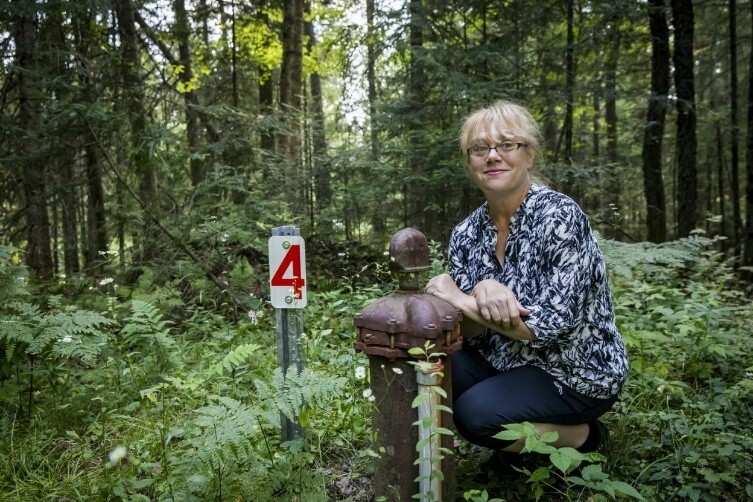
Figure 1. Davina Thurston, Town of St. Armand Supervisor, at the municipality's wellhead #4.
Q: Prior to your involvement with the program, had you ever been involved in a planning and/or implementation process like DWSP2?
A: (Davina Thurston, Town Supervisor, Town of St. Armand): As Town Supervisor I was involved with the creation of St. Armand’s Comprehensive Plan, and I would say there were similarities between that experience and working on DWSP2. In both cases there was a group of people working on different tasks at regularly scheduled meetings, and by attaining smaller goals every month, the entire thing eventually got done. I treated my involvement in DWSP2 similarly, with good results.
A: (Emily Beers, Chautauqua County Department of Health, Chautauqua Lake Communities): Not through New York State, but I did work on a project in graduate school when I was in Ohio. The project centered around drinking water reservoirs and the use of algal herbicides on these water sources, namely which ones were least harmful to apply to the source and were most friendly to the treatment process. While working on the research for that project I had the opportunity to attend several working group meetings about algal limitation in drinking water sources. I would say that experience and working on DWSP2 are comparable.
Q: What was working with your technical assistance provider like?
A: (Davina Thurston, Town Supervisor, Town of St. Armand): It was great! They were extremely knowledgeable. It was an engineering firm, of course. The way the application process worked, you know, the state awarded our technical assistance provider, so while we didn't get to pick who we worked with, they were fantastic, they were diligent, and they brought up a lot of topics I hadn't even thought of before. I'm not a geologist. I'm not an expert in fractures and granite and how that functions with our wells. So working with a group who did possess that knowledge was very interesting and I really learned a lot. I am really grateful for their assistance.
A: (Emily Beers, Chautauqua County Department of Health, Chautauqua Lake Communities): We mostly work with a DOH technical assistance provider, and currently Maya Ray is the specific point person. Maya has taken over the reins and yeah, Maya's been great, very knowledgeable, always willing to help, consistently sending examples of things that others involved in drinking water source protection have done. Overall, she has been a fantastic support.
I’ll also add that it's nice that they do some of the GIS work for our mapping series, especially because that's some of my background as well. The state has access to so many different files and databases. Between the two of us we had everything that was needed to complete the mapping portion of the of the plan and complete it well.
Q: How much time per month would you estimate the stakeholder group spent working on plan development?
A: (Davina Thurston, Town Supervisor, Town of St. Armand): Quite a bit, I spent several hours after each meeting organizing notes and evaluating progress. On the weeks that we would meet, I would spend about 10 hours after each meeting, gathering data like historical information, well data, and water withdrawal reports.
A: (Emily Beers, Chautauqua County Department of Health, Chautauqua Lake Communities): I was not present for a portion of the writing process. Due to other work, I was pulled away for two years from DWSP2 work and brought back in six months ago.
Q: From a champion’s POV, what is the importance of your role on the stakeholder group? In other words, without a champion, consider how the progress would be different from where it is today.
A: (Davina Thurston, Town Supervisor, Town of St. Armand): In my experience, champion equals “point-person”. To thrive, I believe a DWSP2 plan needs dedication from at least one individual to manage the various personalities working towards the same goal. My primary reason for running for Town Supervisor was to one day own our wellfield, and when I became aware of DWSP2 as an opportunity to do that, I felt compelled to be as involved as I could be. Even if that meant championing DWSP2 after losing an election, I took my role in DWSP2 very seriously. To sum my answer up, it is critical to have one person that is really passionate about the project, which obviously Emily is too. Having one person truly commit to the follow up and follow through to make sure that all the outcomes can be met ignites DWSP2 progress.
A: (Emily Beers, Chautauqua County Department of Health, Chautauqua Lake Communities): I would agree with Davina about the crucial nature of being passionate about the program. On the task management side, proper delegation can be a useful skill to have as champion and figuring out how to play to the strengths of your PMT members is a skill that will help DWSP2 out in both the short term and long term. Without a champion, plan development and implementation progress would stagnate, and the work would be unorganized.
Q: What 3-5 words would you use to describe what it takes to become a successful DWSP2 Champion?
A: (Davina Thurston, Town Supervisor, Town of St. Armand): Committed, dedicated, diligent.
A: (Emily Beers, Chautauqua County Department of Health, Chautauqua Lake Communities): Passionate, organized, persistent.
Q: What advice would you give to other champions embarking on their DWSP2 experience?
A: (Davina Thurston, Town Supervisor, Town of St. Armand): Embrace the program and utilize the stakeholder group connections. The opportunity to learn is immense, the detail is interesting, even if you are someone who has frequently visited your source water. I would stress viewing DWSP2 as a collaborative opportunity. Being involved in DWSP2, I became aware of the source of one of our key contaminants (PFOAs). Overall, be open-minded, realize it is work, but it is worth it as well.
A: (Emily Beers, Chautauqua County Department of Health, Chautauqua Lake Communities): I would echo the open-minded concept Davina mentioned. For our DWSP2 plan, there are a lot of people with different backgrounds and roles on our stakeholder group, so managing personalities is as much a part of it as assigning roles and they go hand-in-hand. Being a champion requires patience. Don’t get discouraged if progress doesn’t feel quick enough or attendance is lower.
Understanding that DWSP2 champions are integral to the sustained success of source water protection at the municipal level, the program wanted to listen to those who have been championing DWSP2 for years. The program leaned on current DWSP2 champions for their distinctive relationship with PMT members and unique position in their respective local programs to learn how effective their role is to sustain municipally-driven source water protection.
Gathering two DWSP2 champions together had the additional benefit of cross-collaboration problem solving. For example, when Emily Beers was asked about the goals she set for herself as DWSP2 champion, the overarching goal she communicated was to facilitate the passing of Chautauqua Lake Communities DWSP2 plan at the local level. While detailing this goal and talking through potential strategies and connections she may use, Davina Thurston chimed in. As Town Supervisor, she has experience passing local laws, and a conversation blossomed.
Other conversations like this dotted the interview, namely concerning stakeholder group management and overall DWSP2 champion strategy. As more DWSP2 communities launch their plans into implementation, more champions will emerge. We highly encourage communities in the program to take the initiative to conduct local roundtables for the development of working relationships between key DWSP2 participants. Additionally, program staff look forward to providing more roundtable opportunities in which champions can share their experiences and collaboratively troubleshoot common issues associated with managing source water protection plans at the municipal level.
Hosting an event, webinar, or conference in 2026? Reach out to us at source.water@dec.ny.gov to schedule a presentation or tabling event. If you would like to learn more about DWSP2 and how it could help your municipality, fill out our Interest Form and a member of the DWSP2 team will contact you to discuss further.
Missed the previous edition? Visit the DWSP2 Newsletter Archive to stay up to date.
Have you begun the DWSP2 process? Or do you have a program or are you aware of a program relevant to source water? Send in any helpful hints or information at source.water@dec.ny.gov and we may highlight them!
Follow DEC on Instagram to see what more you can learn about Connecting Climate Change to Drinking Water.
|