|
Stony Brook University's New York State Center for Clean Water Technology Highlight
The Long Island Watershed Program is focused on protecting and restoring the region’s groundwater, lakes, rivers, and coastal waters through coordinated, science-based action. The work of the Stony Brook University New York State Center for Clean Water Technology (the Center) directly supports these goals by developing, testing, and implementing innovative wastewater and nutrient management solutions that reduce nitrogen, phosphorus, and emerging contaminants at their source. Through applied research, pilot-scale testing, and real-world deployment, the Center helps translate watershed planning objectives into measurable water quality improvements across Long Island.
Funded by the New York State Environmental Protection Fund, administered by the New York State Department of Environmental Conservation (DEC), and with additional state funding from the New York State Department of Health, the Center continues to play a pivotal role in driving innovation and delivering much-needed improvements in water and wastewater technology. "Thanks to our support from New York State, the Center has reached exciting new milestones with regards to removing nitrogen, phosphorus, and emerging contaminants from wastewater, groundwater, and drinking water,” stated the Center’s Director, Dr. Christopher Gobler. “I am confident that several of our ongoing projects will soon be transforming our collective ability to provide New York with clean water for generations to come."
In this month’s Long Island Watershed Program newsletter, we take a deeper look at several of the innovative technologies and initiatives currently underway at the Center.
Wastewater Nitrogen Management
Conventional Retrofits
A major focus of the Center’s work continues to be the reduction of nitrogen from conventional onsite wastewater systems. To that end, the Center has successfully installed a new full-scale prototype of a “conventional retrofit,” designed by the Center’s Watershed Manager, Tom Varley. This technology removes nitrogen in a conventional septic tank and leaching structure using a novel, simple, and relatively inexpensive retrofit approach.
The system introduces floating moving bed bioreactor (MBBR) pods into the septic tank to achieve nitrification, combined with a woodchip biofilter for denitrification. This unique retrofit application allows for reuse of a homeowner’s existing infrastructure, significantly reducing Innovative Alternative Onsite Wastewater Treatment Systems (IA) costs while minimizing property disruption and restoration, with minimal additional operation and maintenance expenses. Testing conducted during the summer and fall demonstrated that the system produced effluent meeting drinking water standards for nitrogen (10 mg/L). With the potential to upgrade more than 100,000 conventional systems in Suffolk County, this approach represents a significant opportunity for cost-effective nitrogen reduction at scale.
FlexTreat™
Building on these advances, the Center has also continued to refine proprietary treatment systems. In April 2024, the Center was granted a U.S. patent for its FlexTreat Biofilter™ wastewater treatment system, designed by the Center’s Associate Director of Engineering and Construction, Frank Russo, P.E. FlexTreat is a prefabricated, plug-and-play, continuous-flow nitrogen-removing onsite wastewater treatment system that uses inexpensive and readily available filtration media and woodchips to convert ammonia to nitrogen gas.
The system incorporates a variety of flexible, operator-friendly controls to ensure consistent nitrogen reduction under varying wastewater strength and flow conditions from home to home. After three years of successful pilot testing, FlexTreat has consistently produced effluent meeting or exceeding Suffolk County’s target of 19 mg/L total nitrogen. Ongoing refinement aims to lower costs, reduce maintenance requirements, and further improve performance, with plans to seek approval from the Suffolk County Department of Health Services (SCDHS) and certification for entry into the global market.
“The Wastewater Research and Innovation Facility enables the installation of full-scale prototypes, enabling comprehensive performance studies and in-field physical enhancements, while always seeking a less costly system that maintains strict performance goals for nitrogen removal,” said Mr. Russo. “The FlexTreat Biofilter would not have been possible without the facility.”
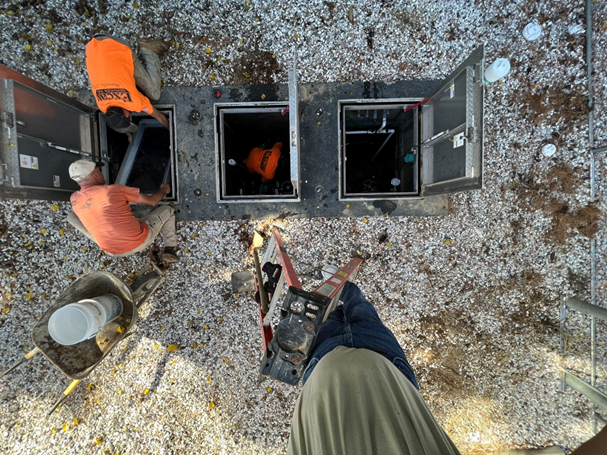 |
NYS Center for Clean Water Technology, Wastewater Research and Innovation Facility; Flex-Treat Prototype 1. Photo Credit: The Center.
Nitrogen-Removing Biofilters (NRBs)
In parallel with proprietary system development, the Center continues to advance non-proprietary nitrogen-removal technologies. Under the direction of the Center’s Associate Director of Wastewater Initiatives, Dr. Stuart Waugh, the Center’s NRB designs have been installed at more than two dozen sites. These systems treat wastewater through a sand bed and an oxygen-free sand and woodchip biofilter to remove nitrogen and other pollutants.
Recent testing of two NRB variants—the lined NRB and the woodchip-box NRB—demonstrated nitrogen removal rates of 85% and 90%, respectively, significantly outperforming conventional systems. These systems use local materials and labor, have few moving parts, and are the only IA systems in Suffolk County demonstrated to remove pharmaceuticals, personal care products, and other emerging contaminants. Both systems have received provisional approval from SCDHS and are progressing toward general use approval.
To further expand deployment, the Center will install five gravity-dosing NRBs in sensitive Suffolk County Parks through a Water Quality Protection and Restoration Program (WQPRP) grant (subject to appropriation by the Suffolk County Legislature). These systems require no electrician, no control panel, and incur no monthly electricity costs—unlike all other IA systems approved for provisional or general use in Suffolk County.
Additionally, in 2025 the Center has been awarded more than $500,000 from the Long Island Sound Futures Fund to install ten woodchip-box NRBs within the Long Island Sound watershed of Suffolk County. Following evaluation of more than 30 potential sites, design and permitting are complete, and installations are expected this year.
Woodchip Box Polishing Units
Complementing these efforts, the Center authored an engineering report—approved by SCDHS—that enables the use of woodchip box polishing units as complimentary components to approved IA systems. Several polishing units have now been installed and tested, with initial results indicating that IA systems paired with woodchip box polishing units can produce effluent meeting drinking water standards for nitrogen.
To support broader adoption, the Center secured Community Preservation Funding from the Towns of East Hampton and Southampton to cover the cost of these woodchip boxes. Funding remains available for additional installations, which the Center continues to encourage.
Failed Denites
The Center is also addressing legacy wastewater challenges. Through a WQPRP grant (subject to appropriation by the Suffolk County Legislature), the Center is evaluating the feasibility of retrofitting failed modified subsurface sewage disposal systems, commonly referred to as “failed denites.” These systems were installed in the 1980s to allow increased development density in unsewered areas, however only the first demonstration system performed as intended. The subsequent 450 installations failed, leading to a DEC ban on the technology.
This project will evaluate retrofit options using superior nitrogen-removing biofilters and other IA systems. Three sites will be selected for evaluation, with the goal of constructing at least one retrofit in 2027.
Permeable Reactive Barriers
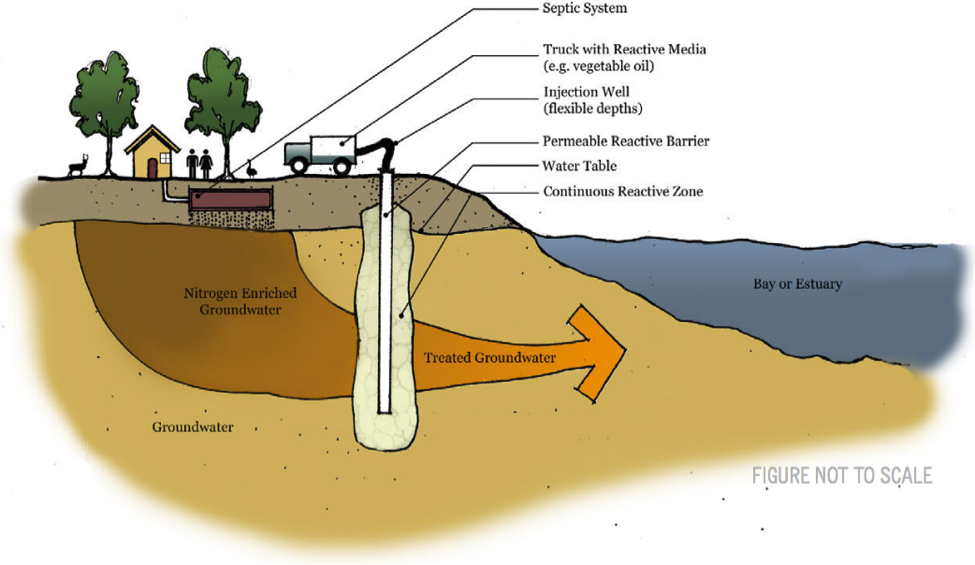
Beyond onsite systems, the Center continues to advance groundwater-based nitrogen reduction strategies. In collaboration with DEC and SCDHS, the Center completed a Roadmap document for the design, installation, and maintenance of Permeable Reactive Barriers (PRBs). Faculty collaborator Professor Nils Volkenborn played a key role in conducting the field and laboratory research that informed this guidance. The Roadmap document can be read here.
Professor Volkenborn’s lab continues to optimize PRB designs to achieve effective nitrate removal while avoiding over-treatment that could generate undesirable byproducts such as methane or sulfide gas. The lab also completed foundational research identifying optimal mixtures of emulsified vegetable oil (EVO) for nitrate removal via injection wells.
Diagram of injection well PRB. Photo Credit: Cape Cod Commission.
Using this scientific foundation, the Center initiated site characterization efforts in the watersheds of Mill Pond in Water Mill, Southampton, and Wainscott Pond in East Hampton. Work at Mill Pond enabled the Center to secure a $300,000 Community Preservation Fund grant from the Town of Southampton to install a PRB at that site. Additional site characterization is ongoing at Wainscott Pond and Georgica Pond, supporting future grant applications for PRB installation.
“PRBs are an additional tool in our toolbox,” according to Professor Volkenborn. “While the Center’s ultimate goal is to reduce and eventually stop the release of excess nitrogen to Long Island’s groundwater, we still have to deal with the nitrogen that has entered the aquifer years and sometimes decades ago. Strategically placed PRBs that intercept the groundwater flowing towards and eventually discharging into surface water bodies are an effective approach to remove this ‘legacy nitrogen’ before it causes harm to lakes and coastal ecosystems.”
Wastewater: Phosphorus Initiatives
As LINAP expands into the Long Island Watershed Program and Watershed Action Agenda, the Center has increased its focus on phosphorus, a key contaminant responsible for impairments in numerous Suffolk County freshwater bodies, including Lake Ronkonkoma. Wastewater represents a potentially significant source of phosphorus, particularly in nearshore areas adjacent to lakes and streams.
Led by Dr. Xinwei Mao, Associate Director of Phosphorus Initiatives, the Center is developing affordable, reliable, and effective onsite wastewater treatment technologies for phosphorus removal. These efforts employ multiple treatment approaches, including adsorption, precipitation, and electrochemical reactions.
Materials Development, Testing, and Process Evaluation
The Center has synthesized a novel, bio-based phosphorus removal and recovery media that integrates woodchip-based biochar and oyster shells using a one-pot conversion method. This material demonstrates a phosphorus capture efficiency of 99%, with low energy requirements. Initial testing shows that 70–90% of captured phosphorus can be desorbed and recovered as plant-available orthophosphate. A patent application for this technology is currently underway.
In addition, the Center is evaluating other materials for phosphorus treatment. Pilot-scale testing of Polonite, a filter media based on the natural mineral Opoka, over a 300-day experiment has identified effective configurations and hydraulic residence times for phosphorus removal.
Field Characterizations
Field studies examining phosphorus fate and transport downstream of septic systems near Lake Como, NY, have continued. Preliminary findings suggest dissolved phosphorus in residential wastewater is largely adsorbed by nearby silts and clays, though it may migrate through gravel layers. Soil samples collected between residential sites and the lake revealed total phosphorus accumulation downstream of leaching fields. The Center is currently conducting extraction and grain size analyses, with results expected by early 2026.
Real-World System Testing
Looking ahead, the Center plans to install at least three phosphorus removal systems in 2026 to evaluate treatment efficiency and impacts on groundwater and surface waters. Through a recently awarded WQPRP grant (subject to appropriation by the Suffolk County Legislature), two systems based on Dr. Mao’s lab research will be installed within the Lake Ronkonkoma watershed. Prior to installation, phosphorus loading and transport from existing septic systems will be assessed. A third phosphorus filter will be installed at a Suffolk County Park site within a separate freshwater watershed.
Wastewater Emerging Contaminants
Led by Associate Director for Emerging Contaminants Research, Dr. Lokesh Padhye, the Center’s emerging contaminants program evaluates pollutants such as 1,4-dioxane, PFAS, and other contaminants in wastewater, groundwater, drinking water, surface waters, and aquatic ecosystems.
A key focus of this work is biochar—a carbon-rich material produced through pyrolysis of organic feedstocks. Biochar’s stable carbon structure enables long-term carbon sequestration while also providing strong sorption capacity for nutrients and emerging contaminants, including PFAS. The Center plans to install biochar production units to create renewable, sustainable treatment solutions using Long Island feedstocks such as invasive bamboo, waste wood, kelp, and oyster shells.
Phase 1, beginning in 2026, will focus on bench-scale testing, with the goal of scaling up production in 2027 for real-world applications across Suffolk County.
Welcoming the Newest Member of the Team: Walter Dawydiak
This past year the Center welcomed Walter Dawydiak P.E., J.D. as the newest member of the team. Walter serves as the Center’s Water Quality Development Liaison, advancing Center objectives in collaboration with various agencies and partners. Walter served as Suffolk County’s Director of Environmental Quality for the last 14 years of his 36-year career with the Suffolk County Department of Health Services (SCDHS). At SCDHS, he managed a staff of 160 professionals, conducting comprehensive programs addressing pollution control (wastewater, and toxics/hazardous materials), groundwater, drinking water, lab analysis, and freshwater and estuarine health.
Walter directed, managed, or coordinated every major environmental health plan developed by SCDHS between the 1980s and the 2020s, including the Brown Tide Study (1992), Peconic Estuary Program (now Peconic Estuary Partnership, commenced in 1993), Source Water Assessment Program (2000), Suffolk County Comprehensive Water Resources Management Plan (2015), and Subwatersheds Wastewater Plan (2020). This work served as the technical foundation for progressive Sanitary Code changes, as well as the newly formed Suffolk County Wastewater District and the voter-approved Water Quality Protection Act fund.
“It’s an exceptionally exciting time to join Dr. Gobler’s team at the Center at this historic turning point for environmental health,” said Mr. Dawydiak. “I’m grateful for the opportunity to support the Center’s science and technology initiatives, and to help deliver results to agencies and stakeholders in the most efficient and useful way possible.”
Connect with Us!
|