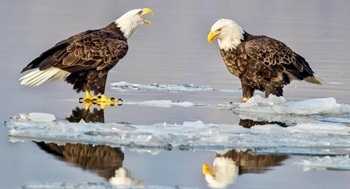
Photo of bald eagles on ice courtesy of John Badura
In this issue:
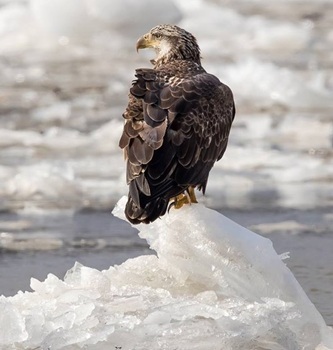
This is the season to watch eagles on ice floes. With good optics you can get incredible looks of eagles on tidewater in action rather than just loafing in trees. In addition to catching the mating antics of the birds, maintenance activity at most eagle nests are in high gear.
1/10 – Rensselaer County, HRM 133: A bean-goose (Anser sp.) was photographed today at Swartz Farm in South Schodack by Jim de Waal Malefyt. It looked very similar to the bean-goose that spent much of early 2025 between Saratoga and Washington counties (and which itself had a short sojourn into Northern Rensselaer county).
- Zach Schwartz-Weinstein, Hudson-Mohawk Bird Club
[A Taiga [forest] bean-goose (Anser fabalis) — the referenced 2025 bean goose — is one of two Anser species that taxonomically share the same genus and family (Anatidae), which includes the tundra bean-goose (A. serrirostris). There is some discussion among taxonomists that the two Scandinavian/Siberian Anser species may be regional variations of the same species. They are recognized as separate species by the American Ornithological Society and the International Ornithologists' Union but are considered a single species by other authorities and are collectively called bean-goose. Rich Guthrie]
[The "bean-goose" is a duo of mostly brown geese, smaller than the familiar Canada goose. They have an indistinct white line along the folded wings and distinctive bright orange/pink legs, especially visible when the goose is standing on ice. The distinguishing feature separating the two sibling species is the shape and color of their bill, with the amount of orange being the key difference (Ottenburghs, Honka, Müskens, and Ellegren, 2022.]
Photo of taige bean-goose courtesy of Zach Schwartz-Weinstein
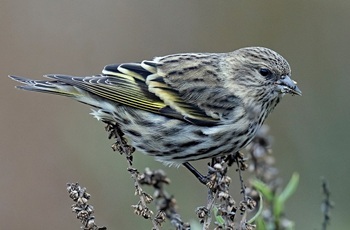
1/10 – Orange County, HRM 11: I had a day at the Wallkill River National Wildlife Refuge’s Liberty Loop in the Black Dirt region. The warm temperatures we’ve been experiencing melted nearly all the snow, which also allowed me to walk some trails such as the Wallkill River National Wildlife Refuge’s Winding Waters Trail. I missed my target bird of the day, a northern shrike, that had been reported there in recent days. But it was a nice, birdy walk, and I added three species to my 2026 Orange County list: Northern flicker, swamp sparrow, and a gorgeous pine siskin.
- Matt Zeitler
Photo of pine siskin courtesy of Deborah Allen
1/11 – Town of Saugerties, HRM 102: The 21st annual Esopus Bend Nature Preserve Winter Bird Count was conducted on January 11. One field party surveyed the 160-acre nature preserve recording a total of 308 birds representing 37 species during an eleven-hour effort that included two hours of nocturnal “owling."
The most conspicuous aspect of this year’s effort was the general lack of bird abundance. Our total number of individuals was a record low for this census, well-below our ten-year average of 584 birds. For the first time, we failed to exceed 450 individuals since our previous low count of 361 in 2011. Most of the terrain we surveyed was ominously quiet with a noticeable scarcity of bird activity.
Several flyovers, however, added three black vultures and an adult bald eagle to the day’s tally. American tree sparrow was not detected for the first time in this count’s 21-year history. Sparrows were few with just six song sparrows tying our previous low count. White-throated sparrow (33) and dark-eyed junco (20) were 50% below their recent ten-year averages, and we did not encounter any field sparrows for the first time in the last seven years. One swamp sparrow coaxed out of a dense cattail bed was the one positive sparrow highlight.
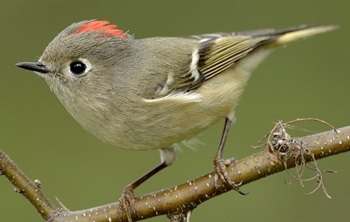
Three ruby-crowned kinglets established a new record high for a species that has only been detected on this count as single individuals in three of the previous 20 years. Thanks to Mark DeDea, George Baird, and Erica Obey for assisting with this year’s count.
- Steve M. Chorvas
Photo of ruby-crowned ringlet courtesy of Allen Murphy
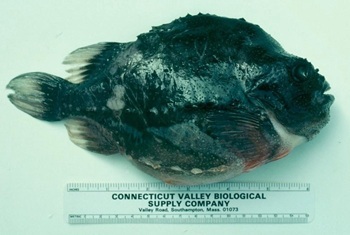
1/12 – Hudson River Watershed: Fish-of-the-Week for Week 349 is the lumpfish (Cyclopterus lumpus Linnaeus, 1758), number 142 (of 239) on our watershed list of fishes. If you would like a copy of our list, e-mail - trlake7@aol.com. Note that Cyclopterus lumpus has a valid synonym, C. lumpus. hudsonius (Cox, 1920).
Lumpfish is the only member of their family, the lumpsuckers (Cyclopteridae), found in our watershed. They are classified as a temperate marine stray. The lumpfish looks decidedly oblong and lumpy, like a small football. There are very few forms of wildlife whose common name is a better fit. Bigelow and Schroeder describe them as “ungainly” in their 1953 classic, The Fishes of the Gulf of Maine. They refer to them as “lump,” or collectively, “the lumps.”
They are a solitary bottom (benthic) fish, feeding on isopods, amphipods, small crustaceans, small fishes, and ctenophores (one of few fishes that feeds on comb jellies). They have a ventral sucking disc that allows them to hold fast to bottom structure in strong currents. Most lumpfish average a foot-long but can reach 24-inches and weigh 20 lbs. They are caught, often as bycatch, in lobster pots set on stony bottoms. While they are rarely eaten, their roe is a good source of omega-3 fatty acids and is marketed as an inexpensive caviar. Briggs and Waldman (2002) find them not uncommon in the New York Bight in winter and early spring.
Bob Schmidt investigated lumpfish records at the New York State Museum and found a report by ichthyologist Samuel Latham Mitchill of two “lump suckers” (C. caruleus, synonym for C. lumpus), from “the Bay of New York,” caught in commercial shad nets on April 11 and May 14, 1815 (On the Fishes of New York 1815).
Photo of lumpfish courtesy of Tom Lake
The lumpfish made it onto our present Fishes of the Hudson River list in May 1992. Legendary Edgewater (NJ) shad fisherman Ron Ingold, and I, were out on a night tide tending to his series of 300-foot-long anchor gillnets under the George Washington Bridge. It was low tide and the net was slack in the water. We waited patiently for the turn of the tide, the beginning of the flood, that would give the net some stretch (scope) and make hauling and picking of the shad much easier.
Near the end of our haul, I came upon a fish in Ron’s 5¼ -inch mesh that I had never seen before. Our mentor, Dr. C. Lavett Smith of the American Museum of Natural History, had coached us to be on the lookout for new-to-the-river fish species. This was surely one of those. I took it home in my ice chest.
A few days later, I visited the AMNH Department of Ichthyology (NYS) where “Smitty” confirmed our identification: we had a Cyclopterus lumpus Linnaeus (1758). Adult males in their spawning season develop a vivid red blotch near a bony suction disc on their chest. This lumpfish had hints of red on its chest, thus, likely a male. I added the fish to our watershed fish list.
I kept the fish in my freezer for a month or more and it became a valuable addition to my elementary school classes on fish morphology. I also suggested to the students that Swedish Zoologist, Carl Linnaeus, who named the lumpfish, had a good sense of humor.
- Tom Lake
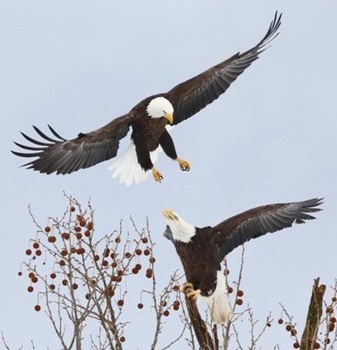
1/13 – Dutchess County, HRM 83: I made a tour through eastern Dutchess County today to find and photograph bald eagles. Being that it was the mating season for eagles, I was not surprised to find many examples of paired adults cavorting in amorous exchanges in the sky.
- Judy Winter
Photo of bald eagles courtesy of Judy Winter
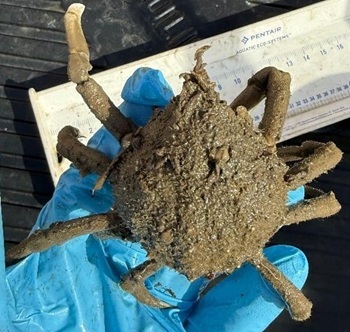
1/13 – Manhattan, HRM 1-2: On an unseasonably warm January afternoon, our Hudson River Park's River Project staff checked our research gear (pots and traps) that we deploy from floating docks on the south-side of Piers 26 and 40 for our ongoing Fish Ecology Survey. Our catch was seasonally slim, with the highlight being a wintering, young-of-year, striped bass (80 mm). Some common invertebrates included black-fingered mud crabs, grass shrimp (Palaemon sp.), and isopods. Surprisingly, four juvenile (10-15 millimeters) common spider crabs (Libinia emarinata) were also collected, which was uncommon for our site in winter.
- Toland Kister, Renee Mariner, Beryl Kahn
[Note: One-inch equals 25.4 millimeters (mm). Tom Lake]
[Crab measurements (size) are calculated in millimeters (mm) point-to-point across their carapace. Tom Lake]
Photo of spider crab courtesy of Jimi Wiggins
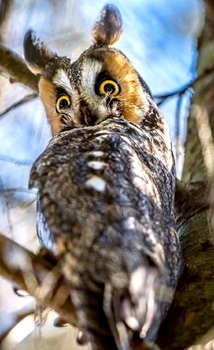
1/14 – Rensselaer County, HRM 143: On my way to work this morning, I came upon a deceased long-eared owl at Grafton. I'm not familiar with the species and don't know if it is a common species in this area.
- Ashley
[The northern long-eared owl (Asio otus) breeds and winters locally in our region but is by no means common. In the winter they can form large communal roosts of multiple individuals. Some may recall the eight long-eared owls roosting together in the Fort Edward grasslands in 2019. [The long-eared owl ranges from the “tree line” in northern Canada to the Southeast and Gulf Coasts (Peterson 1980)]. Zach Schwartz-Weinstein]
Photo of long-eared owl courtesy of Karin Maloy-Brady
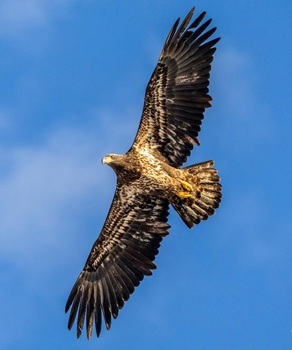
1/15 – Town of Poughkeepsie: It was not surprising to spot a wayward immature bald eagle gliding across the sky above Bald Eagle nest NY62 today. The mated pair in NY62 paid it no mind. We have always wondered when we see an immature shadowing an established nest if it is last year’s fledgling or just a passing migrant.
- Tom Lake
Photo of bald eagle courtesy of Bob Rightmyer
1/15 – Hudson River Estuary, HRM 154-0: An easy and often rewarding wintertime activity is to travel along the river looking for eagles on ice floes. I made such a journey today along the river from Newburgh to Poughkeepsie, a fifteen-mile reach, where a strong west wind had pushed much of the ice to the eastern side of the river. In the down tide, the floes were heading seaward. Along the reach I counted ten bald eagles on the ice, nine immatures and one adult. That was not a rare ratio in wintering locations; immatures regularly outnumber adults (when you figure each mated pair can fledge one-to-three young each season, the math adds up).
- Tom Lake
[The ice floes act as a conveyor, like a moving sidewalk at the airport. Eagles can hunt with a free ride saving calories, a major wintering concern. A while ago during a public bald eagle program at Old Steamboat Dock in Verplanck, we watched an immature eagle drift down on an unsuspecting male bufflehead and snatched him off the ice. Tom Lake, Chris Letts]
Photo of bald eagle courtesy of John Badura
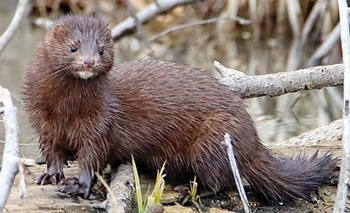
1/16 – Hudson River Watershed: The American mink (Neogale vison) is a semiaquatic species of mustelid native to North America, though human introduction has expanded its range to many parts of Europe and Asia. Mustelids are a diverse family of carnivoran mammals, including weasels, badgers, otters, polecats, martens, grisons, and wolverines, otherwise known as mustelids (King 1984).
Mink are closely associated with water and are found along streams, rivers, and lakes and in or near marshes. Their aquatic adaptations include a streamlined body, partially webbed toes, a thick undercoat and oily, water-repellent guard hairs. Mink have a top swimming speed of around one to two miles per hour. They can dive down as far as 15-20 feet but usually forage near shore in vegetation. In winter Mink will forage underwater and come up for air through an air hole in the ice.
Active all year, mink may travel up to seven miles daily while foraging for small, slow-moving fish, frogs, crabs and crayfish, birds, muskrats and small mammals. This member of the weasel family is known for its habit of caching surplus prey for later consumption. One mink’s cache consisted of 13 freshly killed muskrats, two mallard ducks and one American coot in a hollow ash stump six feet above ground at the edge of a marsh. (Godin, Wild Mammals of New England).
- Mary Holland
Photo of mink courtesy of Brian Teague
Snapshot NY
The NYSDEC, in collaboration with the New York Cooperative Fish and Wildlife Research Unit at Cornell University, has launched Snapshot NY, a citizen science program that allows the public to participate in wildlife monitoring through the deployment of trail cameras. The project will help improve the way DEC monitors and manages more than a dozen wildlife species. For more information on Snapshot NY and how to participate, visit the Snapshot NY website.
Join DEC's Hudson River Estuary Management Program and the Hudson River National Estuarine Research Reserve’s - Free Virtual Winter Speaker Series!
Meet and learn from scientists, community leaders, and environmental educators who work at the intersection of research, education, and environmental and social justice. Engage in discussions about monitoring and research, field-based learning, and creating pathways to overcome barriers and challenges in the field of science and education. Visit our website for more information and to register.
Hudson River Lesson Plans
Explore our collection of Hudson River lesson plans, videos and online activities to support hand on investigations of the Hudson River in your classroom.
Hudson River Miles
The Hudson is measured north from Hudson River Mile 0 at the Battery at the southern tip of Manhattan. The George Washington Bridge is at HRM 12, the Tappan Zee 28, Bear Mountain 47, Beacon-Newburgh 62, Mid-Hudson 75, Kingston-Rhinecliff 95, Rip Van Winkle 114, and the Federal Dam at Troy, the head of tidewater, at 153. The tidal section of the Hudson constitutes a bit less than half the total distance—315 miles—from Lake Tear of the Clouds to the Battery. Entries from points east and west in the watershed reference the corresponding river mile on the mainstem.
To Contribute Your Observations
The Hudson River Almanac is compiled and edited by Tom Lake and emailed weekly by DEC's Hudson River Estuary Program. Share your observations by e-mailing them to trlake7@aol.com.
Was this Newsletter Forwarded to You?
Subscribe today to DEC Delivers Hudson River Almanac topic for weekly natural history journal that covers the Hudson from the High Peaks of the Adirondacks to New York Harbor.
Helpful Resources
National Oceanic and Atmospheric Administration online tide and tidal current predictions are invaluable when planning Hudson River field trips. For real-time information on Hudson River tides, weather, and water conditions from sixteen monitoring stations, visit the Hudson River Environmental Conditions Observing System website.
DEC's Smartphone app for iPhone and Android is now available at New York Fishing, Hunting, and Wildlife App.
|