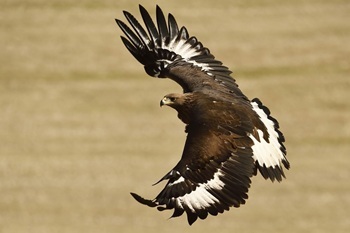
Photo of golden eagle courtesy of US Fish and Wildlife
In this issue:
As we began 2026, we also celebrated the beginning of the 33rd year of the Hudson River Almanac, a weekly natural history journal that seeks to capture the spirit, magic, and science of the Hudson River Watershed from the High Peaks of the Adirondacks, 320 miles to the sea. Natural history features include a rare duck, a ‘daring’ rescue on the ice, and a scary-looking Fish-of-the-Week.
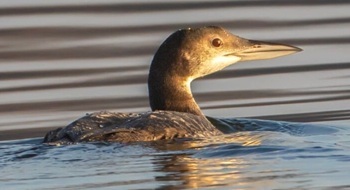
12/27 – Catskill, HRM 113: Following a lead from a social media post on a community page, along with the Hudson Fire Department, we successfully rescued a stranded common loon (Gavia immer) from the ice on Catskill creek this evening (the loon was flat on the slippery ice with few options for taking off).
When the Catskill Fire Department chief saw the post and the attention that ensued, a call was made to the Hudson Fire Department. The Hudson chief and his rescue swimmers-divers decided this was a very low risk operation. It took twenty minutes to break through the thin ice and launch a small boat to give Hudson diver Lieutenant Adam Finden the opportunity to make the rescue. He gently gathered up the bird for transport to the nearby Hudson River. Once there, the loon was released into the open water and the rescue was successful.
- Ellen Kalish (Ravensbeard Wildlife Center), and Cathy Poluski
[I recall spring 1995 working for the Wyatt Group on the upper Connecticut River at South Deerfield, Massachusetts (100 miles upstream from Long Island Sound). My son, Christopher, and I were middle-of-the-night drifting a gill net from an 18-foot jon boat at a point where the river was less than 300-feet wide, catching and transporting female American shad to the Susquehanna River as part of a population restoration project. On one drift, we caught a common loon that had been diving for fish. I carefully extracted the bird from the mesh and set it on the boat’s gunnel. Engrossed in our netting, we lost track of the bird. When we looked back twenty minutes later, the loon was still there. We immediately recognized that the bird could not take off from our elevated gunnel. I carefully set the loon into the river, and eventually it sped off.
Common loon can take off from a flat hard surface. However, taking flight from a standing start on land or ice takes great effort for these large diving birds. Given a choice, common loons prefer to take off from open water, which allows them to use their feet for thrust on the water’s surface. Taking off from ice requires the loon to achieve enough velocity and lift using only its wings. Tom Lake]
Photo of common loon courtesy of Matt Zeitler
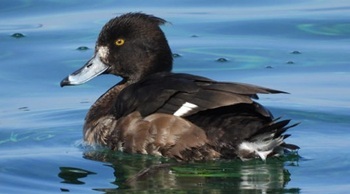
12/28 – Dutchess County, HRM 81: A first year male tufted duck (Aythya fuligula) was spotted on Sylvan Lake today in company with many ring-necked ducks and a few scaup by Carena Pooth. This was only the second tufted duck record for Dutchess County. The first one was a male (March 22-26, 2009) spotted on the Hudson River.
- Stan DeOrsey
[The tufted duck breeds in northern latitudes from Iceland across to Siberia, as well as being the most widespread diving duck in the United Kingdom and Europe. There are occasional sightings along the western Atlantic coast south to New Jersey. In nearly all cases the tufted duck is found with ring-necked ducks and scaup. Stan DeOrsey]
Photo of tufted duck courtesy of Harold Bradley
12/29 – Sandy Hook, NJ: I joined birding bud Maria Loukeris for a day of birding at Sandy Hook Gateway National Recreation Area. It had been just over three years since I'd last birded Sandy Hook, so I jumped at the opportunity. My favorite moment of the day was getting a nice look (my first good look ever) at a beautiful Ipswich Savannah sparrow (Passerculus sandwichensis princeps).
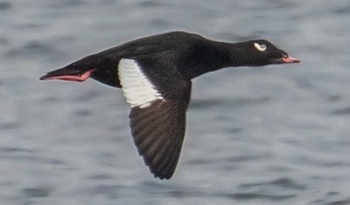
We also enjoyed seeing and hearing several flocks of snow buntings flying up and down the beach. Yellow-rumped warblers were numerous; we seemed to be seeing and hearing them at almost every turn. And then there was a gorgeous white-winged scoter (Melanitta deglandi) that passed by.
- Matt Zeitler, Maria Loukeris
[Sandy Hook borders on the Lower Bay of New York Harbor and is either the beginning or the end of the Hudson River watershed, depending upon your perspective. Migrants, from fish to songbird to raptors to butterflies, closely follow the coastline in autumn and again in springtime, making Sandy Hook an important way-station in and out of the watershed. Tom Lake]
Photo of white-winged scoter courtesy of Matt Zeitler
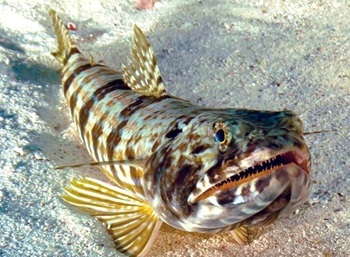
12/30 – Hudson River Watershed: Fish-of-the-Week for Week 348 is the inshore lizardfish (Synodus foetens, Linnaeus 1766), number 102 (of 239) on our watershed list of fishes. If you would like a copy of our list, e-mail trlake7@aol.com.
The inshore lizardfish is the only member of its family (Synodontidae) found in the watershed. They favor inshore marine waters of the Atlantic from Cape Cod to Brazil. They lurk in sandy shallows, burrowing in the bottom sediments to ambush passing prey. The common name of their close relative, the sand diver (S. intermedius), found from the Carolinas to points south, describes the “sand diver” behavior of the genus.
Inshore lizardfish are terete in cross-section and have been likened to a large, colorful cigar. While only reaching 18-inches, they have the countenance of an apex predator with tooth-studded jaws and a reptilian look. At various times in the long ichthyological past, because of their tiny adipose fin and impressive teeth, taxonomists have mistakenly placed lizardfish in with the trouts (Salmo sp.) and pikes (Esox sp.).
Years ago, as I was snorkeling along the sandy beach at Croton Point, I drifted over a foot-long inshore lizardfish, stock-still, propped on its pelvic fins, mouth slightly agape, and looking very much like a dragon in wait.
The inshore lizardfish is designated as a temperate marine stray in the estuary. Young-of-year are carried into the brackish waters of the Hudson River on summer flood tides and are found as far upriver as Croton Point (river mile 35).
- Tom Lake
Photo of inshore lizardfish courtesy of Don Rhodes
12/31 – Hook Mountain, HRM 31: Among the twelve south-migrating raptors today at the Hook Mountain Hawkwatch, bald eagle was high count with seven. Red-tailed hawk was next with four. Turkey vulture led among non-raptor migrants with seven. Some of the raptors, especially eagles, could have well continued to fly through the weather all day, but we were ready to call it a day, and a season.
- Tom Fiore
[With great thanks to our compiler of all data, Trudy Battaly, and to her friend and fellow-watcher Drew Panko, as well as to all of the many counters and observers of the full season, some of whom have been at this for many years and given so many days to the watch and found so many birds. Our counters on the Hook contribute to important migration data that has shown clear species trends over the decades since 1971. Here is to hoping that we all re-convene on the Hook in 2026 for our 55th season. Trudy Battaly]
1/1 – Hudson River Watershed: Today, as 2025 turned to 2026, we began our 33rd year of the Hudson River Almanac. With direction from Fran Dunwell, we began on the Vernal Equinox of 1994 and have been an ongoing forum for capturing defining moments of the seasons ever since.
[The Hudson River Almanac is a weekly natural history journal that seeks to capture the spirit, magic, and science of the Hudson River Watershed from the High Peaks of the Adirondacks, 320 miles to the sea. The Almanac is produced by the NYSDEC's Hudson River Estuary Program and its staff in partnership with hundreds of enthusiasts whose adventures, observations, and sentiments are found in its entries. Each edition of the Almanac covers the previous week and is sent as a free e-mail to a distribution of more than 18,000 readers. We encourage personal contributions, including stories and photos. If you would like to contribute entries or subscribe, please e-mail. Tom Lake trlake7@aol.com. Tom Lake]
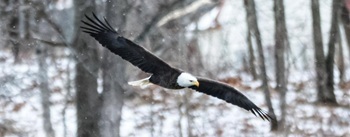
1/2 – Saratoga County, HRM 157: In response to the Arctic cold temperatures, the coming together of migrating bald eagles under the Falls at Cohoes continued. The message to find open water was loud and clear in points north.
From Overlook Park in Cohoes, with a panoramic view of The Falls, the eagles were on display. Many were perched in Mohawk riverside trees. Others were flying over the swirling pools under the falls looking for a meal. One passed by in the familiar, ever diagnostic, “flying on flat wings.”
- Andrew Walters
Photo of bald eagle courtesy of Andrew Walters
1/3 – Hudson River Watershed: Among indigenous peoples, full moons have long been labeled with fanciful names that are rooted in oral traditions, indigenous memories, and ethnographic accounts.
Among Mohican people, whose ancestral homeland lies wholly within the Hudson River watershed, the January full moon is known as the Cracking Tree Moon, Pathe'naawe mtok keesoox/neepã'ak. The “Cracking Tree” refers particularly to apple, maples, and willows.
“On a cold, dark, winter night, when we are indoors away from the freezing air, we may hear a loud CRACK! This sound is caused by frost cracks in trees. When air temperatures drop below zero, trees will make all kinds of popping and cracking noises, especially if the temperature drops very quickly. A frost cracks occurs when sap inside the tree freezes, causing it to expand in volume. Frost cracks most often occur after very cold, sunny days.”
- Larry Madden, Stockbridge-Munsee Band of Mohican Indians
Among the Haudenosaunee (Iroquoian speakers), much of whose ancestral homeland lies within the Mohawk River Valley on the periphery of the Hudson River watershed, the January full moon is known as The Mid-Winter Moon (Sha’tekohserí:hen Wenhnì:tare).
[Tribal translations of full moons pre-date colonization and generally reflect the seasonality of the lunar phase. Moon phases, in fact, were used by indigenous people as measurements of time. Tom Lake]
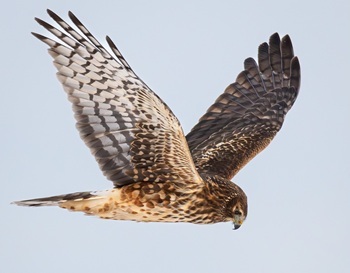
1/3 – Ulster County, HRM 74: Recently, I have been photographing short-eared owls (Asio flammeus) currently residing at the Shawangunk Grasslands National Wildlife Refuge. Today it was the northern harrier’s turn.
- John Badura
Photo of northern harrier courtesy of John Badura
1/4 – Saratoga County, HRM 164: From the Crescent Power House in Half Moon today, I counted eleven bald eagles (mixed age) perched together in trees on the east side of the Hudson River. Each season we reason that eagles and waterfowl migrate south in winter in search of open water to hunt and rest. Today was a good example of a last-minute move.
- Katrina Van Tassel
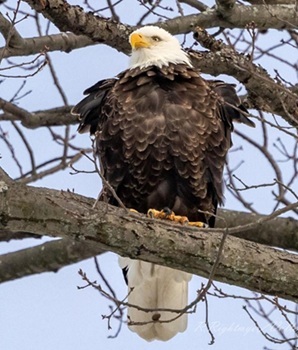
1/4 – Town of Poughkeepsie: It seemed like a day of rest for the adults at bald eagle nest NY62. They have been busy. The male was perched on a nearby limb enjoying the afternoon sun.
- Bob Rightmyer
Photo of bald eagle couresy of Bob Rightmyer
1/5 – Minerva, HRM 284: We have a quarter-inch of ice on everything; not warm enough weather has come to free the trees and twigs from the ice coating. The snow has been accumulating; we get a half to two-inches of snow almost every day. There's nearly a foot out in the woods, including a heavy crust under three or four inches of snow, which isn't pleasant for hiking.
- Mike Corey
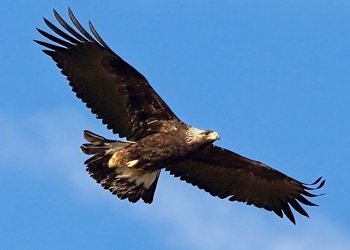
1/5 – Dutchess County: Northeast Dutchess County has long been a conduit for migrating eagles, especially golden eagles. Among bald eagles, immatures seem to dominate, a common ratio during winter migration in the watershed. However, golden eagles bring their own aura of grace, beauty, and supremacy. Bald eagles make a statement; golden eagles make an imprint on your mind.
- Judy Winters
[Among many Native people of the American Southwest — Puebloan, Diné, and others — the golden eagle has long been a sacred bird, known to the shaman, healers, and mystics as the Thunderbird. Tom Lake]
Photo of golden eagle courtesy of Terry Hardy
1/5 – Town of Wappinger, HR 67: The mated pair at bald eagle nest NY459, dubbed the “The Bridge Eagles” after a nearby bridge over the tidewater Wappinger Creek, seemed ready for their ninth breeding season.
We have seen a lone adult, likely the female, perched in the crown of tall trees along the creek adjacent to the nest since November. The nest’s first season was 2018; in their first five breeding seasons, the pair produced ten nestlings. Photographer and birder Judy Winter has been the nest’s ultra-vigilant monitor.
- Tom Lake
[May 15, 2018:The high winds from a micro-burst destroyed newly established bald eagle nest NY459. Two 42-day-old nestlings had fallen 75 feet to the ground during the massive storm. Meghan Oberkircher (DEC) and Annie Mardiney (Wild Mountain Birds) commenced a rescue operation. One of the nestlings was unhurt but the second one had a broken leg. Both were taken to the Delaware Valley Raptor Center. The wildlife rehabilitators were able to place the unhurt nestling into a “foster nest,” and the injured nestling underwent a lengthy but successful recovery. Gary and Mauricette Char Potthast]
1/5 – Manhattan, HRM 1-2: Our Hudson River Park’s River Project staff checked our research gear (pots and traps) that we deploy from floating docks on the south-side of Piers 26 and 40 in Hudson River Park for our ongoing Fish Ecology Survey.
The catch was, as expected, light with the colder winter weather and chilled river. Our traps yielded one wintering, juvenile striped bass (67.5 millimeters) alongside grass shrimp, mud dog whelks, mud crabs, isopods, and a sand shrimp.
- Toland Kister, Jenevieve Joseph
[Note: One-inch equals 25.4 millimeters (mm). Tom Lake]
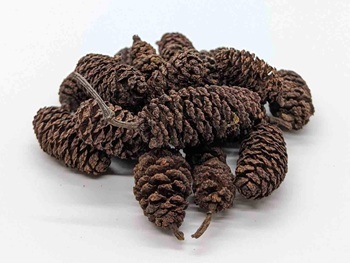
1/6 – Millbrook, HRM 82: Walking in the woods after a snow always presents puzzles. Examples include the flat, 3-lobed, several-millimeter particles that cluster on the snow in some areas but not others, and the numerous bird tracks often found under birch trees (Betula spp.). As it happens, the two are related. Birches retain their cones on their twigs into the winter, slowly shedding their bracts (the 3-lobed particles) and seeds. The seeds provide an important food source for birds foraging on the snow, hence their tracks under the birches.
- Nelson Johnson
Photo of birch cones courtesy of Tom Lake
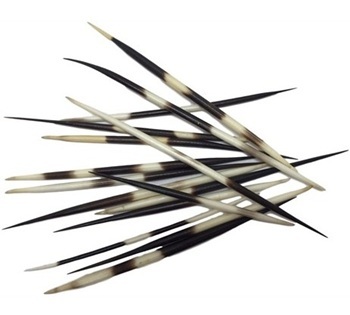
1/7 – Hudson River Watershed: Photographing wildlife, or even signs of wildlife, can include a certain amount of physical risk. Some of my encounters over the years include being bitten by a coyote, charged by a white-tail buck, and falling through the ice on a beaver pond while wearing snowshoes. A far more minor inconvenience occurred recently when I was photographing a porcupine den (Erethizon dorsatum) while on my knees to get the perspective I wanted. Upon returning home I noticed a sharp pain in one leg, only to discover a small porcupine quill had lodged itself in my knee.
The tip of a porcupine quill is covered with overlapping one-way barbs, making it extremely easy for the quill to enter a body, but very difficult to extract it, as anyone who has a dog that has encountered a porcupine knows. But the beauty of being the recipient of this sharp, pointed, modified hair is that you needn’t worry about infection. The quills of the back and tail of a porcupine have a greasy coating which contains fatty acids which have antibacterial properties.
- Mary Holland
Photo of porcupine quills courtesy of Mary Holland
1/8 – Putnam County, HRM 46.5: There was a big uptick in the amount of bald eagles I’ve been seeing in the last week. I assumed this was in response to the Arctic cold air temperatures and additional ice. Yesterday, I saw a pair of adult bald eagles on the Manitou nest for the first time this year. I take that as a good early sign.
- Scott Craven
[Bald eagle nest NY527 was established in 2018 and seems to have been successful during each of the ensuing years. The caveat for this nest has always been its location: When the new leaves of spring fill out, a direct viewing of the nest and its goings-on becomes very difficult to observe. Tom Lake]
1/9 – Ulster-Dutchess Counties: The 15th annual Ulster/Dutchess Christmas Bird Count was conducted on Saturday, December 27, in the wake of a substantial snowstorm. The weather event was characterized by varying bands of intensity and as a result dropped up to a foot of powdery snow within our Bird Count circle. There was so much that it necessitated the use of snow shoes in two sectors. Pre-dawn owling was abbreviated by many field parties and aborted all together by others.
The diurnal portion of the survey saw raw conditions not exceeding 26 degrees Fahrenheit. There was approximately 85 percent ice coverage on a still and quiet Hudson River. Smaller standing bodies of water were iced over with river tributaries nearly frozen as well.
Forty-five birders in 19 field parties along with five feeder watchers contributed in the ten sectors of the Bird Count that included parts of the Towns of Hurley, Woodstock, Ulster, Kingston, Saugerties, Esopus, and the City of Kingston in Ulster County, parts of the Towns of Rhinebeck and Red Hook in Dutchess County, parts of the Towns of Clermont and Germantown in Columbia County, and the tiniest slice of Greene County near Cementon.
This year we identified a total of 14,912 individual birds representing 80 species on count day. The Christmas Bird Count has averaged 84 species and 18,759 individuals. No new species were added to our list this year which now stands at 134 species.
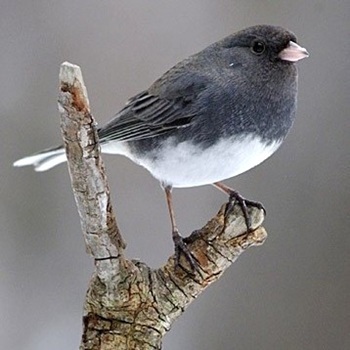
High counts were set for five species: Common merganser, Cooper’s hawk, red-shouldered hawk, common raven, and dark-eyed junco. Exceptional showings came from common merganser (396) and dark-eyed junco (2,478), both species doubling their average numbers. Once again, a big thanks to Steve Chorvas for his expert contribution.
- Mark DeDea
Photo of dark-eyed junco courtesy of Gerrit Vyn
Snapshot NY
The NYSDEC, in collaboration with the New York Cooperative Fish and Wildlife Research Unit at Cornell University, has launched Snapshot NY, a citizen science program that allows the public to participate in wildlife monitoring through the deployment of trail cameras. The project will help improve the way DEC monitors and manages more than a dozen wildlife species. For more information on Snapshot NY and how to participate, visit the Snapshot NY website.
Join DEC's Hudson River Estuary Management Program and the Hudson River National Estuarine Research Reserve’s - Free Virtual Winter Speaker Series!
Meet and learn from scientists, community leaders, and environmental educators who work at the intersection of research, education, and environmental and social justice. Engage in discussions about monitoring and research, field-based learning, and creating pathways to overcome barriers and challenges in the field .of science and education. Visit our website for more information and to register.
Hudson River Lesson Plans
Explore our collection of Hudson River lesson plans, videos and online activities to support hand on investigations of the Hudson River in your classroom.
Hudson River Miles
The Hudson is measured north from Hudson River Mile 0 at the Battery at the southern tip of Manhattan. The George Washington Bridge is at HRM 12, the Tappan Zee 28, Bear Mountain 47, Beacon-Newburgh 62, Mid-Hudson 75, Kingston-Rhinecliff 95, Rip Van Winkle 114, and the Federal Dam at Troy, the head of tidewater, at 153. The tidal section of the Hudson constitutes a bit less than half the total distance—315 miles—from Lake Tear of the Clouds to the Battery. Entries from points east and west in the watershed reference the corresponding river mile on the mainstem.
To Contribute Your Observations
The Hudson River Almanac is compiled and edited by Tom Lake and emailed weekly by DEC's Hudson River Estuary Program. Share your observations by e-mailing them to trlake7@aol.com.
Was this Newsletter Forwarded to You?
Subscribe today to DEC Delivers Hudson River Almanac topic for weekly natural history journal that covers the Hudson from the High Peaks of the Adirondacks to New York Harbor.
Helpful Resources
National Oceanic and Atmospheric Administration online tide and tidal current predictions are invaluable when planning Hudson River field trips. For real-time information on Hudson River tides, weather, and water conditions from sixteen monitoring stations, visit the Hudson River Environmental Conditions Observing System website.
DEC's Smartphone app for iPhone and Android is now available at New York Fishing, Hunting, and Wildlife App.
|