Freshwater Fishing, Fisheries Management, and Fishing Access News
In this issue:
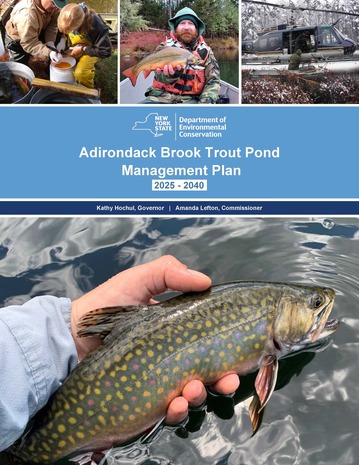
DEC recently released the final Adirondack Brook Trout Pond Management Plan (PDF) that will guide the management of Adirondack brook trout ponds for the next 15 years, helping to ensure the future of this unique fisheries resource. The plan was developed from an intense review of what fisheries managers have learned over the past four decades, along with recent public feedback through three information sessions, a focus group of sportspersons and conservation organizations, and a 45-day public comment period on the draft plan.
Find supporting documents and additional information on the DEC website at Adirondack Brook Trout Pond Management.
Over the course of 2025, DEC Bureau of Fisheries staff were hard at work managing the abundance of freshwater fisheries resources throughout New York State. The list below includes several highlights and noteworthy items that occurred in the past year.
1. New State Fish Records Established
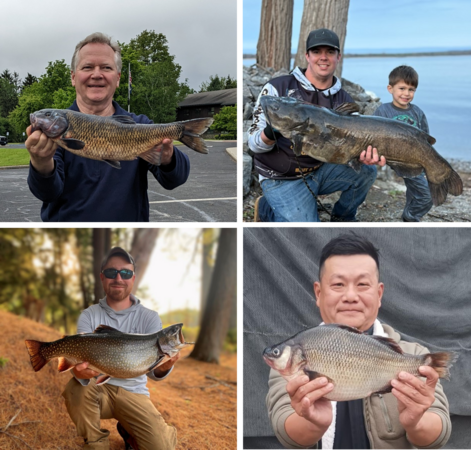
Through the New York State Angler Achievement Awards Program, four new state records were set in 2025:
-
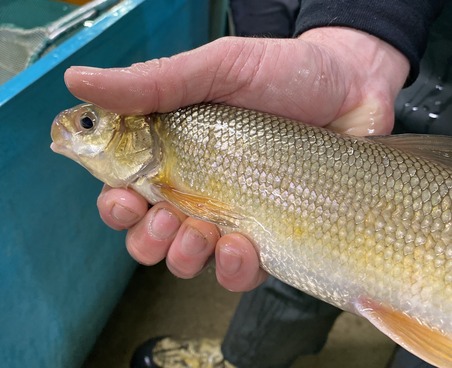
Fallfish: 4 lbs. 1 oz. from the St. Lawrence River, St. Lawrence County on May 13, 2025. Caught by Alex Pidhorodeckyj.
-
Channel Catfish: 37 lbs. 9 oz. from Black River Bay (Lake Ontario), Jefferson County on May 3, 2025. Caught by Dylan Kampnich.
-
Brook Trout: 6 lbs. 3 oz. from the St. Regis Canoe Area, Franklin County on July 5, 2025. Caught by Benjamin Furguson.
-
White Perch: 3 lbs. 4 oz. from the Cross River Reservoir, Westchester County on November 23, 2025. Caught by Yongfeng Tian.
Photos of anglers with their state record catches (from top left to bottom right): Fallfish caught by Alex Pidhorodeckyj; Channel Catfish caught by Dylan Kampnich; Brook Trout caught by Benjamin Furguson; and White Perch caught by Yongfeng Tian
2. Habitat Rehabilitation and Site Access Improvements
Funds through the Habitat and Access Stamp support various projects related to habitat conservation and improved outdoor recreational opportunities. The 2025 projects listed below were completed by DEC in collaboration with numerous partners to restore popular fishing access sites and to enhance critical fish habitat:
-
Mongaup Creek, Sullivan County
This project removed and replaced deteriorating log cribbing with a secure rock retention wall and instream grade controls to reinforce and stabilize the stream serving to improve fishing access and habitat for native brook trout.
-
Schenevus Creek, Otsego County
Boulder clusters and instream root wads were installed in the stream to create refuge for wild trout during the summer months. This will protect fish seeking cold groundwater to avoid harmful exposure to high water temperatures.
-
Schroon River, Warren County
A popular canoe and kayak launch site and parking area was greatly improved by creating a new hand launch area and stabilizing the site through erosion control techniques and stormwater drainage upgrades.
-
Naples Creek, Ontario County
To create pool habitat for native rainbow trout populations of Canandaigua Lake during spawning runs, five degraded pool diggers were removed and replaced, and three new log weirs were added along the Public Fishing Rights portion of the stream.
-
Wiscoy Creek, Wyoming County
At the Boy Scout Camp fishing access site, the degraded stream bank was repaired and stabilized using large stone for erosion control, and three engineered log clusters were added to enhance adult wild brown trout habitat.
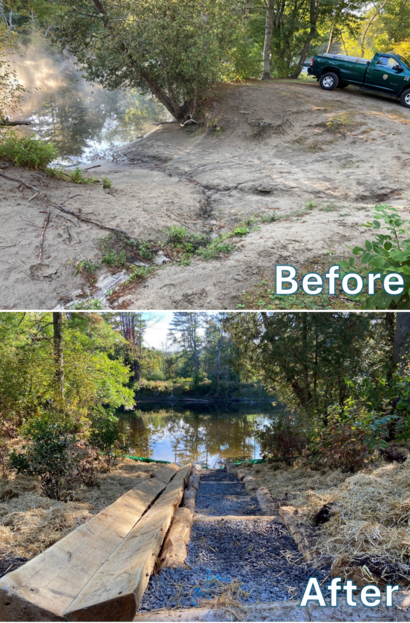 |
DEC and Warren County collaborated to create this new improved hand launch site at Schroon River.
3. Groundbreaking Habitat Restoration Method Developed on Lake Erie
In an effort to clean and restore spawning habitat impacted by invasive zebra and quagga mussels, a groundbreaking high-velocity jetting method was developed and tested at two experimental sites on Brocton Shoal, a historical lake trout spawning site in Lake Erie. Over the past 30 years, invasive mussels have rendered the habitat unsuitable for spawning by filling in the available rock crevices used for lake trout egg incubation. After comprehensive planning, the high-velocity jetting method successfully removed silt, sand, and the invasive mussels covering the rock piles and crevices. In the coming years, the sites will be monitored for lake trout spawning success and invasive species recolonization. Learn more about this groundbreaking habitat enhancement project.
4. First Year of Black Bass Fishing Tournament Permit Complete
2025 marked the first full fishing season with the new DEC Black Bass Fishing Tournament Permit in place. A total of 806 permit applications were approved, with most tournaments occurring on Lake Champlain, Onondaga Lake, Cayuga Lake, and Oneida Lake. DEC is currently developing an annual report that will be shared with the public to highlight results from the Black Bass Fishing Tournament Permitting and Reporting Systems.
5. Updated List for Endangered, Threatened, and Special Concern Species
In 2025, the New York list of endangered, threatened, and special concern species was updated for the first time since 1999 to reflect the latest status of rare fish and wildlife populations across the state. Freshwater fish such as round whitefish, bluebreast darter, and Eastern sand darter received an improved status due to recovering populations resulting from effective conservation measures. On the other hand, burbot, lake whitefish, several minnow species, and longnose sucker received added protections due to declining populations from invasive species and habitat loss. Conservation strategies for imperiled species are being developed to aid in their recovery.
Improvements to the status of round whitefish is the result of active restoration by DEC in Adirondack waters.
6. Self-Sustaining Lake Trout Populations in Lake Champlain
Lake Champlain lake trout populations have officially been re-established thanks to a long-term cooperative effort by DEC, Vermont Fish and Wildlife, and U.S. Fish and Wildlife Service to manage environmental impacts and invasive sea lamprey. As a result of self-sustaining populations, the 75-year long effort to augment native lake trout with hatchery-reared fish has concluded. The health of lake trout will continue to be monitored, and a plan will be established for reinstituting stocking if wild lake trout numbers appear to be declining. Get more details on this success story.
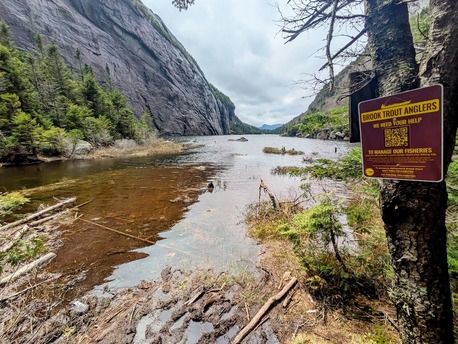
7. Trek for Trout: Partnership to Modernize Brook Trout Management
In May 2025, a collaborative one-day Trek for Trout event took place, where DEC and volunteers from numerous partner organizations and colleges hiked to add new signage at remote Adirondack brook trout ponds as a part of a citizen science effort to collect angler data and support baitfish regulations. A pond-specific QR-code on each sign directs anglers to a survey form for collecting key data that will inform management of this unique fishery. A total of 266 miles were trekked, with 120 volunteers posting signs at 149 ponds within 11 counties and 40 towns. Since the event, DEC staff posted 74 more signs, bringing a total of 223 ponds posted. To date, 307 survey responses have been received, with more to come during the upcoming spring fishing season!
Anglers can scan the QR-code found on the signs at Adirondack ponds and submit data directly to DEC.
8. New Trout Management Plan for Delaware River Tailwaters
DEC and the Pennsylvania Fish and Boat Commission completed the Delaware Tailwaters Joint Trout Management Plan (PDF) in 2025 to provide a structured approach for collaboration in monitoring and managing one of New York's most renowned wild trout fisheries. The plan will guide both agencies in the strategic and science-based management of trout in the East and West branches of the Delaware River, and the Delaware River from the village of Hancock in Delaware County, downriver to the town of Callicoon in Sullivan County.
9. Enhanced Monitoring of Atlantic Salmon in the Boquet River
DEC and U.S. Fish and Wildlife Service along with assistance from the Town of Willsboro installed a resistance board weir downstream of the cascades on the Boquet River as an innovative method to improve monitoring of Atlantic salmon populations and guide management decisions of the Lake Champlain salmon fishery. When in operation, the weir acts as an upstream migration barrier, funneling salmon into a trap that’s monitored daily. Captured salmon are tallied (providing a run size estimate), measured, and have a genetic sample (fin clip) taken before being released upstream of the weir. The data collected will allow biologists to obtain population size estimates and evaluate the success of different stocking strategies.
10. Lake Sturgeon Reintroduced into Cattaraugus Creek
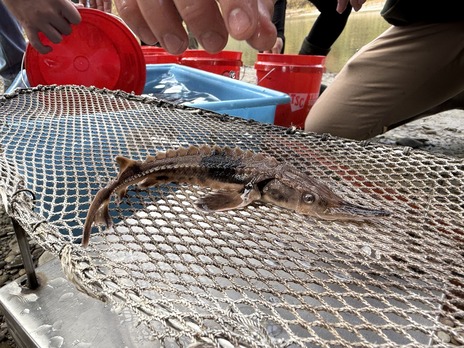
In an effort to reestablish an adult lake sturgeon spawning population in Cattaraugus Creek, DEC, the Seneca Nation of Indians, and the U.S. Fish and Wildlife Service joined forces to stock 1,000 juvenile lake sturgeon into the creek for the first time. These fish will leave the creek and head to Lake Erie for several years before making a return to the creek to spawn. Lake Erie historically supported at least 19 spawning populations of lake sturgeon, including Cattaraugus Creek, but today only two wild spawning populations remain. Efforts to restore lake sturgeon across the state are described in the New York State Lake Sturgeon Recovery Plan 2018–2024 (PDF), which is currently being updated to reflect Cattaraugus Creek restoration efforts and future conservation management.
Eight-inch lake sturgeon as shown were stocked in Cattaraugus Creek in an effort to reestablish a spawning population.
11. Five-Year Atlantic Salmon Net Pen-Rearing Study Complete
DEC and partners completed their final year of a five-year experimental Atlantic salmon pen-rearing project aimed to increase salmon returns to the Saranac River and numbers within Lake Champlain. During this study, six net pens were set each spring within the Saranac River delta and stocked with juvenile Atlantic salmon where they were held for three weeks before being released. The net pens protect and improve survival of the stocked fish, as well as allow for imprinting of the fish to return and spawn in future years. Monitoring will continue to determine if there is increased recruitment and catches of adult Atlantic salmon in Saranac River and Lake Champlain. Learn more about this innovative pen-rearing study.
12. Big Panfish Initiative (BPI) Study Completes Its Fifth and Final Year
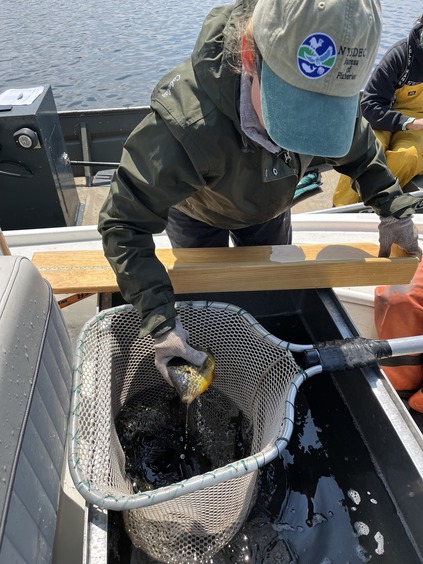
Sunfish and crappie surveys conducted as part of the 5-year Big Panfish Initiative (BPI) study came to a close in 2025. This study was developed to create destination fisheries for larger size panfish in 16 waters across the state. The sunfish and crappie populations were sampled each spring for the duration of the study to monitor potential impacts of experimental harvest regulations. Stay tuned in 2026, as DEC will prepare a final report discussing survey results and future management of these panfish species.
Data collected during annual surveys are used to determine changes in catch rates, size, and age structure.
13. Fishing on New York’s Great Lakes: A Banner Year
Lake Erie anglers experienced an excellent year of fishing! Walleye fishing in 2025 was the best year on record, with an average of 11 walleye caught per boat trip and 2 in 5 walleye trips getting their 6 fish limit. The yellow perch catch rate (35 perch/trip) and average size for harvested yellow perch (11.5 inches) in New York remains the highest in Lake Erie.
On Lake Ontario, salmon and trout fishing was outstanding in 2025, with catch rates averaging 4.8 fish per boat trip, ranking the 6th highest on record and about 7% above the recent 10-year average. Anglers experienced record catches of Atlantic salmon averaging 300% higher than normal, and coho salmon catch rates were the 2nd highest on record. Although Chinook salmon fishing was relatively slow in the spring, fishing eventually turned around in July and early August and catch rates ended near average for the season.
14. Hatchery Research: Progress on Improved Steelhead Growth
Staff from our Salmon River Hatchery and Fish Culture section teamed up to investigate ways to increase steelhead growth and size at stocking to improve post release survival and subsequent returns to the fishery. They have done this by using a multi-faceted approach that has included evaluating historical hatchery data, modifying feeding protocols, improving water quality, and creating a more favorable rearing environment. Analyses to understand the implications of this research are ongoing, but initial results indicate that improved steelhead growth can be achieved with a combination of hatchery rearing modifications.
Stay tuned for more noteworthy news and updates in the year ahead!
|