This bulletin provides only the most recent notices. Check the Adirondack Backcountry webpages for more detailed information on access, outdoor recreation infrastructure, and conditions. Whenever you are planning your next outdoor adventure, plan on arriving at your destination early and have several back-up plans in place in case parking at your desired location is full.
Emergency Situations: If you get lost or injured; keep calm and stay put. If you have cell service, call 911 or the DEC Forest Ranger Emergency Dispatch, 833-NYS-RANGERS.
Welcome to the Adirondacks. The Welcome to the Adirondacks webpage provides information about the Forest Preserve, conservation easement lands, outdoor recreation, and Leave No Trace™.
Love Our New York Lands: All New Yorkers and visitors should be able to access, enjoy, and feel welcome on state lands. While enjoying these shared spaces, be respectful of other visitors. Share trails, treat people with kindness, and leave things as you found them for others to enjoy. All of us have a responsibility to protect state lands for future generations. Learn more about how you can Love Our New York Lands.
In this issue:
The following are only the most recent notices pertaining to public lands in the Adirondacks. Please check the Adirondack Backcountry webpages for a full list of notices, including seasonal road statuses, specific trail conditions, and other pertinent information.
Follow @NYSDECAlerts on X for updates about DEC-managed lands across New York State! The @NYSDECAlerts X feed provides real-time info on the most crowded places, especially when those places and parking areas are at capacity.
NEW THIS WEEK
If you notice any damage or hazardous areas not listed below, please report to info.r5@dec.ny.gov.
Northern
-
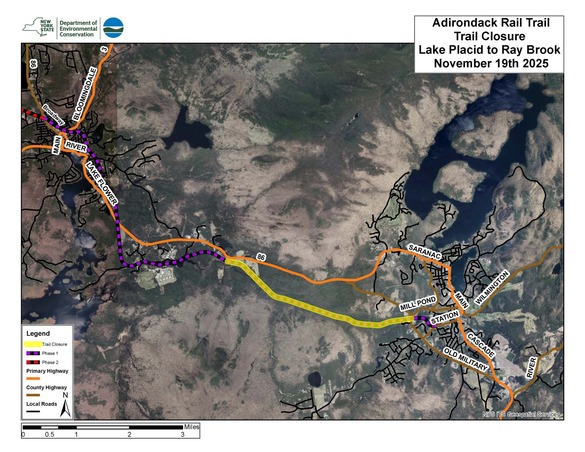
Adirondack Rail Trail: There will be a day-long shut down of the rail trail from Old Military Road to Ray Brook on Wednesday, November 19 for vegetation management under the power lines.
 LAST WEEK
Fire Danger: Check the fire rating map for daily updates.
Drought Warnings: Check the drought conditions map to stay updated on which counties are currently under a drought watch or warning.
Sunrise/Sunset: Sunrise = 6:51 a.m.; Sunset = 4:28 p.m. Pack at least one headlamp (two headlamps recommended) even if you expect to finish your activity before sunset. Phone batteries drain quickly and are discouraged.
Water Crossings: Water levels are average for this time of year throughout the Adirondack region. Expect water levels to rise with rainfall. Check the USGS Current Water Data for New York for stream flow of selected waters. (Personal Flotation Devices - PFDs aka lifejackets - are required from November through May.)
Temperatures: These are forecast temperatures (Fahrenheit) for base elevations throughout the region.
Weekend temperatures in the region at BASE elevations are expected to produce highs in the low-40s and lows in the low-20s. Rain and snow Sunday, with freezing rain possible.
Check the National Weather Service’s Mountain Point Forecast for more accurate forecasts at elevation on or near your intended route.
Reminder: These forecasts are for low elevations. Anticipate losing 5 degrees Fahrenheit for every 1,000 feet of elevation gain.
Even with sunny skies, inclement weather is always a possibility and can change very quickly. Remember – hypothermia is always a risk in wet conditions, even when it feels warm outside. Be prepared with extra dry layers and keep an eye on the weather.
Conditions:
- No matter where you’re hiking, bringing traction is a must. Bring microspikes for any elevation hike and snowshoes for higher elevation hikes, like those that reach 4000 feet. Be prepared to switch from spikes to snowshoes as conditions dictate.
- Remember that all visitors to the High Peaks Wilderness are REQUIRED to use snowshoes or skis when snowpack is in excess of 8 inches (20 cm) on or next to the trail.
- Sunrise = 6:51 a.m.; Sunset = 4:28 p.m. Plan your turnaround time accordingly and don’t forget your headlamp (not your cell phone flashlight).
- As you’re packing your hiking bag, ask yourself: “Will this last me through the night if need be?”.
- It’s cold out there – layer properly to prevent hypothermia with the three types of layers: moisture-wicking inner layers (avoid cotton!), insulating mid-layers of wool or fleece, and wind/waterproof shell layers. An extra pair of wool socks can double as water bottle insulators!
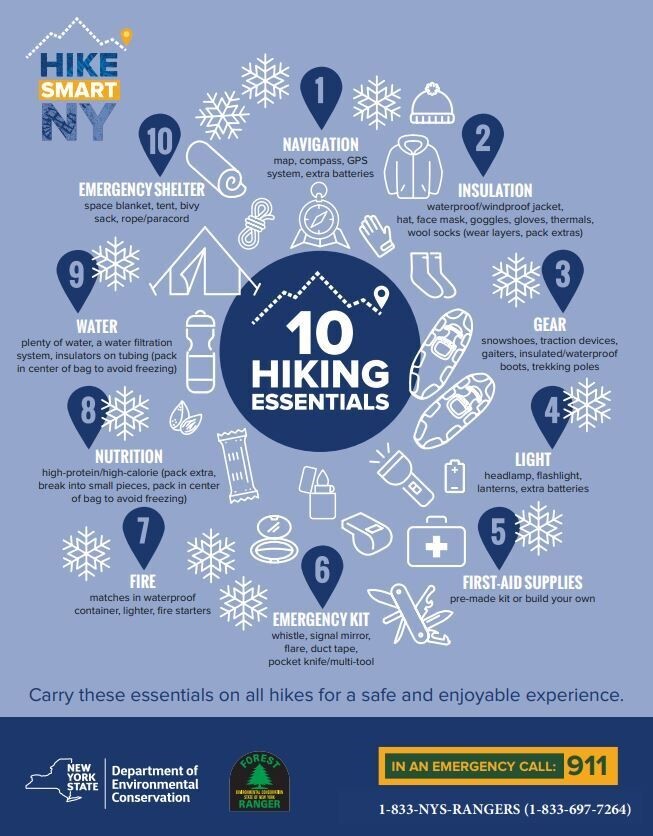
- To further prevent hypothermia and stay safe during your hike, bring the 10 Winter Hiking Essentials.
- Note: The Avalanche Pass trail is still closed due to the recent slide.
- For weekly updates on specific trail conditions or closures, visit Backcountry Information For The Adirondack Park - NYSDEC.
Check the Weather: Check the forecast for your destination and pack and plan accordingly. Check the National Weather Service Northern Adirondacks and Southern Adirondacks Mountain Point Forecasts for select summit forecasts. Check both daytime and nighttime temperatures and remember that temperatures will drop as you gain elevation.
Check the Air Quality Index (AQI) Forecast: If the AQI is forecast to exceed 100, DEC and the New York State Department of Health (DOH) will issue an Air Quality Health Advisory with precautionary recommendations for affected areas. View DEC’s current AQI forecasts and real-time air pollution data from DEC’s monitoring network.
Visit the main Adirondack Backcountry page for more trip-planning resources.
Bear Canisters, Required Dates: NYSDEC requires the use of bear-resistant canisters by overnight users in the Eastern High Peaks Wilderness between April 1 and November 30. NYSDEC encourages campers to use bear-resistant canisters throughout the Adirondack backcountry. Bear canisters should be used to store all food, food garbage, toiletries, and other items with a scent. Canisters should be stored a minimum of 100ft from tents, lean-tos and cooking sites and kept closed whenever they are not being accessed. Learn more about bear canisters and avoiding human-bear conflicts.
Adirondack Rail Trail: The Adirondack Rail Trail is a multi-use trail allowing for various types of recreational activities. To ensure safety for all while sharing the trail, all users should travel on the right side of the trail unless passing others. Groups should move in single file on the right when other users are passing. Cyclists should pass on the left and inform others prior to and while passing. Snowmobilers should pass slowly on the left and travel in single file, paying extra attention to those nearby at turns, intersections, and popular/congested areas. Lastly, pet owners must ensure that all waste is picked up and dogs are kept on leashes. For more information, visit the Adirondack Rail Trail webpage.
Mount Colden Trapdike: The trapdike is considered a technical climb and not a hike. Climbers should be prepared with helmets, ropes, and climbing gear to ascend this route. Hikers looking to summit Mount Colden should do so via the hiking routes. Attempting to climb the trapdike unprepared can result in a rescue operation, serious injury, or death.
No Overnight Camping at Trailheads: Overnight camping is not permitted at trailheads or other roadside locations where a camping disc is not present. This includes individuals sleeping in cars, vans, and campers. Campers should seek out designated roadside campsites marked with a "Camp Here" disc or open campgrounds. When camping, always carry out what you carry in and dispose of trash properly. Use designated bathroom facilities, pack out human and pet waste, or dig a cat hole.
Outdoor recreators of all kind should have clothing and gear for hypothermic conditions.
For hikers, this includes clothing like hat, gloves, balaclava, plastic eye protection, non-cotton base layers, fleece or wool mid-layer, windproof shell, non-cotton socks (bring an extra pair), and insulated boots. Plus, items like occlusive (such as Vaseline) for exposed skin, sleeping bag and insulated pad, emergency shelter, extra headlamp and batteries, liquid fuel stove and chemical handwarmers.
As of November 1, anyone underway in a boat less than 21 feet in length must wear a lifejacket/personal flotation device (PFD). This includes canoes, kayaks, rowboats and motorboats. The life-jacket law lasts through May 1 when life jackets become optional again.
No matter what form of outdoor recreation you're partaking in, Hike Smart NY can help you prepare with a list of 10 essentials, guidance on what to wear, and tips for planning your trip with safety and sustainability in mind.
Snowshoes or skis are required wherever snow depths exceed 8 inches in the High Peaks Wilderness. With new snowfall amounts in the last several days, particularly in higher elevations, snowshoes are a must for hikes that reach 4000 feet in elevation.
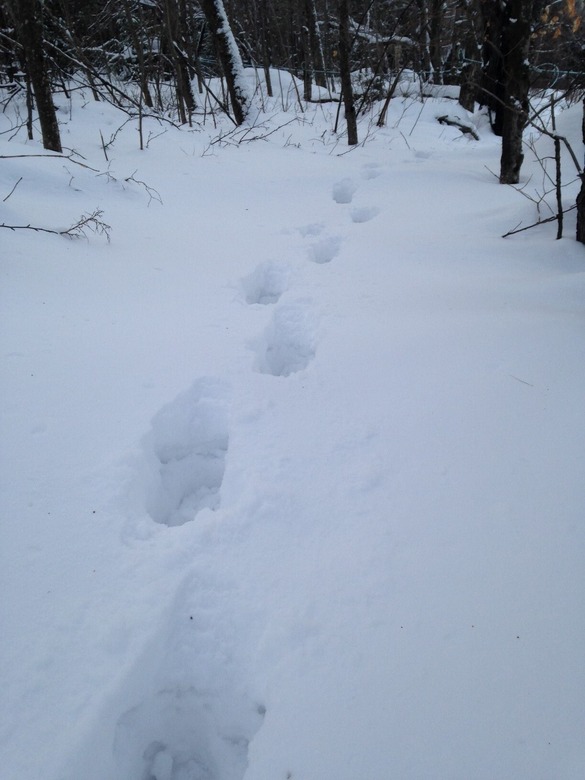
Snowshoes and skis keep you afloat and prevent post-holing, or leaving deep footprints in the snow from your boot sinking in, which are highly dangerous for other users of the trail. A hole in a downhill track could easily lead to major injury. Not to mention, post-holing through the trail is an exhausting way to hike.
If you want to help maintain safe trail conditions, fill in the holes. Once they freeze, they are difficult to fill in. But most importantly, remember to wear your snowshoes when needed to prevent the creation of post-holes in the first place.
As always: Follow the Seven Principles of Leave No TraceTM to maintain minimal impact on the environment and the natural resources of the Adirondacks.
Post-holes like this are easy to prevent!
|