|
2025 Long Island Water Quality STEAM Challenge (LIWQC) Winners
The 6th annual Long Island Water Quality Challenge (LIWQC), an initiative under the Long Island Nitrogen Action Plan (LINAP), engages students in grades 6-12 in project-based learning in STEAM (Science, Technology, Engineering, Arts, and Mathematics). The challenge encourages innovative solutions to water quality issues on Long Island, with a specific focus on reducing nitrogen pollution on school grounds.
This year, the goal of the LIWQC was for student teams to create green infrastructure designs aimed at reducing nitrogen pollution from stormwater runoff on school grounds. Fourteen student teams from across Long Island competed for the possibility of being awarded a grant of up to $2,500 to be used to implement their winning project design on school grounds. The winning schools include William Floyd High School, Central Islip High School, The Stony Brook School, and Smithtown High School West.
A panel of experts from the Department of Environmental Conservation (DEC), the Long Island Regional Planning Council (LIRPC), and the Nassau County Soil and Water Conservation District (NCSWCD) evaluated and scored the project proposals. Assessment considerations included creativity, understanding and researching the issue, feasibility, technical merit, and alignment with the goals of the LINAP.
Here is a brief look at the 2025 winning projects and schools:
William Floyd High School: Members of the Science Technology Entry Program (STEP) proposed installing native rain gardens to manage stormwater runoff from impermeable surfaces. The proposed rain gardens would be installed in strategically chosen low-lying areas of the school grounds where stormwater naturally accumulates. Using student volunteers, the team hopes to promote a new generation of environmental leaders.
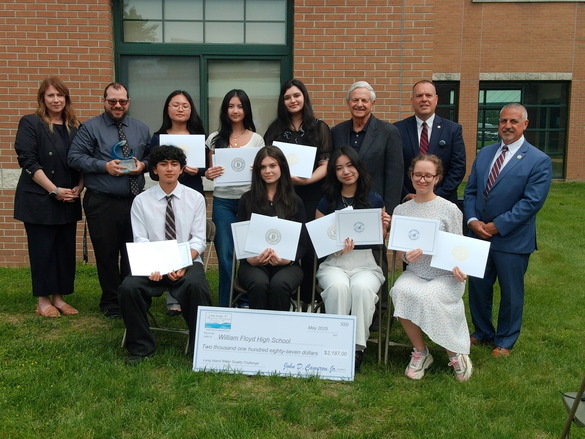 |
William Floyd High School Award Ceremony. The winning team will receive a grant award of $2,200 and were presented with citations from elected officials in attendance.
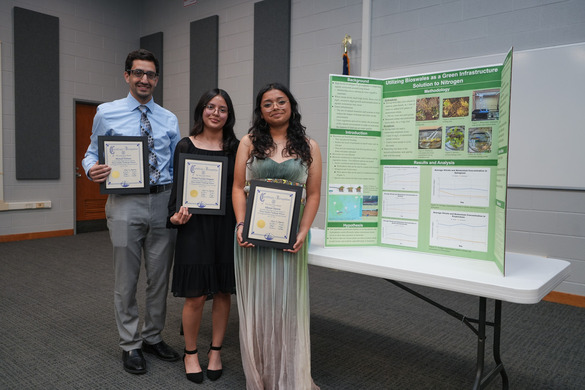
Central Islip High School: Two 11th grade Science Research students proposed implementing bioswales around the edges of the school parking lot where ground elevation is lowest to efficiently filter pollutants carried by rainwater and prevent flooding. The bioswales will include plants and mosses native to Long Island that retain water and adapt to various conditions. Monthly nitrate level monitoring is proposed to track the effectiveness of the bioswales.
Central Islip High School’s winning team and advisor in front of a poster depicting their project design and research findings: Utilizing Bioswales as a Green Infrastructure Solution to Nitrogen.
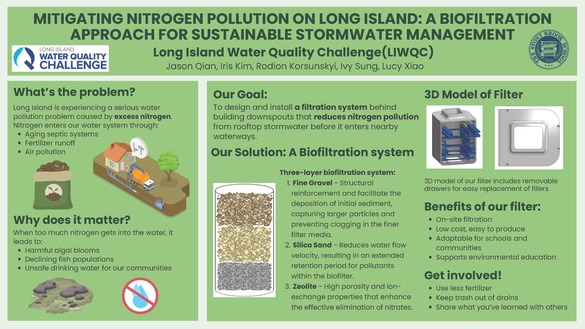
The Stony Brook School: The team, made up of students in an Advanced Scientific Research class, designed a 3D-printed filtration system incorporating fine gravel, silica sand, and zeolite to remove nitrogen from stormwater runoff. The students determined stormwater runoff pipes behind Johnston Hall and Barnhouse were the most suitable locations for sampling. Students analyzed the water prior to and following filtration which demonstrated a reduction in nitrate levels, indicating that this is an ideal location for the filtration system to be placed. The project highlights the importance of innovative water management strategies on school
The Stony Brook School’s visual representation of the 3-layer biofiltration system made of fine gravel, silica sand, and zeolite to reduce nitrogen pollution from rooftop stormwater before it enters nearby waterways.
Smithtown High School West: The 9th and 10th graders enrolled in the school’s Science Research Elective proposed building rain gardens with native plants and soil composed of sand, gravel, mulch, and compost to ensure drainage. The rain gardens will provide a method of filtration for water coming off the roof of the school from downspouts, reducing stormwater runoff. The project includes plans to establish a Garden Club for ongoing maintenance and educational opportunities.
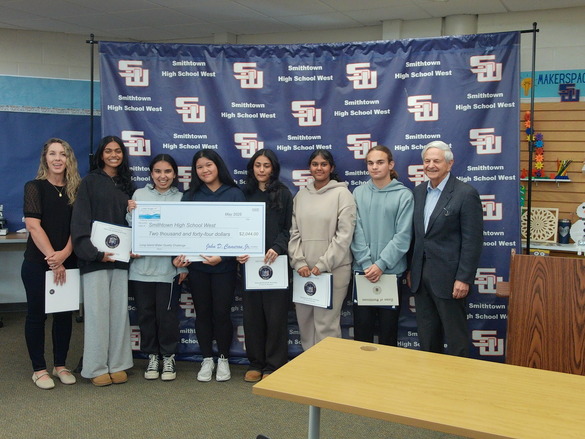
Smithtown High School West winning team and advisor.
The 2026 Long Island Water Quality Challenge will be launched in the fall with additional grants to be awarded. For more information, visit Long Island Water Quality Challenge – A STEAM Competition – LIRPC.
Connect with Us!
|