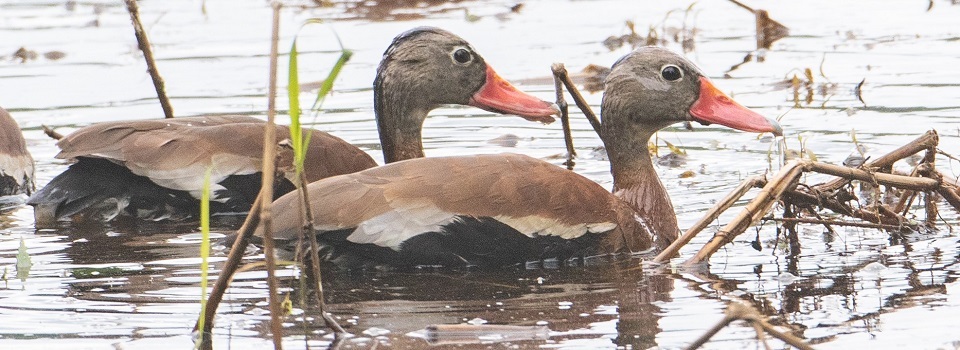
Photo of black-bellied whistling duck courtesy of Matt Zeitler
In this issue:
The sighting of an uncommon-to-rare species of waterfowl dominated the week. A single sighting would have been significant, and we had at least two instances of multiple birds each. On the water, our incredible Hudson River education programs reached a broad number of students from several schools and many grade levels.
5/24 – Orange County, HRM 41: I was birding as I walked the Wallkill River National Wildlife Refuge’s Liberty Loop in the Town of Warwick this morning when I came upon some very beautiful ducks that I had never seen before. After some investigation, I determined that they were black-bellied whistling ducks.
- Paula Spector.
[For years, the black-bellied whistling duck (Dendrocygna autumnalis) was not found, or at least very uncommon, in the U.S. Most were showing up from Mexico to southern Arizona, southern Texas, and a few in Florida. However, for the past 20 years they have expanded their range north but not reaching New York. The black-bellied whistling duck does not breed in New York or even in most places north of Florida and Texas.
The New York State Avian Records Committee's list for the black-bellied whistling duck notes that the first accepted record for a “bird in the wild” occurred in May 2002 in Suffolk County. Since 2002, there have been 21 scattered sightings in New York State. Stan DeOrsey]
Photo of black-bellied whistling duck courtesy of Larry Trachtenberg
5/24 – Ulster Park, HRM 87: Last week on consecutive days we ran our Hudson River Sloop Clearwater’s Tideline beach seining program at Esopus Meadows Preserve. We had two days of great fishing for both halves of a 5th grade class from Brinckerhoff Elementary in Fishkill.
On Day One, we caught all native species, from many spottail shiners to one alewife, now in the river from the sea to spawn. Also in the net was a yearling striped bass (80 millimeters), a banded killifish, and ten white perch.
- Eli Schloss, Larry Kosofsky, Mira Fink, Kate Phipps
On Day Two, we caught some of the biggest fish of the season including a foot-long largemouth bass and a near foot-long river herring that, from the size and other features, was a blueback herring, also in from the sea to spawn. Also in the seine were tessellated darters, banded killifish, and spottail shiners.
- Eli Schloss, Larry Kosofsky, Rick Nestler, Donna Nestler
[Note: One-inch equals 25.4 millimeters (mm). Tom Lake]
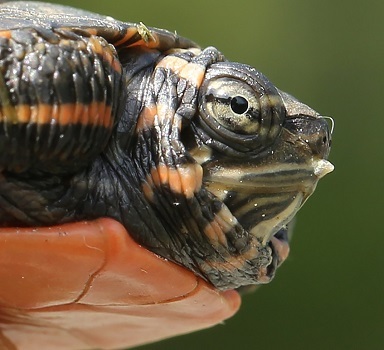
5/24 – Hudson River Watershed: When turtles hatch, they use a modified scale called an egg-tooth, or carbuncle, located on the front of their upper jaw, to puncture their leathery egg shell. (Although referred to as an egg-tooth, it is not a real tooth.) Typically, the egg tooth disappears in a matter of days or weeks after hatching. However, painted turtle hatchlings in northern New England retain their egg tooth through the winter and emerge in the spring with it still intact.
- Mary Holland
Photo of painted turtle courtesy of Nancy and Rob Foote
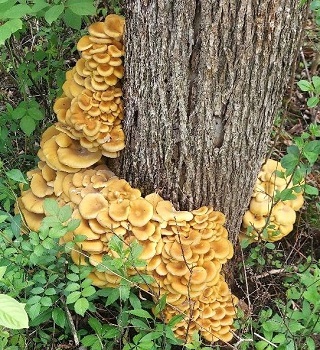
5/24 – Albany County, HRM 133: The continuous onslaught of spring rain brought about an abundant wild mushroom harvest. Golden oyster mushrooms were in abundance and hopefully the prized chanterelles will be in early June.
- Gary Sottosanti
[The golden oyster mushroom is native to eastern Russia, northern China, and Japan. Like other oyster mushrooms, the species is a wood-decay fungus. In the wild, it most commonly occurs with decaying hardwoods such as oak and elm. The first recorded observation of naturalized golden oysters in the United States was in 2012, a decade after the cultivation of the species began in North America (Bruce 2018).]
[On occasion, the exact location of an entry is intentionally left vague. Usually, it is done to protect the sensitivity of the subject from the all-to-often unbridled zeal of collectors. Among the most common examples are rattlesnake dens, vulnerable nests, especially of bald eagles, osprey, and shorebirds, fields of prickly pear, stands of orchids, choice mushrooms (foragers would rather give you their car keys than disclose a location where prime mushrooms were appearing), and archaeological investigations. Tom Lake]
Photo of golden oyster mushroom courtesy of Gary Sottosanti
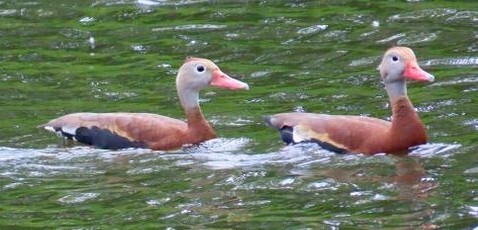
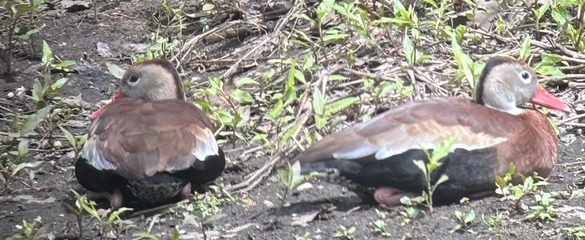
5/24 – Westchester County: I was in Rye birding, when an e-Bird report came to my phone of two black-bellied whistling ducks that had been spotted at Columbus Park in Mamaroneck a short distance away. I hurried there and found two black belied whistling ducks sitting on the muddy bank of a creek that bisects the park.
- John Askildsen
[This was just the second sighting of the black-bellied whistling duck (Dendrocygna autumnalis) in Westchester County. Tom Lake]
Photo of black-bellied whistling duck courtesy of John Askildsen
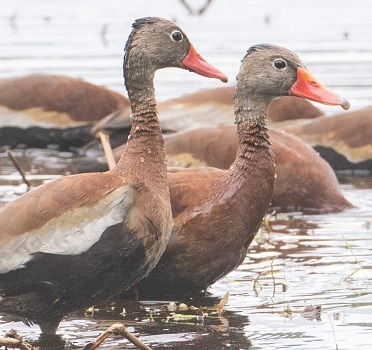
5/25 – Orange County, HRM 41: I headed out to the Wallkill River National Wildlife Refuge’s Liberty Loop in the Town of Warwick today to see if I could catch up with the seven black-bellied whistling ducks that had been reported there yesterday.
Fortunately, the birds were still there and in a good location, although they spent most of their time with their heads under water. The birds' preferred area at the refuge was about 300 yards south of the Orange County border, so technically, at least for today, they were in Sussex County, NJ.
- Matt Zeitler
Photo of black-bellied whistling duck courtesy of Matt Zeitler
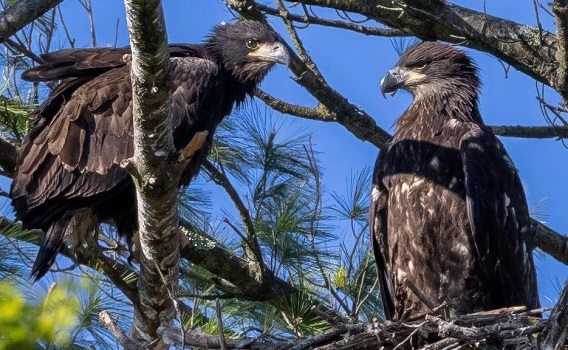
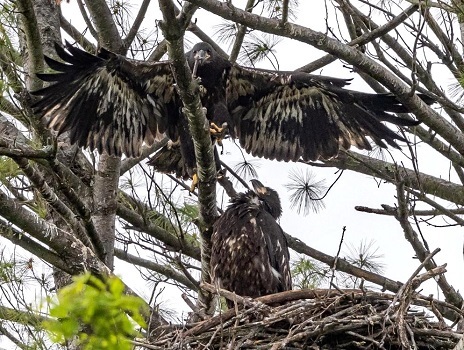
5/25 – Town of Poughkeepsie: For the first half-hour that we watched bald eagle nest NY62 with our scope from a knoll 250 yards away, it was totally quiet. No signs. No movement. We figured the nestlings were down inside keeping warm on a somber, cloudy day. Then one head popped up and went right back down. Two heads popped up and both went right back down. Then there was a medley of big, flapping feathered wings as the two large nestlings stood up — more like they emerged from the bottom of the nest. Through our scope, it looked like Mothra meets Godzilla. How did three ever fit in that nest?
- Tom Lake, Tommy Jackson, Ben Jackson
Photo of bald eagle courtesy of Bob Rightmyer
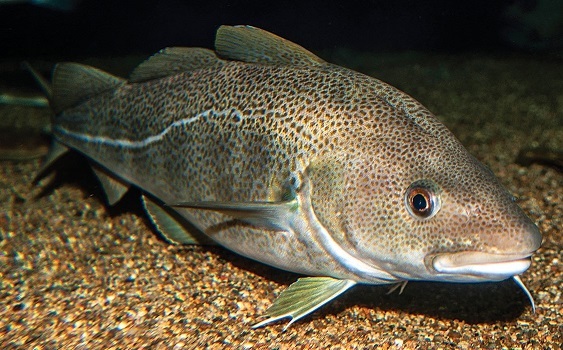
5/26 – Hudson River Watershed: Fish-of-the-Week for Week 321 is the Atlantic cod, Gadus morhua Linnaeus, 1758, number 105 (of 238), on our Hudson River Watershed List of Fishes. If you would like a copy of our list, e-mail: trlake7@aol.com
The Atlantic cod is one of three Cods & Haddocks (Gadidae) documented for our watershed. The others are Atlantic tomcod (Microgadus tomcod) and pollock (Pollachius virens). Atlantic cod and pollock are designated as temperate marine strays in our watershed while the Atlantic tomcod is seen as diadromous (freely migrating from marine to estuarine waters).
In the northwest Atlantic, Gadus morhua range from Greenland to North Carolina. In U.S. waters, cod is most often commercially caught on Georges Bank and in the western Gulf of Maine. According to Bigelow & Schroeder’s Fishes of the Gulf of Maine (1953), the most noticeable external characteristic of the cods is their three dorsal and two anal fins. While they are known to reach seven-feet-long and weigh 200 lbs., adult cod are most commonly seen in the range of 25-40 lbs. They feed on shellfish, squid, and fish, most favorably Atlantic herring.
Atlantic cod is an iconic fish of New England but in recent times their stocks have declined dramatically. Historically, cod was so abundant and well-known in New England that early explorers named Cape Cod for the fish. Gloucester (MA) was established by a colonial charter issued to profit from cod fishing, and a painted “Sacred Cod” carved from pine has been hung in the Massachusetts State House since 1784 as a symbol of prosperity.
There are scant records for Atlantic cod in the Hudson River estuary. The 17th century Dutch spoke of cod in the East River and legendary commercial fisherman Ace Lent reportedly caught cod in the river off Verplanck in the 1960s (Boyle 1969). Given their rarity, especially 41 miles upriver in brackish water, it is possible Ace Lent was referring to tomcod.
The head of an Atlantic cod was recovered (minus skeletal bones) on December 3, 1982, at Croton Point (T.R. Lake, in C.L. Smith 1990). Extrapolating from the size of the head, the live cod may have been two-feet-long. However, the head minus the rest of the fish begs the question of how it got there. J.R. Greeley (A Biological Survey of the Lower Hudson Watershed, 1937), found no evidence of Atlantic cod in the estuary.
- Tom Lake
[As a result of high fishing pressure, both commercial and recreational, Gulf of Maine and Georges Bank coastal stocks had been drastically reduced. By the 1990s, spawning biomass had fallen to just 1% of its estimated peak. Since the epicenter of Atlantic cod stocks are in Canadian waters, Canada made the first move to begin recovery.
In 1992 the Canadian government implemented a cod moratorium, a ban on commercial fishing primarily affecting the northwest Atlantic cod stocks off the coast of Newfoundland and Labrador. Due to decades of overfishing, the cod population was on the verge of collapse. Thirty-two years later (2024), Canada announced an end to the moratorium with a reopening that would amount to only a small increase in the fishing activity. A scientific assessment of the northern Atlantic cod stock had improved slightly from "critical" to "cautious."
In U.S. waters, the National Oceanic and Atmospheric Administration Fisheries (NOAA) has also been working to rebuild these stocks (a stock assessment is available at NOAA). With both the George’s Banks and the Gulf of Maine stocks continually subject to overfishing, commercial fishing is still allowed, but at much reduced levels. Tom Lake]
Photo of Atlantic cod courtesy of NOAA
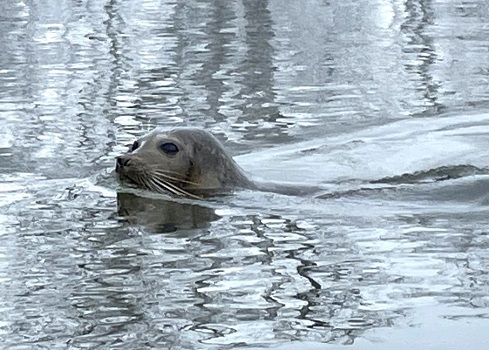
5/26 – Saugerties, HRM 102: This afternoon, guests of the Saugerties Lighthouse reported seeing a seal while kayaking-canoeing near the waterfall at the head of tide on Esopus Creek. According to their report, the seal swam away at first and then came back appearing to be curious and staying with them for a while. The location and behavior are consistent with the male harbor seal (flipper tagged 2-4-6 in 2018) who has visited this area over the last eight years, exhibiting a curiosity toward paddlers. This seal has been frequenting the tidal Esopus Creek since August 5, 2019.
- Patrick Landewe
[As a new pup, this harbor seal was rescued on April 28, 2018, from Lower Goose Island, Harpswell, Maine. Following rehabilitation at the Mystic Connecticut Aquarium Animal Rescue Center, a white tag (246) was applied on its rear flipper before the seal was released as a yearling at Charlestown, RI, on January 17, 2019. Following a long journey down the coast and up the Hudson River, from August 5, 2019, on and off through May 26, 2025, the seal found a home in Esopus Creek at Saugerties, 110 miles from the sea. Patrick Landewe]
Photo of harbor seal courtesy of Derek Brown
5/27 – Saratoga County, HRM177: I was birding at the south entrance to the Saratoga Battlefield National Historical Park. The area was very active with many bird sightings — just about anything with feathers — including eastern meadowlark, common yellowthroat, bobolink, Savannah sparrow, and a gorgeous clay-colored sparrow.
- Katrina Van Tassel
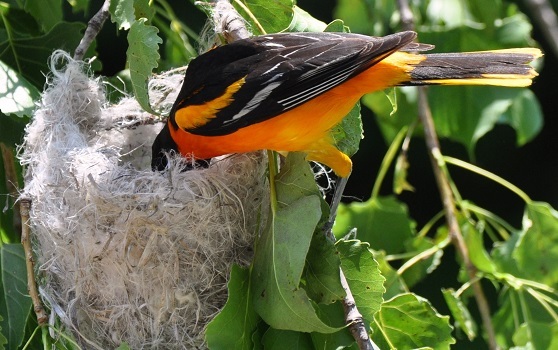
Photo of baltimore oriole courtesy of Lowell Washburn
5/27 – Milan, HRM 90: My neighbor, a farmer, recently had an interesting experience. He called me for help in identifying a bird that had been unraveling a flag on his porch. From his description, I was certain that the bird was a male Baltimore oriole.
He explained what happened when the oriole became tangled in the unraveled flag. Through great effort, he managed to untangle the oriole while being pecked at throughout the process. It's nice to see a farmer that appreciates the birds on his farm by helping them and always trying to learn about them. I explained to him the uniqueness of the oriole nest and why flags threads would be an important part of its nest's construction.
- Frank Margiotta
5/27 – Yonkers, HRM 18: This morning, our research and education team at the Sarah Lawrence Center for the Urban River at Beczak hosted two 5th grade classes from MLK Academy in Yonkers.
It was high tide as we made twenty seine hauls resulting in a great mix of the river’s aquatic life. High count among invertebrates was blue crab (17), along with grass shrimp, eastern oyster, and white-fingered mud crab. Among five fish species were mummichog, alewife, yearling striped bass, and young-of-year bay anchovy and bluefish.
The river was 61 degrees Fahrenheit (F), the salinity was 6.2 parts-per-thousand (ppt), and the dissolved oxygen (DO) was 8.0 parts-per million (ppm).
On an afternoon low tide with some Yonkers High School students, we made six hauls of our seine. A highlight among the fishes was an Atlantic tomcod (65 mm). Others were summer flounder, naked goby, and mummichog, Blue crab (61) were overall high count (10-55 mm). Water temp had risen to 65 degrees F., salinity was 6.9 ppt, and the dissolved oxygen (DO) was 9.6 ppm.
- Jason Muller, Amy Lienert, Christina Edsall, David Jiao, Mika Hughes
[Crab measurements (size) are calculated in millimeters (mm) point-to-point across their carapace. Tom Lake]
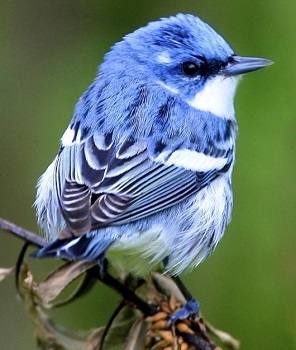
5/28 – Schodack Island State Park, HRM 134: At least three cerulean warblers were actively singing in the Riverside Campground at Schodack Island State Park this morning. Other species of interest included Baltimore oriole, scarlet tanager, yellow-throated vireo, multiple highly vocal American redstarts, red-eyed vireos, and veeries, one of which walked all the way down a road very close to us.
- Scott Stoner, Greg Recer, Hudson-Mohawk Bird Club
Photo of cerulean warbler courtesy of Mary Holland
5/28 – Yonkers, HRM 18: At high tide, our research and education team at the Sarah Lawrence Center for the Urban River at Beczak made six hauls of our seine. Young-of-year bay anchovy (4) was high count among fishes and blue crab led invertebrates (70-85 mm). The river was 62 degrees F., salinity was 5.3 ppt, and the dissolved oxygen was 8.1 ppm.
- Jason Muller, Mika Hughes, David Jiao
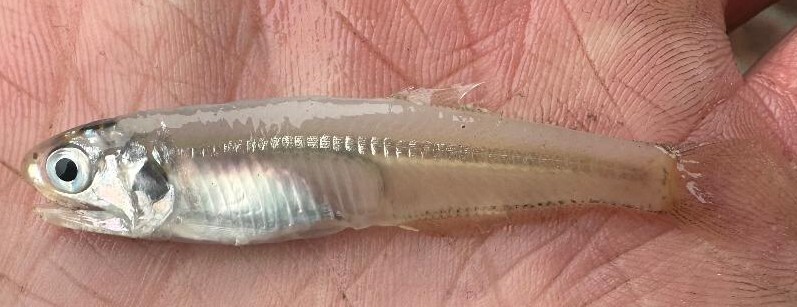
5/29 – Norrie Point, HRM 82: We had a super-crew of students from teacher Tom Mullane's Pearl River High School with us today. Between four seine hauls in the south-side cove and five at the up-river side, we netted 81 fish of 12 different species. High counts included white perch(25) and spottail shiners(14) as well as various sunfish, white suckers, largemouth bass, and two lovely American eels.
The surprise of the day was two bay anchovies caught on the river side of the center. These were young-of-year fishes, a regular spring migrant in from the sea. Some references (e.g., Boyce-Thompson 1977) cite them as the single most numerous fish in Hudson Tidewater in spring. They were here because, as filter-feeders, they find the plankton-rich estuarine waters an all-night deli.
- Chris Bowser, Maija Niemisto, Tom Mullane
Photo of bay anchovy courtesy of Chris Bowser
5/29 – Sleepy Hollow HRM 28: Sixty 7th grade students from Sleepy Hollow joined us at Kingsland Point Park for a Hudson River Sloop Clearwater Tideline seining program. Across 15 hauls of our 25 x 4-foot net we caught four Atlantic silverside, two young-of-year alewives (40 mm), and a yearling striped bass (60 mm).
- Eli Schloss, Larry Kosofsky, Chloe Faroe, Sarah Levin, Brian Reid
5/29 – Yonkers, HRM 18: At high tide, our research and education team at the Sarah Lawrence Center for the Urban River at Beczak, with enthusiastic assistance from two 5th grade classes from the Allen-Stevenson School in Manhattan, made 25 hauls of our seine. Among invertebrates, blue crab was high count (11); among fishes, bay anchovy was high count with eight. We also caught our second Atlantic tomcod of the week as well as a foot–long American eel. The river was 62 degrees F., salinity was 5.4 ppt, and dissolved oxygen (DO) was 7.8 ppm.
- Christina Edsall, Katie Lamboy Roman, Amy Lienert, Suzy Schwimmer, Mika Hughes, David Jiao
5/30 – Dutchess County, HRM 98.5: There wasn't much fish activity in the Saw Kill today; the white sucker and alewife runs were over for the year. There were still a few smallmouth bass around and I caught a rock bass for the first time this year. I wonder whether this species moves in from the tidal river or whether they just hang around until the temperature spurs them to activity. On my way along the bank, I stumbled on a pair of mating northern water snakes, an activity I had never seen before. Later, I encountered a third water snake, more of them by far than I usually see in a day.
- Bob Schmidt
5/30 – Yonkers, HRM 18: Our research and education team at the Sarah Lawrence Center for the Urban River at Beczak checked our glass eel fyke net, that we set overnight in the Beczak Tidemarsh, four days this week. Collectively, we caught five glass eels and thus it became our final fyke net sampling week of the year.
We finished the season with 4,020 glass eels spread over 68 days of sampling. This is our second highest seasonal total. Our 12-year seasonal average is 2,126 glass eels.
Water quality parameters oscillated across the four days: Water temperature 61-64 degrees F., salinity 5.3 to 6.9 ppt, and dissolved oxygen (DO) 8.1 to 9.6 ppm.
- Jason Muller, David Jiao. Mika Hughes, Hilary Vidalakis, Callista Tse, Sophia Tache
In the afternoon, our team made six high tide seine hauls. Blue crab (to 60 mm) was high count of the catch (5). The river was 63 degrees F., salinity was 5.4 ppt, and dissolved oxygen (DO) was 9.3 ppm.
- Jason Muller, Mika Hughes, David Jiao, Callista Tse, Sophia Tache
5/30 – Town of Poughkeepsie: The two remaining nestling were now “branching,” the time of their stay in the nest when they discover their wings and explore the nest tree as a prelude to fledging. One nestling seems nearly ready but still a little tentative. Next week probably.
- Bob Rightmyer
Photo of bald eagle courtesy of Bob Rightmyer
Help celebrate the many fishes and fishing communities of the world! There will be several events throughout the lower Hudson and New York Harbor. Find out more about the events.
As part of this, the NYSDEC will be hosting a free and family-friendly seine-netting event at Lemon Creek Park on Staten Island, from 11:00am to 1:00pm. Educators from NYSDEC, NOAA, and the NYCDEP will be on hand to lead participants to net fish and crabs in the shallows and along the beaches. Lots of fun for all! No registration required.
Science Saturdays at Norrie Point
Science Saturdays is a monthly program hosted by the DEC at the Norrie Point Environmental Center at Mills-Norrie State Park in Staatsburg, NY. These free, family friendly events will be led by staff with excitement for each topic, or in collaboration with regional events from other organizations. No registration needed!
Monthly program details can be found in our flyers on Events - Hudson River National Estuarine Research Reserve. Our next events are:
-
June 14, 11:00 AM to 12:00 PM, Get Outdoors Day
-
July 12, 8:30 AM to 11:00 AM, Who's That Fish?
Hudson River Lesson Plans
Explore our collection of Hudson River lesson plans, videos and online activities to support hand on investigations of the Hudson River in your classroom.
River’s Treasure Trove: Collecting for the Classroom - let natural history, artifacts, and outdoor learning tell a story
Date: June 30 - July 2, 2025
Time: 8:45 AM - 4:00 PM; half day July 2
Location: Norrie Point Environmental Center, 256 Norrie Point Way, Staatsburg, NY
CTLE Credits: 17 hours
Join us this summer as we explore the River’s past, present and future through the art and science of collecting. We will be joined by staff from the NYS Museum, NYSDEC, Hudson River Maritime Museum, and the Hudson River National Estuarine Research Reserve. Teachers will have fun finding, organizing and interpreting the natural and cultural history of the Hudson River. Interact with an interdisciplinary professionals providing you with valuable information to take back to your classrooms.
Hudson River Miles
The Hudson is measured north from Hudson River Mile 0 at the Battery at the southern tip of Manhattan. The George Washington Bridge is at HRM 12, the Tappan Zee 28, Bear Mountain 47, Beacon-Newburgh 62, Mid-Hudson 75, Kingston-Rhinecliff 95, Rip Van Winkle 114, and the Federal Dam at Troy, the head of tidewater, at 153. The tidal section of the Hudson constitutes a bit less than half the total distance—315 miles—from Lake Tear of the Clouds to the Battery. Entries from points east and west in the watershed reference the corresponding river mile on the mainstem.
To Contribute Your Observations
The Hudson River Almanac is compiled and edited by Tom Lake and emailed weekly by DEC's Hudson River Estuary Program. Share your observations by e-mailing them to trlake7@aol.com.
Was this Newsletter Forwarded to You?
Subscribe today to DEC Delivers Hudson River Almanac topic for weekly natural history journal that covers the Hudson from the High Peaks of the Adirondacks to New York Harbor.
Helpful Resources
National Oceanic and Atmospheric Administration online tide and tidal current predictions are invaluable when planning Hudson River field trips. For real-time information on Hudson River tides, weather, and water conditions from sixteen monitoring stations, visit the Hudson River Environmental Conditions Observing System website.
DEC's Smartphone app for iPhone and Android is now available at New York Fishing, Hunting, and Wildlife App.
|