|
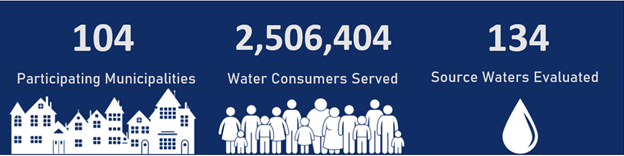
2024 was another banner year for DWSP2 with 34 new municipalities joining the program. To date, a total of 104 municipalities encompassing 82 plans have participated in the program.
DWSP2 statistics summary as of January 2025
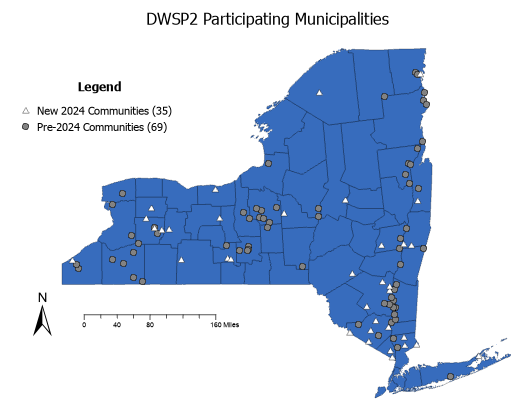
In 2024, DWSP2 welcomed its second round of participants. While most regions of NYS saw at least one new DWSP2 plan, the Greater Niagara, Finger Lakes, Hudson Valley, and Westchester areas were the clear standouts. Twenty-three of the thirty-five new DWSP2 municipalities came out of these four parts of NYS.
In 2025, program staff will keep seeking and maintaining the continued growth of DWSP2 in these regions, while expanding into other areas of the state that are underrepresented within the program. This will be done by collaborating with regional planning boards, other agencies (e.g. Department of Agriculture and Markets), and organizational partners (e.g. Association of Towns) to target specific areas in NYS that could benefit from source water protection.
More program growth is anticipated as the State plans to offer another DWSP2 application round to municipalities. Staff will promote the program through presentations, email blasts, and digital/social media outlets. Watch your email inbox for the announcement.
General map of NYS communities that participate in DWSP2. First-round communities (circles) and second-round communities (triangles) are depicted.
Since mid-2024, several DWSP2 municipalities have started implementing their source water plans. Implementation is an exciting time when planning efforts become actions. To date, a total of eight DWSP2 plans have transitioned to implementation work.
Municipalities are applying to the DEC Water Quality Improvement Project (WQIP) grant to fund projects that directly protect or improve water quality and habitat, promote flood risk reduction, restoration, and enhance flood and climate resiliency. The latest round (Round 20) of WQIP grantees include 12 DWSP2 municipalities that received funding for a wide array of projects related to source water protection including land acquisition, stormwater management, and salt storage and road salt reduction. The growing nexus between DWSP2 municipalities and WQIP grants is an encouraging sign that communities are taking actions to protect their source waters by conserving land and reducing pollutants.
A DWSP2 plan is considered a “joint” plan when two or more municipalities participate together to protect their drinking water sources. With the addition of three “joint” plans in 2024, nearly 35% of all DWSP2 communities are now involved in a “joint” plan.
The continued increase in the number of “joint” plans demonstrates the importance of municipalities collaborating on source water protection activities beyond their municipal boundaries. The DWSP2 process encourages these partnerships.
The in-person workshop was a success. During the workshop, stakeholder group members from the two communities had in-depth conversations about how each were addressing challenges, as well as any solutions they had implemented to protect their source waters. The conversations led the municipalities and Technical Assistance (TA) providers toward a deeper understanding of each water system.
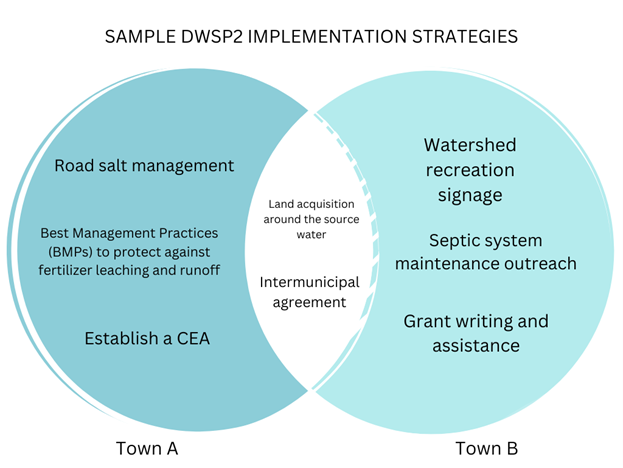
The City and Town completed a Venn diagram prior to the joint meeting using their implementation tables created during plan development. At the in-person meeting, each municipality participated in an implementation alignment exercise. During this exercise, the City and Town discussed the accuracy of the Venn diagrams and how they could collaborate on overlapping implementation actions. After this, communities were separated into smaller groups to work on drafting project profiles derived from the middle piece of the Venn diagram (example diagram below).
Additionally, a representative from the Lake Champlain Basin Program gave meeting attendees an overview of applicable grants, tips for applying, and how to follow up with grant applications. Group discussion followed, with the conversation centered on how to fund overlapping implementation activities.
Participant feedback indicated that they found the in-person joint meeting helped set a strong roadmap for the implementation phase and fostered a stronger exchange of ideas compared to separate, virtual meetings.
Example Venn diagram depicting individual and overlapping implementation activities for two separate municipalities.
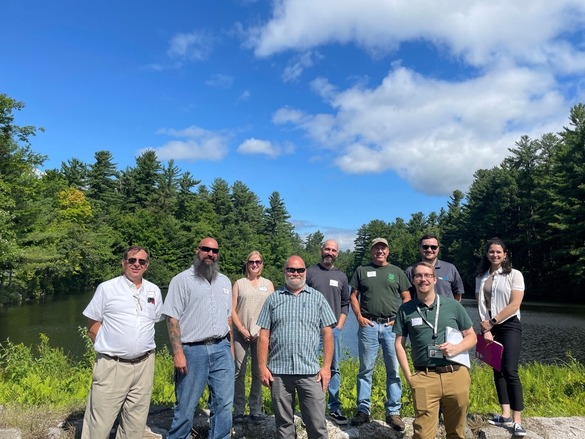
Plattsburgh Joint Water System Tour Photo. Left to right: Ron Laberge, Mike Stoutenger, Janelle Henry, Scott Stoddard, Trevor Cole, Peter Hagar, Charles Rorick, Sam Blake, Madeline Silecchia. Photo credit: Alyssa Bement.
The extended in-person meeting allowed both municipalities to efficiently address multiple topics. Also, participating in exercises that were specifically designed for a multi-municipality meeting presented insight into varying perspectives held by the stakeholders, potentially helping to bridge some gaps in communication.
In the fall of 2024, the DWSP2 webpage received a functional and aesthetic boost. The goal was to increase and improve user experience with the DWSP2 webpage. The webpage was condensed and clarified to communicate all aspects of the program. The format of the landing page and subpages were modernized to be more user-friendly. With the enhanced functionality, webpage content is more accessible and readily available to all. If you haven’t already, we encourage you to visit the updated DWSP2 section of DEC's website to view the full makeover.
|