Freshwater Fishing, Fisheries Management, and Fishing Access News
In this issue:
The open season for largemouth bass and smallmouth bass, begins on June 15 and extends through November 30. Not only are there plentiful waters to fish for them, but many provide outstanding opportunities to catch trophies. There's a reason why New York draws national-level bass fishing tournaments every year. Special fishing regulations exist for some waters, so be sure to check the current fishing regulations before heading out to fish.
If you're interested in taking that next step and going "beyond the bobber," give bass fishing a try. A spin-casting (push-button) or medium action spinning rod rigged with a soft stick bait "wacky-style," is very popular and can be very effective in catching both species. It's great for kids too because fishing it really just involves casting it out, letting it sink to the bottom and reeling it in with a twitch-pause action. Most times, bass will strike on the drop. Some other popular lures include crank baits, spinner baits, and tube jigs.
Check out the DEC website for information on learning how to get started in fishing and where to go:
Bass fishing season is closed from December 1 through June 14 on all waters in St. Lawrence, Jefferson, Franklin and Hamilton counties. This includes Lake Ontario (in Jefferson County) and the St. Lawrence River. For these specific counties, targeting largemouth and smallmouth bass, including catch and release, is prohibited until the season opens on June 15.
Tip: Consider switching your fishing technique/lure or moving to another spot if you find yourself catching bass while targeting other species.
For more information, visit DEC’s website for freshwater fishing regulations.
Get Outdoors & Get Together! On June 8, DEC and State Parks, in partnership with the Office for People with Developmental Disabilities and the NYS Division of Veterans' Services, will host a day of free events to connect people to nature and provide increased access to the outdoors. It is offered as part of Governor Hochul’s initiative to ensure inclusivity of access to State public lands and bring together people of all abilities, ages, identities, and backgrounds for fun, healthful activities. It coincides with National Get Outdoors Day, an annual event to encourage healthy, outdoor fun.
Try fishing, archery, kayaking, bird watching, hiking, and so much more at one of our many statewide locations.
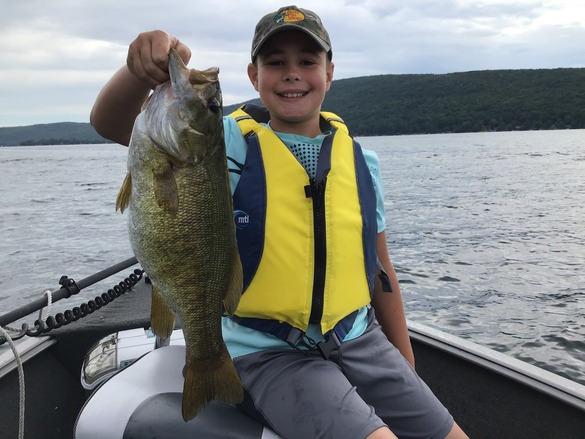
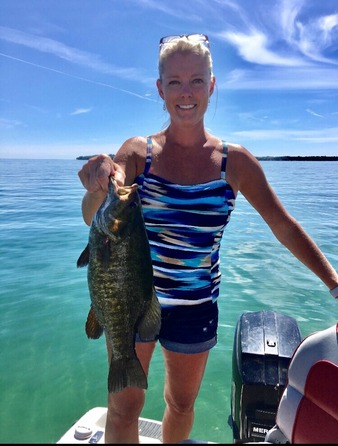
Smallmouth bass were the popular choice for Lake Erie anglers in May, and the fishing did not disappoint. Anglers caught 18 bass per boat trip, the highest May catch rate in the last four years. Stellar bass fishing on Lake Erie should continue into June, so get out and enjoy this world-class fishery!
The Lake Erie angler survey is conducted annually from May through October along the entire New York portion of Lake Erie to estimate angler effort, catch, and harvest for all sport fish species in the open lake.
Smallmouth bass fishing on Lake Erie
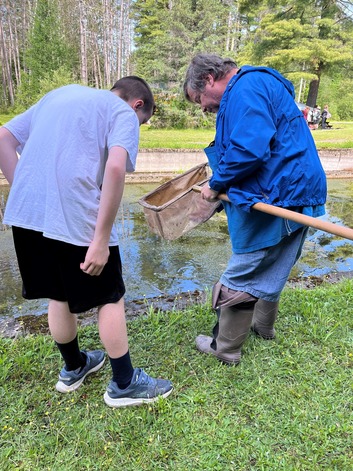
DEC staff recently hosted students from Fonda-Fultonville Middle School for the annual Field Day at the Hale Creek Field Station in Gloversville, Fulton County. Organizers set up rotating stations for the Field Day allowing students to roll up their sleeves and participate in stream ecology, fish identification, pollutants in fish and wildlife, fish processing for pollutant analysis, amphibian identification and ecology, and forest ecology. They also learned about the impact of invasive species on New York's environment.
Connecting young people to New York's natural resources allows them to witness first-hand the impact they have on the health of our environment and helps cultivate the next generation of environmental stewards.
Located on an 85-acre site that was formerly the Johnstown Fish Hatchery, the Hale Creek Field Station is the only in-state lab that analyzes fish and wildlife for contaminants such as polychlorinated biphenyls (PCBs), metals like mercury, and emerging contaminants like polyfluoroalkyl substances (PFAS).
The property is open to the public and maintains fish ponds and race ways stocked with trout. There are also several miles of hiking trails that provide a great opportunity to explore local forest habitats and view the flora and wildlife.
Funding for student transportation to the event was provided by the Office of Parks, Recreation, and Historic Preservation through the Connect Kids to Parks Program.
Visit Hale Creek Field Station
Municipalities (including Indian Nations), non-profit organizations, and soil and water conservation districts are eligible to apply for funding to conserve New York State’s diverse fish and wildlife by restoring and enhancing important habitats. Through the Water Quality Improvement Project (WQIP) program these entities can receive state money to restore and enhance wetlands and riparian corridors that serve as critical locations for native fish and wildlife to nest, spawn, forage, migrate, and overwinter.
WQIP is a competitive, statewide, reimbursement DEC grant program. One project type offered through WQIP is for Fish and Wildlife Habitat Restoration and Enhancement. This provides funding for projects that will, as their primary goal, restore and/or enhance impaired, degraded, or marginal fish and wildlife habitat by directly addressing one or more factors that are compromising the habitat's value. Projects will improve a habitat’s ability to serve as a high-quality spawning, nursery, wintering, migratory, nesting, breeding, or foraging environment for fish and wildlife. Projects should prioritize species of conservation concern or interest, including state-designated Species of Greatest Conservation Need. By restoring habitats that are essential for behaviors, such as foraging and breeding, projects can help address one of the most significant threats to the state’s fish and wildlife—habitat loss and impairment.
Maximum grant amount: $1,000,000
Required local match: at least 25% of total project cost
Project Subtypes: Wetlands and Riparian Corridors
WQIP is part of the New York State Consolidated Funding Application (CFA). Applications are due July 31, 2024, at 4:00 p.m.
For full grant details, view the WQIP Program Overview.
A webinar will be offered on June 14, 2024 at 10 a.m. to provide details on the grant program. Registration for the Habitat Restoration and Enhancement WQIP webinar is preferred, but not mandatory.
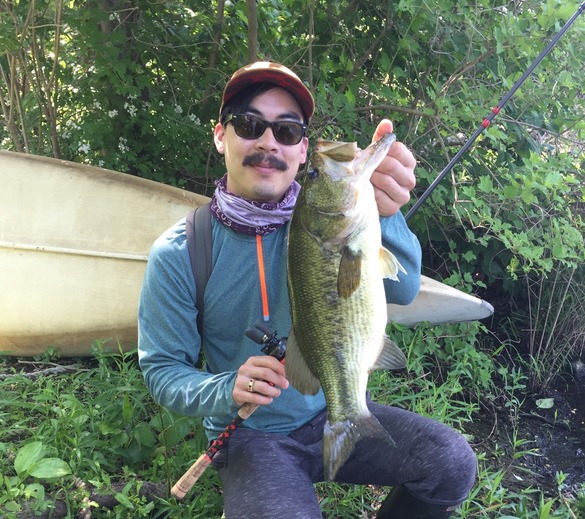
Scientific Name: Micropterus salmoides
Nicknames: Bucket mouth, Melon head, Hawg
State Record: 11 lbs. 4 oz., Buckhorn Lake (Otsego County), 9/11/87
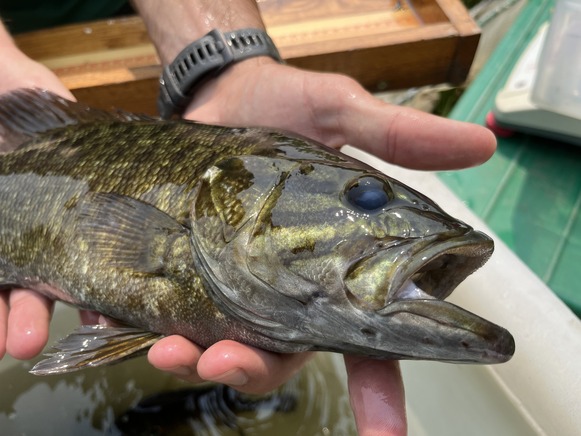
Identification: Dark band extending the length of the body, greenish coloration in many waters, jaw extends past the eye (jaw doesn’t extend past eye in smallmouth bass)
Where to Fish: Often found in shallow, weedy areas of lakes, ponds and rivers, as well as submerged cover (logs, docks and stumps).
How to Fish: Chances are there’s at least one lure in your tackle box that will work for bass. Spinnerbaits, crank baits, and soft stick baits are all usually effective. Perhaps the most popular is the wacky rig, which is essentially a plastic worm with a hook inserted through the middle (or use an o-ring), casted out and twitched/bounced on the bottom. Bass cannot resist it- trust us on this one! For more details on bass fishing techniques check out the link below.
Safe Handling: Bass can easily be handled by gripping their lower jaw between your thumb and forefinger. If holding horizontally, be sure to support the back of their body with your other hand. Otherwise, you can hold them vertically. The rough texture you feel in their mouth are their very tiny teeth.
Fish Fact: During spawning season, male bass guard the nest until fry are fully free swimming, which takes 1-2 weeks after hatching. Not all fish species demonstrate this level of parental care.
Fishing for Largemouth and Smallmouth Bass
|