Project of the Hudson River Estuary Program
Compiled and edited by Tom Lake, Consulting Naturalist
Overview
In the aftermath of the relentless rain in the Hudson Valley three weeks ago, salinity levels in the estuary had hit bottom with readings of near zero parts-per-thousand where normally it would be as much 30% seawater. This week, with freshwater input from upriver slowing, the salt began to rebound. With the recovery came a mix of salt and brackish water fishes, our expected summer visitors.
Highlight of the Week
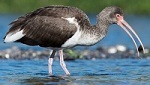 7/31 – Saratoga County, HRM 173: An immature white ibis was photographed at Wright’s Loop in Saratoga County (town of Stillwater) today (6:57 p.m.). (Photo of white ibis courtesy of Tom Johnson) 7/31 – Saratoga County, HRM 173: An immature white ibis was photographed at Wright’s Loop in Saratoga County (town of Stillwater) today (6:57 p.m.). (Photo of white ibis courtesy of Tom Johnson)
- Zach Schwartz-Weinstein (Hudson-Mohawk Bird Club)
[White ibis (Eudocimus albus) is a long-legged wading bird that is very uncommon-to-rare in New York. Their native range includes the southeastern United States, the coastal Carolinas, Florida, and the Gulf Coast through the Caribbean where they gather in groups in shallow wetlands and estuaries. New York State Avian Records Committee (NYSARC) has confirmed just 17 sightings in New York State since 1980 (this was the first for Saratoga County), and only four in the Hudson River Valley. The two most recent sightings were Orange County 2011 (Ken McDermott) and Dutchess County 2017 (Barbara Butler, Adrienne. Tom Lake]
Natural History Entries
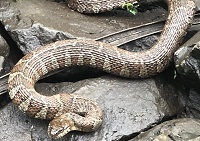 7/28 – Columbia County, HRM 124: Our "Drop in Hudson" fishing program, led by Leanna O'Grady of Columbia County Soil & Water Conservation District, on Ice House Road in Nutten Hook, had a lot of action today. Rods, reels, and worm bait were provided, free of charge, along with a “Fishing 101" lesson. We caught many white perch and channel catfish, and we enjoyed a stunning flyover by an adult bald eagle. 7/28 – Columbia County, HRM 124: Our "Drop in Hudson" fishing program, led by Leanna O'Grady of Columbia County Soil & Water Conservation District, on Ice House Road in Nutten Hook, had a lot of action today. Rods, reels, and worm bait were provided, free of charge, along with a “Fishing 101" lesson. We caught many white perch and channel catfish, and we enjoyed a stunning flyover by an adult bald eagle.
The excitement of the day was provided by a curious four-foot-long northern water snake as it swam close to the shore where participants were fishing. The snake chased after a bobber as the line was being reeled in which sent a couple of people running for the hills! (Photo of northern water snake courtesy of Chris Bowser)
- Fran Martino
[The northern water snake (Nerodia sipedon) is a large, non-venomous, and common native snake. They can grow to nearly five-feet-long and are found in and around almost any water body or wetland where they feed heavily on fish and amphibians, swallowing their prey alive. Although they are no threat to people, they can be unnervingly aggressive with a nasty disposition. Tom Lake]
7/28 – Manhattan, HRM 1-2: Our Hudson River Park’s River Project staff, along with Field Science Assistants Stefan, Vivan, and Colman, and Seasonal Educators Sasha, Kelly, Hart, and Sarah, checked our research gear (pots and traps) that we deploy off Piers 26 and 40 as part of our fish ecology survey and monitoring.
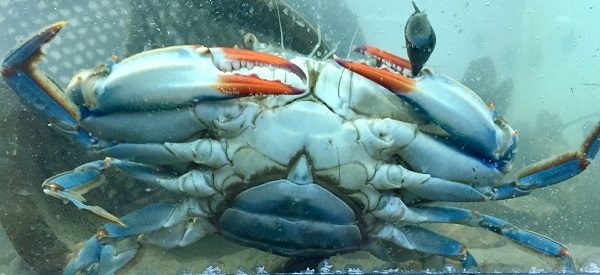
Our collection gear at Pier 40 was nearly empty. However, the discerning eye of our Field Science Assistants spotted among the grass shrimp and isopods a tiny skilletfish that measured just ten millimeters. Pier 26 produced our “wow” of the day with a 15-inch adult tautog, one of our largest this season. It was keeping company with a male blue crab in our crab pot (130 mm).
- Toland Kister, Siddhartha Hayes, Zoe Kim
[Crab measurements (size) are calculated in millimeters (mm) point-to-point across their carapace. Tom Lake]
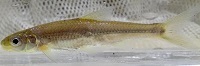 7/29 – Beacon, HRM 61: In what had become a common theme of summer, we were again just a short step ahead of a thunderstorm. The humid air on the beach carried a sultry anticipation. As the horizon grew darker, we set and hauled our net with a weather eye on Storm King. 7/29 – Beacon, HRM 61: In what had become a common theme of summer, we were again just a short step ahead of a thunderstorm. The humid air on the beach carried a sultry anticipation. As the horizon grew darker, we set and hauled our net with a weather eye on Storm King.
Our catch was completely unremarkable, a day when the ambiance filled in the gaps. While we caught tessellated darters and young-of-year striped bass, the high count was nearly a hundred tiny spottail shiners (22-30 mm). The water was a very toasty 84.5 degrees Fahrenheit (F) with no trace of salinity. (Photo of spottail shiner courtesy of Tom Lake)
-Tom Lake, A. Danforth
[Spottail shiner is a native Hudson River fish, one of 32 species of carps and minnows (Cyprinidae), the largest family of fishes in the watershed. They are found across a wide swath of North America from far west Canada southeast through the American Midwest, the Great Lakes, the Hudson River Valley, and then south along the coast to Georgia. They are common throughout our watershed from ponds, lakes, reservoirs, and rivers, even venturing into the tidal brackish water of the lower estuary. Prior to 1824, however, the spottail shiner seemed to be unknown to science.
Following the protocol for naming a fish — most biological life on earth has a scientific name, usually Latin or Greek — the spottail shiner was described and named by DeWitt Clinton in 1824 between his two terms as governor of New York State (1817-1823 and 1825-1828). Clinton's very detailed description of the fish was submitted to the forerunner of the International Commission on Zoological Nomenclature in 1824. They determined that this was a new species and accepted his name Clupia hudsonius (Clupea, Latin for a herring-like fish, and hudsonius paying homage to the Hudson River). After several iterations of the genus, New York State Ichthyologist J.R. Greeley settled on Notropis hudsonius (1935).
The spottail shiner’s type site location is the Hudson River, making the species a true Hudson River fish. However, the type specimen (by which others are systematically compared) was lost in 1866 when a fire destroyed the Lyceum of Natural History (now The New York Academy of Sciences) in Manhattan. Tom Lake]
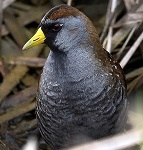 7/30 – Saratoga County, HR 157: I heard a sora (Porzana carolina) early this morning at Vischer Ferry Preserve along the towpath west of the Whipple Bridge. This is one of those marshy wetlands birds that you seldom hear and rarely see at Vischer Ferry. However, like the common owls, you assume they are present even though they aren't usually detected at least during the day. For the year so far, I've heard at least two of the bittern species (American and Least) and the three usual rails (common gallinule, Virginia rail, and sora) at Vischer Ferry. (Photo of sora courtesy of Deborah Tracy Kral) 7/30 – Saratoga County, HR 157: I heard a sora (Porzana carolina) early this morning at Vischer Ferry Preserve along the towpath west of the Whipple Bridge. This is one of those marshy wetlands birds that you seldom hear and rarely see at Vischer Ferry. However, like the common owls, you assume they are present even though they aren't usually detected at least during the day. For the year so far, I've heard at least two of the bittern species (American and Least) and the three usual rails (common gallinule, Virginia rail, and sora) at Vischer Ferry. (Photo of sora courtesy of Deborah Tracy Kral)
- John Hershey (Hudson-Mohawk Bird Club).
[The Mohawk Towpath Byway runs from Waterford to the historic Stockade District of Schenectady along the historic route of the Erie Canal. Tom Lake]
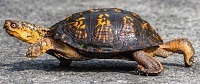 7/30 – Pine Island, HRM 40: We had a storm pass through early this morning that left some nice ”puddling” in the Black Dirt fields. I had loads of killdeer, several least sandpipers, solitary sandpipers, a single greater yellowlegs, and my personal highlight of the morning, four pectoral sandpipers. Among reptiles, I helped a box turtle cross Turtle Bay Road. (Photo of box turtle courtesy of Matt Zeitler) 7/30 – Pine Island, HRM 40: We had a storm pass through early this morning that left some nice ”puddling” in the Black Dirt fields. I had loads of killdeer, several least sandpipers, solitary sandpipers, a single greater yellowlegs, and my personal highlight of the morning, four pectoral sandpipers. Among reptiles, I helped a box turtle cross Turtle Bay Road. (Photo of box turtle courtesy of Matt Zeitler)
- Matt Zeitler
[“Black Dirt” is an area of southwest Orange County between Florida and Pine Island. The region is an important agricultural area growing farm produce such as onions, potatoes, lettuce, radishes, cabbage, carrots, corn, pumpkin, and squash in the rich black soil. The Black Dirt topsoil is immensely organic, essentially a compost heap, originating from the decaying flora and fauna of a late-Pleistocene post-glacial lake and swampland. The fields and wetlands contain bones of long extinct species such as mammoths, mastodons, elk-moose, peccary, ground sloth, horse, giant beaver, and other magnificent animals that lived and died there. Tom Lake]
7/31 – Yonkers, HRM 18: Our staff at the Sarah Lawrence Center for the Urban River at Beczak made six high-tide hauls of our seine today. Fish dominated our catch (92%) with Atlantic silverside high count with 46 (young-of-year). Mummichog was next with 35. We also caught young-of-year striped bass (40-50 mm), moon jellyfish and blue crabs. The water temperature was 79 degrees F, the salinity was 7.8 parts-per-thousand (ppt), and the dissolved oxygen (DO) was 6.9 parts-per-million (ppm).
- Jason Muller, Muhammad Rayan Arshad, Jordyn Medina
[Note: One-inch equals 25.4 millimeters (mm). Tom Lake]
 7/31 – Manhattan, HRM 1-2: Our Hudson River Park’s River Project staff, along with Field Science Assistants Stefan, Vivan, and Colman, and Seasonal Educators Sasha, Kelly, Hart, and Sarah, checked our research gear (pots and traps) that we deploy off Piers 26 and 40 as part of our fish ecology survey and monitoring. 7/31 – Manhattan, HRM 1-2: Our Hudson River Park’s River Project staff, along with Field Science Assistants Stefan, Vivan, and Colman, and Seasonal Educators Sasha, Kelly, Hart, and Sarah, checked our research gear (pots and traps) that we deploy off Piers 26 and 40 as part of our fish ecology survey and monitoring.
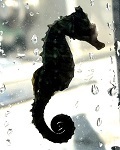
We had a busy day at Pier 40, collecting four oyster toadfish, ranging from young-of-year to adult (25-300 mm), in our minnow pot and crab pot. In the same gear, we met up with members of Syngnathidae, a family of fishes that includes seahorses, pipefishes, and seadragons. Today, we caught two of the three: a lined seahorse (55 mm) and a northern pipefish (95 mm). (Photo of lined seahorse courtesy of Zoe Kim)
- Zoe Kim
 8/1 – Hudson River Watershed: Among indigenous peoples, full moons have long been labeled with fanciful names that are rooted in oral traditions, native memories, and ethnographic accounts. 8/1 – Hudson River Watershed: Among indigenous peoples, full moons have long been labeled with fanciful names that are rooted in oral traditions, native memories, and ethnographic accounts.
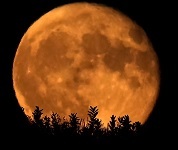
Among Mohican people, whose ancestral homeland lies wholly within the Hudson River watershed, the August full moon is known as the Corn Moon, Skumoone Neepãʔuk in the Mohican dialect. Tribal translations of full moons pre-date colonization and reflect the seasonality of the lunar phase. Moon phases, in fact, were used by indigenous peoples as measurements of time. (Photo of full moon courtesy of Deborah Tracy Kral)
- Larry Madden, Stockbridge-Munsee Band of Mohican Indians
[Among the Oneida people (Haudenosaunee), whose homeland shares the mid-western end of the Hudson River Watershed, the August full moon is called the Fresh Corn Moon (On^tase). Tom Lake]
[Tonight’s full moon was also considered to be a “supermoon.” The term "supermoon" was coined by astrologer Richard Nolle in 1979 as either a new or full Moon that occurs when the Moon is within 90% of perigee, its closest approach to Earth. Since we can't see new Moons (except when they block the Sun), what has caught the public's attention in recent decades are full supermoons, as these are the biggest and brightest full Moons of the year. NASA]
8/1 – New York Bight: The World’s collective ocean water temperature last week averaged 70 degrees Fahrenheit, the warmest one-week ocean water temperature ever recorded.
- NOAA
8/1 – New Windsor, HRM 60: The often seen, of late, and rare neotropic cormorant (Nannopterum brasilianum) was spotted this morning by Bruce Nott Jr. at Quassaic Creek. Bruce had previously found the cormorant here on June 27. That sighting was a first for Orange County as well as for the Hudson River Valley.
- Tom Lake
[Bruce Nott, Jr. has been terrific in keeping track of the rare neotropic cormorant, visiting the river every day in both Orange and Dutchess counties. Stan DeOrsey, R.T. Waterman Bird Club]
8/1 – Yonkers, HRM 18: Our staff at the Sarah Lawrence Center for the Urban River at Beczak made seven high-tide hauls of our seine today with mediocre results. Among the fishes, Atlantic silverside was high count with 15. Striped bass was next with six (60-80 mm). Among non-fish, we found six blue crabs in the net (50-90 mm), as well as comb jellies, and moon jellyfish. The water temperature was 77 degrees F, the salinity was 8.9 ppt., and the dissolved oxygen (DO) was 5.8 ppm.
- Jason Muller, Emily Orr, Samantha Calcagni, Jordyn Medina, Muhammad Rayan Arshad
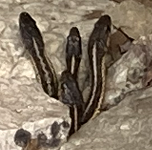 8/2 – Ulster County, HRM 72: We live along the Wallkill River in Gardiner. When you live in the same place for a long time, you get to know everybody else who lives there. For many years, we had a single garter snake (Thamnophis sirtalis sirtalis) living in a stone wall by our front door. Last year there were two. 8/2 – Ulster County, HRM 72: We live along the Wallkill River in Gardiner. When you live in the same place for a long time, you get to know everybody else who lives there. For many years, we had a single garter snake (Thamnophis sirtalis sirtalis) living in a stone wall by our front door. Last year there were two.
This year there were six and the last four must have been offspring of the first two. Initially, they were about six-inches-long and would vanish whenever you walked nearby. Since it is a busy doorway, after a while they have become used to our activity, and now they just freeze when we walk past. (Photo of garter snake courtesy of Bill Munzer)
- Bill Munzer
8/2 – Beacon, HRM 61: During a five-hour fishing session at Scenic Hudson’s Long Dock Park, I caught and released four channel catfish ranging in size from 13-18-inches. Another angler came by while I was there; he had spent three hours casting small shiny lures and managed to catch just a few small white perch. Carp activity was absent.
- Bill Greene
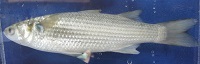 8/2 – Yonkers, HRM 18: Our staff at the Sarah Lawrence Center for the Urban River at Beczak, with the much-appreciated help from the Lanza Learning Center (Yonkers), made eight hauls of our seine today. With the welcome rise in salinity (10.1 ppt), the diversity of our catch was quite extraordinary. 8/2 – Yonkers, HRM 18: Our staff at the Sarah Lawrence Center for the Urban River at Beczak, with the much-appreciated help from the Lanza Learning Center (Yonkers), made eight hauls of our seine today. With the welcome rise in salinity (10.1 ppt), the diversity of our catch was quite extraordinary.
Among the five species of fishes, Atlantic silverside led with seven, followed by young-of-year bay anchovy, striped bass (55-65 mm), white perch, and a single, uncommon for us, striped mullet (130 mm). Other catches included blue crab (105 mm), grass shrimp, moon jellyfish, and comb jellies. The water temperature was 77 degrees Fahrenheit, the salinity was 10.1 ppt., and the dissolved oxygen (DO) was 5.6 ppm. (Photo of striped mullet courtesy of Tom Lake)
- Emily Orr, Jason Muller, Christina Edsall, Samantha Calcagni, Jordyn Medina, Riley Khan
8/2 – Manhattan, HRM 1-2: Our Hudson River Park’s River Project staff, along with Field Science Assistants Stefan, Vivan, and Colman, and Seasonal Educators Sasha, Kelly, Hart, and Sarah, checked our research gear (pots and traps) that we deploy off Piers 26 and 40 as part of our fish ecology survey and monitoring. Today’s catch, confined to Pier 40, included blue crab, grass shrimp, mud crabs, mud dog whelks, isopods, and amphipods.
- Toland Kister, Siddhartha Hayes, Zoe Kim
8/3 – North Germantown, HRM 109: At low tide, the DEC boat launch at North Germantown is a tricky, slippery, stony, seining site. Therefore, we waited an hour until the tide began to rise before giving it a go. We only had to make a few hauls to get an idea of “who was home,” specifically young-of-year fishes. Among them were bluegill, pumpkinseed, redbreast sunfish, and a few sunfish hybrids. River herring came in by the dozens, all blueback herring, heading seaward, having been born more than a month ago in the Mohawk River half-way across New York State. The river was 77 degrees Fahrenheit.
- Tom Lake, Maddy Wright
[Cornell Cooperative of Saratoga County had a table at the boat launch with posters, literature, live specimen of Hudson River flora and fauna, and a Cornell Cooperative representative eager to answer questions. The information focused on invasive species and education for boaters, anglers, and other river users. Tom Lake]
*** Fish of the Week***
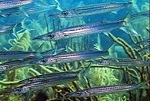 8/3 – Hudson River Watershed: Fish-of-the-Week for Week 231 is the northern sennet (Sphyraena borealis), number 199 (of 237) on our watershed list of fishes. If you would like a copy of our list, e-mail: trlake7@aol.com. 8/3 – Hudson River Watershed: Fish-of-the-Week for Week 231 is the northern sennet (Sphyraena borealis), number 199 (of 237) on our watershed list of fishes. If you would like a copy of our list, e-mail: trlake7@aol.com.
We like to get students in the water whenever possible, especially when seining. There is no substitute to feeling the chill, the warmth, the seasons of the river. A sure-fire way to capture the attention of students, while seining in our tidewater, is to casually mention that barracuda are known to be in these waters! And that is true.
The northern sennet is a barracuda and is known from Cape Cod to Florida, the Gulf of Mexico, and the Caribbean, although they are much more common in the southern reach of their range. They are one of two members of their family (Sphyraenidae) in our watershed. The other is the similar-looking guaguanche (S. guachancho). To maintain the anxiety among our students, we generally withhold the fact that these barracudas max out at 18-inches-long, hardly the great barracuda (S. barracuda) that can get to more than six-feet. The barracudas all feature a large mouth, many prominent teeth, their lower jaw slightly projecting revealing an ominous-looking toothy gape. The first time I encountered a close-up look of a three-foot-long great barracuda while snorkeling in the warm water at Key Largo (Florida) it gave me a cold chill.
There are only a few documented records of northern sennet in the estuary, where they are designated as a temperate marine stray. Although they are a smaller barracuda, they are an apex predator. Those we see in seines, however rarely, are usually young-of-year measuring 3- to 5-inches-long. The most recent record, a young-of-year (95 mm) northern sennet, came from the East River during the 2022 Great Hudson River Fish Count caught by the Brooklyn Bridge Park Conservancy team. Notes from that occurrence describe the catch as, "We hauled the seine right into a small school of northern sennet, all of them 100-120 mm-long." That was the first catch of a northern sennet in the East River since July 24, 2010. (Photo of northern sennet courtesy of FishBase)
- Tom Lake
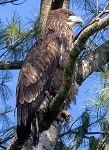 8/4 – Town of Poughkeepsie: Bald eagle nest NY62 had three nestlings this year. One died very shortly after hatching for reasons unknown. Of the remaining two, the smaller of them, a presumed male, fledged on June 20. The other, larger nestling left the nest on June 21 but remained on the ground near the nest showing no inclination to fly. Over the next few days, the adults brought food to the fledgling, but the bird showed no improvement. She was only able to make short, 20-foot flights, and one of her wings looked damaged. 8/4 – Town of Poughkeepsie: Bald eagle nest NY62 had three nestlings this year. One died very shortly after hatching for reasons unknown. Of the remaining two, the smaller of them, a presumed male, fledged on June 20. The other, larger nestling left the nest on June 21 but remained on the ground near the nest showing no inclination to fly. Over the next few days, the adults brought food to the fledgling, but the bird showed no improvement. She was only able to make short, 20-foot flights, and one of her wings looked damaged.
On June 29, the decision was made to attempt a rescue of the eagle, which was successfully accomplished by Friends of the Feathered and Furry Wildlife Center (New Paltz). It was discovered that her wing had damaged flight feathers and feather mites were possibly attacking her wings well as her tail. She was transferred to Cornell University for treatment. (Photo of bald eagle courtesy of Bob Rightmyer)
- Bob Rightmyer
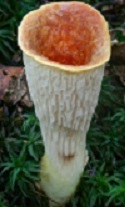 8/4 – Hudson River Watershed: Recent rains had produced an explosion of fruiting fungi, among them the distinctive scaly vase or woolly chanterelle (Turbinellus floccosus). Scaly vase is a cantharelloid mushroom [cone, or trumpet-shaped] of the family Gomphaceae, native to Asia and North America. 8/4 – Hudson River Watershed: Recent rains had produced an explosion of fruiting fungi, among them the distinctive scaly vase or woolly chanterelle (Turbinellus floccosus). Scaly vase is a cantharelloid mushroom [cone, or trumpet-shaped] of the family Gomphaceae, native to Asia and North America.
This mushroom is not a chanterelle but does have similarities. Like chanterelles, scaly vase appears in mid- to-late July, have false gills that look like ridges or wrinkles, and is an orange color (chanterelles are usually more golden yellow than orange, while scaly vases are orange to pinkish). Unlike the chanterelle that foragers highly prize as a dining delicacy, scaly vase causes gastrointestinal distress. While it won’t kill you, you might regret sampling it.
As far as recognizing this mushroom, look for a cap that looks like a vase or an empty ice cream cone or a turban (hence the scientific name Turbinellus). These fungi can grow up to a foot tall and a foot wide.
The scaly vase mushroom grows in mycorrhizal association [symbiotic relationship between a fungus and a green plant] with conifers, including pines, firs, hemlocks, and spruces. It usually grows singularly, but there is often more than one scattered around the area. It only grows from the ground, never on or from trees, stumps, or logs. (Photo of scale vase mushroom courtesy of Mary Holland)
- Mary Holland
[Eating some species of wild mushrooms can cause sickness and even death. Despite widespread beliefs to the contrary there is no general rule that allows you to distinguish between a poisonous mushroom and one that is safe to eat. Wild mushrooms should only be considered for consumption after being identified by an expert mycologist and even then, only in moderation with samples of fresh specimens retained and properly stored to aid in identification whenever poisoning is considered a possibility.
Steve Rock]
8/4 – Yonkers, HRM 18: Our staff at the Sarah Lawrence Center for the Urban River at Beczak, with the enthusiastic help from the Environmental Leaders of Color (high school students), made eight high-tide hauls of our seine today. Atlantic silverside (11) was high count among fishes. Striped bass (8) was next. Blue crabs and comb jellies completed the catch. The water temperature was 76 degrees F, the salinity was 7.5 ppt., and the dissolved oxygen (DO) was 5.6 ppm.
- Katie Lamboy, Christina Edsall, Jason Muller, Riley Khan, Samantha Calcagni
Summer 2023 Natural History Programs and Events
Great Hudson River Fish Count
Saturday, August 5
The annual Great Hudson River Fish Count will be held on Saturday August 5 at nine sites from Staten Island, New York City, to Peebles Island State Park in Albany and Saratoga counties. To find a Fish Count site near you, as well as the start time, go to https://hrnerr.org/great-hudson-river-fish-count/.
All Fish Count programs are family-friendly and free of charge. The event is sponsored by DEC’s Hudson River Estuary Program and Hudson River National Estuarine Research Reserve in partnership with other environmental organizations.
Each summer, organizations all along the Hudson River and New York Harbor gather at riverfront sites to collect, count, and catalog fish species. During the fish count, participating organizations encourage visitors to help collect fish using seines (nets), minnow traps, or rods and reels. The fish are identified, counted, and released back into the river.
- Sarah Mount
Paddle the Hudson River Estuary
With our staff naturalists with free educational canoe trips. Join us to explore tidal marshes, observe birds and wildlife, and discover unique plants.
These trips are suitable for adults and children (6+), whether you’re an experienced or beginner paddler. The trips leave from three different launch sites in the lower, upper, and mid-Hudson Valley. All gear is provided, and registration is required.
Registration link:https://2023-nysdec-canoeprogram.eventbrite.com/
Volunteer for Hudson River Striped Bass Cooperative Angler Program
Do you fish for striped bass in the Hudson River? Whether you catch-and-release or take home a keeper, you can be part of the Cooperative Angler Program. Share your fishing trip information and help biologists understand and manage our striped bass fishery.
Here's how it works: Fill out a logbook we provide or record your trips on your smartphone using DEC's Hudson River online logbook (PDF) whenever you fish on the tidal Hudson River (by boat or on the shore). Record general location, time, gear used, what you caught (or if you didn't catch anything), and return the logbook when you are done fishing.
Join today! For more information on the angler program and instructions on installing the Survey123 App to access the online logbook, visit Hudson River Cooperative Angler or email hudsonangler@dec.ny.gov.
Note: If you primarily fish for striped bass in New York waters south of the George Washington Bridge, the DEC has a separate Striped Bass Cooperative Anglers Program.
Hudson River Miles
The Hudson is measured north from Hudson River Mile 0 at the Battery at the southern tip of Manhattan. The George Washington Bridge is at HRM 12, the Tappan Zee 28, Bear Mountain 47, Beacon-Newburgh 62, Mid-Hudson 75, Kingston-Rhinecliff 95, Rip Van Winkle 114, and the Federal Dam at Troy, the head of tidewater, at 153. The tidal section of the Hudson constitutes a bit less than half the total distance – 315 miles – from Lake Tear of the Clouds to the Battery. Entries from points east and west in the watershed reference the corresponding river mile on the mainstem.
To Contribute Your Observations or to Subscribe
The Hudson River Almanac is compiled and edited by Tom Lake and emailed weekly by DEC's Hudson River Estuary Program. Share your observations by e-mailing them to trlake7@aol.com. To subscribe to the Almanac (or to unsubscribe), use the links on DEC's Hudson River Almanac or DEC Delivers web pages.
Useful Links
National Oceanic and Atmospheric Administration online tide and tidal current predictions are invaluable when planning Hudson River field trips. For real-time information on Hudson River tides, weather, and water conditions from sixteen monitoring stations, visit the Hudson River Environmental Conditions Observing System website.
DEC's Smartphone app for iPhone and Android is now available at New York Fishing, Hunting & Wildlife App.
|