Project of the Hudson River Estuary Program
Compiled and edited by Tom Lake, Consulting Naturalist
Special Event: Hudson River Fish Count, Saturday August 5: Check out the Events section at the end of the Almanac for links, sites, and times. Free family-oriented fishing from NYC to the Capital Region.
Overview
In the aftermath of the severe storms of July 9-10, the Hudson River estuary underwent a dramatic change. The outpouring of rainwater from the uplands pushed salinity far downriver. At Yonkers, 25 miles from the open sea, levels fell to 0.4 parts-per-thousand (ppt), essentially freshwater. Adapting to such abrupt and extreme environmental changes, reinforces our understanding of the resiliency of estuarine life.
Highlight of the Week
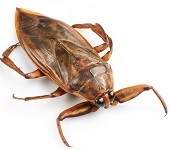 7/15 – Piermont Pier, HRM 25: This was a very hot (92 degrees Fahrenheit [F]) and humid day for our staff at the Hudson River Field Station as we went seining for our City of Water Day. Despite the conditions, we caught a good variety of fishes including a very large (for the species) white perch (14 inches). Chief among the others was young-of-year Atlantic menhaden, Atlantic silverside, mummichog, hogchoker (our first in two years), and shore shrimp. The most excitement came from an insect, a giant water bug. They are usually found in freshwater areas of the estuary, which made finding it in the warm (82 degrees F) and, albeit less salty this week, water at Piermont very strange. (Photo of giant water bug courtesy of Melissa Pino) 7/15 – Piermont Pier, HRM 25: This was a very hot (92 degrees Fahrenheit [F]) and humid day for our staff at the Hudson River Field Station as we went seining for our City of Water Day. Despite the conditions, we caught a good variety of fishes including a very large (for the species) white perch (14 inches). Chief among the others was young-of-year Atlantic menhaden, Atlantic silverside, mummichog, hogchoker (our first in two years), and shore shrimp. The most excitement came from an insect, a giant water bug. They are usually found in freshwater areas of the estuary, which made finding it in the warm (82 degrees F) and, albeit less salty this week, water at Piermont very strange. (Photo of giant water bug courtesy of Melissa Pino)
- Matthew Tang
[The giant water bug (Lethocerus americanus), known colloquially as “toe-biters,” can grow more than four inches long making it one of the largest insects in the world. It has a ferocious bite that is said to be one of the most painful bug-related injuries a human can suffer. A.C. Huntley]
Natural History Entries
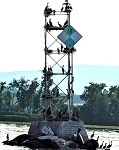 7/15 – Greene County, HRM 114: I came upon an unusual sight while boating on the Hudson River near Catskill. The green ANT marker 1B had been adopted by more than a dozen double-crested cormorant pairs, nesting or just drying off. It truly looked like a city high-rise with their many “teenager” offspring hanging out on the various landings. For them, fast food was only one dive away. (Photo of double-crested cormorant courtesy of Mario Meier) 7/15 – Greene County, HRM 114: I came upon an unusual sight while boating on the Hudson River near Catskill. The green ANT marker 1B had been adopted by more than a dozen double-crested cormorant pairs, nesting or just drying off. It truly looked like a city high-rise with their many “teenager” offspring hanging out on the various landings. For them, fast food was only one dive away. (Photo of double-crested cormorant courtesy of Mario Meier)
- Mario Meier
[The acronym ANT stands for Aids to Navigation. Tom Lake]
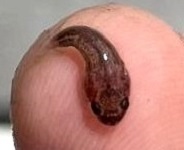 7/15 – Manhattan, HRM 1-2: Our Hudson River Park’s River Project staff checked our research gear (pots and traps) that we deploy off Piers 26 and 40 as part of our fish ecology survey and monitoring. We found a young-of-year black sea bass (110 millimeters) in our gear at Pier 26. However, our most delightful catch of the week was three skilletfish ranging from (10-20 mm). These young-of-year were collected in a minnow trap. We found another tiny skilletfish (10 mm) At Pier 40, along with a blue crab (80 mm) and an adult oyster toadfish (200 mm). Invertebrates included mud crabs, grass shrimp, mud dogs whelks, clam worms, amphipods, and isopods. (Photo of skilletfish courtesy of Sivan Gordon-Buxbaum) 7/15 – Manhattan, HRM 1-2: Our Hudson River Park’s River Project staff checked our research gear (pots and traps) that we deploy off Piers 26 and 40 as part of our fish ecology survey and monitoring. We found a young-of-year black sea bass (110 millimeters) in our gear at Pier 26. However, our most delightful catch of the week was three skilletfish ranging from (10-20 mm). These young-of-year were collected in a minnow trap. We found another tiny skilletfish (10 mm) At Pier 40, along with a blue crab (80 mm) and an adult oyster toadfish (200 mm). Invertebrates included mud crabs, grass shrimp, mud dogs whelks, clam worms, amphipods, and isopods. (Photo of skilletfish courtesy of Sivan Gordon-Buxbaum)
- Zoe Kim, Sivan Gordon-Buxbaum
[Note: One-inch equals 25.4 millimeters (mm). Tom Lake]
*** Fish of the Week ***
 7/16 – Hudson River Watershed: Fish-of-the-Week for Week 229 is the Atlantic cutlassfish (Trichiurus lepturus), number 216 (of 236) on our watershed list of fishes. If you would like a copy of our list, e-mail - trlake7@aol.com. 7/16 – Hudson River Watershed: Fish-of-the-Week for Week 229 is the Atlantic cutlassfish (Trichiurus lepturus), number 216 (of 236) on our watershed list of fishes. If you would like a copy of our list, e-mail - trlake7@aol.com.
The Atlantic cutlassfish is the only member of the snake mackerel family (Trichiuridae) documented for the watershed. With its large, fang-like teeth, the Atlantic cutlassfish looks like a creature from a nightmare. They are elongated, strongly compressed, silver to metallic blue, and a dorsal fin that runs from its head to the tip of its tail. From Greek, its genus translates to hair, and its trivial name to head, thus their other common name, largehead hairtail.
They are found in circum-tropical and temperate waters of the world; in the Atlantic, they range from Cape Cod to the Gulf of Mexico, the Caribbean Sea, to Argentina, being much common south of Chesapeake Bay. They frequent muddy bottoms of shallow coastal waters, often entering estuaries in the southern reach of their range. They can get to five-feet-long, The adults feed mainly on fishes and occasionally on squid and crustaceans.
In our area, they are designated as a temperate marine stray. Briggs and Waldman (2002) consider them rare in the New York Bight, with two old records from Gravesend Bay (Brooklyn) in 1897 and 1901. There is one Hudson River estuary record, a 165 mm juvenile (1985), from Indian Point (river mile 42). (Photo of Atlantic cutlassfish courtesy of Bob Grieser)
- Tom Lake
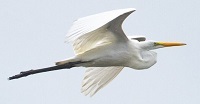 7/16 – Newburgh, HRM 61: I went to the Newburgh Waterfront this morning to see if I could find something special, or at least catch up with the neotropic cormorant, first spotted there on June 27 by Bruce Nott Jr. Unfortunately, it was mostly uneventful, but I did manage to see my first Orange County great egret of the year. (Photo of great egret courtesy of Matt Zeitler) 7/16 – Newburgh, HRM 61: I went to the Newburgh Waterfront this morning to see if I could find something special, or at least catch up with the neotropic cormorant, first spotted there on June 27 by Bruce Nott Jr. Unfortunately, it was mostly uneventful, but I did manage to see my first Orange County great egret of the year. (Photo of great egret courtesy of Matt Zeitler)
- Matt Zeitler
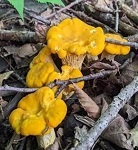 7/17 – Greene County: I found some bright, trumpet-shaped, golden chanterelles (Cantharellus sp.) in the woods of Greene County. They are a much sought-after edible for the experienced forager. On the same day, I came upon a tall, six-inch diameter cap, brilliant orange fungi species, Amanita jacksonii. They are beautiful to behold, but are one of the notorious Amanita family, most of which are highly toxic. This Amanita happens to be less toxic, but still, it is safer to look at than to touch. Nearby, the Amanita Jacksonii buttons looked like red hard-boiled eggs, emerging from a white papery volva, a cup-like structure at the base of a mushroom. Colorful fungi are part of the beauty of our woodlands. (Photo of golden chantarelles courtesy of Mario Meier) 7/17 – Greene County: I found some bright, trumpet-shaped, golden chanterelles (Cantharellus sp.) in the woods of Greene County. They are a much sought-after edible for the experienced forager. On the same day, I came upon a tall, six-inch diameter cap, brilliant orange fungi species, Amanita jacksonii. They are beautiful to behold, but are one of the notorious Amanita family, most of which are highly toxic. This Amanita happens to be less toxic, but still, it is safer to look at than to touch. Nearby, the Amanita Jacksonii buttons looked like red hard-boiled eggs, emerging from a white papery volva, a cup-like structure at the base of a mushroom. Colorful fungi are part of the beauty of our woodlands. (Photo of golden chantarelles courtesy of Mario Meier)
- Mario Meier
[Eating some species of wild mushrooms can cause sickness and even death. Despite widespread beliefs to the contrary there is no general rule that allows you to distinguish between a poisonous mushroom and one that is safe to eat. Wild mushrooms should only be considered for consumption after being identified by an expert mycologist and even then, only in moderation with samples of fresh specimens retained and properly stored to aid in identification whenever poisoning is considered a possibility. Joining a mushroom club and participating in lectures, forays and mushroom identification classes is an excellent way to begin to learn all that needs to be known before you should feel that you can competently and independently identify a mushroom as being safe and edible 100% of the time. Steve Rock]
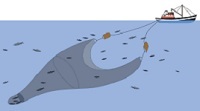 7/17 – Ulster County, HRM 74: We had a wonderful sail aboard the Hudson River Sloop Clearwater today with our TIDES (The Institute Discovering Environmental Scientists) group. Just south of the Mid-Hudson Bridge near Blue Point, our otter trawl came up with a bunch of fish including several channel catfish, half-dollar-sized hogchokers, a few white perch, a small American eel, and a lot of young-of-year freshwater drum. A dozen of the drum were very small (less than 25-mm). In one week, young-of-year freshwater drum went from being a very uncommon catch, to one of relative abundance, at least in the river off Blue Point. (Photo of otter trawl courtesy of NOAA) 7/17 – Ulster County, HRM 74: We had a wonderful sail aboard the Hudson River Sloop Clearwater today with our TIDES (The Institute Discovering Environmental Scientists) group. Just south of the Mid-Hudson Bridge near Blue Point, our otter trawl came up with a bunch of fish including several channel catfish, half-dollar-sized hogchokers, a few white perch, a small American eel, and a lot of young-of-year freshwater drum. A dozen of the drum were very small (less than 25-mm). In one week, young-of-year freshwater drum went from being a very uncommon catch, to one of relative abundance, at least in the river off Blue Point. (Photo of otter trawl courtesy of NOAA)
- Chris Bowser, Chloe Grey Smith
[An otter trawl is a net used by researchers, educators, and commercial fisheries to capture aquatic life. The net is generally pulled by a head rope behind a vessel under way operating much like a seine hauled along a beach. The trawl has a bag, also called the “cod end,” where catch collects. The sides of the net are held open by pressure exerted on two rectangular boards (“doors”), one on either side. The depth it fishes can be regulated depending on the speed of the vessel and how much head rope is played out, called the “scope.” As the scope increases — the distance between the vessel and the otter trawl — the net fishes deeper. Tom Lake]
7/17 – Manhattan, HRM 1-2: Our Hudson River Park’s River Project staff checked our research gear (pots and traps) that we deploy off Piers 26 and 40 as part of our fish ecology survey and monitoring. At Pier 26, we caught a skilletfish (50 mm) and an adult oyster toadfish (295 mm). Mud dog snails, grass shrimp, and oyster drill snails made up our invertebrates. Pier 40 gave us a variety of interesting fish including a cunner (90 mm), a feather blenny (55 mm), and an oyster toadfish (195 mm), as well as a male blue crab (12.5 mcm).
- Zoe Kim
[Crab measurements (size) are calculated in millimeters (mm) point-to-point across their carapace. Tom Lake]
 7/18 – Hudson River Watershed: Aquatic vegetation, tree flowers, grasses and leaves have made up much of a black bear’s (Ursus americanus) diet since its emergence from hibernation in April. Skunk cabbage, interrupted fern stems, dandelion leaves and flowers, red maple seeds and clover are important sources of food in May and June. As some of these species mature, they become fibrous and less digestible as their nutrients become incorporated into cell walls as cellulose, which is not easily digestible, so black bears seek new sources of nutrition as the summer progresses. 7/18 – Hudson River Watershed: Aquatic vegetation, tree flowers, grasses and leaves have made up much of a black bear’s (Ursus americanus) diet since its emergence from hibernation in April. Skunk cabbage, interrupted fern stems, dandelion leaves and flowers, red maple seeds and clover are important sources of food in May and June. As some of these species mature, they become fibrous and less digestible as their nutrients become incorporated into cell walls as cellulose, which is not easily digestible, so black bears seek new sources of nutrition as the summer progresses.
As a rule, berries and jewelweed help provide mid-summer meals until nuts, a favored food, ripen and become available in the fall. Beechnuts, specifically, are a very important source of food in autumn for black bears bulking up prior to hibernation, as they have about twice as much protein and calories per edible portion compared to acorns.
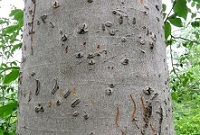
There are exceptions to this dietary schedule, however. This photograph, taken recently in New Hampshire, shows that there are some bears that don't wait until days shorten drastically and temperatures drop before harvesting the fruit of American Beech (Fagus grandifolia). (Photo of American beech courtesy of Alfred Balch)
- Mary Holland
[Notice on the accompanying photo, that there are both fresh and previous years' claw marks on this American Beech tree. Alfred Balch.)
 7/18 – Yonkers, HRM 18: Our staff at the Sarah Lawrence Center for the Urban River at Beczak made five high-tide hauls of our seine today with the assistance of our Center for the Urban River at Beczak’s Blue Team of High School Interns. In a very atypical catch for mid-summer in the Tappan Zee, blue crab and mummichog shared high count of seven each. 7/18 – Yonkers, HRM 18: Our staff at the Sarah Lawrence Center for the Urban River at Beczak made five high-tide hauls of our seine today with the assistance of our Center for the Urban River at Beczak’s Blue Team of High School Interns. In a very atypical catch for mid-summer in the Tappan Zee, blue crab and mummichog shared high count of seven each.
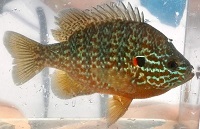
The lingering storm effects continued to lower the salinity (1.9 ppt) as well as mixing up our fish. In the Tappan Zee (inland sea), we netted a pumpkinseed sunfish, our first on record after having caught three largemouth bass last week — all freshwater fishes. The water temperature was 78 degrees F, and the dissolved oxygen (DO) was 6.6 parts-per-million (ppm). (Photo of pumpkinseed courtesy of Tom Lake)
- Ishika Joshi
7/19 – Little Stony Point Preserve, HRM 55: The storm-submerged trail to the beach required us to slog through what seemed like a knee-deep bayou complete with piles of Trapa seeds and hordes of biting mosquitos. Once on the sand, it seemed that the fish had been swept away in the storm. Our first six hauls caught us nothing. The next three found a small school of young-of-year blueback herring, as well as a few bay anchovies and young-of-year striped bass. Mid-July, in a typical summer, ought to be nearing the peak of both species diversity and species richness in our catches. The river will need to catch its breath before we see that here. The water was 81degrees F and showed no evidence of salt.
- Tom Lake, A. Danforth
[Species diversity relates to the number of species present in one place at one time; species richness refers to the number of individuals of each of the species. Tom Lake]
7/19 – Yonkers, NRM 18: Our staff at the Sarah Lawrence Center for the Urban River at Beczak made five high-tide hauls of our seine today with the assistance of our Center for the Urban River at Beczak’s Blue Team of High School Interns. Our catch, likely because of the high tide, was meager. Blue crab (4) was high count, with Atlantic menhaden and bay anchovy next with one each. The water temperature was 78 degrees F, the salinity had dropped again to 1.6 ppt, and the dissolved oxygen (DO) was 6.5 ppm.
- Ishika Joshi
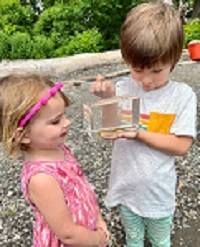 7/20 – Beacon, HRM 61: One year ago, on an extremely hot day (97 degrees), we were joined on the beach by Jeff Vele (Mohican Nation) and Becky Vele (Menominee Nation). We had gathered to discuss the effects of climate change on the Hudson River (the ancestral Mohican Homeland) and evidence of ancestral indigenous fishing practices. 7/20 – Beacon, HRM 61: One year ago, on an extremely hot day (97 degrees), we were joined on the beach by Jeff Vele (Mohican Nation) and Becky Vele (Menominee Nation). We had gathered to discuss the effects of climate change on the Hudson River (the ancestral Mohican Homeland) and evidence of ancestral indigenous fishing practices.
The inshore water, drained by ebb tide, was 85 degrees F offering us limited expectations. In addition to the warmth, we wondered how much dissolved oxygen could be in what seemed like a simmering cauldron. We all agreed that indigenous fishers would have stayed home on such a day. However, our stubbornness overcame ancestral wisdom, and we hauled our seine through thigh-deep water that was hot to the touch. Our catch was meager but very appropriate as all the fishes were native species — the Mohican people knew these fish.
Among the fishes was tessellated darter (Namakw), striped bass (Mãanuxeekun), white perch (Mãakwun), and American eel (Ma'am). The names are of Mohican dialect (Ma'eekaanew). The salinity was 3.0 ppt. (Photo of American eel courtesy of Tom Lake)
- Tom Lake
7/20 – Yonkers, HRM 18: Our staff at the Sarah Lawrence Center for the Urban River at Beczak made six hauls of our seine today during a tricky tide. The continuing watershed-long effects from the July 9-10 storms had the tide extra high resulting in very few fish. In our meager catch, blue crab (20-70 mm) was high count (3). Among fishes, two young-of-year striped bass (50-105 mm) were followed by a single spot (115 mm). The water temperature was 79 degrees F, the salinity was 2.0 ppt, and the dissolved oxygen (DO) was 6.2 ppm.
- Jason Muller, Ishika Joshi, Maykaela Ortilla, Vivian Navarrete, Samantha Calcagni, Muhammad Rayan Arshad
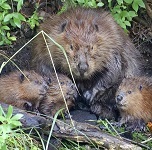 7/21 – Hudson River Watershed: The heavy flood waters that Vermont recently experienced created havoc for both two-and four-legged animals. This beaver family (photo) was displaced, most likely by high water filling their lodge above the interior platform level, leaving little, if any, dry substrate or breathing room for the inhabitants. The North American beaver (Castor canadensis) gives birth in early spring — these young beaver are about one to two months old. It is highly unusual to see beavers this young, as they spend their first month or two in the lodge before emerging into the surrounding water with their parents. 7/21 – Hudson River Watershed: The heavy flood waters that Vermont recently experienced created havoc for both two-and four-legged animals. This beaver family (photo) was displaced, most likely by high water filling their lodge above the interior platform level, leaving little, if any, dry substrate or breathing room for the inhabitants. The North American beaver (Castor canadensis) gives birth in early spring — these young beaver are about one to two months old. It is highly unusual to see beavers this young, as they spend their first month or two in the lodge before emerging into the surrounding water with their parents.
Paddlers discovered this mother beaver nursing her three kits on the bank of a small pond, several hundred feet from the lodge they most likely evacuated. Within days, the water receded allowing this family to move back into their lodge. (Photo of beaver courtesy of Sue Elliott)
- Sue Elliott, Marv Elliott, Sue Wetmore.
[The northeastern corner of our watershed extends into Vermont via the Battenkill and Hoosic River watersheds. Tom Lake.
7/21 – Yonkers, HRM 18: Our staff at the Sarah Lawrence Center for the Urban River at Beczak made ten hauls of our seine today with assistance from the Center for the Urban River at Beczak’s Hudson River Ecology Course (high school and college students).
Blue crab continued as high count (16). Among fishes, there were a few striped bass, white perch, mummichog, and Atlantic silverside. The highlight was a young-of-year bluefish (100 mm). The water temperature was 78 degrees F, the salinity was 2.1 ppt, and the dissolved oxygen (DO) was 6.5 ppm.
- Jason Muller, Christina Edsall, Katie Lamboy, Samantha Calcagni

Summer 2023 Natural History Programs and Events
Great Hudson River Fish Count
Saturday, August 5
The annual Great Hudson River Fish Count will be held on Saturday August 5 at nine sites from Staten Island, New York City, to Peebles Island State Park in Albany and Saratoga counties. To find a Fish Count site near you, as well as the start time, go to https://hrnerr.org/great-hudson-river-fish-count/.
All Fish Count programs are family-friendly and free of charge. The event is sponsored by DEC’s Hudson River Estuary Program and Hudson River National Estuarine Research Reserve in partnership with other environmental organizations.
Each summer, organizations all along the Hudson River and New York Harbor gather at riverfront sites to collect, count, and catalog fish species. During the fish count, participating organizations encourage visitors to help collect fish using seines (nets), minnow traps, or rods and reels. The fish are identified, counted, and released back into the river.
- Sarah Mount
Paddle the Hudson River Estuary
With our staff naturalists with free educational canoe trips. Join us to explore tidal marshes, observe birds and wildlife, and discover unique plants.
These trips are suitable for adults and children (6+), whether you’re an experienced or beginner paddler. The trips leave from three different launch sites in the lower, upper, and mid-Hudson Valley. All gear is provided, and registration is required.
Registration link:https://2023-nysdec-canoeprogram.eventbrite.com/
Volunteer for Hudson River Striped Bass Cooperative Angler Program
Do you fish for striped bass in the Hudson River? Whether you catch-and-release or take home a keeper, you can be part of the Cooperative Angler Program. Share your fishing trip information and help biologists understand and manage our striped bass fishery.
Here's how it works: Fill out a logbook we provide or record your trips on your smartphone using DEC's Hudson River online logbook (PDF) whenever you fish on the tidal Hudson River (by boat or on the shore). Record general location, time, gear used, what you caught (or if you didn't catch anything), and return the logbook when you are done fishing.
Join today! For more information on the angler program and instructions on installing the Survey123 App to access the online logbook, visit Hudson River Cooperative Angler or email hudsonangler@dec.ny.gov.
Note: If you primarily fish for striped bass in New York waters south of the George Washington Bridge, the DEC has a separate Striped Bass Cooperative Anglers Program.
Hudson River Miles
The Hudson is measured north from Hudson River Mile 0 at the Battery at the southern tip of Manhattan. The George Washington Bridge is at HRM 12, the Tappan Zee 28, Bear Mountain 47, Beacon-Newburgh 62, Mid-Hudson 75, Kingston-Rhinecliff 95, Rip Van Winkle 114, and the Federal Dam at Troy, the head of tidewater, at 153. The tidal section of the Hudson constitutes a bit less than half the total distance – 315 miles – from Lake Tear of the Clouds to the Battery. Entries from points east and west in the watershed reference the corresponding river mile on the mainstem.
To Contribute Your Observations or to Subscribe
The Hudson River Almanac is compiled and edited by Tom Lake and emailed weekly by DEC's Hudson River Estuary Program. Share your observations by e-mailing them to trlake7@aol.com. To subscribe to the Almanac (or to unsubscribe), use the links on DEC's Hudson River Almanac or DEC Delivers web pages.
Useful Links
National Oceanic and Atmospheric Administration online tide and tidal current predictions are invaluable when planning Hudson River field trips. For real-time information on Hudson River tides, weather, and water conditions from sixteen monitoring stations, visit the Hudson River Environmental Conditions Observing System website.
DEC's Smartphone app for iPhone and Android is now available at New York Fishing, Hunting & Wildlife App.
|