Project of the Hudson River Estuary Program
Compiled and edited by Tom Lake, Consulting Naturalist
Overview
Highlights-of-the-Week are usually poignant, exciting eye-openers, standouts from regular Almanac text, that present surprise to readers. But not always. This week’s Highlight characterizes a catastrophic storm as a highlight for reasons of meteorological records and its impact on the Hudson River Watershed. Some meteorologists noted that the Hudson Valley received a summer’s worth of rain in one day. While others cited the storm as a 1,000-year event, it was certainly a 100-year storm.
Highlight of the Week
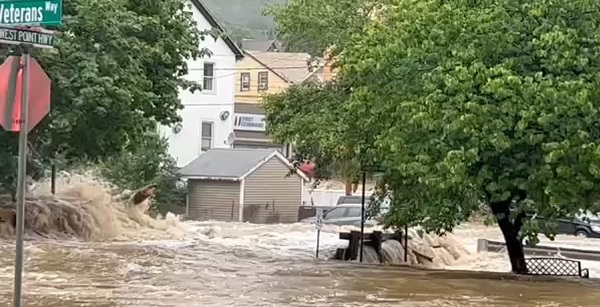
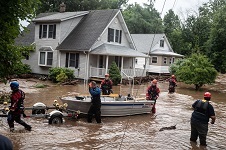 7/10 – Hudson River Watershed: An apocalyptic storm with unrelenting rain and high winds struck the Hudson Valley yesterday with severely damaging effects that continued into today and beyond. The most severe impacts were felt in Orange County especially at the U.S. Military Academy at West Point where 8.12 inches of rain was recorded, prompting New York Governor Kathy Hochul to declare a State of Emergency for Orange County. Calamitous agricultural damage was experiences throughout the watershed. 7/10 – Hudson River Watershed: An apocalyptic storm with unrelenting rain and high winds struck the Hudson Valley yesterday with severely damaging effects that continued into today and beyond. The most severe impacts were felt in Orange County especially at the U.S. Military Academy at West Point where 8.12 inches of rain was recorded, prompting New York Governor Kathy Hochul to declare a State of Emergency for Orange County. Calamitous agricultural damage was experiences throughout the watershed.
Much of the Hudson Valley-wide damage came from localized thunderstorms that slowly moved over the region in waves into the evening of July 9 and hit some communities much harder than others with flash floods and major washouts. Many thousands of power outages were recorded in Putnam, Ulster, Orange, Dutchess, and Albany counties. By July 14, a Federal Disaster Declaration was approved for some areas of the watershed, most notably western Vermont. (Photo of apocalyptic storm courtesy of Seth Harrison)
- National Weather Service
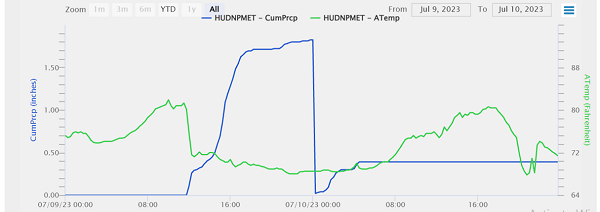 This screenshot from the National Estuarine Research Reserve System shows precipitation and air temperature at the Norrie Point Environmental Center in Dutchess County. Air temperatures dropped rapidly mid-day on July 9th, and within a few hours over two inches of rain had fallen. Note this graph shows cumulative rain over each day, so the sharp line denotes a “reset” at midnight between July 9 and 10. (Image source: https://cdmo.baruch.sc.edu/dges/) This screenshot from the National Estuarine Research Reserve System shows precipitation and air temperature at the Norrie Point Environmental Center in Dutchess County. Air temperatures dropped rapidly mid-day on July 9th, and within a few hours over two inches of rain had fallen. Note this graph shows cumulative rain over each day, so the sharp line denotes a “reset” at midnight between July 9 and 10. (Image source: https://cdmo.baruch.sc.edu/dges/)
-Chris Bowser
Natural History Entries
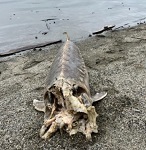 7/4 – Little Stony Point Preserve, HRM 55: On our daily beach walk at Little Stony Point, we came upon a dead Atlantic sturgeon (Acipenser oxyrinchus oxyrinchus) that the receding flood tide had left on the sand. The fish was a big one, a male, measuring four-feet in length, and was missing its head, likely from a boat strike. (Photo of Atlantic sturgeon courtesy of Seth Dinitiz) 7/4 – Little Stony Point Preserve, HRM 55: On our daily beach walk at Little Stony Point, we came upon a dead Atlantic sturgeon (Acipenser oxyrinchus oxyrinchus) that the receding flood tide had left on the sand. The fish was a big one, a male, measuring four-feet in length, and was missing its head, likely from a boat strike. (Photo of Atlantic sturgeon courtesy of Seth Dinitiz)
- Seth Dinitz, Elle Dinitz
[When accounting for the size of the missing head, in life, this sturgeon was about five-feet-long and 12-13 years old. Amanda Higgs]
[Boat strikes are not rare for sturgeon. While they are generally bottom-dwelling, deep-water fish in the estuary, they rise to the surface on occasion to refill their swim bladder with oxygen so they can maintain neutral buoyancy, or their position in the water column. When that rise meets the prop of a large vessel, life-threatening trauma can occur.
Atlantic sturgeon can live to at least sixty years, grow to approximately 16 feet long, and can weigh up to 800 pounds. In June 2018, a 14.1-foot-long female sturgeon was recorded on side-scan sonar near Esopus Island. In the Hudson River estuary, Atlantic sturgeon are protected by the Federal Endangered Species Act (U.S. Fish & Wildlife Service). Tom Lake]
[Report sightings of dead sturgeon to DEC's Marine Life Incident Report online survey. Reports of live sturgeon help us better understand the occurrence of Atlantic Sturgeon in New York's waters. Report live sturgeon in the Hudson River should be reported to 845-256-3073 or by emailing us and in marine waters to 631-444-0444 or by emailing us.]
7/5 – Newburgh, HRM 61: We went sailing this morning aboard the Hudson River Sloop Clearwater with a group of families from Outdoor Promise, an organization in Newburgh dedicated to increasing urban access to the outdoors. We had a great time and caught Atlantic tomcod, channel catfish, a yearling alewife (class of 2022), and a young-of-year freshwater drum.
- Chloe Smith
7/7 – Croton-Harmon, HRM 33.5: While waiting for an early Metro North train to Manhattan today, I saw what appeared to be this year’s osprey chick sitting on one of the cell tower antennas just below the level of the nest.
Nearby, but too far to identify, was a small bird about the size of a sparrow that was also sitting on one of the antennas. On several occasions, the small bird took flight and buzzed the osprey, causing it to rear up and spread its wings. After several of these forays, the osprey began calling, perhaps expecting to be saved by a benevolent parent. After a few minutes with no response, the osprey took off and flew a short distance south, before returning to the nest and disappearing inside. Meanwhile, the sparrow remained perched on the antenna next to the nest as I boarded my train and headed to work. In the many years I have been observing this osprey nest, this is the first time I ever saw this version of the “pecking order.”
- Hugh McLean
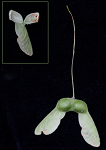 7/8 – Hudson River Watershed: Maple fruits come in the form of samaras — pairs of winged seeds that spiral to the ground, distribute some distance, as far as 330 feet from the parent tree. Aided by the wind, they’ve been clocked at falling at a speed of three miles-per-hour. Some, such as red and silver maple seeds, mature early and are fully ripe now. The seeds of other species of maples, including sugar maple, striped maple, and box elder, will mature by early autumn. 7/8 – Hudson River Watershed: Maple fruits come in the form of samaras — pairs of winged seeds that spiral to the ground, distribute some distance, as far as 330 feet from the parent tree. Aided by the wind, they’ve been clocked at falling at a speed of three miles-per-hour. Some, such as red and silver maple seeds, mature early and are fully ripe now. The seeds of other species of maples, including sugar maple, striped maple, and box elder, will mature by early autumn.
All maple species native to the Northeast have edible seeds which are loaded with protein and carbohydrates. They are especially popular with evening grosbeaks, ruffed grouse, nuthatches, porcupines, foxes, flying squirrels, eastern chipmunks, white-footed mice, white-tailed deer, and moose.
Humans also eat the seeds of maples, both raw as well as steamed or boiled with a little added salt and butter. Maple seeds can also be roasted, added to salads and other dishes, or dried and ground into flour. (Photo of sugar maple seeds courtesy of Mary Holland)
- Mary Holland
*** Fish of the Week ***
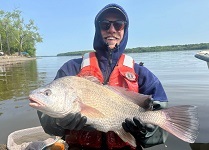 7/8 – Hudson River Watershed: Fish-of-the-Week for Week 228 is the freshwater drum (Astroscopus guttatus), number 205 (of 236), on our Hudson River Watershed List of Fishes. If you would like a copy of our list, e-mail: trlake7@aol.com 7/8 – Hudson River Watershed: Fish-of-the-Week for Week 228 is the freshwater drum (Astroscopus guttatus), number 205 (of 236), on our Hudson River Watershed List of Fishes. If you would like a copy of our list, e-mail: trlake7@aol.com
Freshwater drum (colloquially sheepshead) is one of seven members of the drum family (Sciaenidae) in our watershed and the only member of its family in North America to occur completely in freshwater habitats. Other drums include silver perch, weakfish, spot, northern kingfish, Atlantic croaker, and black drum; *the latter six are marine or estuarine species.
In the Midwest and Northeast, freshwater drum are found throughout the Great Lakes watershed, where they are widespread and native. Their Type Site, where they were first described to science in 1819, is the Ohio River. In New York, they are common in the Hudson River watershed as well as lakes Erie, Ontario, and Champlain. They occur in bottoms of medium to large rivers and lakes. Adults feed on immature aquatic insects such as mayflies (Hexagenia), amphipods, fish (especially herring and young drum), crayfish and mollusks. Larval stages of drum consume larvae of other fishes. They can reach three-feet in length and weigh 54 lb., although their average size is far smaller (C.L. Smith 1985).
Young-of-year freshwater drum are not commonly caught in collection gear, so it was a bit of a surprise when Chloe Grey Smith, with the Hudson River Sloop Clearwater’s otter trawl, caught an immature freshwater drum (75 millimeters) July 4 at Poughkeepsie, and a second one at Beacon (also 75 mm) the next day. (Photo of freshwater drum courtesy of Chris Bowser)
- Tom Lake
[There is an almost parallel story, certainly a connection, between freshwater drum and zebra mussels (Dreissena polymorpha). The zebra mussel is native to lakes in southern Russia and Ukraine. The first record of zebra mussels in the Hudson River estuary was May 1991, in Greene County, just south of the Rip Van Winkle Bridge. Based on the initial size and number of mussels, it is estimated they first arrived in 1989.
Freshwater drum like to eat bivalves. They have large, specialized (molariform) teeth that are adapted for crushing shells. Drum eat both zebra mussels and native “pearly” mussels (Unionidae). Ecologists suspect that the zebra mussel population explosions in the estuary in the early 1990s facilitated the spread and population growth of freshwater drum in the Hudson River. Dave Strayer]
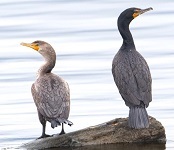 7/9 – Newburgh, HRM 61: I went looking for the extremely uncommon neotropical cormorant today, first spotted here on June 27 by Bruce Nott Jr., but with no success. The Jun 27 bird might have been the same one that visited here last summer. That neotropic cormorant was a first, for not only Orange County but for the Hudson River Valley. Today’s tally was a pair (an adult and immature) of double-crested cormorants. (Photo of double-crested cormorants courtesy of Matt Zeitler) 7/9 – Newburgh, HRM 61: I went looking for the extremely uncommon neotropical cormorant today, first spotted here on June 27 by Bruce Nott Jr., but with no success. The Jun 27 bird might have been the same one that visited here last summer. That neotropic cormorant was a first, for not only Orange County but for the Hudson River Valley. Today’s tally was a pair (an adult and immature) of double-crested cormorants. (Photo of double-crested cormorants courtesy of Matt Zeitler)
- Matt Zeitler
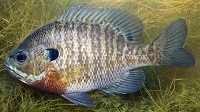 7/10 – Town of Wappinger, HRM 67.5: I was walking on Creek Road in the Town of Wappinger this morning and was surprised to see a mass of small fish, some still swimming and flopping around, many more dead, on the side of Creek Road next to Wappinger Creek. (Photo of bluegill courtesy of NYS Department of Environmental Conservation) 7/10 – Town of Wappinger, HRM 67.5: I was walking on Creek Road in the Town of Wappinger this morning and was surprised to see a mass of small fish, some still swimming and flopping around, many more dead, on the side of Creek Road next to Wappinger Creek. (Photo of bluegill courtesy of NYS Department of Environmental Conservation)
- Marcy Wagman
[From Marcy’s photo, it appeared that the fish were sunfish, bluegills from the look of them. The tidal Wappinger Creek had risen, flooded over its banks, brought fish with it, and then left them in the flood plain when the water level in the creek subsided. Tom Lake]
7/11 – Waterford, HRM 158: We compiled our final report for the 2023 season at bald eagle nest NY485 on Peebles Island. Egg incubation began on March 3 with the first feeding of the sole nestling witnessed on April 8. There were reports of two, even three nestlings, but we only confirmed one. On June 27, the nestling became a fledgling, and has since seemed to be healthy and active. [P.S. One of the adults and the fledgling were seen perched together in a tree on July 16.]
- Howard Stoner
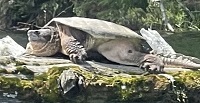 7/12 – Upper Saranac Lake, Franklin County: We were canoeing in the Saranac Lakes Wild Forest Area on the border of the Saint Regis Wilderness. I was paddling my Hemlock Nessmuck, a 10-foot pack canoe that weighs just 16 lb. While portaging to Horseshoe Pond, we came upon a very large and incredibly clean (sans algae) snapping turtle, that was at least two-feet-long. Other highlights along the hemlock forest paddle included white water lilies, bullhead pond lilies, pitcher plants, pickerel weed, rose pogonia, bog laurel, common loons, and an adult bald eagle. (Photo of snapping turtle courtesy of Michael Kalin) 7/12 – Upper Saranac Lake, Franklin County: We were canoeing in the Saranac Lakes Wild Forest Area on the border of the Saint Regis Wilderness. I was paddling my Hemlock Nessmuck, a 10-foot pack canoe that weighs just 16 lb. While portaging to Horseshoe Pond, we came upon a very large and incredibly clean (sans algae) snapping turtle, that was at least two-feet-long. Other highlights along the hemlock forest paddle included white water lilies, bullhead pond lilies, pitcher plants, pickerel weed, rose pogonia, bog laurel, common loons, and an adult bald eagle. (Photo of snapping turtle courtesy of Michael Kalin)
- Julie Elson
[This entry did not occur within the Hudson River Watershed, our standard measure for inclusion in the Hudson River Almanac. However, on occasion, we will include a sighting or observation from a closely adjacent area that we feel is notable. Tom Lake]
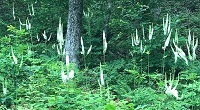 7/12 – High Falls, HRM 87: The mystical fronds of my favorite wildflower, Cimicifuga racemosa (snakeroot), had completely blanketed the hill below us this year. They used to signal the beginning of autumn, but lately have been appearing in early July. I’ve been noticing the backpedaling of bloom time for a while now (we have lived here for 32 years). (Photo of snakeroot courtesy of Sue Horowitz) 7/12 – High Falls, HRM 87: The mystical fronds of my favorite wildflower, Cimicifuga racemosa (snakeroot), had completely blanketed the hill below us this year. They used to signal the beginning of autumn, but lately have been appearing in early July. I’ve been noticing the backpedaling of bloom time for a while now (we have lived here for 32 years). (Photo of snakeroot courtesy of Sue Horowitz)
- Sue Horowitz
[Snakeroot is a member of the buttercup family, a perennial plant native to North America. Other, mostly historical, names for this herb include black cohosh, black bugbane, rattleweed, and rheumatism weed. Snakeroot has a long history of use by indigenous peoples, for example to treat musculoskeletal pain, fever, cough, and pneumonia. National Institute of Health]
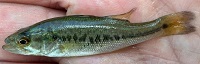 7/12 – Yonkers, HRM 18: Our staff at the Sarah Lawrence Center for the Urban River at Beczak made five hauls of our seine today with a nice mix of fishes and crustaceans. Among the fishes, high count went to young-of-year Atlantic menhaden (50-70 mm). Others included bay anchovy, mummichog, northern pipefish, and two American eels (8-12 inches). Five blue crabs (20–35 mm) and fifteen grass shrimp led the crustaceans. 7/12 – Yonkers, HRM 18: Our staff at the Sarah Lawrence Center for the Urban River at Beczak made five hauls of our seine today with a nice mix of fishes and crustaceans. Among the fishes, high count went to young-of-year Atlantic menhaden (50-70 mm). Others included bay anchovy, mummichog, northern pipefish, and two American eels (8-12 inches). Five blue crabs (20–35 mm) and fifteen grass shrimp led the crustaceans.
The water temperature was 78 degrees Fahrenheit (F), the salinity had dropped to 4.9 parts-per-thousand (ppt) — the July 9 storm had nearly halved the salinity in three days — and the dissolved oxygen (DO) was 6.4 pars-per-million (ppm). (Photo of largemouth bass courtesy of Tom Lake)
- Jason Muller, Mika Hughes, Samantha Calcagni, Jordyn Medina
[Crab measurements (size) are calculated in millimeters (mm) point-to-point across their carapace. Tom Lake]
7/13 – Yonkers, HRM 18: Our staff at the Sarah Lawrence Center for the Urban River at Beczak made ten hauls of our seine today with the enthusiastic support of the Groundwork Hudson Valley Green Team. Fish were the highlight of our catch with young-of-year bay anchovy high count with 13. Others included American eel, mummichog, white perch, and a real surprise, young-of-year largemouth bass (30-45 mm). The latter were likely an artifact of the rapidly disappearing salinity.
The water temperature was 78 degrees F, the salinity had dropped further to 4.2 ppt, and the dissolved oxygen (DO) was 6.5 ppm.
- Emily Orr, Christina Edsall, Jason Muller
[Note: One-inch equals 25.4 millimeters (mm). Tom Lake]
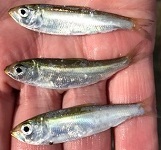 7/14 – Beacon, HRM 61: Beach access at Little Stony Point Preserve was impassibly flooded (it was as if the flood tide had never ebbed) so we switched our efforts to Long Dock Park. The water temperature at 79 degrees F was building to a summer high into the 80s. Despite the deluge from the storm earlier in the week that pushed the salinity far downriver, we still managed a minuscule reading of just over 1.0 ppt, small enough to be background and statistically zero. 7/14 – Beacon, HRM 61: Beach access at Little Stony Point Preserve was impassibly flooded (it was as if the flood tide had never ebbed) so we switched our efforts to Long Dock Park. The water temperature at 79 degrees F was building to a summer high into the 80s. Despite the deluge from the storm earlier in the week that pushed the salinity far downriver, we still managed a minuscule reading of just over 1.0 ppt, small enough to be background and statistically zero.
We set and hauled our 30-foot seine with meager results (which we attributed to the storm effects). We did get into a small school (30 fish) of young-of-year blueback herring (25 mm). Side-by-side in the net were four Beroe’s comb jellies (M&M size), remnants of saltier days. (Photo of blueback herring courtesy of Tom Lake)
- Christopher Lake, T.R. Jackson, Tom Lake
Summer 2023 Natural History Programs and Events
Paddle the Hudson River Estuary
With our staff naturalists with free educational canoe trips. Join us to explore tidal marshes, observe birds and wildlife, and discover unique plants.
These trips are suitable for adults and children (6+), whether you’re an experienced or beginner paddler. The trips leave from three different launch sites in the lower, upper, and mid-Hudson Valley. All gear is provided, and registration is required.
Registration link:https://2023-nysdec-canoeprogram.eventbrite.com/
Volunteer for Hudson River Striped Bass Cooperative Angler Program
Do you fish for striped bass in the Hudson River? Whether you catch-and-release or take home a keeper, you can be part of the Cooperative Angler Program. Share your fishing trip information and help biologists understand and manage our striped bass fishery.
Here's how it works: Fill out a logbook we provide or record your trips on your smartphone using DEC's Hudson River online logbook (PDF) whenever you fish on the tidal Hudson River (by boat or on the shore). Record general location, time, gear used, what you caught (or if you didn't catch anything), and return the logbook when you are done fishing.
Join today! For more information on the angler program and instructions on installing the Survey123 App to access the online logbook, visit Hudson River Cooperative Angler or email hudsonangler@dec.ny.gov.
Note: If you primarily fish for striped bass in New York waters south of the George Washington Bridge, the DEC has a separate Striped Bass Cooperative Anglers Program.
Hudson River Miles
The Hudson is measured north from Hudson River Mile 0 at the Battery at the southern tip of Manhattan. The George Washington Bridge is at HRM 12, the Tappan Zee 28, Bear Mountain 47, Beacon-Newburgh 62, Mid-Hudson 75, Kingston-Rhinecliff 95, Rip Van Winkle 114, and the Federal Dam at Troy, the head of tidewater, at 153. The tidal section of the Hudson constitutes a bit less than half the total distance – 315 miles – from Lake Tear of the Clouds to the Battery. Entries from points east and west in the watershed reference the corresponding river mile on the mainstem.
To Contribute Your Observations or to Subscribe
The Hudson River Almanac is compiled and edited by Tom Lake and emailed weekly by DEC's Hudson River Estuary Program. Share your observations by e-mailing them to trlake7@aol.com. To subscribe to the Almanac (or to unsubscribe), use the links on DEC's Hudson River Almanac or DEC Delivers web pages.
Useful Links
National Oceanic and Atmospheric Administration online tide and tidal current predictions are invaluable when planning Hudson River field trips. For real-time information on Hudson River tides, weather, and water conditions from sixteen monitoring stations, visit the Hudson River Environmental Conditions Observing System website.
DEC's Smartphone app for iPhone and Android is now available at New York Fishing, Hunting & Wildlife App.
|