A Project of the Hudson River Estuary Program
Compiled and edited by Tom Lake, Consulting Naturalist
Overview
We had some first-of-the-season fishes arrive in the estuary this week as summer settled into our Hudson Valley. In the air, we had some rare to very uncommon bird visits. Schools entered their summer recess and our on-the-river education programs switched to a broader audience.
Highlight of the Week
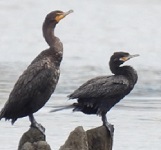 6/27 – Town of New Windsor, HRM 60: Within a small group of double-crested cormorants at the mouth of Quassaick Creek, looking south on the pilings, I spotted an adult Neotropic cormorant (Nannopterum brasilianum). Although it cannot be proven, I believe it to be same adult as last year, seen May 28-October 9. The plumage looked identical at the same time last year. The 2022 Neotropic cormorant was a first, not only for Orange County, but for the Hudson River Valley. (Photo of Neotropical cormorant courtesy of Bruce Nott, Jr.) 6/27 – Town of New Windsor, HRM 60: Within a small group of double-crested cormorants at the mouth of Quassaick Creek, looking south on the pilings, I spotted an adult Neotropic cormorant (Nannopterum brasilianum). Although it cannot be proven, I believe it to be same adult as last year, seen May 28-October 9. The plumage looked identical at the same time last year. The 2022 Neotropic cormorant was a first, not only for Orange County, but for the Hudson River Valley. (Photo of Neotropical cormorant courtesy of Bruce Nott, Jr.)
- Bruce Nott Jr.
Neotropic Cormorants are extremely uncommon anywhere north of the Gulf States (Texas to Florida). They are Meso-American-South American birds but are also found along the Gulf of Mexico. The first New York State record was August 2013 along the shore of Lake Ontario.
- Stan DeOrsey
[A nearly all-black waterbird with a snaky neck, the neotropic cormorant occurs in sheltered waters of southern U.S. states, the Caribbean, and Latin America. It is smaller and longer-tailed than other cormorants, but otherwise looks very similar to the double-crested cormorant, and the two species often flock together. Unlike its larger cousin, it sometimes plunge-dives for fish from a few feet above the water, almost like a booby, though it dives mostly as it paddles along the water’s surface, catching fish as it darts through the water. eBird]
Natural History Entries
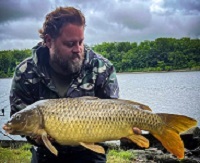 6/24 – Albany County, HRM 135: The Carp Anglers Group’s 2023 Yankee Challenge was held at Henry Hudson Park in Selkirk. The day was stuck in the middle of a series of days that featured high humidity, heavy rain, and thunderstorms. On the day of our Yankee Challenge, it rained from 5:30 a.m. to 3:00 p.m. Seventeen anglers participated, eight of which caught, weighed, and released 290 pounds of common carp. Blake Carlson had 15 carp, weighing 205 lb., the largest of which was 20 lb. The pool winner was Johnny Jackets and his 23 lb. 3 oz. carp. (Photo of common carp courtesy of Sam Williams) 6/24 – Albany County, HRM 135: The Carp Anglers Group’s 2023 Yankee Challenge was held at Henry Hudson Park in Selkirk. The day was stuck in the middle of a series of days that featured high humidity, heavy rain, and thunderstorms. On the day of our Yankee Challenge, it rained from 5:30 a.m. to 3:00 p.m. Seventeen anglers participated, eight of which caught, weighed, and released 290 pounds of common carp. Blake Carlson had 15 carp, weighing 205 lb., the largest of which was 20 lb. The pool winner was Johnny Jackets and his 23 lb. 3 oz. carp. (Photo of common carp courtesy of Sam Williams)
- Sam Williams
6/24 – Yonkers, HRM 18: Our staff at the Sarah Lawrence Center for the Urban River at Beczak made eight hauls of our seine today for the Yonkers Summer Kickoff Riverfront Festival. The tide was high (you cannot always select the best times to net).
High count went to ten blue crabs (13.0 millimeters). Other invertebrates included comb jellies and moon jellyfish. Fishes in the net were, two each, mummichog and spot. The water temperature was 71 degrees Fahrenheit, the salinity was 10.5 parts-per-thousand (ppt), and the dissolved oxygen (DO) was 7.6 parts-per-million (ppm).
- Christina Edsall, Ishika Joshi, Emily Orr, Rachel Lynch, Liliane LeClercq
[Blue crab measurements (size) are calculated in millimeters (mm) point-to-point across their carapace. Tom Lake]
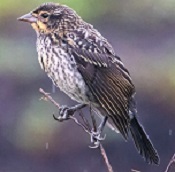 6/25 – Town of Warwick, HRM 41: I walked in the rain today at the Wallkill River National Wildlife Refuge’s Liberty Loop — specifically, the back pond. I was hoping for least bitterns, sora, or anything exciting. Instead, I got plenty of red-winged blackbirds singing in the rain. (Photo of red-winged blackbird courtesy of Matt Zeitler) 6/25 – Town of Warwick, HRM 41: I walked in the rain today at the Wallkill River National Wildlife Refuge’s Liberty Loop — specifically, the back pond. I was hoping for least bitterns, sora, or anything exciting. Instead, I got plenty of red-winged blackbirds singing in the rain. (Photo of red-winged blackbird courtesy of Matt Zeitler)
- Matt Zeitler
6/26 – Yonkers, HRM 18: Our staff at the Sarah Lawrence Center for the Urban River at Beczak seined, again today, at high tide. We made six hauls with the eager assistance of CURB Blue Team Interns. Comb jellies (possibly Leidy’s comb jelly, Mnemiopsis leidyi), was high count with 21. Other invertebrates included blue crabs, grass shrimp, moon jellyfish, and a single ribbed mussel. For fishes, we collected spot and mummichogs. The water temperature was 73 degrees Fahrenheit (F), the salinity was 9.2 ppt, and the dissolved oxygen (DO) was 8.4 ppm.
- Jason Muller, Katie Lamboy, Christina Edsall, Ishika Joshi, Emily Orr
6/26 – Manhattan, HRM 1-2: Recently, our Hudson River Park’s River Project staff, along with Seasonal Field Science Assistants Vivian and Stefan, Seasonal Environmental Educators Sasha, Jelene, Kelly, and Jerin, have been checking our research gear (pots and traps) that we deploy off Piers 26 and 40 as part of our fish ecology survey and monitoring.
Our pots and traps were rather full at Pier 40, with two juvenile oyster toadfish (45, 60 mm), a black sea bass (111 mm), some mud dog whelks, grass shrimp, mud crabs, comb jellies (possibly Beroe comb jelly, Beroe cucumiss), and one spider crab. At Pier 26, our pots and traps collected a male blue crab (105 mm), an oyster toadfish (35 mm), and a black sea bass (80 mm). Other invertebrates included: a long-clawed hermit crab, mud crabs, grass shrimp, oyster drill snails, and mud dog whelk snails.
- Siddhartha Hayes, Toland Kister, Sierra Drury, Zoe Kim
[Note: One-inch equals 25.4 millimeters (mm). Tom Lake]
6/27 – Yonkers, HRM 18: Our staff at the Sarah Lawrence Center for the Urban River at Beczak made five hauls of our seine today, catching a little bit of a lot, and but not much of many. Collectively, invertebrates were high count, with five each blue crab, moon jellyfish, and sand shrimp. The blue crabs averaged 120 mm, with two of them soft-shelled. Other invertebrates included grass shrimp and comb jellies. Four fishes, mummichog, bay anchovy, Atlantic menhaden, and white perch completed the catch. The water temperature was 71 degrees F, the salinity was 10.1 ppt, and the dissolved oxygen (DO) was 8.7 ppm.
- Jason Muller, Jordyn Medina, Emily Orr
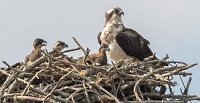 6/27 – Ulster County, HRM 92: The osprey nest at the mouth of Rondout Creek in Kingston had three nestlings this spring. (Photo of osprey courtesy of Jim Yates) 6/27 – Ulster County, HRM 92: The osprey nest at the mouth of Rondout Creek in Kingston had three nestlings this spring. (Photo of osprey courtesy of Jim Yates)
- Jim Yates
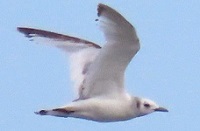 6/27 – Rhinecliff, HRM 89: Early in the morning, six days ago, we spotted a black-legged kittiwake (Rissa tridactyla) on the Hudson River (the bird was still around today). The kittiwake was on the rocks by the Rondout Lighthouse straight across the river from the Rhinecliff train station. After a half-hour, the gull lifted off into flight. We watched it through our scope noticing field marks that suggested it was immature. The kittiwake flew close to where we were standing allowing us to further verify the species diagnostic field marks: black legs and bill, black fine edging at the end of the white tail, and grayish band with a black mark at the back of the neck. We had excellent views of this beautiful bird.(Photo of black-legged kittiwake courtesy of Barbara Mansell) 6/27 – Rhinecliff, HRM 89: Early in the morning, six days ago, we spotted a black-legged kittiwake (Rissa tridactyla) on the Hudson River (the bird was still around today). The kittiwake was on the rocks by the Rondout Lighthouse straight across the river from the Rhinecliff train station. After a half-hour, the gull lifted off into flight. We watched it through our scope noticing field marks that suggested it was immature. The kittiwake flew close to where we were standing allowing us to further verify the species diagnostic field marks: black legs and bill, black fine edging at the end of the white tail, and grayish band with a black mark at the back of the neck. We had excellent views of this beautiful bird.(Photo of black-legged kittiwake courtesy of Barbara Mansell)
- Barbara Mansell, Kyle Bardwell (R.T. Waterman Bird Club)
[These coastal seabirds (Laridae), same genus as gulls, are simply not expected inland, and they certainly are not found in June. When they do show up, they do not stay long. Normally, kittiwakes are only found, October to March, off eastern Long Island over the ocean or a few along the Great Lakes, generally along the Niagara River. This black-legged kittiwake showed first-winter plumage and would have been born last year, likely in Canada. This sighting, coupled with an adult bird spotted earlier this month near Buffalo, was the first June record for the state (any inland sightings in late-spring and summer are very uncommon). Stan DeOrsey, (R.T. Waterman Bird Club)]
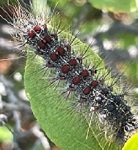 6/27 – Millbrook, HRM 82: This was an outbreak year for spongy moth caterpillars (née gypsy moth), Lymantria dispar. It is indigenous to Europe, was introduced in North America, and is classified as a pest — its larvae consume the leaves of over 500 species of trees, shrubs, and plants. It is one of the most destructive pests of hardwood trees in the Eastern United States and is listed as one of the 100 most destructive invasive species Worldwide. 6/27 – Millbrook, HRM 82: This was an outbreak year for spongy moth caterpillars (née gypsy moth), Lymantria dispar. It is indigenous to Europe, was introduced in North America, and is classified as a pest — its larvae consume the leaves of over 500 species of trees, shrubs, and plants. It is one of the most destructive pests of hardwood trees in the Eastern United States and is listed as one of the 100 most destructive invasive species Worldwide.
The extent of the defoliation is regionally significant and locally astonishing. Two weeks ago, an apple tree and a pair of oaks in my top field had full crowns of leaves. Last Saturday every leaf had been eaten to the midrib. Not all plants are suitable spongy moth hosts, however. In the Taconic Hereford multi-use area of Dutchess County, there are areas where giant oaks, hornbeams (Carpinus caroliniana) and hop hornbeams (Ostrya virginiana) are as leafless as winter, while the maples, witch hazels (Hamamelis virginiana) and others are only nibbled. Fortunately, the trees have survived these outbreaks before (spongy moth outbreaks occur every 10-15 years), and they likely will promptly re-foliate and survive this one. (Photo of spongy moth caterpillar courtesy of Mike Corey)
- Nelson Johnson
6/28 – Yonkers, HRM 18: We caught a nice low tide today for our staff at the Sarah Lawrence Center for the Urban River at Beczak to make five hauls of our seine. As the season goes on and the river warms, young-of-year fishes and invertebrates continued to dominate our catch. Among the fishes was the high-count Atlantic menhaden (47), Atlantic silverside, spot, and bluefish. Moon jellyfish (47) led invertebrates with sand shrimp (44) next. The water temperature was 73 degrees F, the salinity was 9.5 ppt, and the dissolved oxygen (DO) was 9.4 ppm.
- Jason Muller, Jordyn Medina, Samantha Calcagni, Mika Hughes
6/28 – Denning’s Point, HRM 60: The shallow bay that spans the river between Denning’s Point and the mouth of Fishkill Creek was in full summer bloom with bank-to-bank Eurasian water chestnut (Trap natans). But this was not a tranquil scene. The random explosions out of the Trapa beds conjured up a vision of someone dropping cement blocks into the water. These were common carp, and it was their prime spawning season. Male carp, in their unbridled enthusiasm, burst up through the green mat often clearing the water before crashing back. The carp’s aggressive shallow water spawning rituals disturb the spawning activities of other fish, even native fishes such as pumpkinseed sunfish. Scattered throughout the bay, perched on stick-ups, were great blue and green herons.
- Tom Lake
[Common carp (Cyprinus carpio) are nonnative having been introduced to North America from Europe in the Hudson River at Newburgh in 1831 (Robert Boyle,1969). They are the largest member of our largest family (34) of fishes (Cyprinidae). Carp are often hybridized and are domesticated as an ornamental variety called koi. - Tom Lake]
*** Fish of the Week***
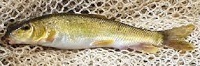 6/28 – Hudson River Watershed: Fish-of-the-Week for Week 226 is the summer sucker (Catostomus utawana), species number 72 (of 237) on our watershed list of fishes. If you would like a copy of our list, e-mail - trlake7@aol.com 6/28 – Hudson River Watershed: Fish-of-the-Week for Week 226 is the summer sucker (Catostomus utawana), species number 72 (of 237) on our watershed list of fishes. If you would like a copy of our list, e-mail - trlake7@aol.com
The summer sucker is one of six suckers (Catostomidae), plus one hybrid, documented for the Hudson River Watershed. Others include longnose sucker, white sucker, creek chubsucker, northern hog sucker, shorthead redhorse, and a hybrid, black buffalo x smallmouth buffalo (Ictiobus sp.). All are native species except for the hybrid and the shorthead redhorse; they are both canal migrants from the Great Lakes and Mississippi refugium. The summer sucker is a fish of small waters and is small for a sucker, averaging 100-110 mm in length.
Summer sucker had been known to science since at least 1866, when it was described and named by Fred Mather (Catostomus utawana) and has certainly been in our watershed much longer. They live in small headwater lakes and streams of the Adirondack Mountains and are the only endemic (found nowhere else) species in New York State. And yet, until recently, was not on our list of watershed fishes. That omission was corrected in 2016, when it was added as species number 225.
The summer sucker was formerly included with the white sucker (C. commersoni), a common species in the watershed. However, analyses done by Morse and Daniels in 2009 (A re-description of Catostomus utawana, Cypriniformes: Catostomidae, Copea 2009: 214-220), elevated the summer sucker to full species status. The paper cited a 1934 record (NYSM 33225) from Little Pine Lake, Hamilton County, in the Mohawk River drainage, thus the Hudson River drainage. The summer sucker has both global and New York ranking of “Imperiled.” This species has a small range in lakes and tributary streams in the Adirondack Mountains of New York. Within its range it is common but declining (NatureServe 2012).
Karin Limburg notes that the summer sucker is a good example of allopatric speciation. This occurs when a population becomes sufficiently isolated from its parent population (white sucker) to allow unique mutations and adaptations to occur to make if significantly different enough to warrant being a new species. (Photo of summer sucker courtesy of Doug Carlson)
- Tom Lake
6/29 – Esopus Meadows, HRM 87: Our Hudson River Sloop Clearwater’s Tideline Education team ran our first program of the summer season with Camp Eagle Hill from Columbia County. Forty-five campers joined us for seining, fish identification, and our “Bucket Brigade” race that focuses on water usage (we call it the Water Wasting Wingding). Across a dozen hauls, we caught 13 mummichogs and 12 banded killifish. The water was 70 degrees F.
- Eli Schloss
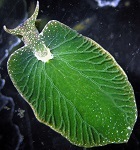 6/29 – Piermont Pier, HRM 25.4: Our staff at the Hudson River Field Station went seining today, close to low tide, on the north side of Piermont Pier. The river had warmed to 77 degrees F, and the salinity was 7.0 ppt. Our net collected a small northern pipefish, four blue crabs, of varying sizes (25-150 mm), eight sand shrimp, and Beroe comb jellies. Our featured creature was a nudibranch, the eastern emerald elysia (Elysia chlorotica). Additionally, we had a wonderful osprey hanging around the area most of the day. (Photo of nudibranch courtesy of Patrick Kraig) 6/29 – Piermont Pier, HRM 25.4: Our staff at the Hudson River Field Station went seining today, close to low tide, on the north side of Piermont Pier. The river had warmed to 77 degrees F, and the salinity was 7.0 ppt. Our net collected a small northern pipefish, four blue crabs, of varying sizes (25-150 mm), eight sand shrimp, and Beroe comb jellies. Our featured creature was a nudibranch, the eastern emerald elysia (Elysia chlorotica). Additionally, we had a wonderful osprey hanging around the area most of the day. (Photo of nudibranch courtesy of Patrick Kraig)
- Matthew Tang
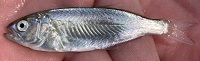 6/29 – Yonkers, HRM 18: Our staff at the Sarah Lawrence Center for the Urban River at Beczak made ten hauls of our seine today with an assist from the Yonkers Urban Advantage Retreat. Our effort featured an impressive array of young-of-year fishes including Atlantic menhaden (46), spot, bay anchovy, Atlantic silverside, and three bluefish (80 mm), our first of the season and always a sign of summer. Other fishes were hogchoker and our first northern pipefish of the year. Invertebrates showed well with sand shrimp (61), grass shrimp (40), and moon jelly fish. The water temperature was 73 degrees Fahrenheit, the salinity was 9.3 ppt, and the dissolved oxygen (DO) was 9.3 ppm. (Photo of bluefish courtesy of Tom Lake) 6/29 – Yonkers, HRM 18: Our staff at the Sarah Lawrence Center for the Urban River at Beczak made ten hauls of our seine today with an assist from the Yonkers Urban Advantage Retreat. Our effort featured an impressive array of young-of-year fishes including Atlantic menhaden (46), spot, bay anchovy, Atlantic silverside, and three bluefish (80 mm), our first of the season and always a sign of summer. Other fishes were hogchoker and our first northern pipefish of the year. Invertebrates showed well with sand shrimp (61), grass shrimp (40), and moon jelly fish. The water temperature was 73 degrees Fahrenheit, the salinity was 9.3 ppt, and the dissolved oxygen (DO) was 9.3 ppm. (Photo of bluefish courtesy of Tom Lake)
- Jason Muller, Christina Edsall, Ishika Joshi, Emily Orr, Maykaela Ortilla, Vivian Navarrete
[Note: When a single number is given for the size of a fish, it represents the average for the group.]
 6/30 – Hudson River Estuary: Seines are frequently mentioned in Almanac observations relating to fisheries research and education. Seine is a French word, from the Latin sagëna, which means a fishing net designed to hang vertically in the water, the ends of which are drawn together to enclose fish. A seine is a net with a float line on top, a lead line on the bottom, and tight meshes in between. 6/30 – Hudson River Estuary: Seines are frequently mentioned in Almanac observations relating to fisheries research and education. Seine is a French word, from the Latin sagëna, which means a fishing net designed to hang vertically in the water, the ends of which are drawn together to enclose fish. A seine is a net with a float line on top, a lead line on the bottom, and tight meshes in between.
Seines range in length from fifteen to six-hundred feet long, four-to-eight-feet in depth, and mesh size of ¼ to 2½-inches, or even larger for sturgeon, depending upon application. The longer seines must be set and hauled by a boat and crew. Shorter nets are used by educators, researchers, and bait dealers. New York State residents can use a seine in the Hudson River, not to exceed 36 square feet in area, to catch bait for their own personal use. Using a larger seine requires a License to Collect and Possess (LCP) from the NYSDEC Special Licenses Unit.
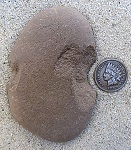
Stone netsinkers, from prehistoric contexts, found along the river provide evidence that seines, and other nets were being used in the Hudson River for as long as our species has been here. Net sinkers are often a palm-size stone (most often sandstone) with notches or peckings at three-and-nine on its face to hold a strip of natural cordage.
It is believed that our species brought the technology for using handmade nets to catch birds, fish, turtles, and other forage, with them when they arrived here from points north and west, at least 12,000 years ago. (Photo of net sinkers courtesy of Tom Lake)
- Tom Lake
Summer 2023 Natural History Programs and Events
Paddle the Hudson River Estuary
With our staff naturalists with free educational canoe trips. Join us to explore tidal marshes, observe birds and wildlife, and discover unique plants.
These trips are suitable for adults and children (6+), whether you’re an experienced or beginner paddler. The trips leave from three different launch sites in the lower, upper, and mid-Hudson Valley. All gear is provided, and registration is required.
Registration link:https://2023-nysdec-canoeprogram.eventbrite.com/
Volunteer for Hudson River Striped Bass Cooperative Angler Program
Do you fish for striped bass in the Hudson River? Whether you catch-and-release or take home a keeper, you can be part of the Cooperative Angler Program. Share your fishing trip information and help biologists understand and manage our striped bass fishery.
Here's how it works: Fill out a logbook we provide or record your trips on your smartphone using DEC's Hudson River online logbook (PDF) whenever you fish on the tidal Hudson River (by boat or on the shore). Record general location, time, gear used, what you caught (or if you didn't catch anything), and return the logbook when you are done fishing.
Join today! For more information on the angler program and instructions on installing the Survey123 App to access the online logbook, visit Hudson River Cooperative Angler or email hudsonangler@dec.ny.gov.
Note: If you primarily fish for striped bass in New York waters south of the George Washington Bridge, the DEC has a separate Striped Bass Cooperative Anglers Program.
Hudson River Miles
The Hudson is measured north from Hudson River Mile 0 at the Battery at the southern tip of Manhattan. The George Washington Bridge is at HRM 12, the Tappan Zee 28, Bear Mountain 47, Beacon-Newburgh 62, Mid-Hudson 75, Kingston-Rhinecliff 95, Rip Van Winkle 114, and the Federal Dam at Troy, the head of tidewater, at 153. The tidal section of the Hudson constitutes a bit less than half the total distance – 315 miles – from Lake Tear of the Clouds to the Battery. Entries from points east and west in the watershed reference the corresponding river mile on the mainstem.
To Contribute Your Observations or to Subscribe
The Hudson River Almanac is compiled and edited by Tom Lake and emailed weekly by DEC's Hudson River Estuary Program. Share your observations by e-mailing them to trlake7@aol.com. To subscribe to the Almanac (or to unsubscribe), use the links on DEC's Hudson River Almanac or DEC Delivers web pages.
Useful Links
National Oceanic and Atmospheric Administration online tide and tidal current predictions are invaluable when planning Hudson River field trips. For real-time information on Hudson River tides, weather, and water conditions from sixteen monitoring stations, visit the Hudson River Environmental Conditions Observing System website.
DEC's Smartphone app for iPhone and Android is now available at New York Fishing, Hunting & Wildlife App.
|