A Project of the Hudson River Estuary Program
Compiled and edited by Tom Lake, Consulting Naturalist
Overview
The richness of this week’s Almanac can be found in the many on-the-river education programs conducted with students.
Highlight of the Week
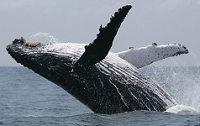 5/27 – Queens, New York City: Bringing binoculars to a field site is most akin to bringing an umbrella in the event of rain: You may have an umbrella to carry if no rain falls; you may wear binoculars with nothing of note to scan. Miraculously, however, this was not the case today. Meeting with a group of colleagues to assess the beach situation at Riis Park, I looked idly out over the placid Atlantic Ocean where my gaze landed on an enormous black tail just a few hundred feet offshore. The tail came up and slapped ponderously again and again, affording me one of the best whale sightings I've ever had from land or sea. From the graceful "S-curve" of the trailing edge of each enormous fluke, my guess was I was watching a humpback whale. 5/27 – Queens, New York City: Bringing binoculars to a field site is most akin to bringing an umbrella in the event of rain: You may have an umbrella to carry if no rain falls; you may wear binoculars with nothing of note to scan. Miraculously, however, this was not the case today. Meeting with a group of colleagues to assess the beach situation at Riis Park, I looked idly out over the placid Atlantic Ocean where my gaze landed on an enormous black tail just a few hundred feet offshore. The tail came up and slapped ponderously again and again, affording me one of the best whale sightings I've ever had from land or sea. From the graceful "S-curve" of the trailing edge of each enormous fluke, my guess was I was watching a humpback whale.
Riveted, I stared for ten minutes until I realized that the huge animal was probably warning off motorboats that kept pushing in closer. Finally, it was the whale that departed, leaving the original boat and a ring of four others anchored or headed in that direction.
However, the morning's sightings were not over. Closer to shore, where breakers were coming over a sand bar, six dolphins frolicked in the waves, likely hunting and good naturedly teasing each other, rolling and surfing in the mild chop. I assumed that a potential meal was attracting both dolphins and whales, perhaps a dense school of Atlantic menhaden (bunker) that had been surrounded. The action ceased as quickly as it began, and I left the beach in a rare mood, pleased that I had made it to the meeting and glad that I had remembered the binoculars. (Photo of humpback whale courtesy of Tim Collins)
- Dave Taft
Natural History Entries
While an Almanac week (reports) runs from Saturday to the following Friday, there are occasions when entries arrive late, and based on their significance, are presented as look-backs.
- The Editor
The Hudson River Sloop Clearwater’s Tideline Education Program made several stops last week across 50 river miles, introducing elementary school students to the magic of the estuary.
5/30 – Croton Point Park HRM 35: On a gorgeous little beach called “Mother’s Lap,” our Hudson River Sloop Clearwater team hosted 140 students over three sessions from Lakeland Copper Beech Middle School today. Although we seined about 36 times altogether, most of our fish came in one sweep, hauled by a student whose nickname was "Fisherman Jack." And he did not disappoint. White perch (9) was high count, but also included were striped bass and blue crabs. Another student found a live soft-shell clam (Mya arenaria). The river was 70 degrees Fahrenheit, and the salinity was 3.0 parts-per-thousand (ppt).
- Eli Schloss
[Mother's Lap, a legendary beach at Croton Point, is a colloquial name for a small, sheltered cove in Haverstraw Bay on the north-east end of Croton Point. When commercial fishing was in its heyday in the early-to-mid-twentieth century, fishermen knew they could find refuge from wind and tide in this little bay as their nets worked offshore. In that regard, it reminded them of the calm and solace of sitting in “mother’s lap.” Tom Lake]
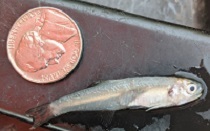 6/1 – Esopus Meadows, HRM 87: Our Hudson River Sloop Clearwater Tideline Education team was back upriver for two days with Marbletown Elementary third-graders. The class chaperones were highly motivated to catch lots of fish. Over four hauls of our seine, our high count was, surprisingly, young-of-year bay anchovy (11), a far upriver migration for this species from the sea. Other fish caught included bluegill sunfish, largemouth bass, and tessellated darters. (Photo of bay anchovy courtesy of Eli Schloss) 6/1 – Esopus Meadows, HRM 87: Our Hudson River Sloop Clearwater Tideline Education team was back upriver for two days with Marbletown Elementary third-graders. The class chaperones were highly motivated to catch lots of fish. Over four hauls of our seine, our high count was, surprisingly, young-of-year bay anchovy (11), a far upriver migration for this species from the sea. Other fish caught included bluegill sunfish, largemouth bass, and tessellated darters. (Photo of bay anchovy courtesy of Eli Schloss)
- Eli Schloss
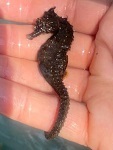 6/1 – New York Harbor, Upper Bay: The Hudson River Sloop Clearwater hosted fifth-grade students from P.S. 107 from Brooklyn today. While underway, during our sail in Buttermilk Channel, we set our otter trawl and caught three flounder, two sea robins, and a 60-mm lined seahorse (Hippocampus erectus). (Photo of lined seahorse courtesy of Ella Agoos) 6/1 – New York Harbor, Upper Bay: The Hudson River Sloop Clearwater hosted fifth-grade students from P.S. 107 from Brooklyn today. While underway, during our sail in Buttermilk Channel, we set our otter trawl and caught three flounder, two sea robins, and a 60-mm lined seahorse (Hippocampus erectus). (Photo of lined seahorse courtesy of Ella Agoos)
- Ella Agoos
[Buttermilk Channel is a small, narrow, one-mile-long tidal strait in the Upper Bay of New York Harbor that separates Brooklyn from Governors Island. Tom Lake]
6/2 – Esopus Meadows HRM 87: This was Day 2 with another group of students from Marbletown Elementary. Our Hudson River Sloop Clearwater team, with help from the students, set and hauled our seine. We caught ten more young-of-year bay anchovies (45 mm) as well as banded killifish and white perch. Two immature bald eagles, flying in tandem over the water, cruised down the river past us.
- Eli Schloss
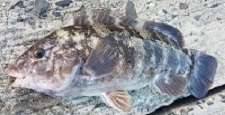 6/3 – Manhattan, HRM 1-2: Recently, our Hudson River Park’s River Project staff with Harbor School interns (Beatrix and Ella), have been checking our research gear (pots and traps) that we deploy off Piers 26 and 40 as part of our fish ecology survey and monitoring. 6/3 – Manhattan, HRM 1-2: Recently, our Hudson River Park’s River Project staff with Harbor School interns (Beatrix and Ella), have been checking our research gear (pots and traps) that we deploy off Piers 26 and 40 as part of our fish ecology survey and monitoring.
At Pier 26, we captured several tautog (blackfish), both adults and juveniles (180-310 mm), as well as a small skilletfish (35 mm). Our minnow traps were populated with grass shrimp, mud crabs, and a Pacific shore crab. At Pier 40, our crab pots and minnow traps were teeming with fish, including ten oyster toadfish (230-290 mm), five adult tautog (350 mm), and three black seas bass (95 mm). (Photo of tautog courtesy of Nicola Lagonigro)
- Sierra Drury, Sivan Gordon-Buxbaum, Siddhartha Hayes, Toland Kister, Zoe Kim, Rachel Swanson,
[Blackfish is a colloquial name for tautog (Tautoga onitis) a rather common, bottom-dwelling fish of New York Harbor. Their common name, blackfish, refers to the adults as they attain a deep and mottled coal black color. Among their favorite foods are shellfish that they find in abundance in near-shore rocky areas. In the spirit of “you are what you eat,” blackfish, perhaps owing to their shellfish diet, are a sought-after food fish. - Tom Lake]
6/4 – Hudson River Watershed: Among indigenous peoples, full moons have long been labeled with fanciful names that are rooted in oral traditions, indigenous memories, and ethnographic accounts.
Among Mohican people, whose ancestral homeland lies wholly within the Hudson River watershed, the June full moon is known as the Strawberry moon, Otaʔeemeene Neepãuk, in the Mohican dialect. Tribal translations of full moons pre-date colonization and generally reflect the seasonality of the lunar phase. Moon phases, in fact, were used by indigenous people as measurements of time.
- Larry Madden, Stockbridge-Munsee Band of Mohican Indians
*** Fish of the Week***
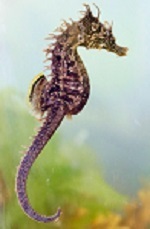 6/5 – Hudson River Watershed: Fish-of-the-Week for Week 223 is the lined seahorse (Hippocampus erectus), number 132 (of 237) on our watershed list of fishes. If you would like a copy of our list, e-mail - trlake7@aol.com. 6/5 – Hudson River Watershed: Fish-of-the-Week for Week 223 is the lined seahorse (Hippocampus erectus), number 132 (of 237) on our watershed list of fishes. If you would like a copy of our list, e-mail - trlake7@aol.com.
[The lined seahorse is one of two pipefishes (Syngnathidae) documented for our watershed. The other is the northern pipefish (Syngnathus fuscus). The lined seahorse is a small, pinky-finger-to-palm-sized fish (to 190 mm) that swims in an upright position looking much like the Knight piece in a game of chess.
They are poor swimmers as fish go and use their prehensile tail to wrap around stationary objects such as vegetation, crab pots, pilings, ropes, or other hold-fasts to maintain their place in the face of strong currents. Seahorse colors are highly variable, ranging from olive-brown to orange and yellow. They are a master of camouflage and a voracious ambush predator. It can change its color in seconds to match its background and await potential prey items.
Male sea horses are notable for their brood pouch in which they carry fertilized eggs (250-300) deposited by the females. In one of the rare instances in the animal kingdom, it is the males that give live birth. (Photo of lined seahorse courtesy of Chris Bowser)
- Tom Lake]
6/5 – Manhattan, HRM 1-2: Our Hudson River Park’s River Project staff and Harbor School interns (Beatrix and Ella) have been checking our research gear (pots and traps) that we deploy off Piers 26 and 40 as part of our fish ecology survey and monitoring.
We found two juvenile black sea bass (75-85 mm) at Pier 26 along with grass shrimp, mud crabs, and mud dog whelks. A juvenile oyster toadfish (45 mm) was caught in a minnow pot at Pier 40. Hanging on a crab pot was a large, lined seahorse (75), our second of the season. It will join us in the River Project’s Wetlab this season.
- Sierra Drury, Sivan Gordon-Buxbaum, Siddhartha Hayes, Toland Kister, Zoe Kim, Rachel Swanson
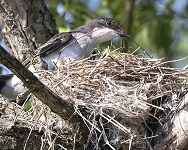 6/6 – Hudson River Watershed: Female eastern kingbirds are busy building nests and in about a week they will be laying clutches of three or four eggs. It is unusual for these birds to have a second brood. A small clutch and a single nesting period translate into low productivity for this species. 6/6 – Hudson River Watershed: Female eastern kingbirds are busy building nests and in about a week they will be laying clutches of three or four eggs. It is unusual for these birds to have a second brood. A small clutch and a single nesting period translate into low productivity for this species.
Ornithologists suggest that the eastern kingbird’s low reproductive rate is related to the fact that they rely heavily on flying insects for food, the supply of which can be limited if cool, wet weather occurs. In addition, eastern kingbirds care for their young for three to five weeks after the young fledge, longer than many species of birds. This also limits the time available for a second brood. (Photo of eastern kingbird courtesy Mary Holland)
- Mary Holland
6/6 – Ulster County, HRM 90: The tide was halfway out early this morning as I kayaked to the Ulster County shore near bald eagle nest NY394 (The Esopus Nest). When I arrived, the two nestlings were perched on a branch above or on the rim of the nest. (One of the two had already fledged.) An adult was also perched on a limb near the nest.
Later, paddling back home, an adult flew in front of me and dove into the water. After a significant struggle, the eagle began swimming, using its huge wings as paddles, toward the shore. I guessed the fish was about 24-inches-long and, considering the struggle to haul the fish ashore, and the overall commotion in the water, I figured it was a carp.
- Dale Becker
6/6 – Yonkers, HRM 18: Our staff at the Sarah Lawrence Center for the Urban River at Beczak went seining today from the Beczak Beach with the enthusiastic assistance of a sixth-grade class from Hostos School in Yonkers. Ten hauls of our 30-foot net collected three fish species including bay anchovy, mummichog, and spot. Among invertebrates were blue crabs, comb jellies, and moon jellyfish. The water temperature was 66 degrees Fahrenheit, the salinity was 11.3 parts-per-thousand (ppt), and the dissolved oxygen (DO) had fallen a bit to 7.7 parts-per-million (ppm)
- Katie Lamboy, Frankie Lloyd, Christina Edsall, Emily Orr
6/7 – Town of Wappinger, HRM 67: For a month now, we have had a raccoon (muddy tracks on our deck railing suggest just one) visiting our hummingbird feeders. It very deftly removes the covers and then drains the sugar-water. There is never any damage. In fact, some nights the raccoon puts the covers back on. Raccoons are compulsively fastidious. It is difficult to be angry; if this was a black bear, the feeders would have been in shambles after the first visit.
In an effort to dull its memory, we’ve taken the feeders in for a couple of days at a time, but as soon they go back, the raccoon is also back. Our routine had become one of feeding our ruby-throated hummingbirds by day, and our raccoon by night. An obvious solution, one used to thwart black bears, will be to bring in the hummingbird feeders each evening.
- Tom Lake
 6/8 – Orange County, HRM 61: Two days before reading about raccoons raiding hummingbird feeders in the Hudson River Almanac, we had the exact same experience with both of ours. The feeders are located, each on a separate post, near a four-foot-high cyclone fence surrounding our in-ground swimming pool. Strangely, one of the feeders had all its yellow plastic flowers removed and left nearby and both feeders were drained of their sugar-water. This had never happened before in the many years we have put up our hummingbird feeders. (Photo of raccoon courtesy of Mary Holland) 6/8 – Orange County, HRM 61: Two days before reading about raccoons raiding hummingbird feeders in the Hudson River Almanac, we had the exact same experience with both of ours. The feeders are located, each on a separate post, near a four-foot-high cyclone fence surrounding our in-ground swimming pool. Strangely, one of the feeders had all its yellow plastic flowers removed and left nearby and both feeders were drained of their sugar-water. This had never happened before in the many years we have put up our hummingbird feeders. (Photo of raccoon courtesy of Mary Holland)
- Kyle Conselyea.
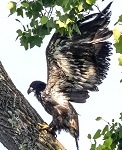 6/9 – Town of Poughkeepsie: The two ready-to-fledge nestlings at bald eagle nest NY62 were exercising their legs and wings by branching up and down the stout limbs of their nest-tree, a huge tulip tree. It always seems, when they are close to leaving the nest for the first time, that nestlings are gathering their courage to ultimately make that first step out into the world. (Photo of bald eagle courtesy of Bob Rightmyer) 6/9 – Town of Poughkeepsie: The two ready-to-fledge nestlings at bald eagle nest NY62 were exercising their legs and wings by branching up and down the stout limbs of their nest-tree, a huge tulip tree. It always seems, when they are close to leaving the nest for the first time, that nestlings are gathering their courage to ultimately make that first step out into the world. (Photo of bald eagle courtesy of Bob Rightmyer)
– Bob Rightmeyer
[As nestlings grow and “discover” their wings, they find that with vigorous flapping they can gain some rise. From that first lift-off comes the realization that they can explore, move from branch to branch, take mini-flights up and down, or “branching.” Over time this gives them the confidence that will help them when they take their first real flight. Watching eagle nestlings reminds us of children at play on the climbing apparatus of modern playgrounds. Tom Lake]
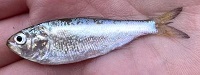 6/9 – Little Stony Point Preserve, HRM 55: We timed our arrival on the beach for low tide but discovered that the ebb current had already switched, and the flood was running up along the shore. Published tide tables offer calculated, estimated times, but factors like wind and weather can create significant variances. Out in deep water, the river was still flowing to the sea; standing knee deep just off the beach, we felt the current pushing north. The Mohican call it Muh-he-con-ne-ok, the river that flows both ways. 6/9 – Little Stony Point Preserve, HRM 55: We timed our arrival on the beach for low tide but discovered that the ebb current had already switched, and the flood was running up along the shore. Published tide tables offer calculated, estimated times, but factors like wind and weather can create significant variances. Out in deep water, the river was still flowing to the sea; standing knee deep just off the beach, we felt the current pushing north. The Mohican call it Muh-he-con-ne-ok, the river that flows both ways.
After a month of less-than-mediocre success, our seining proved to be quite spectacular. Across six hauls, we caught 1,000 fish, almost all young-of-year, including bluefish (58 mm), Atlantic menhaden (59), Atlantic silverside (32-35 mm), bay anchovy (51-70 mm), alewives (28-39 mm), and striped bass (75-90 mm). The first four were migrating in from the sea, the latter two were heading to the sea. The water was 69 degrees Fahrenheit and the salinity, for the first time this spring, was measurable at just over 2.0 ppt). (Photo of Atlantic menhaden courtesy of Tom Lake)
- Tom Lake, Seth Dinitz, Charlotte Dinitz, Ellie Dinitz, Fred Martin
6/9 – Yonkers, HRM 18: Our staff at the Sarah Lawrence Center for the Urban River at Beczak went seining today from the Beczak Beach with encouragement from participants in a Sarah Lawrence College Alumni Tour. Five hauls of our net resulted in a modest catch with bay anchovy high count (9). Other fishes included young-of-year striped bass and mummichog. Blue crabs and moon jellyfish were among the invertebrates. The water temperature was 67 degrees Fahrenheit, the salinity was 12.6 ppt, and the dissolved oxygen (DO) continued to fall at 6.9 ppm.
- Christina Edsall, Frankie Lloyd, Angel Seiffert

Spring 2023 Natural History Programs and Events
The Hudson Valley Firefly Project
Community science study headed by Juliana Chauca, a Science Research student at Ossining High School. This study aims to evaluate how fireflies in the area are impacted by human-related issues including artificial light and urbanization. In addition, this study will assess how participation in community science can promote a role in STEM (Science-Technology-Engineering-Mathematics) interest.
In this study, Citizen Scientists will complete a short demographic survey and STEM interest form. Next, they will choose 2-4 clear sky nights in June and July of their choosing (preferably days that are spread out) to go outside in their backyard or a nearby location at sunset and observe fireflies (common eastern firefly, Photinus pyralis). Then complete a form about their observations after each night as well as about the details of the location.
This is an exciting opportunity for children and adults alike who have an interest in the environment and a desire to learn about local ecology. If you would like to help with this scientific investigation, please go to the link below and join this worthy cause: https://forms.gle/4vKsU1xSGd77BebcA
Once you complete the forms, the surveys will be sent to you. Additionally, follow Twitter for updates: Twitter: @hvfireflies
- Juliana Chauca jchauca0604@students.ossiningufsd.org
Paddle the Hudson River Estuary
With our staff naturalists with free educational canoe trips. Join us to explore tidal marshes, observe birds and wildlife, and discover unique plants.
These trips are suitable for adults and children (6+), whether you’re an experienced or beginner paddler. The trips leave from three different launch sites in the lower, upper, and mid-Hudson Valley. All gear is provided, and registration is required.
Registration link:https://2023-nysdec-canoeprogram.eventbrite.com/
Volunteer for Hudson River Striped Bass Cooperative Angler Program
Do you fish for striped bass in the Hudson River? Whether you catch-and-release or take home a keeper, you can be part of the Cooperative Angler Program. Share your fishing trip information and help biologists understand and manage our striped bass fishery.
Here's how it works: Fill out a logbook we provide or record your trips on your smartphone using DEC's Hudson River online logbook (PDF) whenever you fish on the tidal Hudson River (by boat or on the shore). Record general location, time, gear used, what you caught (or if you didn't catch anything), and return the logbook when you are done fishing.
Join today! For more information on the angler program and instructions on installing the Survey123 App to access the online logbook, visit Hudson River Cooperative Angler or email hudsonangler@dec.ny.gov.
Note: If you primarily fish for striped bass in New York waters south of the George Washington Bridge, the DEC has a separate Striped Bass Cooperative Anglers Program.
Hudson River Miles
The Hudson is measured north from Hudson River Mile 0 at the Battery at the southern tip of Manhattan. The George Washington Bridge is at HRM 12, the Tappan Zee 28, Bear Mountain 47, Beacon-Newburgh 62, Mid-Hudson 75, Kingston-Rhinecliff 95, Rip Van Winkle 114, and the Federal Dam at Troy, the head of tidewater, at 153. The tidal section of the Hudson constitutes a bit less than half the total distance – 315 miles – from Lake Tear of the Clouds to the Battery. Entries from points east and west in the watershed reference the corresponding river mile on the mainstem.
To Contribute Your Observations or to Subscribe
The Hudson River Almanac is compiled and edited by Tom Lake and emailed weekly by DEC's Hudson River Estuary Program. Share your observations by e-mailing them to trlake7@aol.com. To subscribe to the Almanac (or to unsubscribe), use the links on DEC's Hudson River Almanac or DEC Delivers web pages.
Useful Links
National Oceanic and Atmospheric Administration online tide and tidal current predictions are invaluable when planning Hudson River field trips. For real-time information on Hudson River tides, weather, and water conditions from sixteen monitoring stations, visit the Hudson River Environmental Conditions Observing System website.
DEC's Smartphone app for iPhone and Android is now available at New York Fishing, Hunting & Wildlife App.
|