A Project of the Hudson River Estuary Program
Compiled and edited by Tom Lake, Consulting Naturalist
Overview
As the river warmed this week, typical summer fishes continued to show up in the lower estuary. At the same time, our spring glass eel run was slowing, even ending in places. This season’s progeny of blue crabs was commonly high count in seines. On the river, an unexpected coastal seabird arrived, rather out of context for the month.
Highlight of the Week
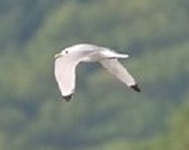 5/5 – Poughkeepsie, HRM 75: There was an adult black-legged kittiwake (Rissa tridactyla) reported on the Hudson River for several days this month. The bird was spotted today on the water and in the air at Poughkeepsie by Debbie van Zyl. This was an unprecedented sighting and only the sixth confirmed sighting for Dutchess County. The previous five were seen in the fall-winter and were immatures. 5/5 – Poughkeepsie, HRM 75: There was an adult black-legged kittiwake (Rissa tridactyla) reported on the Hudson River for several days this month. The bird was spotted today on the water and in the air at Poughkeepsie by Debbie van Zyl. This was an unprecedented sighting and only the sixth confirmed sighting for Dutchess County. The previous five were seen in the fall-winter and were immatures.
These coastal seabirds (Laridae) are simply not expected inland, and they certainly are not found in May. When they do show up, they do not stay more than a few hours. Kittiwakes were first reported this spring from northern New York on May 3. Four were seen from central Connecticut and five altogether through May 8. It is unclear if the Hudson River sightings were from either of these. Normally, kittiwakes are only found, October to March, off eastern Long Island over the ocean or a few along the Great Lakes, generally along the Niagara River. (Photo of black-legged kittiwake courtesy of Andrew Vallely)
- Stan DeOrsey, R.T. Waterman Bird Club
[Altogether, we had ten black-legged kittiwake sightings, from May 5 to 13, across a 35-mile reach on the river, from Rhinecliff to Cold Spring. The kittiwake has since moved on. Kyle Bardwell]
Natural History Entries
5/3 – Manhattan, HRM 1-2: Our Hudson River Park’s River Project staff and Harbor School interns checked our research gear (pots and traps) that we deploy off Piers 26 and 40 as part of our fish ecology survey. Our Pier 26 traps were empty of fish but did collect invertebrates such as mud dog whelk snails, grass shrimp, and mud crabs. Pier 40 was a different story as we caught six impressive fish, including a black sea bass (70 millimeters) and two skilletfish (4.0-5.0 mm) in our minnow pots, and three tautog (100-140 mm) in our crab pots.
- Sierra Drury, Sivan Gordon-Buxbaum, Siddhartha Hayes, Toland Kister, Zoe Kim, Rachel Swanson, and Harbor School interns Beatrix & Ella
[Note: One-inch equals 25.4 millimeters (mm). Tom Lake]
5/5 – Annandale-on-Hudson, HRM 98.5: I made another prospecting trip to the Saw Kill (Dutchess County) today again hoping to see migratory fishes. I expected the stream to be high from recent rains, but my expectations were exceeded by the brown torrent I encountered. Visibility was next to zero. My trip was saved, however, by one of the local bald eagles that had left two very disarticulated alewife carcasses on a stream-side stump. Alewives, fresh from the sea, had arrived in this tributary to spawn.
- Bob Schmidt
5/5 – Yonkers, HRM 18: Our staff at the Sarah Lawrence Center for the Urban River at Beczak tended to our glass eel fyke net that we had set overnight in the Beczak tidemarsh. We could sense in our catch (4 glass eels) that the season was nearing a conclusion. Afterward, our beach seining proved more successful with blue crabs (15–50 mm) as high count with ten. Among fishes we found two mummichogs (80 mm) and six juvenile striped bass (90–130 mm)
The water temperature was 56 degrees Fahrenheit (F), the salinity was a low 3.2 parts-per-thousand (ppt), and the dissolved oxygen (DO) was 9.6 parts-per-million (ppm).
- Jason Muller, Angel Seiffert, Frankie Lloyd, Diane McKay, Annie Bingham
[Crab measurements (size) are calculated in millimeters (mm) point-to-point across their carapace. Tom Lake]
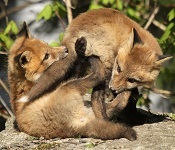 5/6 -- Hudson River Watershed: Red fox kits are roughly two months old now. In another month or so they will be weaned and fed solid food that they will have to learn how to capture. But for now, their parents are caring for all their needs, serving as a milk bar, groomer, and protector. Days are spent near the den, tumbling and mock-fighting with their siblings, chewing on practically anything from sticks to feathers (and each other), and napping in the sun while they wait for a parental food delivery. Life will never be this carefree again! (Photo of red fox courtesy of Mary Holland) 5/6 -- Hudson River Watershed: Red fox kits are roughly two months old now. In another month or so they will be weaned and fed solid food that they will have to learn how to capture. But for now, their parents are caring for all their needs, serving as a milk bar, groomer, and protector. Days are spent near the den, tumbling and mock-fighting with their siblings, chewing on practically anything from sticks to feathers (and each other), and napping in the sun while they wait for a parental food delivery. Life will never be this carefree again! (Photo of red fox courtesy of Mary Holland)
- Mary Holland
5/6 – Waterford, HRM 158: We were at the five-week mark of days since first hatch. I had yet to see more than one young one in the nest. Other observers say they have seen two and some even three. For now, however, I am reporting one and can make a correction if more are verified. Adults were spending some time out of the nest, usually perched on a limb nearby. The one nestling I’ve seen is looking healthy and growing quickly.
- Howard Stoner
[If April 7 remains as the best date for their hatching, we may see a fledge June 17-July 4 (72-90 days post hatch). Tom Lake]
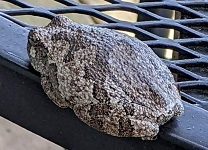 5/7 – Kingston, HRM 92: A gray tree frog (Hyla versicolor), perched itself on our patio table for a while this early afternoon. We often hear them calling in the area but rarely get to see one up close. (Photo of gray tree frog courtesy of Nancy Beard) 5/7 – Kingston, HRM 92: A gray tree frog (Hyla versicolor), perched itself on our patio table for a while this early afternoon. We often hear them calling in the area but rarely get to see one up close. (Photo of gray tree frog courtesy of Nancy Beard)
- Nancy Beard
[We have had an “army” (collective noun) of gray tree frogs in the trees overlooking our deck for a while now. The males’ chattering has been non-stop. It is the season. Often, they unexpectedly drop down on the deck to visit (this evening one landed in a tossed salad I was enjoying). Tom Lake]
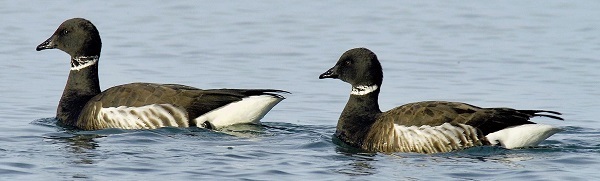
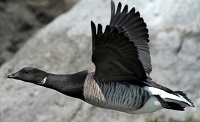 5/7 – Poughkeepsie, HRM 75: Typical of several days this week, highlighting the arrival of brant exiting their wintering waters, many hundreds of these small geese (Branta bernicla) were counted flying upriver today on their return from Mid-Atlantic coastal wintering areas. (Photo of brant courtesy of Teri Franzen) 5/7 – Poughkeepsie, HRM 75: Typical of several days this week, highlighting the arrival of brant exiting their wintering waters, many hundreds of these small geese (Branta bernicla) were counted flying upriver today on their return from Mid-Atlantic coastal wintering areas. (Photo of brant courtesy of Teri Franzen)
- Carena Pooth (R.T. Waterman Bird Club)
[Legendary waterman Dery Bennett used to mark the seasons by noting how brant (Branta bernicla), a small species of goose, left Sandy Hook, NJ, around Memorial Day after spending the winter, and headed north. In his words, “They would shove off for the Canadian Arctic where they breed, fledge young, and then return around Columbus Day.” This year, their move north seemed early. Tom Lake]
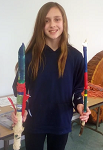 5/8 – Hudson River Watershed: Recently in the Hudson River Almanac we discussed the role of “Beaver Sticks” in Talking Circles, a social construct based on the tradition of an orderly sharing of points of view. Participants sit in a circle, which symbolizes completeness. Among First Nations, Talking Circles demand some reverence and are often seen as a sacred ceremony. 5/8 – Hudson River Watershed: Recently in the Hudson River Almanac we discussed the role of “Beaver Sticks” in Talking Circles, a social construct based on the tradition of an orderly sharing of points of view. Participants sit in a circle, which symbolizes completeness. Among First Nations, Talking Circles demand some reverence and are often seen as a sacred ceremony.
An object, often referred to as a Talking Stick, is chosen by the group to be used as a symbolic “microphone” for the speaker to ensure that only one voice is heard at a time and requiring others to listen. Talking Stick, as a generic term, can be an everyday object like a wild turkey feather, a stone, or a pencil. A decorated beaver stick [Moskw] is a not an uncommon choice among the Haudenosaunee (Iroquoian) and Mohican (Muhheaconneok). When a person within the Circle has the object, they have the floor, and everyone respects that by waiting for their turn to speak.
Mohican tribal member Jeff Vele offered that the Talking Circle may be less of a sacred ceremony and more of a common denominator for good manners and decorum. (Photo of Talking Stick (beaver) courtesy of Fran Martino)
- Tom Lake
[Our thanks to Amalya LaPlante, as well as Fran Martino for her exemplary research on this topic.]
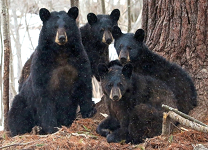 5/8 – Ulster County, HRM 82: I was driving east on Routes 44/55 near to the Mohonk Preserve headquarters when a black bear ran across the road in front of me. Wow! A bear! Then, off the road to the left, I saw a bumble of three more black bears as my car scared them into a quick stop. I stopped as well. One scampered part way up a tree as another grabbed her moment to run past my car. I jumped out and watched as the third and fourth crossed safely before I could even find my camera phone ready. I was forced to just watch. (Photo of black bears courtesy of Mary Holland) 5/8 – Ulster County, HRM 82: I was driving east on Routes 44/55 near to the Mohonk Preserve headquarters when a black bear ran across the road in front of me. Wow! A bear! Then, off the road to the left, I saw a bumble of three more black bears as my car scared them into a quick stop. I stopped as well. One scampered part way up a tree as another grabbed her moment to run past my car. I jumped out and watched as the third and fourth crossed safely before I could even find my camera phone ready. I was forced to just watch. (Photo of black bears courtesy of Mary Holland)
- Betty Boomer
5/8 – Poughkeepsie to New Hamburg, HRM 75-55: The adult black-legged kittiwake, or a different one, first seen three days ago, was spotted again today along a twenty-mile reach of the river from Poughkeepsie to northern Putnam County by Chris Chappell, Brian DelPizzo, Claudius Feger, and Kyle Bardwell.
- Stan DeOrsey, R.T. Waterman Bird Club]
[Two adult black-legged kittiwakes were later sighted along this same reach of the river on May 13. Presently, it is not clear how many kittiwakes there were on the river, but apparently at least two. Storms did not appear to be instrumental in how these kittiwakes got here. Stan DeOrsey, R.T. Waterman Bird Club]
5/8 – Beacon, HRM 61: I caught and released a 10½-inch brown bullhead and a 20½- inch channel catfish during a 4+ hour fishing session. There was also some bait-stealing going on by smaller fish, probably golden shiners.
- Bill Greene
5/8 – Yonkers, HRM 18: Our staff at the Sarah Lawrence Center for the Urban River at Beczak hosted a second-grade class from the Fieldston Lower School (Bronx). With the extra help, we were able to double our usual quota of hauls to ten. Eleven tiny, young-of-season blue crabs (20 mm) were high count. Among fishes, we caught six mummichogs (60-80 mm) and one juvenile (70 mm) striped bass. We caught one other aquatic animal that was unable to out-swim our seine: a soft-shell clam (Mya arenaria). The water temperature was 60 degrees Fahrenheit, the salinity was a low 2.5 ppt, and the dissolved oxygen (DO) was 9.3 ppm.
- Jason Muller, Christina Edsall, Katie Lamboy, Suzy Schwimmer, Frankie Lloyd, Angel Seiffert
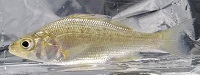 5/8 – Manhattan, HRM 1-2: Our Hudson River Park’s River Project staff and Harbor School interns checked our research gear (pots and traps) that we deploy off Piers 26 and 40 as part of our fish ecology survey. At Pier 26 we found a white perch (180 mm) in a crab pot, a species we do not see very often. 5/8 – Manhattan, HRM 1-2: Our Hudson River Park’s River Project staff and Harbor School interns checked our research gear (pots and traps) that we deploy off Piers 26 and 40 as part of our fish ecology survey. At Pier 26 we found a white perch (180 mm) in a crab pot, a species we do not see very often.
Pier 40, on the other hand, had a busy day. In one minnow pot we had collected four young-of-year black sea bass (55-80 mm). One of our crab pots caught an adult tautog (370 mm) and a skilletfish (60 mm). Three other crab pots caught two tautog (75-170 mm), an adult oyster toadfish (250 mm), and another skilletfish (40 mm). Ten fish, altogether, from Pier 40. Grass shrimp, mud crabs, amphipods, and mud dog whelk snails were also found. (Photo of white perch courtesy of Tom Lake)
- Sierra Drury, Sivan Gordon-Buxbaum, Siddhartha Hayes, Toland Kister, Zoe Kim, Rachel Swanson, and Harbor School interns Beatrix & Ella
[You will notice that throughout many entries in the Almanac, especially those reporting fish catches, that we supply the total length in millimeters (one-inch equals 25.4 millimeters). By doing so, readers can visualize the relative size of fishes, for example, from young-of-year, to juveniles, to adults, providing a more accurate mind’s-eye image. Tom Lake]
5/9 – Esopus Meadows Preserve, HRM 87: Hudson River Sloop Clearwater’s Tideline program works from many waterfront locations on the estuary. Today, first-graders from Highland Elementary School helped us set and work our seine. Four hauls resulted in an incredible diversity of fish species (8), including American eel (120 mm), pumpkinseed sunfish (180 mm), spottail shiner, white perch, tessellated darter, banded killifish, and two juvenile striped bass (60 mm).
- Eli Schloss
5/9 – Yonkers, HRM 18: Our staff at the Sarah Lawrence Center for the Urban River at Beczak tended to our glass eel fyke net that we had set overnight in the Beczak tidemarsh. The glass eel run was weak, but by continuing to be consistently weak, was still worth the effort and typical for the waning migration run. Today’s catch was six glass eels, a 129 mm elver (class of 2022), two small blue crabs (15 mm), and some grass shrimp.
Later we made five hauls off the beach, but we had already seen the best of the day. Our seine caught five blue crabs (20-35 mm) and a lone mummichog (60 mm). The water temperature was 59 degrees Fahrenheit, the salinity was a very low 1.8 ppt, and the dissolved oxygen (DO) was 9.1 ppm.
- Jason Muller, Angel Seiffert, Frankie Lloyd
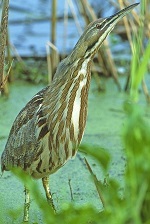 5/10 – Saratoga County, HRM 157: I heard an American bittern at the Vischer Ferry Preserve along the towpath this morning calling with a short two-note vocalization. I didn't spot any new warblers, but I had a first-of-season green heron, yellow-throated vireo, and veery. Others that had been present at least once before included Virginia rail, pied-billed grebe, wood duck, least flycatcher, great crested flycatcher, warbling vireo, blue-gray gnatcatcher, wood thrush, eastern bluebird, marsh wren, yellow warbler, common yellowthroat, American redstart, rose-breasted grosbeak, and Baltimore oriole. (Photo of American bittern courtesy of Michael Leveillle) 5/10 – Saratoga County, HRM 157: I heard an American bittern at the Vischer Ferry Preserve along the towpath this morning calling with a short two-note vocalization. I didn't spot any new warblers, but I had a first-of-season green heron, yellow-throated vireo, and veery. Others that had been present at least once before included Virginia rail, pied-billed grebe, wood duck, least flycatcher, great crested flycatcher, warbling vireo, blue-gray gnatcatcher, wood thrush, eastern bluebird, marsh wren, yellow warbler, common yellowthroat, American redstart, rose-breasted grosbeak, and Baltimore oriole. (Photo of American bittern courtesy of Michael Leveillle)
- John Hershey (Hudson-Mohawk Bird Club)
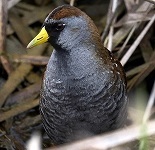 5/10 – Saratoga County, HRM 157: I was also at the Vischer Ferry Preserve this morning and, although I heard no bittern, I did hear a sora [rail] at the Preserve Pond as well as a singling first-year male orchard oriole. Near Lock 19, there was a black-billed cuckoo, a least flycatcher, and a black-throated blue warbler. At Ferry Drive, there were a couple of spotted sandpipers and a lesser yellowlegs. (Photo of Sora courtesy of Deborah Tracy Kral) 5/10 – Saratoga County, HRM 157: I was also at the Vischer Ferry Preserve this morning and, although I heard no bittern, I did hear a sora [rail] at the Preserve Pond as well as a singling first-year male orchard oriole. Near Lock 19, there was a black-billed cuckoo, a least flycatcher, and a black-throated blue warbler. At Ferry Drive, there were a couple of spotted sandpipers and a lesser yellowlegs. (Photo of Sora courtesy of Deborah Tracy Kral)
- David Halm (Hudson-Mohawk Bird Club)
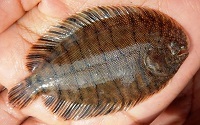 5/10 – Esopus Meadows Preserve, HRM 87: This was Day 2 with first-graders from Highland Elementary School. As the chaperones were hauling in our seine, one of the students noticed a dead white catfish on the beach. On closer inspection, we noticed a palm-sized hogchoker stuck in its mouth. The catfish had committed the unpardonable, and often fatal, sin, of swallowing the hogchoker tail first! Four more hauls of our net produced ten banded killifish and three bluegill sunfish. (Photo of hogchoker courtesy of Chris Bowser) 5/10 – Esopus Meadows Preserve, HRM 87: This was Day 2 with first-graders from Highland Elementary School. As the chaperones were hauling in our seine, one of the students noticed a dead white catfish on the beach. On closer inspection, we noticed a palm-sized hogchoker stuck in its mouth. The catfish had committed the unpardonable, and often fatal, sin, of swallowing the hogchoker tail first! Four more hauls of our net produced ten banded killifish and three bluegill sunfish. (Photo of hogchoker courtesy of Chris Bowser)
- Eli Schloss
[Hogchokers are flatfish, delightful little soles (Soleidae), found in marine, brackish and freshwater coastal waters from Cape Cod to Venezuela. They range in size from a penny to the palm of your hand. There is a fanciful story, with elements of truth, of how Trinectes maculatus got its name. There was a time when the Northeast had a more agrarian economy. Farmers supplemented their livestock feed by visiting tidewater areas to catch or otherwise acquire these little flatfish by the wagon-full.
However, the readily available little flatfish came with a warning: When you stroke them from head-to-tail, they are incredibly smooth. But, if you run your finger tail-to-head, it will feel like the fine teeth on a hack-saw as their tiny scales, at a micro level, rise and resist. In the wild, wise predators have instinctively learned to swallow them headfirst to avoid “choking.” This white catfish failed to heed that warning. For domestic livestock, swallowing them the wrong way could result in their pigs choking. Thus, the colloquial or common name of hogchoker. Tom Lake]
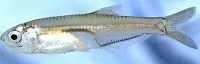 5/10 – Hudson River Watershed: Fish-of-the-Week for Week 219 is the bay anchovy (Anchoa mitchilli), number 34 (of 237), on our Hudson River Watershed List of Fishes. If you would like a copy of our list, e-mail: trlake7@aol.com 5/10 – Hudson River Watershed: Fish-of-the-Week for Week 219 is the bay anchovy (Anchoa mitchilli), number 34 (of 237), on our Hudson River Watershed List of Fishes. If you would like a copy of our list, e-mail: trlake7@aol.com
The bay anchovy is one of two Anchovies (Engraulidae) known from the watershed. The other is the striped anchovy (Anchoa hepsetus). Bay anchovies are greenish above, silvery below, small (100 millimeters or less), herring-like, large eyes, delicate, sleek, transparent as larvae, translucent as adults, with a bright silver lateral stripe. They have a projecting snout with a maxillary (lower jaw) that extends back nearly to their opercle (gill cover). That large hinge gives them a huge mouth when fully opened.
They spawn in salt or brackish water in bays and estuaries from Maine to the Gulf of Mexico. Their ability to adapt to changing conditions makes them one of the prime examples of an estuarine species. In some years, young-of-year bay anchovies are the dominant fish in the Hudson River estuary venturing into freshwater as far upriver as Kingston (river mile 92). Their most notable field mark is their huge mouth. When open to filter-feed on zooplankton and detritus, it looks like they have become “unhinged.” jaw. Along with other small, bright, shiny, and sleek fishes, such as the herrings, they are essentially snacks for predators such as bluefish and striped bass.
J.R. Greeley, in his A Biological Survey of the Lower Hudson Watershed (1937), found them “common” in the lower Hudson River and remarked that their schools “make their way up the river in summer for a considerable distance.” (Photo of bay anchovy courtesy of NJ DEP)
- Tom Lake
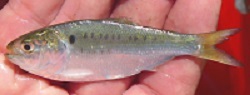 5/10 – Yonkers, HRM 18: Our staff at the Sarah Lawrence Center for the Urban River at Beczak, with help from a third-grade class from Dalton School in Manhattan, set and hauled our 30-foot seine off Beczak Beach. We had a modest catch across nine hauls with high count being blue crab (3). A pair of Atlantic menhaden yearlings (class of 2022) created a stir with the students. Other fish included, one each, striped bass, American eel, and Atlantic silverside. The water temperature was 58 degrees Fahrenheit, the salinity was a low 2.7 ppt, and the dissolved oxygen (DO) was 9.6 ppm. (Photo of Atlantic menhaden courtesy of Peter Park) 5/10 – Yonkers, HRM 18: Our staff at the Sarah Lawrence Center for the Urban River at Beczak, with help from a third-grade class from Dalton School in Manhattan, set and hauled our 30-foot seine off Beczak Beach. We had a modest catch across nine hauls with high count being blue crab (3). A pair of Atlantic menhaden yearlings (class of 2022) created a stir with the students. Other fish included, one each, striped bass, American eel, and Atlantic silverside. The water temperature was 58 degrees Fahrenheit, the salinity was a low 2.7 ppt, and the dissolved oxygen (DO) was 9.6 ppm. (Photo of Atlantic menhaden courtesy of Peter Park)
- Katie Lamboy, Christina Edsall, Angel Seiffert, Frankie Lloyd
[Prior to 2010, when we were allowed to work our commercial gill nets in spring for American shad, the first Atlantic menhaden of the year, coupled with the lilacs blooming, were signs that the shad season was over. Both bio-indicators occurred weeks earlier this year. Tom Lake]
5/10 – Manhattan, HRM 1-2: Our Hudson River Park’s River Project staff and Harbor School interns checked our research gear (pots and traps) that we deploy off Piers 26 and 40 as part of our fish ecology survey. At Pier 26, our minnow pot had collected one skilletfish (55 mm), grass shrimp, and mud crabs. A similar minnow pot at Pier 40 caught a juvenile black sea bass (90 mm). Our Pier 40 crab pots (much larger than minnow pots) had two huge adult oyster toadfish (250-260 mm).
- Sierra Drury, Sivan Gordon-Buxbaum, Siddhartha Hayes, Toland Kister, Zoe Kim, Rachel Swanson, and Harbor School interns Beatrix & Ella
 5/11 – Minerva, HRM 284: I was out tonight with Freya walking the Minerva highway (Route 28N) and it was a good night for wildlife sounds. An American woodcock had been “peenting” near the road for a few nights, peenting (the sound of a breeding call) on the ground, then rising and wing-twittering up into the sky. Tonight, he was quiet. I did hear plenty of spring peepers and various toads. Then there was a barred owl and the sounds of our resident common loon on Minerva Lake. It was an altogether beautiful starry night. There was an Aurora borealis to the north, but too many trees were in the way and kept us from seeing it. (Photo of Aurora borealis courtesy of Dylan Siwicki) 5/11 – Minerva, HRM 284: I was out tonight with Freya walking the Minerva highway (Route 28N) and it was a good night for wildlife sounds. An American woodcock had been “peenting” near the road for a few nights, peenting (the sound of a breeding call) on the ground, then rising and wing-twittering up into the sky. Tonight, he was quiet. I did hear plenty of spring peepers and various toads. Then there was a barred owl and the sounds of our resident common loon on Minerva Lake. It was an altogether beautiful starry night. There was an Aurora borealis to the north, but too many trees were in the way and kept us from seeing it. (Photo of Aurora borealis courtesy of Dylan Siwicki)
- Mike Corey
[Aurora borealis, also called the Northern Lights, is a natural light display in Earth's sky, predominantly seen in high-latitude regions. Auroras display dynamic patterns of brilliant lights that appear as curtains, rays, spirals, or dynamic flickers covering the entire sky. Auroras are the result of disturbances in the magnetosphere caused by the caused by the solar wind.
The word "Aurora" is derived from the name of the Roman goddess of the dawn, Aurora, who traveled from east to west announcing the coming of the sun. "Borealis" is derived from the name of the ancient god of the north wind (Boreas) in Greek mythology. Tom Lake]
5/11 – Annandale-on-Hudson, HRM 98.5: I traveled to the Saw Kill for my weekly visit to document fish migration. On the way, a coyote pup crossed the road in front of me on a back road near Hollowville (Columbia County). Once on the Saw Kill, I began at the tidal mouth where the creek meets the Hudson River. I spotted two common carp (4-7 lb.) swimming in the current. Some carp move upstream into tributaries and subsequently spawn, but not in the Saw Kill to my knowledge. Also, this upstream spawning is trivial compared to the mass spawning we find occurring in the dense beds of Trapa natans (Eurasian water chestnut) along the main river.
A dead white sucker, still in reddish spawning colors, was the last remnant of their spring run. I could see no marks on the body; it may have died from overexertion. I saw no river herring in the stream, but smallmouth bass were present in abundance. I spied a waterthrush but could not see it well enough to tell which species, as well as a spotted sandpiper working the stream margin.
- Bob Schmidt
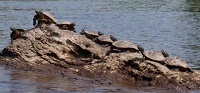 5/11 – Ulster County, HRM 92: While fishing from my kayak on Rondout Creek upstream from the Eddyville Dam, I came upon an unbelievably large congregation of northern map turtles (Graptemys geographica), basking on every bit of rock real estate in this shallow portion of the river. The strong sun and cold water had the turtles stacking up on every available rock. If there was no available rock surface, the emerging turtles climbed atop other turtles. I was ecstatic to be surrounded by such a huge gathering of map turtles (easily over 50 individuals) indicative of a healthy population and environment. Surprisingly there was not a single painted turtle mixed in among the map turtle groupings. (Photo of northern map turtles courtesy of Bob Ottens) 5/11 – Ulster County, HRM 92: While fishing from my kayak on Rondout Creek upstream from the Eddyville Dam, I came upon an unbelievably large congregation of northern map turtles (Graptemys geographica), basking on every bit of rock real estate in this shallow portion of the river. The strong sun and cold water had the turtles stacking up on every available rock. If there was no available rock surface, the emerging turtles climbed atop other turtles. I was ecstatic to be surrounded by such a huge gathering of map turtles (easily over 50 individuals) indicative of a healthy population and environment. Surprisingly there was not a single painted turtle mixed in among the map turtle groupings. (Photo of northern map turtles courtesy of Bob Ottens)
- Bob Ottens
5/11 – Little Stony Point Preserve, HRM 55: Recent heavy rains coupled with a strong northwest wind had littered the beach with countless spiky Eurasian water chestnut seeds. Low tide had stranded branches, boards, sticks, and deadfalls, some of which were the size of an automobile. All these impediments resulted in our seine getting fouled up during every haul. Patience.
The river was a delightful 59 degrees F with no discernable salinity. With much grumbling, we made a half-dozen hauls and each one netted countless fishes, all of which were young-of-year bay anchovies (29-30 mm). Any difference we saw in size was no doubt an illusion; it seemed like all one thousand anchovies were exactly the same size, a perfect definition of a cohort.
- Tom Lake, Phyllis Lake, Ellie Dinitz, Seth Dinitz
[Over many years of seining in tidewater with family, friends, and colleagues I have found that hauling a net is like reading a good book: Every day, every tide, every haul, you turn a page and discover something new. Tom Lake]
5/11 – Yonkers, HRM 18: Our staff at the Sarah Lawrence Center for the Urban River at Beczak tended to our glass eel fyke net that we had set overnight in the Beczak tidemarsh. We were finding it difficult to justify working the fyke net; today’s haul included a single glass eel. Also in the net was a collection of crustaceans including amphipods, grass shrimp, mud crab, blue crab, and an Atlantic marsh fiddler crab (Minuca pugnax).
Later, a dozen, tiny, young-of-the-season, blue crabs (10–30 mm) were high count in seven seine hauls. Among fishes caught were bluegill sunfish (35 mm), mummichog (60 mm), and one juvenile striped bass (100 mm). The water temperature was 62 degrees F, the salinity was very low at 1.7 ppt, and the dissolved oxygen (DO) was 9.4 ppm.
- Jason Muller, Angel Seiffert, Frankie Lloyd, Ella Rastegar, Yashraj Srivastava, Vitaliy Lasiychuk, Wilson Barlow, Brianne Barredo
5/12 – Esopus Meadows Preserve, HRM 87: The Hudson River Sloop Clearwater’s Tideline program educators hosted Woodstock Elementary School third-graders today. Three hauls of our 25-foot seine netted us seven fish species: six juvenile striped bass (60 mm), largemouth bass (200 mm), pumpkinseed sunfish (100 mm), 23 banded killifish, three spottail shiners, an American eel (110 mm), and an 18-inch (450 mm) common carp—the biggest fish of the season so far. The river was warming and provided a refreshing dip with the air temperature at 85 degrees F.
- Eli Schloss
5/12 – Piermont Pier, HRM 25.4: Despite the lack of precipitation and increasing water air temperature (78 degrees F), the Hudson River at Piermont continued to run fully fresh (0.0 ppt). While seining off the north side of the Piermont Pier with a group of home-schooled students, we pulled in five juvenile striped bass (115 mm) and 12 blue crabs (five females, eight males), one of which was soft-shell. These hauls brought in a different complement of fish compared to the eleven young-of-year bay anchovies we caught a week ago.
- Marisa Annunziato (Lamont-Doherty Earth Observatory)
5/12 – Yonkers, HRM 18: Our staff at the Sarah Lawrence Center for the Urban River at Beczak tended to our glass eel fyke net that we had set overnight in the Beczak tidemarsh. This was our 13th and final week of fyke-netting for glass eels migrating in from the sea. We had a zero catch today, very fitting for the last day of our last week of sampling. But the fyke net was not totally empty as we found three grass shrimp and three tiny young-of-the-season blue crabs (15 mm).
Later, we made five hauls of our 30-foot seine with impressive results that featured a high count of 61 blue crabs 15-60 mm). We also had a taste of summer with 14 Atlantic silverside (40–50 mm). Bay anchovies, mummichogs, and striped bass (two each) filled out our catch. Then there was, also, the oft-caught soft-shell clam. The water temperature was 62 degrees F, the salinity was low at 3.3 ppt, and the dissolved oxygen (DO) was 8.1 ppm.
Staff: Jason Muller, Angel Seiffert, Frankie Lloyd, Diane McKay
Spring 2023 Natural History Programs and Events
NYS Get Outdoors Day: Saturday, June 10
DEC and State Parks, in partnership with the Office for People with Developmental Disabilities (OPWDD) and the NYS Division of Veterans' Services, will host free events to connect people to nature and provide increased access to the outdoors. Get Outdoors & Get Together Day brings together people of all abilities, ages, identities and backgrounds together for fun, healthful activities as part of the Governor's initiative to broaden the diversity of users and ensure inclusivity of access to state public lands. For a list of sites near you: https://www.dec.ny.gov/outdoor/113380.html
World Fish Migration Lower Hudson & Harbor Fish Count: Saturday June 10
World Fish Migration Day (WFMD) is a global celebration to create awareness about the importance of migratory fish and free-flowing rivers. On World Fish Migration Day, organizations from around the world coordinate their own event around the common theme of: CONNECTING FISH, RIVERS AND PEOPLE. Environmental organizations of the Lower Hudson and Harbor have come together to put on our own family-friendly, free fishing events for the public to engage in the wonders of the Hudson River! Event times vary by site (Piermont to Staten Island) so please check the details here: https://lamont.columbia.edu/ldeo-hudson-river-field-station/world-fish-migration-lower-hudson-fish-count
Volunteer for Hudson River Striped Bass Cooperative Angler Program
Do you fish for striped bass in the Hudson River? Whether you catch-and-release or take home a keeper, you can be part of the Cooperative Angler Program. Share your fishing trip information and help biologists understand and manage our striped bass fishery.
Here's how it works: Fill out a logbook we provide or record your trips on your smartphone using DEC's Hudson River online logbook (PDF) whenever you fish on the tidal Hudson River (by boat or on the shore). Record general location, time, gear used, what you caught (or if you didn't catch anything), and return the logbook when you are done fishing.
Join today! For more information on the angler program and instructions on installing the Survey123 App to access the online logbook, visit Hudson River Cooperative Angler or email hudsonangler@dec.ny.gov.
Note: If you primarily fish for striped bass in New York waters south of the George Washington Bridge, the DEC has a separate Striped Bass Cooperative Anglers Program.
Hudson River Miles
The Hudson is measured north from Hudson River Mile 0 at the Battery at the southern tip of Manhattan. The George Washington Bridge is at HRM 12, the Tappan Zee 28, Bear Mountain 47, Beacon-Newburgh 62, Mid-Hudson 75, Kingston-Rhinecliff 95, Rip Van Winkle 114, and the Federal Dam at Troy, the head of tidewater, at 153. The tidal section of the Hudson constitutes a bit less than half the total distance – 315 miles – from Lake Tear of the Clouds to the Battery. Entries from points east and west in the watershed reference the corresponding river mile on the mainstem.
To Contribute Your Observations or to Subscribe
The Hudson River Almanac is compiled and edited by Tom Lake and emailed weekly by DEC's Hudson River Estuary Program. Share your observations by e-mailing them to trlake7@aol.com. To subscribe to the Almanac (or to unsubscribe), use the links on DEC's Hudson River Almanac or DEC Delivers web pages.
Useful Links
National Oceanic and Atmospheric Administration online tide and tidal current predictions are invaluable when planning Hudson River field trips. For real-time information on Hudson River tides, weather, and water conditions from sixteen monitoring stations, visit the Hudson River Environmental Conditions Observing System website.
DEC's Smartphone app for iPhone and Android is now available at New York Fishing, Hunting & Wildlife App.
|