|
|
 Monmouth County Environmental Newsletter: February 2017
|
|
|
|
|
Monmouth County Master Plan
now online
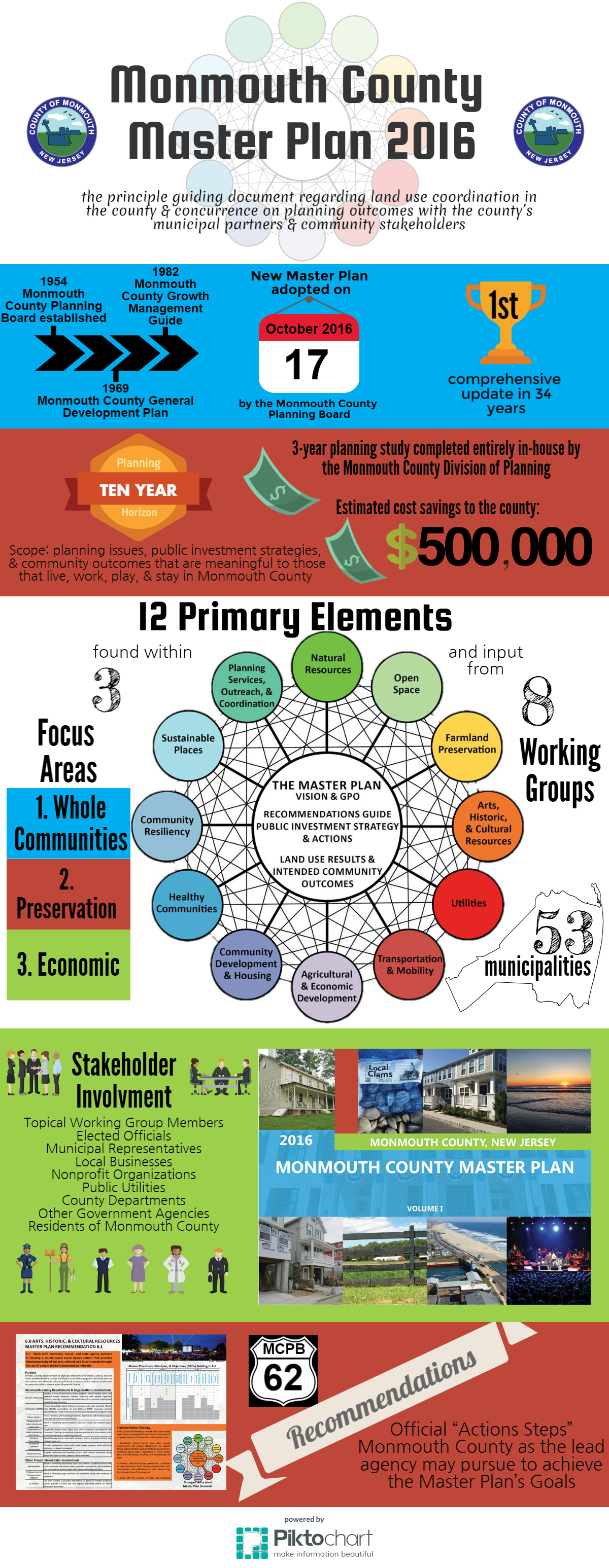
Adopted on October 17, 2016, the new Monmouth County Master Plan 2016 is available online. The countywide Master Plan contains 13 elements including natural resources, open space and farmland, economic development, community resiliency and sustainability. Within each element detailed information includes existing conditions, emerging issues and more.
The Division of Planning and Planning Board thanks those who dedicated their valuable time, knowledge, creativity, and passion to this project. Print copies will be available for public viewing at Monmouth County libraries and the Monmouth County Division of Planning Office, 1 East Main Street, Freehold, NJ.
The Monmouth County Master Plan Infographic provides quick information on the Plan's process, while the Master Plan Overview details this process and the organization of the Plan.
|
|
|
|
Mid-Atlantic Ocean Plan Approved
On December 7, 2016, the National Ocean Council accepted the Mid-Atlantic Regional Planning Body's (MidA RPB) Mid-Atlantic Regional Ocean Action Plan. The MidA RPB will now begin implementation of the plan. The plan is a result of collaboration with the general public, various Federal, State, and local governments and other stakeholders, which together formed the Mid-Atlantic Regional Council on the Ocean (MARCO). The plan improves coordination and information between stakeholders and government entities which each have different duties and jurisdictions concerning the ocean from Virginia to New York.
Monmouth University was a lead team member in designing the MARCO Ocean Data Portal, an online mapping tool to organize data between stakeholders and share information with the public. This mapping tool is useful for coastal stakeholders, such as municipal environmental councils and planners, conveying data relating to fishing, marine life-including species specific ranges, maritime industries, recreation, potential wind energy areas, security, human sseage, and oceanography. This portal helps the MidA RPB reach many of the Plan's objectives, including the identification of Ecologically Sensitive Areas (ESAs).
Visit the webpages below to see the full plan or to visit the MARCO Data Portal.
|
|
ANJEC Grants for Open Space Stewardship Projects
ANJEC is accepting applications from environmental commissions for grants of up to $1500 each for local open space stewardship projects. Examples include proposed projects involving the preservation and upkeep of open space, educational projects on open space lands, creation of printed or online guides to increase accessibility and knowledge of open space. Visit the webpage for a full list of examples, as well as application information.
|
|
Sustainable Jersey Small Grants Program Applications due Feb. 28
Thanks to donations from the PSEG Foundation, Sustainable Jersey will be awarding $200,000 in small grants for municipalities. Grants of $20,000 or $10,000 are available to fund projects which will score Sustainable Jersey program action points, Grants of $2000 will be awarded to cover Green Team Expenses and does not have to be project specific. Recipients will be announced April 11, 2017.
|
|
|
|
Last Fall, the US Environmental Protection Agency (EPA) launched the Adaptation Resource Center (ARC-X) which provides users with local-level information to aid communities increase their climate resiliency. The federal government has spent over $357 billion in direct costs due to extreme weather and fire over the last 10 years. The threat of more frequent extreme weather as a result of climate change pose significant financial and infrastructural challenges to communities.
The ARC-X system is self-guiding, helping users through steps of a community adaptation while providing information on climate change implications of their region, as well as adaptation strategies to mitigate risks. It provides case studies of other communities working through similar threats and tips on how to replicate efforts for your own locality.
To access ARC-X, visit: www.epa.gov/ARC-X
|
|
|
|
About This Newsletter
The purpose of the newsletter is to inform Monmouth County citizens on the health of their environment and list environmental outreach events in their community. The newsletter is produced by the Monmouth County Division of Planning Section of Environmental & Sustainability Planning in coordination with the Monmouth County Environmental Council. The County of Monmouth and the Board of Chosen Freeholders do not necessarily share the viewpoints of any environmental group mentioned in this newsletter.
If you have questions, comments, or wish to have an event listed in the newsletter contact Kyle Clonan at Kyle.Clonan@co.monmouth.nj.us
|
|