JUNE 2024 - NEWSLETTER
Click here to access our summer brochure!
Trenton Youth Have a “Super” Plan for the Future of Environmental Protection
By Sean LaVergne
Mercer County – Issues within our environment can sometimes feel like the work of a super villain. Some dastardly ne'er-do-well bent on the destruction of our forests and waterways or poisoning our air. So, who better to combat these villains than the superheroes in the Youth Art League! Through a generous collaboration with the Mercer County Park Commission, Friends for the Abbott Marshlands, Artworks Trenton, and Alliance for Watershed Education, children in the Youth Art League gained new skills and experiences that influenced their art and relationship with the outdoors.
Over the course of six weeks, the young participants from the Capitol Area YMCA and Foundation Academy explored parks throughout Mercer County to learn about environmental issues that impact our daily lives. Through the use of observation, experimentation, and imagination, participants in the program have learned the importance of native biodiversity, air and water quality, green spaces and outdoor equity, and of course, climate change.
|
With these lessons in mind, the young artists next set out to design comic book heroes and villains with help from Rashad Malik, an award-winning illustrator and Trenton native. The young artists were split into teams of heroes and villains whose superpowers reflect their ability to help or hurt the environment. From a hero with the power to manipulate gasses to remove pollution, to a villain who controls litter with their mind, the children were enthusiastic to create characters that most impacted them.
The Youth Art League’s artistic creations will be on display at the Tulpehaking Nature Center this summer. Join us in celebrating their work in creating the next generation of comic book heroes and villains in the fight for environmental protection!
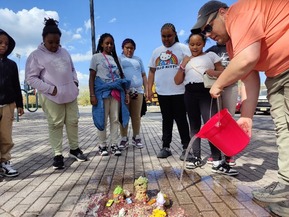
Photo 1: Students in Youth Art League explore the effects of pollution and stormwater runoff on a miniature neighborhood that they created.
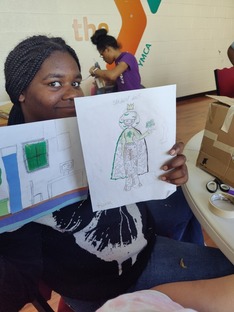
Photo 2: One Youth Art League student proudly shows her villain whose evil power encourages growth of invasive species of plants.
|
Partner Spotlight: Wild Bird Research Group’s Work with Northern Saw-whet Owls
By Ian Gray
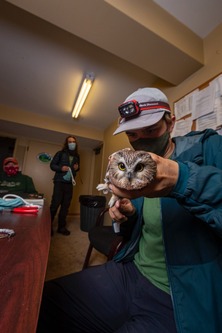
Since 2015, the Mercer County Park Commission has been partnering with Wild Bird Research Group, a local 501(c)(3) non-profit, on several projects related to bird migration, habitat utilization, and population dynamics. Throughout nearly 10 years of working together, one consistent project that has never skipped a beat is the annual fall migration survey of Northern Saw-whet Owls (Aegolius acadicus) at Mercer Meadows. The banding station based at the Hunt House and an additional site at The Watershed Institute are part of a larger project called “Project Owlnet” which is focused on capturing, measuring, and banding Saw-whets while on their annual southbound migration. Saw-whets are only in our area in large numbers during their fall and spring migrations, with a handful of birds staying put and wintering here. Migratory owl species like these typically have cyclical populations that rise and fall, sometimes dramatically, from year to year based on the size of their prey populations. Tracking the number of owls migrating through the area helps to understand these long-term population dynamics. In addition, the Saw-whet Owl study at Mercer Meadows has allowed the MCPC Stewardship department to gain a better idea of the habitat needs of Saw-whet Owls, as well as the timing and duration of their presence in the area. This information guides our stewardship to minimize impact on migratory owls while maximizing useable habitat for them. Towards this end, we have been working to restore the native understory cover and quality shrub habitat.
|
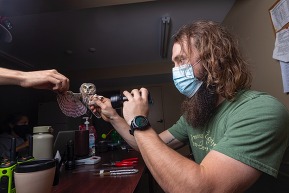
Marking birds for identification is a technique that has been used for thousands of years, starting with message-carrying birds around 200 B.C. with the practice continued by falconers in Europe in the early 1100s A.D. In the early 1900s in the United States, a select few researchers implemented the earliest version of modern bird banding using small leg bands that had individual identification numbers for birds. Since then, the practice has been standardized and used across the globe to study bird populations and provide insight on migratory movements and survival. Over a hundred years after the inception of modern bird banding, it is still the backbone of avian research across the globe. Owls that WBRG has banded here at the Hunt House have been caught in many other states, often a year or more after they were originally banded here. Additionally, the Mercer Meadows banding station has recaptured birds originally banded by stations in Pennsylvania, New York, and even Canada. This data, centrally shared through the federal Bird Banding Lab, is incredibly useful in learning more about the varied migration strategies of Saw-whet Owls, which are notorious for migrating to different locations every winter. In fact, the Hunt House station has never recaptured a Saw-whet Owl that it has banded in a previous year, even though we capture owls banded elsewhere – a consequence of the nomadic nature of their long-distance movements.
Aside from advancing research on some of the coolest birds in the sky, the best part of partnering with WBRG on research for the last 10 years has been the opportunity to give the public access to see this work happening first-hand. There are programs for the public at both the Northern Saw-whet Owl banding station at the Hunt House as well as our summer songbird banding station at Fiddler’s Creek Preserve (which is topic for another article!) These programs help to directly support Wild Bird Research Group’s efforts in Mercer County. This year’s summer program dates are open for sign-up now on CommunityPass; feel free to follow this link and sign up for a session with us: (register.communitypass.net/mercer) To keep up to date on the work happening with MCPC and WBRG be sure to follow along on Instagram and sign up for email newsletters.
Follow MCPC Instagram pages @mcpc_stewardship @mcpc_tulpehaking @mercercoparks
Find WBRG on Instagram @wildbirdresearch and online at wildbirdresearch.org
Photo 1: WBRG field technician Cody Panek measuring the length of a Northern Saw-whet Owl tail during the banding process.
Photo 2: WBRG field technician Ian Gray using UV light to determine the age of a Northern Saw-whet Owl based on distinct molt patterns in the flight feathers.
|
 Come Out and Visit Us!
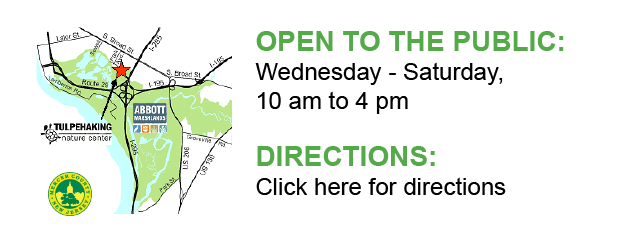
Tulpehaking Nature Center is the headquarters of the Mercer County Park Commission’s Department of Environmental Education. Our programs take an explorative approach to learning about the natural world as we showcase the incredible natural history of Mercer County. Visit the nature center to enjoy walking trails, hands-on activities, a children’s play area, and live turtles and snakes on display.
|