|
Subscribe to EJ Law Notices by County: Did you know that you can receive notices to upcoming EJ Law application hearings in your area? Subscribe online and select the counties in which you'd like to stay up-to-date for hearings near you.
Environmental Justice Newsletter
April 10th, 2025
Summary of Important Dates
Upcoming EJ Law Hearings
|
| |
There are no upcoming public hearings at this time.
|
Apply Now to Become a Member of the Environmental Justice Advisory Council!
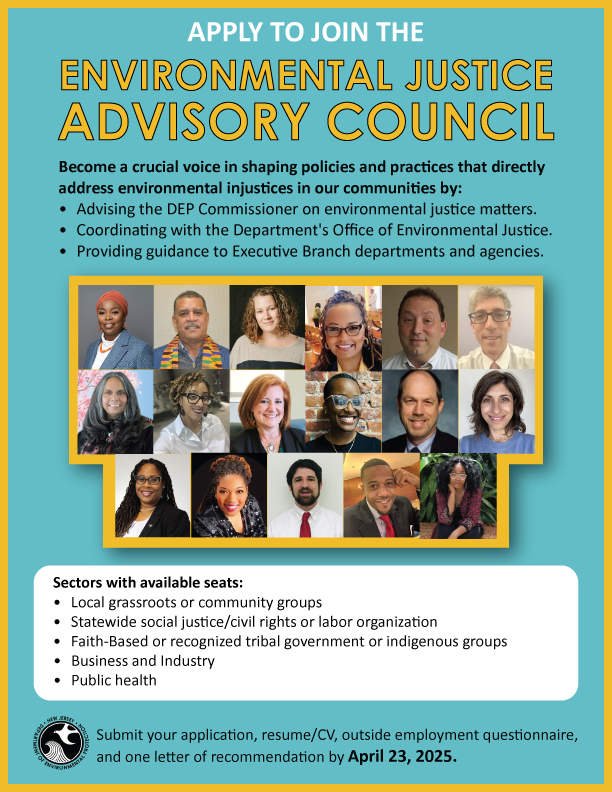
Join the Environmental Justice Advisory Council (EJAC) and make a difference in New Jersey's environmental justice initiatives!
NJDEP is seeking applications to fill seven (7) vacancies for 3-year terms through 2028
EJAC advises the DEP Commissioner on environmental justice matters, coordinates with the Department's Office of Environmental Justice, and provides guidance to Executive Branch departments and agencies. Members represent diverse sectors and have contributed to crucial initiatives like the Environmental Justice Law, the Environmental Justice Seminar series and the What’s in My Community Tool.
Selected candidates will represent the following stakeholder sectors:
- Business and Industry (1 vacancy)
- Local Grassroots or Community Groups (2 vacancies)
- Faith-Based Organizations or State or Federally Recognized Tribal Government or Indigenous Groups (1 vacancy)
- Statewide Social Justice/Civil Rights or Labor Organization (1 vacancy)
- Public Health (2 vacancies)
To apply, you must have a current connection to the sector you're interested in.
Submit your application, resume/CV, outside employment questionnaire, and one letter of recommendation by April 23, 2025. Learn more online.
Announcements
New Mapping Tool to Advance Solutions for Increased Coastal Resilience to Sea-Level Rise
In partnership with NJDEP, the New Jersey Tidal Wetland Monitoring Network recently launched a new informational website and mapping tool to help stakeholders visualize the impacts of increasing rates of sea-level rise on coastal wetland areas throughout the state. Map layers present long-term monitoring data on tidal elevations in comparison to surface elevations of wetlands, allowing users to see which wetlands are most vulnerable to localized flooding, habitat loss. The tool also describes how each site has been modified by sea-level rise. By mapping areas with the most acute tidal flooding risks, the tool will help inform effective wetland management, protect natural resources, and strengthen climate resilience strategies in coastal communities. Learn more online.
Public Hearings on Draft NJ Pollutant Discharge Elimination System Combined Sewer Overflow Permits for PVSC
NJDEP's Division of Water Quality recently issued nine draft New Jersey Pollutant Discharge Elimination System (NJPDES) Combined Sewer Overflow (CSO) permits to Passaic Valley Sewerage Commission (PVSC) and the 8 CSO municipalities that are hydraulically connected to the PVSC Water Resource Recovery Facility in Newark. The nine permits build upon the previously issued CSO permits and incorporate control strategies to reduce CSO discharges and ultimately attain compliance with the Federal CSO Control Policy.
The Department is holding a series of public hearings to solicit public comment on the 9 draft permits. Two virtual public hearings will be held on April 14, 2025 (morning and evening) via Teams and two in-person public hearings will be held on April 16, 2025, in Newark.
The public comment period will close on May 14, 2025. More information is available online.
Participation Opportunities
Upcoming Environmental Justice Law Public Hearings
There are no upcoming public hearings at this time.
Facilities subject to the Environmental Justice Law must facilitate meaningful opportunities for overburdened communities to engage in permitting decisions for pollution-generating facilities through an enhanced public participation process. Subscribe to EJ Law notices by County
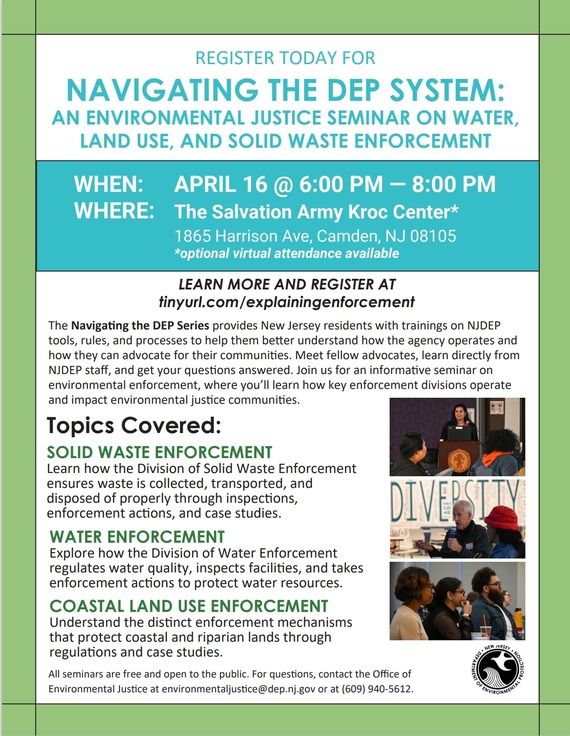
Register Now for "Navigating the DEP System: Explaining Enforcement"!
Join us next Wednesday, April 16th, from 6-8 pm in Camden for the third and final installment of the Navigating the DEP System: Explaining Enforcement Seminar!
Navigating the DEP System: Explaining Enforcement provides an overview of how DEP's Air, Water, Solid Waste, and Land Use programs enforce environmental regulations, rules, and permits. Each session discusses the agency's existing enforcement authority within each program, exploring what constitutes a violation under state law, what actions DEP can take to ensure compliance, and how environmental justice communities can engage with DEP to expand enforcement efforts that effectively and equitably protect public health and the environment.
NJ Comprehensive Climate Action Plan Community Dialogue
The Metuchen, Edison, Piscataway Branch of the NAACP, in partnership with NJDEP, is hosting a listening session on Wednesday, April 23rd from 6 to 8 pm to discuss climate action and air pollution priorities in New Jersey. Feedback from the session will help shape New Jersey’s Comprehensive Climate Action Plan – which will be released at the end of the year.
Previously identified priorities include:
- Centering environmental justice communities in decision-making
- Ensuring those most burdened by pollution are prioritized in decarbonization efforts
- Ensuring energy remains affordable for low-income and renter households
- Reducing co-pollutant emissions along with climate pollutants
- Taking a place-based, wholistic approach to climate action
- Creating ‘zero-emissions zones’ in port communities
- Ensuring equitable access to clean transportation.
The event will take place at the Labor Education Center auditorium in New Brunswick. Learn more online.
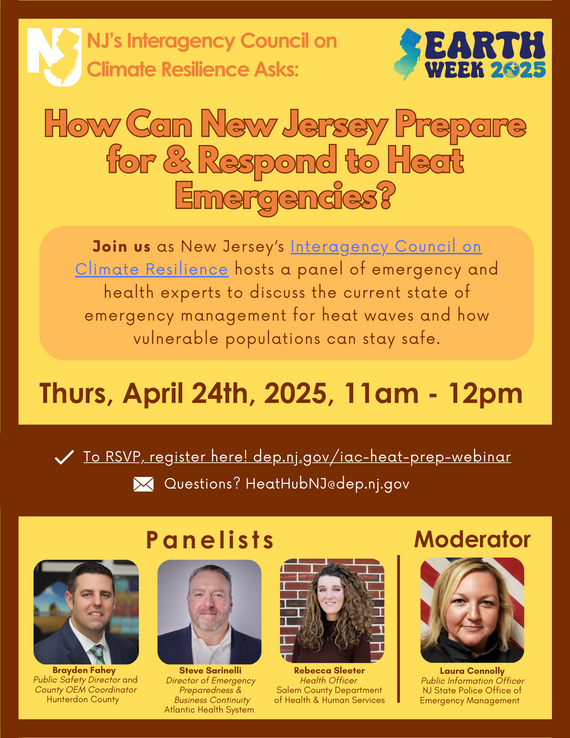
IAC Extreme Heat Webinar Series: How Can NJ Prepare and Respond to Heat Emergencies?
Join NJ's Interagency Council on Climate Resilience (IAC) on April 24, 2025, at 11 a.m. for an informative webinar panel on the current state of emergency management for heat waves and how vulnerable populations can stay safe. Emergency management and health experts will discuss how NJ currently prepares for and responds to extreme heat events, including what key heat planning, response, and training resources are available to communities.
The IAC has three additional webinars scheduled throughout summer 2025, covering extreme heat impacts on our built infrastructure, environmental justice communities, and natural ecosystems, respectively. Learn more online.
Comment on NJBPU's Urban Heat Island Mitigation Program
The NJ Board of Public Utilities (NJBPU) is seeking public comment on the establishment of an Urban Heat Island Mitigation Program. The proposed program aims to build on existing mitigation efforts by implementing targeted interventions that prioritize urban revitalization through redeveloping public spaces, fortify cooling centers to increase access during heatwaves, improve energy efficiency, cool the built environment, enhance urban forestry through sustained maintenance, and support community-based programs. Recognizing disproportionate vulnerabilities to heat stress, NJBPU is requesting stakeholder feedback on program structure and proposed funding mechanisms to effectively reduce extreme heat impacts and improve climate resilience in overburdened communities.
Comments are due by 5 pm on April 17, 2025. Learn more online.
New TCTAC Training: Procedural Justice in Environmental Justice Decision-making
Join WEACT's EPA Region 2 Thriving Communities Technical Assistance Center on April 16th from 5:00 pm - 6:00 pm for the fourth installment of their Environmental Justice Law and Policy series. This session, presented in partnership with the Institute for Policy Integrity, will explore the complex activities that public utility or public service commissions (PUCs) undertake in the name of climate and energy policy. Participants will learn what PUCs are, the kinds of decisions they make, common PUC procedural processes, and how environmental justice communities can engage with PUCs to inform equitable decision-making. Learn more online.
Funding and Technical Assistance Opportunities
In case you missed it, see below for opportunities that provide funding and assistance for projects related to green infrastructure, climate change, healthy communities, and more.
Trees for Schools Grant: $4.5 Million Available for Tree Plantings at Schools
NJDEP, in partnership with The College of New Jersey and Sustainable Jersey, recently announced $4.5 million in Trees for Schools grants for New Jersey public school districts, county colleges, and state colleges and universities through the Trees for Schools grant program. Competitive grants from $10,000 to $250,000 will fund tree planting and associated planning and maintenance costs over three years, with a portion of funding allocated specifically for schools in overburdened communities. Tree plantings at schools will provide a range of environmental and educational benefits, filtering air pollutants, mitigating extreme heat, and creating new learning opportunities for students.
Applications are due May 13, 2025, for spring 2026 plantings. Learn more online.
Safe Streets and Roads Planning and Demonstration Grant
The U.S. Department of Transportation (USDOT) Safe Streets and Roads for All (SS4A) program provides grants to local, regional, and Tribal communities for implementation, planning, and demonstration activities as part of a systematic approach to prevent deaths and serious injuries on the nation’s roadways. The program provides $5 billion over 5 years to fund community-led projects that incorporate safety features into local road infrastructure and vehicles, support intersection improvements, provide pedestrian safety education, and improve post-crash care. Approximately 60% of funds will benefit underserved communities, providing equitable investment to places that need funding the most.
The Department of Transportation is hosting 3 upcoming informational webinars for the FY25 Grant Opportunity. Applications are due. June 25th, 2025. Learn more online.
|
All New Jersey residents, regardless of income, race, ethnicity, color, or national origin, have a right to live, work, and recreate in a clean and healthy environment. Historically, New Jersey’s low-income communities and communities of color face a disproportionately high number of environmental and public health stressors and, as a result, suffer from increased adverse health effects. New Jersey seeks to correct these outcomes by furthering the promise of environmental justice.
DEP’s Office of Environmental Justice (OEJ) aims to improve the quality of life in New Jersey’s most vulnerable communities by educating and empowering communities who are often outside of government decision-making processes and guiding DEP’s programs and other state departments and agencies in implementing environmental justice.
|
|