|
Subscribe to EJ Law Notices by County: Did you know that you can receive notices to upcoming EJ Law application hearings in your area? Subscribe online and select the counties in which you'd like to stay up-to-date for hearings near you.
Environmental Justice Newsletter
February 27th, 2025
Summary of Important Dates
Want to Work with Us? Apply Now for these Exciting Career Opportunities with OEJ!
NJDEP's Office of Environmental Justice aims to improve the quality of life in New Jersey’s most vulnerable communities by educating and empowering communities who are often outside of government decision-making processes, and by supporting DEP programs and other state agencies in incorporating environmental justice into their work.
Part-Time Program Specialist
The Part-Time Program Specialist will receive on-the-job training while performing a number of key professional, administrative, and analytical functions in the Office of Environmental Justice, including:
- Assisting specific DEP Program areas in developing and implementing the Department's Environmental Justice (EJ) Action Plan and supporting coordination efforts relative to the incorporation of environmental justice considerations across all Department activities.
- Serving as a staff liaison to the Department’s Environmental Justice Advisory Council (EJAC), planning and scheduling council meetings, preparing meeting minutes, and coordinating workplan projects.
- Reviewing and commenting on Environmental Justice Impact Statements submitted to DEP by regulated facilities subject to the EJ Law
- Providing feedback on other policy and guidance documents as needed
This is an in-person, hourly position based out of DEP's Headquarters in Trenton. Applicants must possess a Bachelor's Degree in a relevant field, or 4 years of professional experience relevant to the position. The ideal candidate will have experience working collaboratively in teams and be comfortable interacting with the public. The appointee may be required to attend various community events, including during evening hours.
Applications are due March 11, 2025. Learn more online.
OEJ SPARK Summer Outreach and Engagement Internship
As part of NJDEP's Spark Internship Program, the Office of Environmental Justice (OEJ) is looking for an Outreach and Engagement Intern!
The selected candidate will work closely with staff to support the office's outreach and engagement efforts, supporting projects that increase the accessibility of DEP resources, remove barriers to meaningful public participation, and build relationships with residents in overburdened communities. Job responsibilities may include creating educational fact sheets and guidance documents, assisting in event planning, conducting engagement research, and a range of other tasks supporting program implementation.
This is a part-time, in-person, hourly position based out of DEP's Headquarters in Trenton. Strong research and writing skills required. Students with backgrounds in Political Science, Criminal Justice, Environmental Studies, Urban Planning/Design, or Design Research are preferred.
Applications are due March 3rd, 2025. Learn more online.
Announcements
DEP Authorizes Preconstruction Approval at Passaic Valley Sewerage Commission and Proposes Final Permit to EPA
Following NJDEP's Environmental Justice Law Decision issued in July 2024, Passaic Valley Sewerage Commission has been granted Preconstruction Approval for their standby power plant in Newark.The Proposed Final Permit includes special conditions for the facility's construction and operation, drawing directly from stakeholder input received through the EJ Law public engagement process. The special conditions, set forth in the decision document and officially enumerated in the Proposed Final Permit, include requirements that the power plant only be operated during emergencies and for routine maintenance checks, that PVSC install solar panels, and that air pollution control equipment be installed for existing sludge and heat treatment boilers. More information is available online.
NJEDA Board Approves Programs to Expand Number of Zero Emission Medium and Heavy-Duty Vehicles on NJ Roadways
On February 24th, the New Jersey Economic Development Authority (NJEDA) Board approved two programs aimed at incentivizing and accelerating the adoption of zero-emission vehicles and reducing harmful emissions across NJ. Phase III of the New Jersey Zero Emission Incentive Program (NJZIP) will provide vouchers to businesses and institutional organizations to offset the cost of purchasing new, zero emission medium and heavy-duty vehicles. Half of the available funding will be set aside specifically for small businesses in overburdened communities, which are often located near major roadways and subjected to greater air pollution from diesel-powered vehicles. The Board also approved a new, $25 million program known as the Zero Emission Vehicle Financing Program, which provides low-interest loans to businesses that want to modernize their fleets. The program complements NJ ZIP by offering financing for vehicle costs that may not be met by NJ ZIP vouchers or other available grant funding. Together, these programs will advance the state's clean energy goals and reduce greenhouse gas emissions, while also ensuring equitable access to zero emission vehicle alternatives, improving air quality, and mitigating disproportionate health impacts in environmental justice communities. Learn more online.
Murphy Administration Approves New Brownfield Development Areas
As part of the official relaunch of the DEP's Brownfield Development Area (BDA) Program, the Murphy Administration has announced the approval of 13 new Brownfield Development Areas (BDAs) in overburdened communities throughout the state. Through this program, municipalities with high concentrations of contaminated sites work with DEP to design and implement coordinated remediation and reuse plans for multiple properties simultaneously. DEP partners with municipal officials, stakeholders, developers, and residents to determine complimentary site uses based on local priorities and execute community-specific visions for redevelopment. BDA designations qualify municipal governments and redevelopment authorities for additional funding and technical resources, alleviating disproportionate cost burdens of brownfield remediation on environmental justice communities. The relaunch of the program will facilitate expedited clean-ups and finance the development of new community assets, like parks, in areas that have historically lacked environmental and public health benefits. Learn more online.
Participation Opportunities
Upcoming Environmental Justice Law Public Hearings
March 5- Corning Pharmaceutical Glass, Title V Renewal, EJ Rule (hybrid) [En Español]
Facilities subject to the Environmental Justice Law must facilitate meaningful opportunities for overburdened communities to engage in permitting decisions for pollution-generating facilities through an enhanced public participation process. Subscribe to EJ Law notices by County
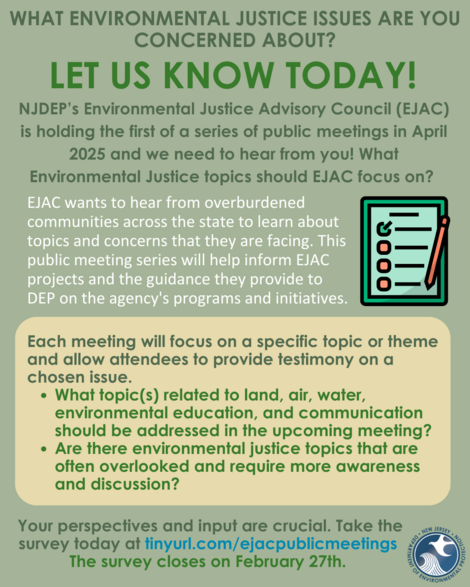
Last Call: Complete the EJAC Public Meeting Series Potential Topics Survey Today!
Funding and Technical Assistance Opportunities
In case you missed it, see below for opportunities that provide funding and assistance for projects related to green infrastructure, climate change, healthy communities, and more.
NJ Water Bank Sewer Overflow and Stormwater Reuse Municipal Grants
The New Jersey Water Bank is now accepting applications for The Sewer Overflow and Stormwater Reuse Municipal Grants. Up to $2 million in funding is available to municipal entities for the planning, design, and construction of infrastructure to prevent combined and sanitary sewer overflows and support local stormwater management. Priority will be given to projects in financially distressed and overburdened communities.
Applications are accepted on a rolling basis. Learn more online.
State Land Urban Acquisition Partnership
The State Land Urban Acquisition Partnership Program aims to acquire properties in Urban Aid municipalities, Community Collaborative Initiative (CCI) communities, and counties creating parks and greenways in these communities. The program is dedicated to repurposing undesirable structures and remediated land, promoting healthier, more resilient and vibrant communities by increasing public green space. Current State land acquisitions enhance and expand recreation and conservation opportunities, particularly in overburdened communities with limited financial resources or capacity to acquire property. All municipalities listed previously are eligible to apply.
Applications are not required. Local governments are encouraged to contact Green Acres to discuss the specifics of potential property acquisitions and receive personalized guidance on how to proceed. Learn more online.
Solid Waste Recycling Enhancement Act (REA) Higher Education Research Grant Program
The Solid Waste Recycling Enhancement Act (REA) Higher Education Research Grant Program has announced an extension for their grant. The grant funds recycling demonstration, research, and education, and professional training initiatives led by higher education institutions. These institutions may partner with eligible entities to enhance existing recycling resources, tools, or methodologies, or create new ones in community-specific contexts. For example, universities may partner with K-12 schools to conduct food waste research, develop best practices for composting programs, and support youth recycling education. By funding and applying institutional research, this program will help to address unique waste reduction and reuse challenges throughout the state and build capacities of local entities to implement meaningful solutions, particularly in overburdened communities that may have limited resources.
Applications are now due March 31, 2025. Learn more online.
|
|
All New Jersey residents, regardless of income, race, ethnicity, color, or national origin, have a right to live, work, and recreate in a clean and healthy environment. Historically, New Jersey’s low-income communities and communities of color face a disproportionately high number of environmental and public health stressors and, as a result, suffer from increased adverse health effects. New Jersey seeks to correct these outcomes by furthering the promise of environmental justice.
DEP’s Office of Environmental Justice (OEJ) aims to improve the quality of life in New Jersey’s most vulnerable communities by educating and empowering communities who are often outside of government decision-making processes and guiding DEP’s programs and other state departments and agencies in implementing environmental justice.
|
|