|
Subscribe to EJ Law Notices by County: Did you know that you can receive notices to upcoming EJ Law application hearings in your area? Subscribe online and select the counties in which you'd like to stay up-to-date for hearings near you.
Environmental Justice Newsletter
January 30th, 2025
Summary of Important Dates
Announcements
AG Platkin Files Actions to Protect and Defend Federal Environmental Regulations from Legal Attack
On January 17th, Attorney General Matthew J. Platkin announced three actions to defend key federal environmental protections that protect the health of all New Jerseyans. These filings were initiated to thwart increasing legal challenges as the new Trump Administration threatens to reverse science-based regulations that protect clean air and water.
In one action, New Jersey, California, and Connecticut co-led an amicus brief on behalf of 18 states supporting the EPA Final PFAS National Primary Drinking Water Regulation that established nationwide drinking water standards for certain per- and polyfluoroalkyl substances (PFAS). The rule extends the health purposes of the Safe Water Drinking Act, setting enforceable standards for six PFAS chemicals found in drinking water across the country and requiring public water systems to test for and treat PFAs in drinking water. In a second case, New Jersey and nine other states have filed a motion to intervene to defend EPA's Lead and Copper Rule Improvements (LCRI). The LCRI calls for most water utilities to replace water pipes made of lead within 10 years, lowers lead action levels, and strengthens other protections to reduce lead exposure. In a third case, New Jersey and a coalition of other state and local governments are asking to intervene in lawsuits to defend California’s Clean Air Act waiver for several vehicle emissions regulations. These EPA waivers allow California to have cleaner air standards than federally required, including stricter standards for greenhouse gas emissions from vehicles that contribute to climate change. This process also permits states like New Jersey to do the same now and in perpetuity.
These filings are reflective of state's ongoing commitment to advancing public health, safety, and environmental standards to improve and protect NJ air and water quality for all residents. More information is available online.
New Climate Change and Health Equity Indicators Website
The Office of Climate Change and Health Equity (OCCHE) at the Department of Health and Human Services recently launched the U.S. Climate Change and Health Equity Indicators Website. The website compiles data on the public health impacts of increasing environmental stressors due to climate change, including heat related illness, wildfire hazards, and cumulative smoke exposure. Designed for residents and local decision makers alike, the website will help increase understanding of how climate change exacerbates health disparities in overburdened communities. The dashboard's "My Community" tab allows users to view local risk factors and climate hazards, and recommends actions to incorporate health equity considerations into resilience planning at the county level. Learn more online.
Murphy Administration Seeks Community Partners for DEP's Youth Inclusion Initiative
NJDEP is now accepting applications for the 2025 Youth Inclusion Initiative Grant! The grant will allow community-based organizations to partner with DEP to recruit, supervise, and guide participants from overburdened communities, aged 16 to 20, seeking to gain hands-on exposure in a variety of environmental careers during the six-week summer program. Up to $100,000 is available for each host organization to support outreach, recruitment, supervisory services, transportation, meals, community projects, and exposure to employment opportunities for the participants. Additionally, each participant will receive a stipend for taking part in the program. Local environmental groups, colleges and universities, neighborhood and community advocacy groups, and church and social organizations are eligible to apply. Building on the Initiative's past success, these grants will equip underserved youth with professional skills for environmental careers, build capacity of host organizations to advance local community projects, and strengthen partnerships in environmental justice communities statewide.
Applications are due by 5 p.m. on February 20, 2025. Learn more online.
Participation Opportunities
Upcoming Environmental Justice Law Public Hearings
February 13- Reworld Union Title V Renewal, AO-25 (virtual)
Facilities subject to the Environmental Justice Law must facilitate meaningful opportunities for overburdened communities to engage in permitting decisions for pollution-generating facilities through an enhanced public participation process. Subscribe to EJ Law notices by County
NOAA Coastal Resilience Fellowship Program
In efforts to support the coastal resilience projects identified through its 2023 Climate Resilience Regional Challenge, the National Oceanic and Atmospheric Association has launched the Coastal Resilience Fellowship Program! NOAA is soliciting applications for two New Jersey fellows to support the implementation of the $72.5 million Building a Climate Ready New Jersey initiative. This initiative will improve community readiness by creating a "pipeline" for projects that restore wetlands, protect critical infrastructure, address stormwater flooding and urban heat islands, and create new public access and recreational opportunities in overburdened communities. The initiative also aims to create replicable resilience project and community engagement designs that can act as models for future regional planning. A related education and workforce development component will facilitate continued coordination between regional governments, helping NJ's coastal communities prioritize equitable resilience planning and build capacity beyond the life cycle of the grant.
The Environmental Justice Fellow will help coordinate the project’s Resilience Project Design Pipeline work, planning and implementing multiple education, engagement, and training activities are planned and implemented in conjunction with the other core activities of the Climate Ready New Jersey project. The fellow will work with Urban Coastal Institute staff, key stakeholders, and community partners to engage disadvantaged and overburdened communities in the development of resilience projects for inclusion in the design pipeline.
The Education and Engagement Fellow will work with partners from the region-wide Education, Climate Awareness, Training, and Engagement (EduCATE) Initiative, providing coordination support to integrate resilience project efforts into its existing program. Fellows will work with each EduCATE partner to codevelop a Theory of Change for ongoing EduCATE projects, and support the planning and implementation of multiple education, engagement, and training activities
The two-year fellowship begins in June 2025. Applications are due February 28, 2025. Learn more online.
Funding and Technical Assistance Opportunities
In case you missed it, see below for opportunities that provide funding and assistance for projects related to green infrastructure, climate change, healthy communities, and more.
Technical Assistance and Planning Design Grant for Water Infrastructure Projects
The New Jersey Water Bank has announced new funding for water infrastructure projects in disadvantaged communities, available through their Technical Assistance and Planning Design Grant Program. This program covers planning and design costs associated with clean water or drinking water environmental infrastructure projects. Grant funds will support the planning and design of a variety of environmental infrastructure projects, including wastewater treatment facilities, stormwater management facilities, water supply facilities, and nonpoint source management facilities. Eligibility is limited to Clean Water and Drinking Water State Revolving Fund borrowers participating in the Water Bank's Technical Assistance Program.
Applications will be accepted on a rolling basis. More information is available online.
Outdoor Recreation Legacy Partnership Program Grants
Managed by the National Parks Service, the Outdoor Recreation Legacy Partnership (ORLP) Program funds new parks, or the substantial renovation of existing parks in urban and underserved communities with limited access to green space and recreational opportunities. The program provides 50% matching grants which can be leveraged with Green Acres grants to fully finance park acquisition, development, and expansion. Competitive proposals should be developed directly in collaboration with community partners and overburdened residents, informed by stated recreation and accessibility needs and priorities. Additionally, the program will prioritize proposals that incorporate nature-based solutions to climate change and highlight the unique character of the local community.
Applications must be submitted through the NJDEP’s Green Acres Program. To determine eligibility and to advance the most competitive projects, Green Acres requires applicants to submit a project proposal by March 7, 2025. The most competitive project proposals will receive authorization and guidance from Green Acres on how to complete the preliminary application to the National Park Service. Technical assistance opportunities are available through Rutgers University. Learn more online.
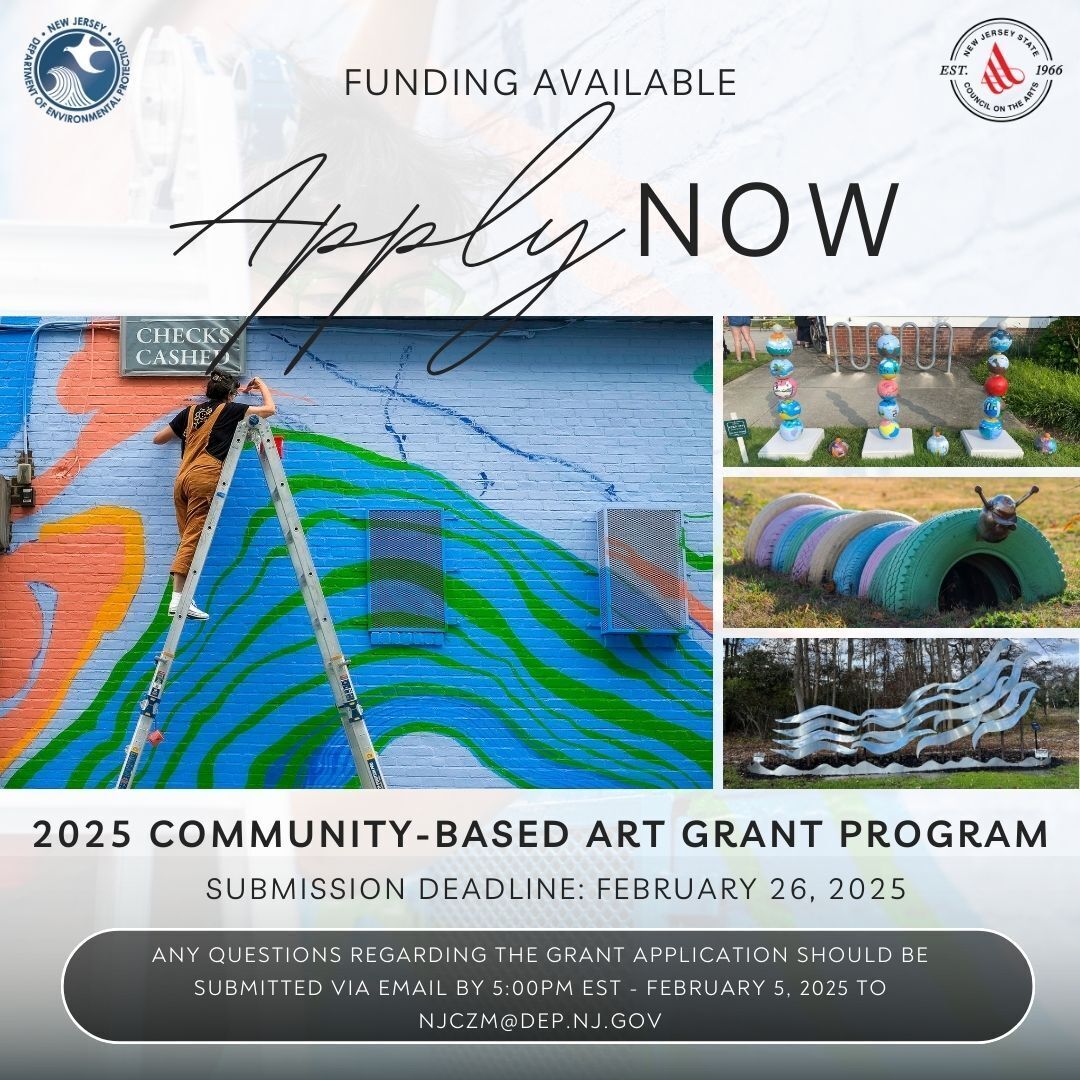 Call for Partner Organizations: Communicating Climate Change Flood Risks in Coastal Communities
NJDEP and the NJ State Council on the Arts are now accepting applications for the 2025 Community-Based Art Grant Program! This program, as part of a broader flood risk communications campaign, aims to raise awareness about increased flooding events related to climate change in coastal areas of New Jersey. Eligible community-based organizations will partner with artists to engage vulnerable residents on flood risk topics, hosting events and creating installations that address themes of climate resilience, reflect lived experiences of localized flood impacts, and increase understanding of actions that reduce risk. These engagement efforts are particularly important in low-income communities and communities of color, who are often disproportionately impacted by climate-related flooding. Past grantees include the Atlantic City Arts Foundation and Bayshore Center at Bivalve in Port Norris.
Applications are due February 26, 2025. Learn more online.
Funding Available for On-Road Diesel Vehicle Electrification Projects!
In a continuing effort to reduce diesel emissions and mitigate climate change, NJDEP's Bureau of Mobile Sources is offering another round of funding to replace medium- and heavy-duty diesel vehicles with electric. Local governments are eligible to apply for the upgrade and replacement of shuttles, transit bus, garbage truck, dump truck, and school bus fleets.
Applications are accepted on a rolling basis. Learn more online.
FEMA Flood Mitigation Assistance and Building Resilient Infrastructure and Communities (BRIC) Grants
FEMA has announced a combined $1.3 billion in hazard mitigation funding available through their Flood Mitigation Assistance and Building Resilient Infrastructure and Communities Grants. Both grants will help state, local, Tribal and territorial governments address high-level future risks to natural disasters, build government capacities for effective natural disaster response, and foster greater community resilience to climate events, particularly in overburdened and under-resourced communities.
The Flood Mitigation Assistance Grant provides funding for activities that build local flood response capacities, reduce localized flood risks, and reduce or eliminate the risk of repetitive flood damage to buildings and structures insured under the National Flood Insurance Program (NFIP), and within NFIP-participating communities. Eligible projects include stormwater infrastructure upgrades, building elevations in areas with chronic flooding, developing flood mitigation and cooperative management plans, and utilizing nature-based solutions for flood storage and floodplain restoration.
The Building Resilient Infrastructure and Communities (BRIC) Grant supports natural hazard risk reduction activities and strengthens public infrastructure in disadvantaged communities.
Eligible hazard mitigation projects include green infrastructure, nature-based solutions, community partnerships to increase local adaptive capacities and ensure resident access to critical emergency services, administrative assistance to develop stronger building codes, and climate resilience planning.
Applications for both grants are due April 18th, 2025. Learn more online.
NJ Community Gardens and Farm Grant
Administered through the Natural Resource Conservation Service, the Community Gardens and Farm Grant seeks to foster environmental stewardship and sustainable agriculture in communities by addressing the need for conservation education and resource support in urban and underserved communities. Projects may include conservation practice demonstration and education opportunities as well endeavors to engage historically underserved growers and communities in NRCS programs. In addition, on established USDA People’s Gardens, projects can include support for things like climate smart conservation practices, stormwater runoff and erosion control, and habitat establishment and management.
Applications are due June 6th, 2025. Learn more online.
Green Acres 2025 Funding Round Now Open!
The Green Acres Program 2025 funding round is now open! These grant opportunities are for local governments and non-profits seeking to acquire open space for recreation and conservation purposes, develop outdoor recreational facilities, and steward natural resources on land held for those purposes. Non-profit grants specifically consider recreational development in urban and densely populated areas to increase accessibility of green space. Applications for land acquisition, park development, stewardship, Jake’s Law (Completely Inclusive Playgrounds), and Urban Parks projects are now being accepted. All applicants must provide opportunity for meaningful public engagement to ensure park planning and development decisions incorporate community input.
All applications are due February 5th, 2025. More information is available online.
|
All New Jersey residents, regardless of income, race, ethnicity, color, or national origin, have a right to live, work, and recreate in a clean and healthy environment. Historically, New Jersey’s low-income communities and communities of color face a disproportionately high number of environmental and public health stressors and, as a result, suffer from increased adverse health effects. New Jersey seeks to correct these outcomes by furthering the promise of environmental justice.
DEP’s Office of Environmental Justice (OEJ) aims to improve the quality of life in New Jersey’s most vulnerable communities by educating and empowering communities who are often outside of government decision-making processes and guiding DEP’s programs and other state departments and agencies in implementing environmental justice.
|
|