|
Subscribe to EJ Law Notices by County: Did you know that you can receive notices to upcoming EJ Law application hearings in your area? Subscribe online and select the counties in which you'd like to stay up-to-date for hearings near you.
Environmental Justice Newsletter
November 21st, 2024
Summary of Important Dates
| Upcoming EJ Law Hearings |
| |
There are no upcoming public hearings at this time. |
Announcements
Murphy Administration Presents Plans for the Inaugural Section of the Greenway in Newark
On November 13th, the NJDEP and NJ TRANSIT held an open house to share plans for the first portion of the Greenway’s development in Newark. The Greenway is New Jersey’s newest state park that will transform a nine-mile stretch of former rail line in Essex and Hudson counties into a linear recreational and transit corridor. Once constructed, the Greenway will expand access to open space and deliver impactful transportation and recreation opportunities in one of the most densely populated areas of the state. Incorporating key community feedback, the multimillion-dollar project will also include tree planting and the construction of green infrastructure to mitigate local flooding issues and improve air quality within several overburdened communities.These development plans exemplify innovative approaches to environmental justice, turning an underutilized and obstructive rail line into a valuable resource for recreation, transportation access, and enhanced public health. Learn more online.
EPA Announces Historic $400M Clean Ports Investment in New Jersey
On October 30th, the EPA announced nearly $400 million in Clean Ports Program funding for the Port Authority of New York and New Jersey and SeaStreak LLC. This funding will support the adoption of new zero-emission equipment and infrastructure at ports, alongside comprehensive climate and air quality planning. As part of President Biden's Justice 40 Initiative, the program will advance environmental justice by reducing diesel air pollution from U.S. ports and protect public health in surrounding communities while also creating jobs that support local economies. Learn more online.
Participation Opportunities
Upcoming Environmental Justice Law Public Hearings
Extension of Public Comment Period for Shell's Newark Terminal - Air Quality Operating Permit Renewal
In accordance with AO-25, the public comment period, as part of the renewal process for Shell Oil Products existing Title V – Air Quality Operating Permit for its Newark Terminal is being extended. This 30-day comment extension will run Friday November 8 through Monday December 9, 2024. Comments can be submitted via email to SHLUSA-NewarkComments@shell.com or by mail to Shell Oil Products, US Newark Terminal 909 Delancy Street Newark, NJ 07105.
The permit renewal application proposes changes such as the potential for loading and storage of other fuel types (e.g. ethanol) and includes administrative changes. More information is available online.
Facilities subject to the Environmental Justice Law must facilitate meaningful opportunities for overburdened communities to engage in permitting decisions for pollution-generating facilities through an enhanced public participation process. Subscribe to EJ Law notices by County
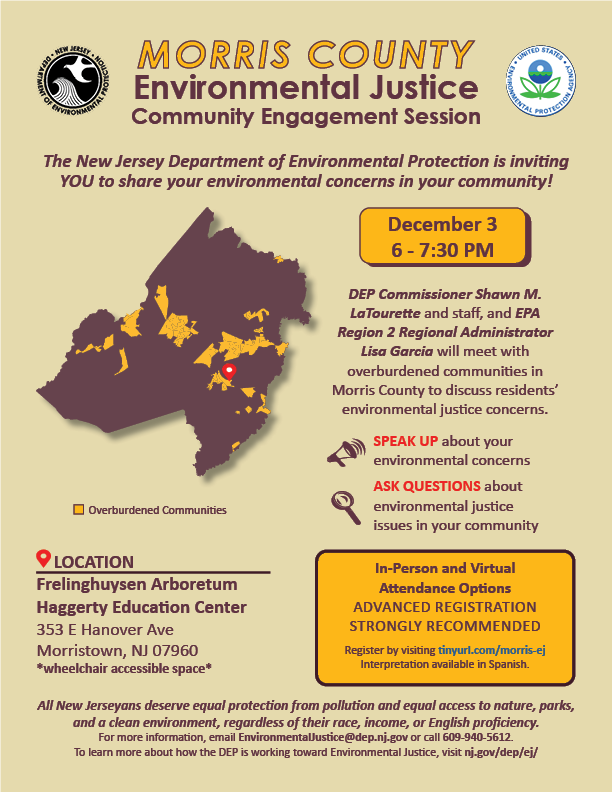 Register Now for OEJ's Upcoming Environmental Justice Community Engagement Session in Morristown!
Join the Office of Environmental Justice on December 3rd to discuss your environmental concerns at the next EJ Community Engagement Session with DEP Commissioner Shawn LaTourette and EPA Region 2 Regional Administrator Lisa Garcia.
Date and Time: Tuesday, December 3rd, 2024, 6:00-7:30pm
Location: Frelinghuysen Arboretum, Haggerty Education Center
353 E Hanover Ave Morristown, NJ 07960
Attend in-person or virtually via Zoom. Spanish translation will be provided. Registration strongly encouraged.
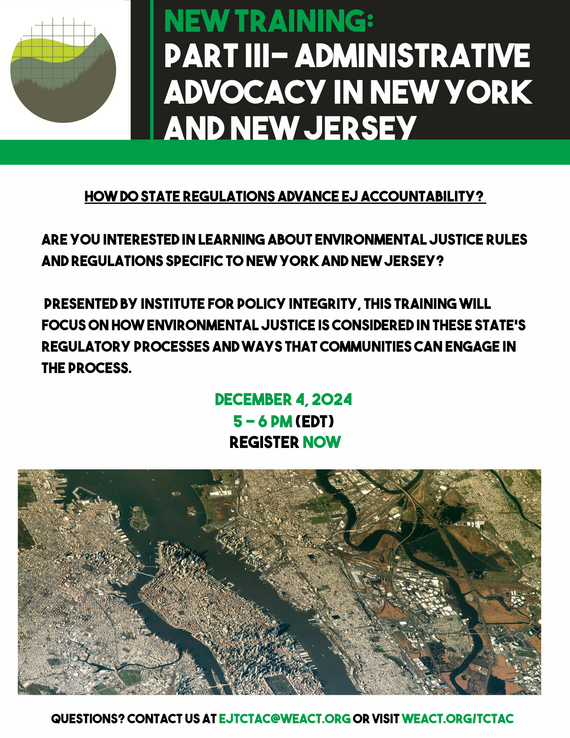
NEW WE ACT TCTAC & NYU TRAINING #3: Administrative Advocacy in New York and New Jersey
Join EPA Region 2's Thriving Communities Technical Assistance Centers on December 4th, 2024, from 5-6 pm for the third part of their Environmental Justice Law and Policy series. This training will focus on how environmental justice is currently considered in NJ and NY regulatory processes and discuss ways that communities can further engage in these processes. Participants will discuss examples of successful engagement with state agencies to protect the environment, public health, and public welfare, and learn how to utilize this information to advance community-based environmental justice initiatives. Learn more online.
Funding and Technical Assistance Opportunities
In case you missed it, see below for opportunities that provide funding and assistance for projects related to green infrastructure, climate change, healthy communities, and more.
Building Blocks for Sustainable Communities
Request for Letters of Interest
Communities across the United States are exploring Smart Growth, and other environmentally sustainable approaches, to revitalize their communities, however, when trying to implement these approaches many communities run into barriers such as outdated zoning codes, contaminated sites, and regulations that deter investment. To address this, the Building Blocks for Sustainable Communities Program provides quick, targeted technical assistance to selected communities, delivering assistance using a team of technical experts who convene local, regional, and federal stakeholders for workshops in the selected communities to collaboratively develop a detailed and focused plan to address the community’s needs and interests.
The program is now accepting letters of interest! This round, EPA will support partnerships between local government and a local grassroots organization representing a disproportionately affected neighborhood to reduce urban heat island impacts in that neighborhood.
Learn more about the current round of assistance. The deadline to submit a letter of interest is December 12, 2024.
Center for Collaborative Heat Monitoring Funding and Technical Assistance
Administered through the National Integrated Heat Health Information System, The Center for Collaborative Heat Monitoring provides funding and technical assistance for community heat monitoring initiatives that evaluate factors influencing local heat risk. Approximately $10,000 in funding is available to support the collection of heat distribution data through community-led campaigns. These campaigns can help inform local cooling solutions, decision-making, advocacy, and education on heat resilience. The center will prioritize applications from communities that have experienced historical patterns of discrimination, underinvestment and disenfranchisement and have limited resources to conduct heat monitoring on their own.
Applications are due January 17, 2025. Rural communities, tribal nations, U.S. territories and communities that have not previously undergone heat mapping are especially encouraged to apply. More information is available online.
The Center for Heat Resilient Communities is now also accepting applications from organizations interested in participating in the inaugural cohort of Heat Resilient Communities. The Center will support communities in determining the best strategies for local heat mitigation and management, leveraging federal investments to enhance heat resilience, and using decision-support tools to develop data-driven and equity-centered heat strategies.
Applications are due by January 24, 2024. Learn more online.
Green Acres 2025 Funding Round Now Open!
The Green Acres Program 2025 funding round is now open! These grant opportunities are for local governments and non-profits seeking to acquire open space for recreation and conservation purposes, develop outdoor recreational facilities, and steward natural resources on land held for those purposes. Non-profit grants specifically consider recreational development in urban and densely populated areas to increase accessibility of green space. Applications for land acquisition, park development, stewardship, Jake’s Law (Completely Inclusive Playgrounds), and Urban Parks projects are now being accepted. All applicants must provide opportunity for meaningful public engagement to ensure park planning and development decisions incorporate community input.
To support local governments and community-based organizations in the application process, Green Acres will be hosting three upcoming virtual application information and Q&A sessions on November 25th and December 18th. Session information and details on how to join are available online.
All applications are due February 5th, 2025. More information is available online.
Farm to School Grant Program
Funded through the USDA, The Farm to School Grant Program is designed to increase the availability of local foods in schools and connect students to the sources of their food through education, taste tests, school gardens, field trips, and local food sourcing for school meals. Grants can launch new farm to school programs or expand existing efforts. Funding is available for projects that develop action plans for farm to school activities, incorporate agricultural education into curriculum, or implement food production operations, like community gardens. This program will support local governments in combating food insecurity, increasing access to fresh, healthy food, providing key environmental education, and empowering youth in underserved communities.
Applications are due January 10th, 2025. Learn more online.
Funding Available for Community Forests!
Offered by the US Forest Service, The Community Forest and Open Space Conservation Program offers a unique opportunity for communities to acquire and conserve forests that provide public access and recreational opportunities, protect vital water supplies and wildlife habitat, serve as demonstration sites for private forest landowners, and provide economic benefits from timber and non-timber products. Local governments, conservation non-profit organizations, and tribal entities are eligible to apply. This funding will help facilitate more equitable access to forests as natural resources and the community benefits they provide, particularly in overburdened communities with limited open space. Learn more online.
|
All New Jersey residents, regardless of income, race, ethnicity, color, or national origin, have a right to live, work, and recreate in a clean and healthy environment. Historically, New Jersey’s low-income communities and communities of color face a disproportionately high number of environmental and public health stressors and, as a result, suffer from increased adverse health effects. New Jersey seeks to correct these outcomes by furthering the promise of environmental justice.
DEP’s Office of Environmental Justice (OEJ) aims to improve the quality of life in New Jersey’s most vulnerable communities by educating and empowering communities who are often outside of government decision-making processes and guiding DEP’s programs and other state departments and agencies in implementing environmental justice.
|
|