|
Subscribe to EJ Law Notices by County: Did you know that you can receive notices to upcoming EJ Law application hearings in your area? Subscribe online and select the counties in which you'd like to stay up-to-date for hearings near you.
Environmental Justice Newsletter
November 7, 2024
Summary of Important Dates
| Upcoming EJ Law Hearings |
| |
There are no upcoming public hearings at this time. |
Announcements
EPA Announces Historic $400M Clean Ports Investment in New Jersey
On October 30th, the EPA announced nearly $400 million in Clean Ports Program funding for the Port Authority of New York and New Jersey and SeaStreak LLC. This funding will support the adoption of new zero-emission equipment and infrastructure at ports, alongside comprehensive climate and air quality planning. As part of President Biden's Justice 40 Initiative, the program will advance environmental justice by reducing diesel air pollution from U.S. ports and protect public health in surrounding communities while also creating jobs that support local economies. Learn more online.
Murphy Administration Releases Updated Potential Lead Exposure Mapping Tool
In recognition of National Lead Poisoning Prevention Week (Oct. 20-26), NJDEP and New Jersey's Department of Health released updates and additions to the Potential Lead Exposure Mapping Tool (PLEM). PLEM is an online mapping tool that uses publicly available data to indicate potential sources of lead exposure statewide, enabling users to visualize exposure risks in their area and helping inform individual, municipal, and community-based actions that safeguard public health. The updates add a new map layer showing community water provider level service line inventories as an indicator of potential lead exposure from drinking water, supplementing existing layers focused on lead paint in New Jersey’s housing stock. The new mapping layer will assist users in identifying and mitigating health risks associated with cumulative exposures, particularly in low-income communities and communities of color who have historically experienced disproportionate lead exposure burdens. Learn more online.
NOAA Fisheries Launches New Environmental Justice Explorer Tool
The Community Environmental Justice Explorer, recently introduced by National Oceanic Atmospheric Administration (NOAA) Fisheries, is an interactive social indicators tool that allows users to identify environmental justice concerns and social conditions in more than 4,600 U.S. coastal communities nationwide. This place-based tool uses detailed dashboard visualizations of various social indicators, such as fishing dependence, gentrification pressure, and poverty, to help resource managers, decision makers, and other users better understand the climate impacts and socioeconomic challenges faced by coastal communities. The Explorer tool advances NOAA's environmental justice goals by facilitating greater identification of and engagement with underserved communities in the fishery management process. Learn more online.
EPA Awards $250 Million to Electrify I-95 Freight Corridor with Green Technology
On October 23rd, EPA, NJDEP and other state representatives celebrated the award of nearly a quarter of a billion dollars to the Clean Corridor Coalition. This landmark grant, funded through the Climate Pollution Reduction Grant program, will fund the electric vehicle charging infrastructure for commercial zero-emission medium- and heavy-duty vehicles along the Interstate-95 freight corridor. The Clean Corridor Coalition, led by NJDEP, includes the state environmental and transportation agencies from Connecticut, Delaware and Maryland. Under the project, state agencies will install infrastructure expected to reduce greenhouse gas emissions by 18.6 million metric tons of CO2 equivalent by 2050 and will provide critical technical assistance for interstate workforce development and corridor planning. The initiative will mitigate harmful air pollution, reduce public health stressors for environmental justice communities along the corridor, and provide job and training opportunities for low-income residents. Learn more online.
Participation Opportunities
Upcoming Environmental Justice Law Public Hearings
Facilities subject to the Environmental Justice Law must facilitate meaningful opportunities for overburdened communities to engage in permitting decisions for pollution-generating facilities through an enhanced public participation process. Subscribe to EJ Law notices by County
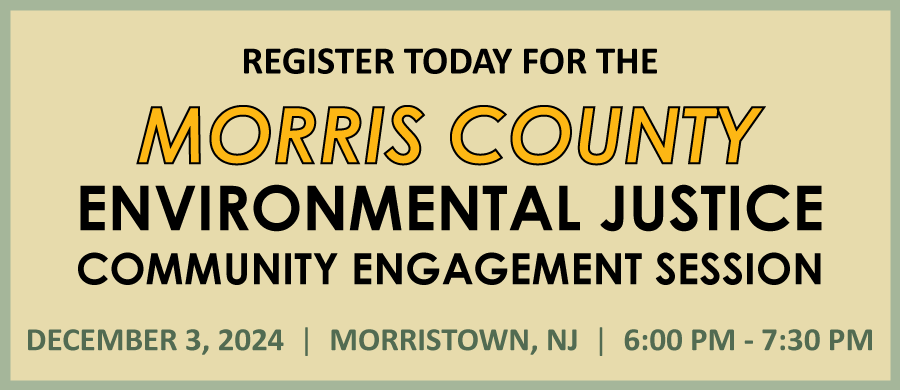 Register Now for OEJ's Upcoming Environmental Justice Community Engagement Session in Morristown!
Join the Office of Environmental Justice on December 3rd to discuss your environmental concerns at the next EJ Community Engagement Session with DEP Commissioner Shawn LaTourette and EPA Region 2 Regional Administrator Lisa Garcia.
Date and Time: Tuesday, December 3rd, 2024, 6:00-7:30pm
Location: TBD
Attend in-person or virtually via Zoom. Spanish translation will be provided. Registration strongly encouraged.
NEW WE ACT TCTAC & NYU TRAINING #3: Administrative Advocacy in New York and New Jersey
Join EPA Region 2's Thriving Communities Technical Assistance Centers on December 4th, 2024, from 5-6 pm for the third part of their Environmental Justice Law and Policy series. This training will focus on how environmental justice is currently considered in NJ and NY regulatory processes and discuss ways that communities can further engage in these processes. Participants will discuss examples of successful engagement with state agencies to protect the environment, public health, and public welfare, and learn how to utilize this information to advance community-based environmental justice initiatives. Learn more online.
NEW TCTAC & DOE Training: How DOE Engages with Community
In partnership with the Department of Energy's Office of Community Engagement, EPA Region 2's Thriving Communities Technical Assistance Centers are hosting an upcoming webinar series about clean energy opportunities on November 14, 2024, from 5:00 – 6:30 PM. This series is designed to introduce communities to tools and resources available through the Department of Energy. Part one will explore the different program offices working to bring clean energy to disadvantaged and energy burdened communities, and the DOE funding opportunities that these communities can apply for to help them transition to cleaner, safer, and cost-efficient clean energy solutions. Participants will leave with a deeper knowledge of how to navigate DOE processes and program offices and understand how to take advantage of DOE’s community focused programming and resources. Learn more online.
Nominate Community Leaders for the Sustainable Communities Accelerator Network!
EPA's Office of Community Revitalization is launching the Sustainable Communities Accelerator Network, a national peer learning program to support local leaders in implementing plans that prioritize sustainability actions in their communities. Each community is invited to nominate a team of up to two leaders in environmental, land use planning and sustainability fields to participate in a nine-month program. Throughout the duration of the program, participants will undertake a specific community project, action or policy, learn and apply sustainability and environmental planning curriculum, and work through project implementation challenges with their peer cohort. Eligible projects include activating vacant lots, creating community gardens, developing tree planting programs, improving pedestrian and bike infrastructure, advancing resiliency hubs, and more. Through this Network, EPA aims to expand the capacity of community leaders and local government professionals to advance sustainability efforts and use the collective expertise of participants to address common barriers in project implementation.
Nominations are due Wednesday, November 13th, 2024. More information is available online.
Funding and Technical Assistance Opportunities
In case you missed it, see below for opportunities that provide funding and assistance for projects related to green infrastructure, climate change, healthy communities, and more.
Applications Now Open for the EJ4Climate Grant Program!
The fourth cycle of the $1.5 million Environmental Justice for Climate (EJ4Climate) Grant Program is now open! Up to $175,000 in grant funding available for community-led education programs that further environmental justice and increase climate adaptation knowledge. Initiated by EPA Administrator Michael S. Regan in 2021, the EJ4Climate Grant Program provides funding directly to community-based organizations and supports disadvantaged communities in finding solutions that address their environmental and human health vulnerabilities, including those due to climate change impacts. Proposals that promote the development of climate adaptation knowledge related to extreme weather impacts, transition to clean energy sources, conservation or restoration initiatives, traditional ecological knowledge to address climate change impacts and/or food sovereignty are encouraged.
Proposals are due by November 14, 2024 and projects will be expected to begin in Spring 2025. Learn more online.
Center for Collaborative Heat Monitoring Funding and Technical Assistance
Administered through the National Integrated Heat Health Information System, The Center for Collaborative Heat Monitoring provides funding and technical assistance for community heat monitoring initiatives that evaluate factors influencing local heat risk. Approximately $10,000 in funding is available to support the collection of heat distribution data through community-led campaigns. These campaigns can help inform local cooling solutions, decision-making, advocacy, and education on heat resilience. The center will prioritize applications from communities that have experienced historical patterns of discrimination, underinvestment and disenfranchisement and have limited resources to conduct heat monitoring on their own.
Applications are due January 17, 2025. Rural communities, tribal nations, U.S. territories and communities that have not previously undergone heat mapping are especially encouraged to apply. More information is available online.
Green Acres 2025 Funding Round Now Open!
The Green Acres Program 2025 funding round is now open! These grant opportunities are for local governments and non-profits seeking to acquire open space for recreation and conservation purposes, develop outdoor recreational facilities, and steward natural resources on land held for those purposes. Non-profit grants specifically consider recreational development in urban and densely populated areas to increase accessibility of green space. Applications for land acquisition, park development, stewardship, Jake’s Law (Completely Inclusive Playgrounds), and Urban Parks projects are now being accepted. All applicants must provide opportunity for meaningful public engagement to ensure park planning and development decisions incorporate community input.
To support local governments and community-based organizations in the application process, Green Acres will be hosting three upcoming virtual application information and Q&A sessions on November 25th and December 18th. Session information and details on how to join are available online.
All applications are due February 5th, 2025. More information is available online.
Reducing Lead in Drinking Water Grant
As part of the Biden Harris Administration's Justice 40 Initiative, EPA's Reducing Lead in Drinking Water Grant Program is designed to facilitate the reduction of lead in drinking water in disadvantaged communities. Up to $35 million in funding is available to municipal, tribal, intergovernmental, and nonprofit entities to support infrastructure investments, water treatment improvements, and facility remediation in schools and child-care facilities. This funding works to address legacies of industrial pollution and disinvestment in disadvantaged communities, accelerate the remediation of water systems, and better protect public health.
Applications are due December 30th, 2024. Learn more online.
EPA Brownfields Program Multipurpose, Assessment, Revolving Loan Fund, and Cleanup Grants
EPA's Brownfields Program is now accepting applications for their Multipurpose, Assessment, Revolving Loan Fund, and Cleanup (MARC) Grants. Through this program, funding is allocated for these four Brownfield project types in order to identify, remediate, and facilitate meaningful involvement of communities in the clean-up of sites contaminated by hazardous substances, pollutants, or contaminants (including hazardous substances co-mingled with petroleum) and petroleum.
Applications are due November 14th, 2024. Learn more online.
|
All New Jersey residents, regardless of income, race, ethnicity, color, or national origin, have a right to live, work, and recreate in a clean and healthy environment. Historically, New Jersey’s low-income communities and communities of color face a disproportionately high number of environmental and public health stressors and, as a result, suffer from increased adverse health effects. New Jersey seeks to correct these outcomes by furthering the promise of environmental justice.
DEP’s Office of Environmental Justice (OEJ) aims to improve the quality of life in New Jersey’s most vulnerable communities by educating and empowering communities who are often outside of government decision-making processes and guiding DEP’s programs and other state departments and agencies in implementing environmental justice.
|
|