|
Subscribe to EJ Law Notices by County: Did you know that you can receive notices to upcoming EJ Law application hearings in your area? Subscribe online and select the counties in which you'd like to stay up-to-date for hearings near you.
Environmental Justice Newsletter
October 24, 2024
Summary of Important Dates
Announcements
EPA Awards $250 Million to Electrify I-95 Freight Corridor with Green Technology
On October 23rd, EPA, NJDEP and other state representatives celebrated the award of nearly a quarter of a billion dollars to the Clean Corridor Coalition. This landmark grant, funded through the Climate Pollution Reduction Grant program, will fund the electric vehicle charging infrastructure for commercial zero-emission medium- and heavy-duty vehicles along the Interstate-95 freight corridor. The Clean Corridor Coalition, led by NJDEP, includes the state environmental and transportation agencies from Connecticut, Delaware and Maryland. Under the project, state agencies will install infrastructure expected to reduce greenhouse gas emissions by 18.6 million metric tons of CO2 equivalent by 2050 and will provide critical technical assistance for interstate workforce development and corridor planning. The initiative will mitigate harmful air pollution, reduce public health stressors for environmental justice communities along the corridor, and provide job and training opportunities for low-income residents. Learn more online.
Attorney General and DEP Announce Filing of 4 New Environmental Justice Enforcement Actions
On October 22nd, New Jersey Attorney General Matthew J. Platkin and DEP Commissioner Shawn LaTourette announced one environmental justice settlement as well as the filing of four lawsuits to enforce environmental law and hold polluters accountable in and around communities considered overburdened under New Jersey’s Environmental Justice Law. The cases announced all consist of current or former gas stations and/or automotive facilities. Learn more online.
Biden-Harris Administration Announces $125M to Upgrade Older Diesel Engines and Implement Cleaner Energy Solutions
On October 17th, the U.S. Environmental Protection Agency announced selections totaling nearly $125 million under the Diesel Emissions Reduction Act National Grants Program to incentivize and accelerate the upgrade or retirement of older diesel engines and implement cleaner and zero-emission alternatives leading to significant emission reductions and public health benefits. Specifically, the DERA program prioritizes projects in areas impacted by poor air quality, especially those projects that benefit disadvantaged communities with heightened public health risks or environmental justice concerns. In total, EPA has tentatively selected approximately 70 national DERA projects to reduce diesel emissions across transportation sectors through engine replacements and upgrades to school buses, as well as port and construction equipment. Projects awarded in NJ's overburdened communities focus on cleaner drayage truck replacements, forklift upgrades, and fleet electrification at state ports. Learn more online.
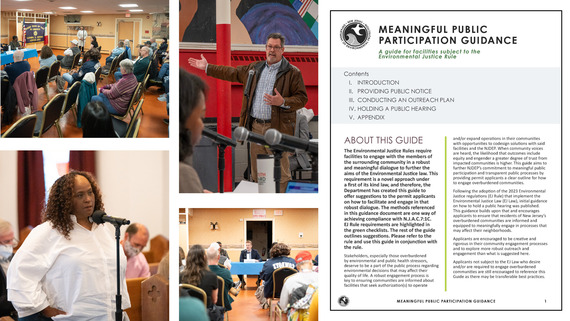
EJ Rule Meaningful Public Participation Guidance is now available!
The Meaningful Public Participation Guidance presents the New Jersey Department of Environmental Protection’s suggestions for how regulated facilities, primarily those subject to the Environmental Justice Rules, can ensure residents of New Jersey’s overburdened communities are informed and equipped to meaningfully engage in processes that affect their neighborhoods. This guidance provides an overview of the steps required to create robust dialogues with communities and shares best practices for conducting outreach, including:
- strategies to identify and connect with relevant stakeholders, like community-based organizations, local anchor institutions, and municipal green teams and environmental commissions
- steps to determine the most effective communication channels to reach impacted communities
- key accessibility considerations, like language access
The guidance rounds out with checklists and templates to further support facilities through the public participation process. More information is available online.
Biden-Harris Administration Requires National Lead Service Line Replacement Within 10 Years and Announces $44M in New Funding
On October 8th, the Biden-Harris Administration finalized The Lead and Copper Rule Improvements, requiring drinking water systems nationwide to identify and replace lead pipes within 10 years. EPA estimates that up to 9 million homes are served through legacy lead pipes across the country, many of which are located in lower-income communities and communities of color, creating disproportionate lead exposure burden for these families. Recognizing these disparities, the improvements advance environmental justice while also mandating more rigorous drinking water testing, lowering lead exposure thresholds, and improving risk communication with overburdened communities. To accelerate replacement and support inventory projects, EPA has announced $44 million in drinking water infrastructure funding through both drinking water state revolving funds (DWSRFs) and additional grant monies.
EPA has developed a website to identify additional available funding sources. More information is available online.
Murphy Administration and NJDEP Announce $15 Million in First Round Funding for Electric School Buses
On October 2nd, DEP Commissioner Shawn M. LaTourette announced $15 million in funding for local purchases of 48 electric school buses in New Jersey, furthering state commitments to curb greenhouse gas emissions, mitigate hazardous air pollution, and protect public health. In addition to funding for bus purchases, the Commissioner announced the first participants in the New Jersey Fleet Advisor program, a free service that connects EV experts with fleets operating 20 or fewer vehicles to develop a zero-emission transition plan for their medium- and heavy-duty trucks, with a focus on fleets in overburdened communities. The Fleet Advisor program addresses knowledge gaps about zero-emission vehicles, providing technical assistance and increasing the accessibility of greener options in communities most adversely impacted by mobile emissions. Learn more online.
Murphy Administration Launches $20 Million Resilience Program to Modernize Stormwater Infrastructure
As part of Climate Week, the Murphy Administration recently announced NJDEP's Ready to Be Resilient Stormwater and Resilience Funding Program. The program will fund a variety of resilience-related efforts, including grants to incentivize regional watershed management, development of local technical assistance programs, advancement of flood mapping, and improvement of post-disaster damage assessment protocols. The program will also make $11 million available as principal forgiveness loans through the State Revolving Fund to incorporate green technologies into local stormwater resilience infrastructure projects. Priority will be given to projects that serve overburdened communities, enabling greater emergency preparedness, increasing accessibility of green infrastructure, and working to offset disproportionate flood risks in environmental justice communities. Learn more online.
Participation Opportunities
Upcoming Environmental Justice Law Public Hearings
October 24- CMC Steel Title V Renewal, AO-25 (virtual)
Facilities subject to the Environmental Justice Law must facilitate meaningful opportunities for overburdened communities to engage in permitting decisions for pollution-generating facilities through an enhanced public participation process. Subscribe to EJ Law notices by County
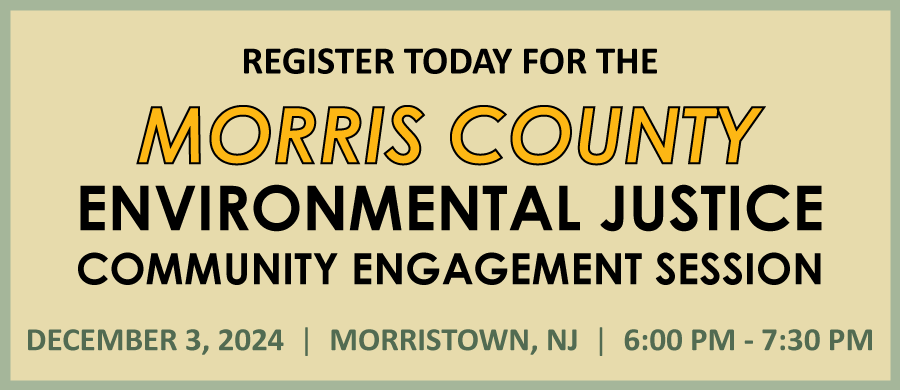 Register Now for OEJ's Upcoming Environmental Justice Community Engagement Session in Morristown!
Join the Office of Environmental Justice on December 3rd to discuss your environmental concerns at the next EJ Community Engagement Session with DEP Commissioner Shawn LaTourette and EPA Region 2 Regional Administrator Lisa Garcia.
Date and Time: Tuesday, December 3rd, 2024, 6:00-7:30pm
Location: TBD
Attend in-person or virtually via Zoom. Spanish translation will be provided. Registration strongly encouraged.
NEW TCTAC & DOE Training: How DOE Engages with Community
In partnership with the Department of Energy's Office of Community Engagement, EPA Region 2's Thriving Communities Technical Assistance Centers are hosting an upcoming webinar series about clean energy opportunities. This series is designed to introduce communities to tools and resources available through the Department of Energy. Part one will explore the different program offices working to bring clean energy to disadvantaged and energy burdened communities, and the DOE funding opportunities that these communities can apply for to help them transition to cleaner, safer, and cost-efficient clean energy solutions. Participants will leave with a deeper knowledge of how to navigate DOE processes and program offices and understand how to take advantage of DOE’s community focused programming and resources. Learn more online.
EPA Webinar on Cumulative Impacts: How Tribes and EPA are Considering Cumulative Impacts to Advance EJ for All
Join EPA’s Office of Environmental Justice and External Civil Rights for the next installment of their EJ Webinar Series for Tribes and Indigenous Peoples on October 30th from 2:30 to 4pm entitled, “Cumulative Impacts: How Tribes and EPA are Considering Cumulative Impacts to Advance EJ for All." The webinar will discuss EPA's efforts to consider cumulative impacts in agency decisions, followed by a panel of speakers. The panel will offer perspectives on current efforts to consider cumulative impacts and how advancing our understanding of cumulative impacts can help protect human health and the environment. Learn more online.
Funding and Technical Assistance Opportunities
In case you missed it, see below for opportunities that provide funding and assistance for projects related to green infrastructure, climate change, healthy communities, and more.
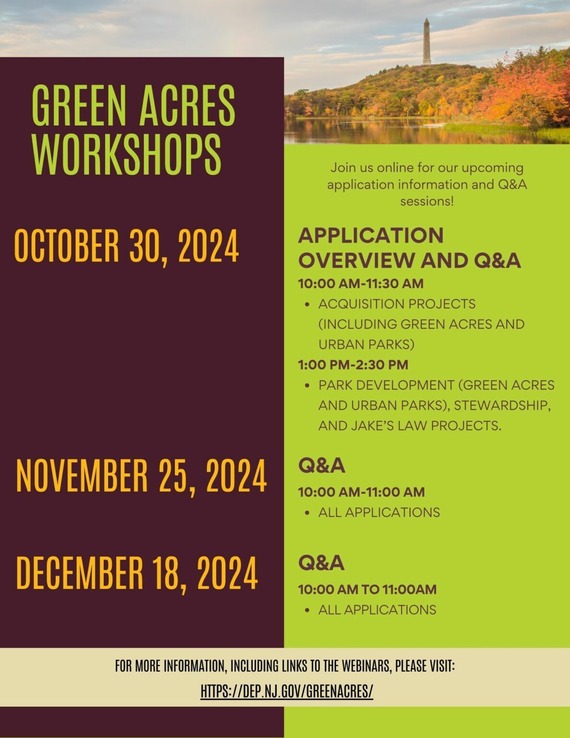 Green Acres 2025 Funding Round Now Open!
The Green Acres Program 2025 funding round is now open! These grant opportunities are for local governments and non-profits seeking to acquire open space for recreation and conservation purposes, develop outdoor recreational facilities, and steward natural resources on land held for those purposes. Non-profit grants specifically consider recreational development in urban and densely populated areas to increase accessibility of green space. Applications for land acquisition, park development, stewardship, Jake’s Law (Completely Inclusive Playgrounds), and Urban Parks projects are now being accepted. All applicants must provide opportunity for meaningful public engagement to ensure park planning and development decisions incorporate community input.
To support local governments and community-based organizations in the application process, Green Acres will be hosting three upcoming virtual application information and Q&A sessions on October 30th, November 25th, and December 18th. Session information and details on how to join are available online.
All applications are due February 5th, 2025. More information is available online.
NJUCF Green Communities Grant Program
The New Jersey Urban and Community Forestry Program (NJUCF) Green Communities Grant is now accepting applications! This program aims to assist local governments in the development of a Community Forestry Management Plan (CFMP) and conduct an inventory as the basis of this plan. A CFMP is a document for action, guiding communities to establish and maintain healthy, safe, and sustainable urban and community forests.
To support municipalities and interested applicants, NJUCF is hosting an upcoming webinar on Tuesday, October 29 12:00 PM – 1:00 PM to delve into the details of the recently updated Community Forest Management Plan (CFMP) Guidelines and the Green Communities Grant. Speakers will provide detailed information about the guidelines, Green Communities grants and how they should be used to develop a CFMP that proactively helps you steward and manage your community tree resource.
Applications will be accepted on a rolling basis for those municipalities and counties developing a Community Forestry Management Plan. The maximum awarded amount is $5,000 for a CFMP alone or $20,000 for CFMP and inventory. Learn more online.
Fordham University's Flourishing in Community Grant Program
As part of EPA's Environmental Justice Thriving Communities Grantmaking Program for Region 2, Fordham University's Flourishing in Community Grant will award funds to community groups actively advancing environmental justice. The program directs funding to frontline community projects that support people disproportionately impacted by climate change, pollution, and environmental stressors in historically underserved areas to advance community-led solutions. Projects can include, among others, local clean-ups, emergency preparedness and disaster resiliency programs, environmental workforce development programs, air quality and asthma-related projects, healthy homes programs, and initiatives addressing illegal dumping.
Applications are now open and will be accepted on a rolling basis over the next three years. The first awards are anticipated for late winter 2024-2025. Learn more online.
Reducing Lead in Drinking Water Grant
As part of the Biden Harris Administration's Justice 40 Initiative, EPA's Reducing Lead in Drinking Water Grant Program is designed to facilitate the reduction of lead in drinking water in disadvantaged communities. Up to $35 million in funding is available to municipal, tribal, intergovernmental, and nonprofit entities to support infrastructure investments, water treatment improvements, and facility remediation in schools and child-care facilities. This funding works to address legacies of industrial pollution and disinvestment in disadvantaged communities, accelerate the remediation of water systems, and better protect public health.
Applications are due December 30th, 2024. Learn more online.
EPA Brownfields Program Multipurpose, Assessment, Revolving Loan Fund, and Cleanup Grants
EPA's Brownfields Program is now accepting applications for their Multipurpose, Assessment, Revolving Loan Fund, and Cleanup (MARC) Grants. Through this program, funding is allocated for these four Brownfield project types in order to identify, remediate, and facilitate meaningful involvement of communities in the clean-up of sites contaminated by hazardous substances, pollutants, or contaminants (including hazardous substances co-mingled with petroleum) and petroleum.
Applications are due November 14th, 2024. Learn more online.
|
All New Jersey residents, regardless of income, race, ethnicity, color, or national origin, have a right to live, work, and recreate in a clean and healthy environment. Historically, New Jersey’s low-income communities and communities of color face a disproportionately high number of environmental and public health stressors and, as a result, suffer from increased adverse health effects. New Jersey seeks to correct these outcomes by furthering the promise of environmental justice.
DEP’s Office of Environmental Justice (OEJ) aims to improve the quality of life in New Jersey’s most vulnerable communities by educating and empowering communities who are often outside of government decision-making processes and guiding DEP’s programs and other state departments and agencies in implementing environmental justice.
|
|