|
Subscribe to EJ Law Notices by County: Did you know that you can receive notices to upcoming EJ Law application hearings in your area? Subscribe online and select the counties in which you'd like to stay up-to-date for hearings near you.
Environmental Justice Newsletter
October 10, 2024
Summary of Important Dates
Announcements
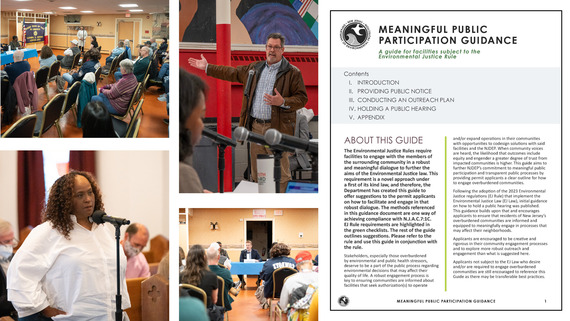
EJ Rule Meaningful Public Participation Guidance is now available!
The Meaningful Public Participation Guidance presents the New Jersey Department of Environmental Protection’s suggestions for how regulated facilities, primarily those subject to the Environmental Justice Rules, can ensure residents of New Jersey’s overburdened communities are informed and equipped to meaningfully engage in processes that affect their neighborhoods. This guidance provides an overview of the steps required to create robust dialogues with communities and shares best practices for conducting outreach, including:
- strategies to identify and connect with relevant stakeholders, like community-based organizations, local anchor institutions, and municipal green teams and environmental commissions
- steps to determine the most effective communication channels to reach impacted communities
- key accessibility considerations, like language access
The guidance rounds out with checklists and templates to further support facilities through the public participation process. More information is available online.
Biden-Harris Administration Requires National Lead Service Line Replacement Within 10 Years and Announces $44M in New Funding
On October 8th, the Biden-Harris Administration finalized The Lead and Copper Rule Improvements, requiring drinking water systems nationwide to identify and replace lead pipes within 10 years. EPA estimates that up to 9 million homes are served through legacy lead pipes across the country, many of which are located in lower-income communities and communities of color, creating disproportionate lead exposure burden for these families. Recognizing these disparities, the improvements advance environmental justice while also mandating more rigorous drinking water testing, lowering lead exposure thresholds, and improving risk communication with overburdened communities. To accelerate replacement and support inventory projects, EPA has announced $44 million in drinking water infrastructure funding through both drinking water state revolving funds (DWSRFs) and additional grant monies.
EPA has developed a website to identify additional available funding sources. More information is available online.
Murphy Administration and NJDEP Announce $15 Million in First Round Funding for Electric School Buses
On October 2nd, DEP Commissioner Shawn M. LaTourette announced $15 million in funding for local purchases of 48 electric school buses in New Jersey, furthering state commitments to curb greenhouse gas emissions, mitigate hazardous air pollution, and protect public health. In addition to funding for bus purchases, the Commissioner announced the first participants in the New Jersey Fleet Advisor program, a free service that connects EV experts with fleets operating 20 or fewer vehicles to develop a zero-emission transition plan for their medium- and heavy-duty trucks, with a focus on fleets in overburdened communities. The Fleet Advisor program addresses knowledge gaps about zero-emission vehicles, providing technical assistance and increasing the accessibility of greener options in communities most adversely impacted by mobile emissions. Learn more online.
Murphy Administration Launches $20 Million Resilience Program to Modernize Stormwater Infrastructure
As part of Climate Week, the Murphy Administration recently announced NJDEP's Ready to Be Resilient Stormwater and Resilience Funding Program. The program will fund a variety of resilience-related efforts, including grants to incentivize regional watershed management, development of local technical assistance programs, advancement of flood mapping, and improvement of post-disaster damage assessment protocols. The program will also make $11 million available as principal forgiveness loans through the State Revolving Fund to incorporate green technologies into local stormwater resilience infrastructure projects. Priority will be given to projects that serve overburdened communities, enabling greater emergency preparedness, increasing accessibility of green infrastructure, and working to offset disproportionate flood risks in environmental justice communities. Learn more online.
Biden-Harris Administration Launches Environmental Justice Climate Corps
On September 25, EPA and AmeriCorps announced the Environmental Justice Climate Corps, a new partnership launched as part of President Biden’s American Climate Corps. The American Climate Corps—a workforce training and service initiative that will ensure more young people have access to the skills-based training necessary for good-paying careers in the clean energy and climate resilience economy. The Environmental Justice Climate Corps will extend the work of the Corps to both provide career opportunities in environmental justice fields for overburdened communities and help these same communities access and benefit from historic funding secured under the Biden Administration. Applications for the Environmental Justice Climate Corps will open in early 2025, with a goal for its first cohort to start later that year. Learn more online.
EPA $1 Million Brownfields Cleanup Grant to Revitalize Contaminated Sites in Woodbine
On September 17th, the EPA, along with the NJDEP and the Borough of Woodbine, celebrated the selection of Woodbine to receive a $1 million grant for the cleanup of several contaminated sites. The event, held at a Municipal Water Plant at Adams Ave. and Longfellow St., highlighted the transformative impact of this funding on the community. The grant is part of the EPA’s ongoing efforts to support economically stressed communities in New Jersey and across the nation. The Brownfields Program provides essential resources to clean up and redevelop contaminated properties, attracting jobs, promoting economic revitalization, and creating sustainable, environmentally just neighborhoods in historically overburdened communities. Learn more online.
NJDEP Advises Residents to Respond to Notices from Water Systems Working to Identify Unknown Lead Service Lines
As of September 12th, NJDEP is advising residential and business owners across the state to respond to letters that they may receive in the mail in the coming weeks indicating that their water system has not been able to determine the materials used in service lines to their properties. The campaign is part of ongoing state and federal efforts to protect public health through the identification and replacement of lead and galvanized water service lines in New Jersey. Learn more online.
Participation Opportunities
Upcoming Environmental Justice Law Public Hearings
October 22- Sunoco Linden Terminal Title V Renewal, AO-25 (virtual)
October 23- Diversified Global Graphics Group Title V Renewa1, AO-25 (virtual)
October 24- CMC Steel Title V Renewal, AO-25 (virtual)
Facilities subject to the Environmental Justice Law must facilitate meaningful opportunities for overburdened communities to engage in permitting decisions for pollution-generating facilities through an enhanced public participation process. Subscribe to EJ Law notices by County
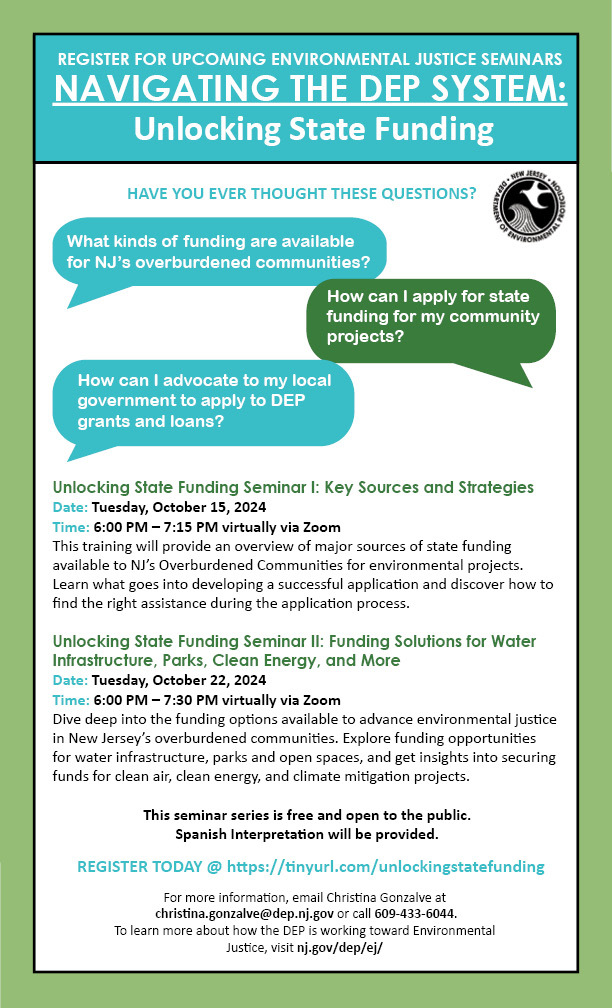
Unlock State Funding for Your Community Projects!
Joiin the Office of Environmental Justice for two upcoming sessions as part of the Navigating the DEP Seminar Series! Navigating the DEP Seminar 4: Unlocking State Funding is designed for Environmental Justice advocates and community-based organizations from across New Jersey who want to learn more about existing state funding opportunities and how to best take advantage of them to fund community projects. The seminar will be split into two virtual sessions and will discuss funding for a wide range of projects, highlighting key strategies for securing and managing state resources for environmental justice initiatives.
State Funding I: Key Sources and Strategies
When: October 15th, 2024, 6-7:15pm virtually via Zoom
State Funding II: State Funding II: Funding Solutions for Water Infrastructure, Parks, Clean Energy, and More
When: October 22nd, 2024, 6-7:30pm virtually via Zoom
Funding and Technical Assistance Opportunities
In case you missed it, see below for opportunities that provide funding and assistance for projects related to green infrastructure, climate change, healthy communities, and more.
NJUCF Green Communities Grant Program
The New Jersey Urban and Community Forestry Program (NJUCF) Green Communities Grant is now accepting applications! The program aims to assist local governments in the development of a Community Forestry Management Plan (CFMP) and conduct an inventory as the basis of this plan. A CFMP is a document for action, guiding communities to establish and maintain healthy, safe, and sustainable urban and community forests. Applications will be accepted on on a rolling basis for those municipalities and counties developing a Community Forestry Management Plan. The maximum awarded amount is $5,000 for a CFMP alone or $20,000 for CFMP and inventory. Learn more online.
NEW TCTAC TRAINING: Federal Accountability and Environmental Justice Obligations
Join the EPA Thriving Communities Technical Assistance Center on October 16th, 2024, for the second session in their six-part training series, presented by NYU Institute for Policy Integrity, focusing on providing Environmental Justice communities with the tools to effectively engage with government at all levels. This training focuses on how Environmental Justice is considered in the regulatory processes across federal agencies and ways that communities can engage the process. Participants will learn how rules and regulations are created by different agencies to protect the environment, public health, and public welfare. Learn more online.
Fordham University's Flourishing in Community Grant Program
As part of EPA's Environmental Justice Thriving Communities Grantmaking Program for Region 2, Fordham University's Flourishing in Community Grant will award funds to community groups actively advancing environmental justice. The program directs funding to frontline community projects that support people disproportionately impacted by climate change, pollution, and environmental stressors in historically underserved areas to advance community-led solutions. Projects can include, among others, local clean-ups, emergency preparedness and disaster resiliency programs, environmental workforce development programs, air quality and asthma-related projects, healthy homes programs, and initiatives addressing illegal dumping.
Applications are now open and will be accepted on a rolling basis over the next three years. The first awards are anticipated for late winter 2024-2025. Learn more online.
$117 Million in EPA Funding Available to Support Recycling Infrastructure
Funded through the Bipartisan Infrastructure Law, EPA has announced three grant opportunities totaling over $117 million now available through the Solid Waste Infrastructure for Recycling Grant Program and the Consumer Recycling Education and Outreach Program. Two of the grants, administered through the SWIFR program, will support improvements to local waste management systems and infrastructure, one designated for Tribes and Intertribal Consortia and the other for municipal, county, and parish entities in nationwide with particular focus on overburdened communities. The third funding opportunity, administered through the Recycling Education and Outreach, will support projects that center food waste prevention as well as composting implementation and education.
Applications for the Solid Waste Infrastructure for Recycling Grant Program for Communities and the Consumer Recycling Education and Outreach Program are due December 20th, 2024.
Applications for the Solid Waste Infrastructure for Recycling Grants for Tribes and Intertribal Consortia are due by March 14th, 2024. More information is available online.
|
All New Jersey residents, regardless of income, race, ethnicity, color, or national origin, have a right to live, work, and recreate in a clean and healthy environment. Historically, New Jersey’s low-income communities and communities of color face a disproportionately high number of environmental and public health stressors and, as a result, suffer from increased adverse health effects. New Jersey seeks to correct these outcomes by furthering the promise of environmental justice.
DEP’s Office of Environmental Justice (OEJ) aims to improve the quality of life in New Jersey’s most vulnerable communities by educating and empowering communities who are often outside of government decision-making processes and guiding DEP’s programs and other state departments and agencies in implementing environmental justice.
|
|