|
Subscribe to EJ Law Notices by County: Did you know that you can receive notices to upcoming EJ Law application hearings in your area? Subscribe online and select the counties in which you'd like to stay up-to-date for hearings near you.
Environmental Justice Newsletter
August 29, 2024
Summary of Important Dates
Announcements
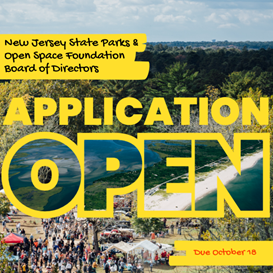
NJDEP Seeks EJ Board Member Nominee Recommendations for NJ State Parks and Open Space Foundation
NJDEP is seeking recommendations for nominees with experience in open space, preservation, land stewardship, environmental education, and environmental equity and justice to fill six vacancies for the inaugural board of directors for the New Jersey State Parks and Open Space Foundation, authorized by state law signed by Governor Phil Murphy earlier this year. The Foundation will create opportunities to further grow and invest in New Jersey’s state parks, forests and historic sites, as well as county and local government open space. The Environmental Justice board member will advise the foundation on equity considerations in its open space expansions statewide and help prioritize investments that increase parks and open space access in overburdened communities.
Recommendations for nominations are due October 18, 2024. Learn more online.
NJDEP Honored Nationally for Food Waste Reduction Plan
Earlier this month, NJDEP’s Division of Sustainable Waste Management was honored by the National Conference of State Legislatures for spearheading a comprehensive and ongoing set of actions to reduce food waste in New Jersey through its Food Waste Reduction Plan. The plan outlines food waste solutions currently being carried out by the state- organizational partnerships to promote reduction strategies at the local government level, supporting food donation outlets, and developing a website identifying actions that stakeholders and residents can take to reduce food waste. To further the Plan's goals, DEP is also funding a number of supplemental projects, many of which combat food waste and food insecurity simultaneously. One highlighted project establishes an interactive map that identifies food waste generators statewide and redistributes excess food to local donation centers in low-income communities and communities with limited food access. Learn more online.
Murphy Administration Highlights Residential Energy Assistance Program to Increase Affordability of Rising Energy Costs
On August 26th, the Murphy Administration highlighted the New Jersey Board of Public Utilities' Residential Energy Assistance Payment (REAP) initiative, which will provide financial relief to thousands of eligible households, further advancing the Administration’s efforts to improve affordability statewide. During the September bill cycle, a $175 one-time bill credit will be automatically issued to approximately 278,000 qualifying residential ratepayers on their electric or gas bills. Understanding the legacies of polluting energy facilities in overburdened communities and the disproportionate impact of rising energy costs due to climate-related events, the initiative seeks to both reduce pollution through clean energy alternatives and alleviate financial strain experienced by low-income households. More information is available online.
EPA Releases External Civil Rights Guidance on Procedural Safeguards
On August 22nd, the EPA’s Office of External Civil Rights Compliance, within the Office of Environmental Justice and External Civil Rights, released the Civil Rights Guidance on Procedural Safeguards: Requirements and Best Practices. The guidance includes a robust explanation of the civil rights laws administered by the Agency and outlines best practices for building strong and effective civil rights programs for recipients of EPA financial assistance. It discusses, among others, obligations to designate a non-discrimination coordinator, adopt grievance procedures that assure prompt and fair resolution of complaints alleging federal civil rights violations, and ensure nondiscrimination in public participation processes. Learn more online.
Participation Opportunities
Upcoming Environmental Justice Law Public Hearings
September 12- Middlesex County Landfill, AO-25 (virtual)
September 18- Citgo - Linden Title V Renewal, AO-25 (virtual)
September 19- Reworld - Union Title V Renewal, AO-25 (virtual)
Facilities subject to the Environmental Justice Law must facilitate meaningful opportunities for overburdened communities to engage in permitting decisions for pollution-generating facilities through an enhanced public participation process. Subscribe to EJ Law notices by County
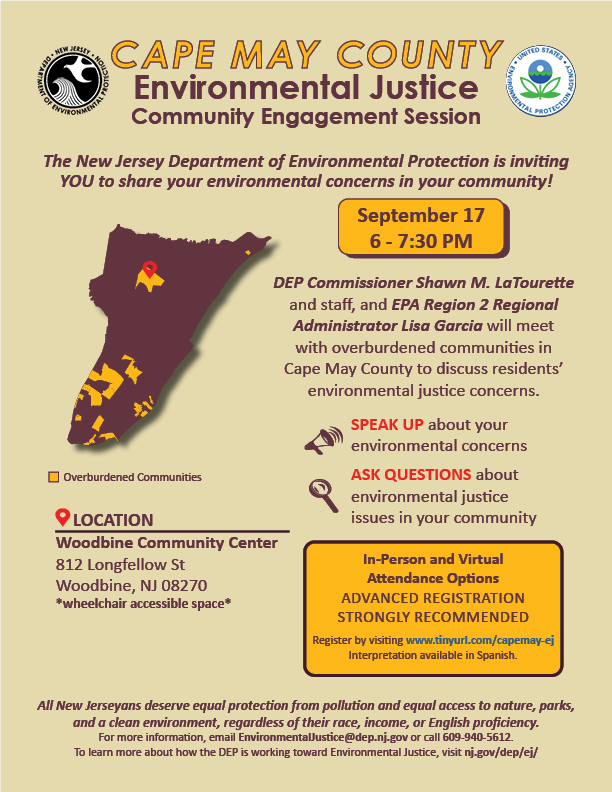 Register Now for OEJ's Upcoming Environmental Justice Community Engagement Session in Woodbine!
Join the Office of Environmental Justice on September 17th to discuss your environmental concerns at the next EJ Community Engagement Session with DEP Commissioner Shawn LaTourette and EPA Region 2 Regional Administrator Lisa Garcia.
Date and Time: Tuesday, September 17th, 2024, 6:00-7:30pm
Location: Woodbine Community Center, 812 Longfellow St, Woodbine, NJ 08270
Attend in-person or virtually via Zoom. Translation is available in Spanish. Registration strongly encouraged.
 Upcoming Public Hearings for New NJPACT REAL Rule Proposal
NJDEP is modernizing land resource protection rules to better support New Jersey communities, residents, and businesses in building their resilience to sea-level rise, extreme weather, chronic flooding, and other impacts of our changing climate. Almost two-thirds of New Jersey’s coastline is already at high or very high risk to coastal erosion and 98% of the coastline is projected at medium or very high risk to sea level rise. Over half a million acres of New Jersey land are highly vulnerable to coastal hazards.
The New Jersey Protecting Against Climate Threats (NJPACT) Resilient Environments And Landscape (REAL) rule proposal is part of an initiative directed by Governor Phil Murphy’s Executive Order 100 (Jan. 2020). Through amendments to existing land resource protection rules, REAL will bolster our resilience to the unavoidable impacts of climate change. The reform will address sea-level rise, coastal storm surge, flooding, and stormwater management concerns while improving water quality, protecting natural resources, and streamlining permitting processes that will expedite resilient investments in New Jersey’s communities and economy.
There will be three public hearings concerning the proposal as follows:
-
September 5, 2024, Live at 6:00 P.M., at Ocean County College, Gateway Lecture Hall #104 (Bldg. #101), College Drive, Toms River, NJ 08754;
-
September 12, 2024, Virtually at 2:00 P.M.
-
September 19, 2024, Virtually at 10:00 A.M.
Written comments can be submitted by mail or via online form by November 3, 2024. More information is available online.
STEW-MAP Survey for Municipal and County Leaders
DEP's NJ Urban and Community Forestry Program wants your input! The Stewardship, Mapping, and Assessment Project (STEW-MAP) was developed by the U.S. Forest Service to identify and map partnerships, organize data, and recognize gaps in stewardship. The goal of this initial survey is to better understand urban and community forestry in the state of New Jersey at the municipal and county level, learning who local governments work with and the extent of their urban and community forestry programs. The outcomes of this project will help inform ways in which the State and its partners can better support collaboration among communities and understand the capacity of urban and community forestry in New Jersey.
The survey is available through September 27th, 2024. Learn more online.
Funding and Technical Assistance Opportunities
In case you missed it, see below for opportunities that provide funding and assistance for projects related to green infrastructure, climate change, healthy communities, and more.
US DOT’s Reconnecting Communities Pilot (RCP) Grant Program
The US Department of Transportation has announced $607 million available through the Reconnecting Communities Pilot Program for capital construction and community planning activities that address economic, environmental, or public health disparities created by federal highway policy, and reconnect communities divided by transportation infrastructure. Eligible projects include the removal, retrofitting, or mitigation of highways that restrict mobility in disadvantaged communities, projects that improve access to daily needs such as jobs, education, health care, food, nature, and recreation, or community-centered development initiatives.
Potential applicants who are interested in pursuing a reconnecting type of project but are not prepared to submit funding requests can submit a request for technical assistance through the Reconnecting Communities Institute, which is also hosting free, virtual clinics and office hours.
Applications are due September 30th, 2024. More information is available online.
Green Workforce Training Grant Applications Now Open!
NJEDA's Green Workforce Training Grant Challenge is a competitive funding opportunity that will award grants to launch or expand workforce development and skills training programs focused on strengthening and diversifying New Jersey’s green economy talent pipeline. A total of $7 million will be available through this program, with individual awards ranging from a minimum of $250,000 to a maximum of $1.5 million.
Priority will be given to applicants that propose initiatives supporting training and job access for residents of Overburdened Communities. Proposed initiatives must focus on one or two (but no more than two) of the following industries: offshore wind, other renewable energy technologies, green design and construction, environmental and green infrastructure, grid resilience, clean transportation, and energy efficiency.
Applications are due October 8th, 2024 by 5pm. Learn more online.
|
All New Jersey residents, regardless of income, race, ethnicity, color, or national origin, have a right to live, work, and recreate in a clean and healthy environment. Historically, New Jersey’s low-income communities and communities of color face a disproportionately high number of environmental and public health stressors and, as a result, suffer from increased adverse health effects. New Jersey seeks to correct these outcomes by furthering the promise of environmental justice.
DEP’s Office of Environmental Justice (OEJ) aims to improve the quality of life in New Jersey’s most vulnerable communities by educating and empowering communities who are often outside of government decision-making processes and guiding DEP’s programs and other state departments and agencies in implementing environmental justice.
|
|