|
Subscribe to EJ Law Notices by County: Did you know that you can receive notices to upcoming EJ Law application hearings in your area? Subscribe online and select the counties in which you'd like to stay up-to-date for hearings near you.
Environmental Justice Newsletter
May 23rd, 2024
Summary of Important Dates
Announcements
Governor Murphy and DEP Introduce First-in-Nation Suite of Reforms to Build Community Resilience to Coastal Flooding
As part of the New Jersey Protecting Against Climate Threats (NJ PACT) initiative, Govenor Murphy and NJDEP have jointly announced a forthcoming rule proposal intended to modernize a suite of DEP regulations to better protect New Jersey communities from coastal flooding, sea-level rise, and other public health and safety risks that are increasing due to climate change. Known collectively as REAL – Resilient Environments and Landscapes- reforms, the proposed rule would make NJ the first state to initiate a comprehensive update of land resource protection regulations to address the current and future impacts of a changing climate. The REAL reforms would amend New Jersey’s existing flood hazard, stormwater, coastal zone, and freshwater wetland regulations statewide to address these ongoing impacts, while improving water quality and flood protections and addressing issues that are of particular concern to overburdened communities.
DEP is hosting a series of webinars to share REAL proposal details with the public. Learn more online.
Biden-Harris Administration Announces $3 Million in NJ Brownfield Grants
On May 20th, the EPA announced the selection of four NJ communities to receive grants totaling $3 million in competitive EPA Brownfields funding through the Multipurpose, Assessment, and Cleanup (MAC) Grant programs. Many communities that are under economic stress, particularly those located in areas that have experienced long periods of disinvestment, lack the resources needed to initiate brownfield cleanup and redevelopment projects. Programs will help transform once-polluted, vacant, and abandoned properties in Camden, Red Bank, and Woodbine into community assets, while helping to create good jobs and spur economic revitalization in overburdened communities. Learn more online.
NJ to Receive $123 Million for Lead Pipe Replacement to Advance Safe Drinking Water
On May 2nd, the EPA announced $123.1 million from President Biden’s Investing in America agenda to help New Jersey identify and replace lead service lines, preventing exposure to lead in drinking water. Working collaboratively, EPA and the State Revolving Funds are advancing the administration's Justice40 Initiative as lead exposure disproportionately affects communities of color and low-income families. The total funding announced through this program to date is expected to replace up to 1.7 million lead pipes nationwide, securing clean drinking water for all families.
Attorney General and DEP Announce Filing of Four New Enforcement Actions in Environmental Justice Communities
On April 25th, the Attorney General's Office and DEP announced four new lawsuits against facilities in and around overburdened communities as defined under New Jersey’s Environmental Justice Law. The facilities sued include Wilenta Feed in Secaucus, Gas Mart in Jersey City, PC Shell in Vorhees and FM Equities in Pennsauken. Including the actions announced, the Office of the Attorney General and the DEP have filed 68 environmental justice cases or actions since 2018. A new resource explaining New Jersey’s environmental justice enforcement actions, including an interactive map, is available online.
NJ Flood Disclosure Laws Now in Effect
New Jersey faces escalating flood risks due to climate change. By 2050, sea-level rise could exceed 2.1 feet, endangering over 40,000 coastal properties. Increased precipitation intensity also heightens severe inland flash flood risks. To address this, New Jersey enacted the Flood Risk Disclosure Law in 2023, which requires landlords and property sellers to disclose flood risks to buyers and tenants. The law went into effect on March 20, 2024.
The flood disclosure law, while not under the jurisdiction of Blue Acres, fosters transparency and awareness of flood risks among property buyers and tenants, in line with Blue Acres' mission to empower informed decisions and address flood-related risks in New Jersey communities and properties. This law is vital to protecting overburdened communities that are vulnerable to flooding. Learn more online.
NJ Board of Public Utilities Selected for EPA's Solar for All Program
Funded through the federal $7 billion Solar for All program, NJ Board of Public Utilities (NJBPU) has designed a SFA program that tackles the major barriers that have prevented the adoption of solar energy by low-income and disadvantaged households. As a result of cross-agency collaboration, the state has determined four key pillars for this federal funding opportunity: residential solar, multi-family housing solar and storage, residential-serving community solar, and technical assistance and workforce development.
The State's proposed use of funds will work to reduce greenhouse gas emissions and other air pollution, deliver cost savings on electric bills for overburdened households, and unlock new markets for distributed solar. Learn more online.
Participation Opportunities
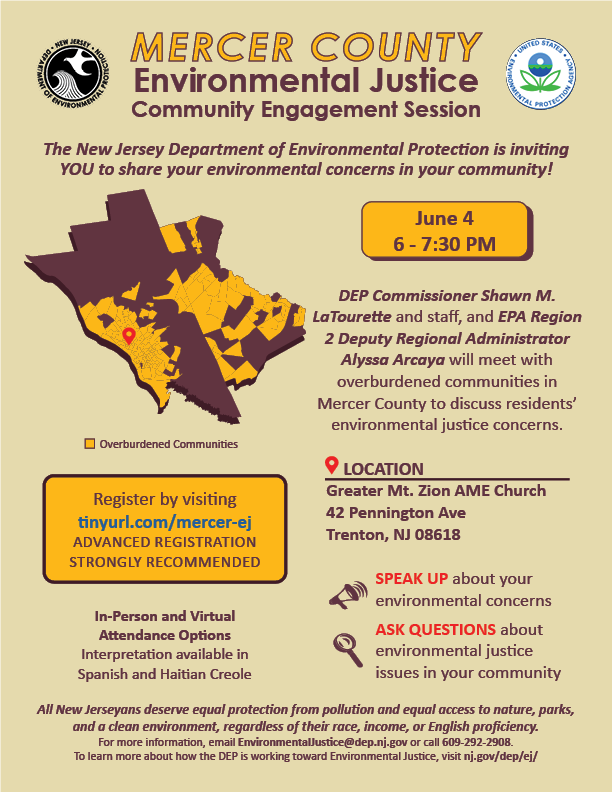
Register Now for Upcoming Mercer County Community Engagement Session!
Discuss your concerns at the next EJ Community Engagement Session with DEP Commissioner Shawn LaTourette and EPA Region 2 Deputy Regional Administrator Alyssa Arcaya.
Date and Time: June 4th, 2024, 6pm - 7:30pm
Location: Greater Mt. Zion AME Church, 42 Pennington Ave Trenton, NJ 08618
Attend in-person or virtually via Zoom. Translation is available in Spanish and Haitian Creole.
 Upcoming Environmental Justice Law Public Hearings
May 28- Safety Kleen- Linden, Union County, EJ Rule (virtual only)
June 12- Gaeta Recycling- Paterson, Passaic County, EJ Rule (hybrid)
Facilities subject to the Environmental Justice Law must facilitate meaningful opportunities for overburdened communities to engage in permitting decisions for pollution-generating facilities through an enhanced public participation process. Subscribe to EJ Law notices by County
NJ Energy Master Plan Public Hearing and Comment Period
The New Jersey Board of Public Utilities (NJBPU) invites you to attend a virtual public hearing on proposed updates to the 2019 New Jersey Energy Master (EMP) Plan on Wednesday, May 29th at 9:30am. The 2024 EMP will serve as a whole-of-government progress report on the goals and strategies in the 2019 EMP, outline the changing landscape of State and Federal support for climate action, and determine the basis for the development of actionable next steps to reduce greenhouse gas emissions and maximize clean energy uptake economy-wide. The meeting will specifically review and seek feedback on strategies and actions related to supporting community energy planning and action in Underserved Communities and expanding the Clean Energy Innovation Economy.
Written comments on the Plan can also be submitted online by 5pm on June 12th, 2024. Learn more online.
Green Acres Stakeholder Outreach Meetings for Local and Nonprofit Assistance Rules
The Green Acres Program is hosting a series of virtual outreach meetings to discuss planned changes to Green Acres rules and receive public feedback. The Green Acres rules govern the award of loans or matching grants, or both, to local government units for the acquisition or development of land, and matching grants to nonprofits for the acquisition or development of land, for outdoor recreation and conservation purposes. In advance of the expiration of these rules in December 2025, the Green Acres Program invites local government and nonprofit partners and the public to contribute to the process of making changes to the rules.
Meeting topics include acquisition funding, park development and stewardship funding, and non-profit issues. Learn more online.
Draft Environmental Justice Strategic Plan Virtual Listening Sessions and Open Public Comment Period
The Justice Department is hosting two Virtual Public Listening Sessions on Wednesday, May 29th, 2024, and Thursday, May 30th, 2024, to gather input for the development of the Department’s Draft Environmental Justice Strategic Plan. As directed by President Biden's Revitalizing Our Nation’s Commitment to Environmental Justice for All Executive Order, the Draft Plan includes goals to prioritize cases, meaningfully engage with impacted communities, increase education and collaboration, and assess and evaluate environmental justice in the Justice Department’s climate adaptation efforts.
Written comments can also be submitted by mail or via online survey through Monday, July 8, 2024. More information can be found online.
Healthy and Resilient Communities Research Webinar Series
EPA's Office of Research and Development invites you to join in their upcoming webinar, Cumulative Impacts: How Potential Flood Exposures, Resource Access, and Social Vulnerability Affect Resilience Outcomes on Tuesday, June 11, 2024, from 3:00 p.m. to 4:00 p.m. Part of EPA's greater Healthy and Resilient Communities Research Webinar Series, this session will cover geospatial model development and model applications in cumulative impacts research.
The presentation will discuss the basic concepts and data that drive the models, as well as case studies that illustrate their utility in decision-making, goal setting and goal tracking. The research is grounded in environmental justice and resilience frameworks and is meant to connect local disparities to broader resilience outcomes, with a focus on delivering information at multiple geographic scales. Learn more online.
Join the WE ACT TCTAC Community Voices Cohort!
As part of EPA Region 2's Thriving Communities Technical Assistance Centers (TCTAC), WE ACT is building a rotating network of community outreach voices to support its in-person outreach throughout New York and New Jersey. The TCTAC Community Voices cohort will provide local support curated to meet the needs of the region, conduct outreach to regional Environmental Justice communities, support design and facilitation of in-person training in their region, and provide feedback on the design, implementation, and impact of the TCTAC program. The TCTAC Community Voices will also be crucial in achieving our movement-building goals.
Participants will meet to determine regional priorities regarding environmental justice, climate justice, and energy justice, informing the development of a Regional Environmental Justice Network in subsequent years of the project.
Applications are due by Friday, May 31, 2024. Learn more online.
Webinar: Redefining “Disadvantaged Communities” in a New Water Infrastructure Era
As part of the EPA Learning Exchange, Source Water Collaborative is hosting a free informational webinar entitled Redefining “Disadvantaged Communities” in a New Water Infrastructure Era on May 30th from 2:30 to 4pm. This webinar will share what clean water advocates can do to help states achieve the most equitable process possible for source water protection in their programs and the role public participation requirements had in modifying their definitions of a “disadvantaged community”. In addition, the webinar will cover how states have ensured their definitions bring about the most equitable outcome possible and challenges states have had in implementing the funding. Learn more online.
Environmental Justice Webinar Series for Tribes and Indigenous Peoples
The U.S. Environmental Protection Agency’s Environmental Justice Webinar Series for Tribes and Indigenous Peoples includes monthly webinars intended to build the capacity of Tribal governments, Indigenous Peoples, and other environmental justice practitioners by discussing priority environmental justice issues of interest to Tribes and Indigenous Peoples. Webinar agendas will include updates from the Office of Environmental Justice and External Civil Rights, best practices to advance EJ, and Tribal presenters. Learn more online.
North Hudson Sewerage Authority Tour and Public Information Meeting
North Hudson Sewerage Authority (NHSA) is hosting an upcoming public information meeting to discuss projects aimed at expanding treatment plant capacity and constructing detention facilities to better manage stormwater. The meeting will include a presentation on their Combined Sewer Overflow (CSO) Long Term Control Plan and review updates on ongoing projects in Hoboken and Weehawken, both designated as overburdened communities. NHSA engineers and representatives will be present to address any questions or concerns.
Date and Time: June 10th, 2024, 4pm-7pm
Location: NHSA Administration Building, 1600 Adams Street Hoboken.
The CSO Long Term Control Plan presentation begins at 4:15 pm and will be repeated at 5:15 pm. Tours of the NHSA Treatment Plant will be at 5:00 pm and 6:00 pm.
Funding and Technical Assistance Opportunities
In case you missed it, see below for opportunities that provide funding and assistance for projects related to green infrastructure, climate change, healthy communities, and more.
Call for Water Utilities: No-Cost Climate Change Risk Assessment Opportunities
Through EPA’s Creating Resilient Water Utilities initiative, drinking water, wastewater, and stormwater (water sector) utility owners and operators can receive one-on-one, no-cost climate change risk assessment support using CRWU’s tools and resources, including their Environmental Justice Story Map. Through this initiative utilities can better understand potential risk to climate change threats, identify adaptive measures to become more resilient to those threats; and identify funding sources for implementation of those adaptive measures. Interested parties can request this technical assistance support via online form. Learn more online.
|
All New Jersey residents, regardless of income, race, ethnicity, color, or national origin, have a right to live, work, and recreate in a clean and healthy environment. Historically, New Jersey’s low-income communities and communities of color face a disproportionately high number of environmental and public health stressors and, as a result, suffer from increased adverse health effects. New Jersey seeks to correct these outcomes by furthering the promise of environmental justice.
DEP’s Office of Environmental Justice (OEJ) aims to improve the quality of life in New Jersey’s most vulnerable communities by educating and empowering communities who are often outside of government decision-making processes and guiding DEP’s programs and other state departments and agencies in implementing environmental justice.
|
|