Announcements
Murphy Administration Advances Greenway Development Plans
A nine-mile former rail line through parts of Hudson and Essex counties is one step closer to becoming a new state park. The first phase of the multimillion-dollar project will be focused on a nearly two-mile span through Newark, Essex County, and Kearny, Hudson County.
DEP plans to break ground on the Newark-Kearny segment of the Hudson-Essex Greenway in early 2024 and open to the public in late 2025. The project adds vital open space and recreational opportunities to the overburdened communities that the Greenway travels through. The project is a catalyst for environmental improvements and economic development, expanding access to green, open space, increasing transportation and recreation opportunities, and improving stormwater management and air quality.
Learn more about the Greenway online.
Murphy Administration Adopts Zero-Emission Vehicle Standards to Improve Air Quality, Fight Climate Change, and Promote Clean Vehicle Choice
On December 18, the Advanced Clean Cars II rule will be adopted, setting the state on the road toward better air quality and cleaner choices for new car buyers while combatting the worsening climate crisis. The rule will take effect starting in model year 2027, ramping up to 100% zero-emission vehicles (ZEVs) by 2035. This will positively impact air quality, especially in overburdened communities near high-traffic corridors.
A pre-publication copy of the rule will be posted in early December to the DEP Rules and Regulations webpage.
Participation Opportunities
Upcoming Environmental Justice Law Public Hearings
December 7 - Diversified Global Graphics Group - AO25 - Bridgewater, Somerset County (virtual/in-person)
Facilities subject to the Environmental Justice Law must facilitate meaningful opportunities for overburdened communities to engage in permitting decisions for pollution-generating facilities through an enhanced public participation process. Subscribe to EJ Law notices by County
Webinar: Technical Assistance for Tribes and Indigenous Peoples to Advance Environmental Justice and Climate/Energy Justice
The EPA Office of Environmental Justice and External Civil Rights (OEJECR) will host a webinar to present information on the new technical assistance programs, such as the Thriving Communities Technical Assistance Centers (TCTAC’s), that are available to Tribes and Indigenous Peoples.
This webinar series is intended to build the capacity of Tribal governments, Indigenous Peoples and other environmental justice practitioners by discussing priority environmental justice issues of interest to Tribes and Indigenous Peoples.
This webinar will take place on December 14 from 2:30 PM to 4:00 PM.
NJDEP Grants and Loans Needs Survey
Help us help you! Please take the NJDEP's survey to share your environmental needs and challenges as a local government or nonprofit organization. Your responses will help the NJDEP better assist you through grants, loans, and other opportunities.
- If you represent or work for a county or municipality, please take this survey.
- If you work for a nonprofit organization, please take this survey.
Questions can be sent to unitingfinancialresources@dep.nj.gov.
Funding and Technical Assistance Opportunities
EPA Community Change Grants Program
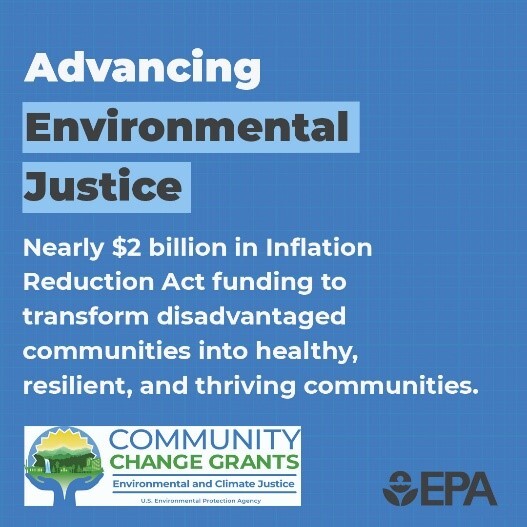
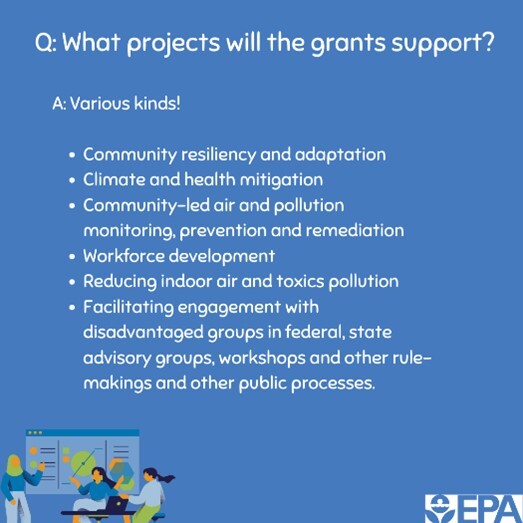
The EPA Environmental and Climate Justice Program (ECJP) Community Change Grants program is NOW OPEN! The program is funding projects to address environmental and climate injustices for communities facing legacy pollution, climate change, and persistent disinvestment. Technical assistance on your application will also be available. In total, $2 Billion will be rewarded with $50 million reserved for U.S. territories.
Who can apply?
- A partnership between at least two community-based organizations.
- A partnership between a community-based organization and one or any of the following: Federally recognized tribes, Local governments, Higher education institutions
Applications are open now and will be accepted on a rolling basis until November 21, 2024.
An informational video is available online.
Small Communities, Big Challenges:
Rural Environmental Public Health Needs Prize Competition
To gain a better understanding of environmental and public health challenges facing rural communities, EPA is launching the “Small Communities, Big Challenges” Competition. The goal of this Competition is for local governments to identify innovative and effective ways to holistically engage rural communities around environmental health issues and to identify any associated barriers to better protecting human health.
EPA will use the solutions from this Competition to learn of unique or innovative strategies for engaging with rural communities and of the environmental public health issues that rural communities are faced with.
Up to 10 selected winners will each receive $25,000. Five individual Challenge winners will be given a 1-year National Environmental Health Association (NEHA) membership. Apply by midnight on January 31.
National Park Service Outdoor Recreation Legacy Partnership Program Grants
NPS announced that it will distribute over $224 million to communities through Round 7 of the Outdoor Recreation Legacy Partnership (ORLP) grant program. ORLP funds the acquisition or development of new parks, or substantial renovation of parks, in economically disadvantaged municipalities of at least 30,000 people.
Applications must be submitted through DEP’s Green Acres Program. To determine eligibility and to advance the most competitive projects, Green Acres requires applicants to submit a project proposal by January 5, 2024.
2024 Green Acres and Urban Parks Funding
Green Acres and Urban Parks 2024 round of grants and loans to local governments and nonprofits is now open. Funds can be used to establish, expand, or revitalize new and existing parks, acquire land, improve waterfront access, develop athletic fields and playgrounds, create open space, and enhance land stewardship. These grants aim to incentivize projects in Overburdened Communities within Urban Aid municipalities.
Upcoming virtual application information sessions will be held on December 13 and January 17. More information about the applications are available online.
Coastal Habitat Restoration and Resilience Grants
To support opportunities for tribes, and/or tribal entities, and underserved communities to meaningfully engage in coastal habitat restoration activities. Potential activities include:
-
Capacity building, (municipal or regional-scale resilience planning, project planning and feasibility studies, stakeholder engagement, proposal development for future funding, and outreach and education, hiring of staff to increase capacity to support implementation)
-
Actionable science support (collection and/or analysis of climate, habitat or other community- or conservation-related data that informs planning and decision making)
-
Restoration project activities (engineering and design, permitting, on-the-ground restoration, and pre- and post-project implementation monitoring)
More information is available online. Applications are due December 19.
2023 Clean School Bus Rebate Program
EPA has announced their 2023 Clean School Bus Rebate Program providing $500 million in funding for electric school buses. EPA is prioritizing applications that will replace buses serving high-need local education agencies, rural areas, Tribal school districts funded by the Bureau of Indian Affairs and public school districts receiving basic support payments for students living on Tribal land.
The EPA has designated 54 New Jersey school districts as priority. An additional 145 school districts are eligible to self-certify as priority. Eligible applicants can apply to receive funding for the purchase of up to 25 zero-emission (ZE) and/or clean school buses, along with ZE charging infrastructure and eligible workforce development costs.
More information is available online. Applications are due on January 31 at 4 PM.
Request Assistance through the Training and Technical Assistance Program for Rural, Small, and Tribal Wastewater Systems
The Clean Water Rural, Small, and Tribal Technical Assistance (RST TA) Grant Program aims to provide technical assistance and training to improve rural, small and tribal wastewater system operations and management practices, making them more sustainable and resilient, and supporting EPA’s mission to protect public health and the environment. The program also aims to provide technical assistance in planning, developing and accessing finance and funding for clean water projects under the Clean Water State Revolving Fund (CWSRF), including Infrastructure Investment and Jobs Act funds.
Communities may request technical assistance support through the EPA’s Water Technical Assistance (WaterTA) Request Form. More information about the RST TA is available online.
Career Opportunities
DEP OEJ Environmental Justice Design Intern
The Office of Environmental Justice (OEJ) is seeking an Environmental Justice Design Intern who will work to 1. Improve DEP’s public engagement tools, and 2. Better inform communities of how the NJDEP operates. The intern will create a series of pamphlets, fact sheets, charts, and timelines to better highlight and educate residents of New Jersey’s overburdened communities on DEP’s various programs, how they can become involved, and how their input is used to inform the agency’s work. Strong graphic design, artistic, research and writing skills required. Apply by January 2.
DEP OEJ Environmental Justice Policy Intern
The Office of Environmental Justice (OEJ) is seeking an Environmental Justice Policy Intern. OEJ has multiple initiatives to integrate environmental justice principles into the DEP’s operations, and the intern will assist in OEJ's integration efforts through projects that include topics such as Trends in Environmental Justice and Civil Rights, and Environmental Justice through Enforcement. Prospective applicants must have strong research and technical writing skills, and collaborate well with others. Apply by January 2.
EJ Disrupt Design: An Environmental Justice Movement Fellowship
EJ Disrupt Design: An Environmental Justice Movement Fellowship is a 2-year experience made up of progressive phases in Environmental Justice and Design for leaders of the Environmental Justice Movement.
Launched by The New School's Tishman Environment and Design Center, Fellows will participate in a combination of virtual and in-person retreats, group coaching sessions, and community ideation to scale project prototypes and build power. EJ Leaders work in self-formed core groups of 3-4 through a collaborative, iterative process to design, test, and scale climate justice solutions rooted in their community.
Applications are open to groups of 3-4 environmental justice leaders. Approximately 4-5 groups will be selected to participate in the 2024-2026 Fellowship cohort. Applications close at midnight on January 15.
|
All New Jersey residents, regardless of income, race, ethnicity, color, or national origin, have a right to live, work, and recreate in a clean and healthy environment. Historically, New Jersey’s low-income communities and communities of color face a disproportionately high number of environmental and public health stressors and, as a result, suffer from increased adverse health effects. New Jersey seeks to correct these outcomes by furthering the promise of environmental justice.
DEP’s Office of Environmental Justice (OEJ) aims to improve the quality of life in New Jersey’s most vulnerable communities by educating and empowering communities who are often outside of government decision-making processes and guiding DEP’s programs and other state departments and agencies in implementing environmental justice.
|
|