Announcements
DEP, TCNJ, and Sustainable Jersey Announce Award
of $4.55 Million in Trees for Schools Grants
DEP Commissioner Shawn M. LaTourette, Sustainable Jersey and The College of New Jersey today announced the award of $4.55 million in grants to fund the planting of trees at 34 public schools, colleges, and universities in the state.
Seventy-five percent of grant project sites are located in an overburdened community, which surpasses the program’s goal of allocating 40 percent of the grant funding for applicants located in overburdened communities. Moreover, many of the trees will be planted in urban communities where excessive paving and deficient tree cover results in higher temperatures, a condition known as the heat-island effect.
More information is available online.
DEP Launches Project to Help Burlington County Municipalities Assess and Become More Resilient to Climate Change Hazards
DEP Commissioner Shawn M. LaTourette today announced the launch of a project that will help 11 Burlington County municipalities assess climate change-related hazards and develop planning efforts that will make them more resilient to the impacts of flooding and severe storms.
The assistance is being offered through the DEP’s Office of Climate Resilience Resilient NJ: Municipal Assistance Program, which provides a team of consultants to evaluate vulnerability to current and future hazards including rising temperatures, flooding and sea-level rise, and hurricanes, among others. The 11 communities along the Delaware River and its tributaries, including the Rancocas, Assiscunk, and Pompeston creeks, are frequently impacted by severe flooding events. Nine of the Burlington County project municipalities meet the state’s criteria as overburdened communities.
More information is available online.
Learn About Extreme Heat Health Risks
Take the Heat Hub NJ Survey
Heat Hub NJ is a digital resource on all things related to extreme heat in NJ. To prepare for the launch of the cooling center locator, Heat Hub NJ welcomes all to take a survey to test your knowledge on extreme heat and the health risks associated with it. The results of the survey will help prepare for cooling center openings, operations, and alerts once the cooling center locator launches in Spring 2024.
Learn about extreme heat and take the survey online.
Biden-Harris Administration Launches American Climate Corps to Train Young People in Clean Energy, Conservation,
and Climate Resilience Skills
The American Climate Corps will mobilize a new, diverse generation of more than 20,000 Americans – putting them to work conserving and restoring our lands and waters, bolstering community resilience, deploying clean energy, implementing energy efficient technologies, and advancing environmental justice, all while creating pathways to high-quality, good-paying clean energy and climate resilience jobs in the public and private sectors after they complete their paid training program. The American Climate Corps will focus on equity and environmental justice – prioritizing communities traditionally left behind, including energy communities that powered our nation for generations, leveraging the talents of all members of our society, and prioritizing projects that help meet the Administration’s Justice40 goal.
Learn more about the American Climate Corps online.
Milestones in Resilience: New Jersey Announces Nearly $298 Million in Construction Contracts for Landmark Flood-Resilience Projects
for Hudson River and Meadowlands
DEP Commissioner Shawn M. LaTourette announced the award of nearly $298 million in construction contracts for two landmark flood-resilience projects in northern New Jersey funded through the U.S. Department of Housing and Urban Development’s Rebuild by Design competition grant program.
The projects – one within Hoboken and parts of Jersey City and Weehawken and another in the Meadowlands communities of Little Ferry, Carlstadt, Moonachie, South Hackensack and Teterboro – represent major milestones in protecting these regions from flooding resulting from more severe storms and sea-level rise associated with the worsening effects of climate change. These projects will benefit the overburdened communities that live in and around these flood-prone areas.
Learn more about the Rebuild By Design Hudson Project online.
Learn more about the Rebuild By Design Meadowlands Project online.
Murphy Administration Launches Resource to Help Teachers Incorporate Climate Change into Lesson Plans
The Summary of Climate Change in New Jersey is an important resource developed by the DEP to help teachers throughout the state understand and incorporate climate science into their lesson plans. With the New Jersey Board of Education’s adoption of the 2020 New Jersey Student Learning Standards, New Jersey became the first state in the nation to include climate change across content areas from kindergarten through high school. These standards are designed to prepare students to understand how and why climate change happens, the impact it has on our local and global communities, and to act in informed and sustainable ways.
Educators may download the summary online.
DEP Launches Online Mapping Tool to Target
and Coordinate Coastal Resilience Projects
The Coastal Ecological Restoration and Adaptation Planning (CERAP) Tool provides the locations of at-risk areas, coastal resource restoration sites, and other data that will greatly assist in the targeting, development and coordination of projects needed to adapt communities to rising sea levels, increased flooding and more severe storms associated with climate change. Data obtained from the tool may also be used to provide supporting documentation for applications for federal and state funding opportunities. This tool can be a vital resource for overburdened communities that have challenges with flooding, and other climate related issues.
More information on the Coastal Ecological Restoration and Adaptation Planning Tool is available online.
Participation Opportunities
Upcoming Environmental Justice Law Public Hearings
September 28 - Mercer Group - Solid Waste/Air Application - Trenton (virtual)
October 23 - Atlantic County Utilities Authority - Title V Renewal - Egg Harbor (virtual) (español)
Facilities subject to the Environmental Justice Law must facilitate meaningful opportunities for overburdened communities to engage in permitting decisions for pollution-generating facilities through an enhanced public participation process. Subscribe to EJ Law notices by County
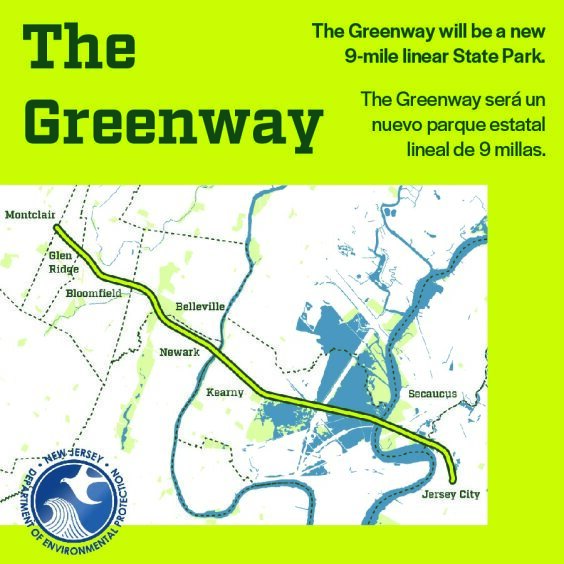 Greenway State Park Community Listening Session Workshops
Friday, 10/13, Art Fair 14C (Liberty State Park), 1-6pm
NJDEP and our consultants will host a booth at Art Fair 14C to gather feedback on preliminary Greenway design considerations and share the beginnings of what we've been learning from the community during past listening sessions. There will be a miniature to-scale model of a section of the Greenway that shows how some of the design pieces could fit together. Swing by to share your thoughts and help shape this project to your vision!
Thursday, 10/19, On the Greenway in Newark, 3-7pm
NJDEP and our consultants will be on the Greenway to show to-scale how various design aspects of the Greenway could fit together! This "fit test" will highlight some of the elements community members have highlighted from previous listening sessions. Come by and experience the Greenway, and provide more thoughts and feedback once you've seen it in action! The address for this event is approximately 225 Manchester Place, Newark, NJ 0710.
DEP Urges Public to Provide Input on Statewide
Comprehensive Outdoor Recreation Plan
DEP is announcing the start of a 30-day public comment period for the Statewide Comprehensive Outdoor Recreation Plan (SCORP) for New Jersey. The SCORP, updated through the department’s Outside, Together! initiative, aims to enhance and provide equitable outdoor recreation and conservation opportunities throughout the state and ensure a sustainable future for New Jersey's natural resources.
Learn more about SCORP and the Outside, Together! initiative online.
Feedback can be submitted online.The public comment period ends October 18.
DEP Unveils Draft Agency-Wide Strategic Climate Action Plan
for Advancing Climate Work
The Strategic Climate Action Plan will set DEP’s course for continuing to address climate change impacts and inform the public about short-term and long-term climate actions.
DEP is issuing the SCAP in draft form to provide an opportunity for the public to inform and shape the final version. Feedback can be submitted online. The public comment period ends October 19 at 4 pm.
Funding Opportunities
HOPE Main Street Grant Program
This program provides grants to small communities to assist in the renovation of an historic or traditional central business district, or “Main Street” area, by replacing unused, obsolete, commercial space in buildings with affordable housing units. This opportunity can bring about economic revitalization to overburdened communities. Applications are due October 12.
Learn more about the HOPE Main Street Grant Program online.
Coastal Habitat Restoration and Resilience Grants
To support opportunities for tribes, and/or tribal entities, and underserved communities to meaningfully engage in coastal habitat restoration activities. Potential activities include:
-
Capacity building, (municipal or regional-scale resilience planning, project planning and feasibility studies, stakeholder engagement, proposal development for future funding, and outreach and education, hiring of staff to increase capacity to support implementation)
-
Actionable science support (collection and/or analysis of climate, habitat or other community- or conservation-related data that informs planning and decision making)
-
Restoration project activities (engineering and design, permitting, on-the-ground restoration, and pre- and post-project implementation monitoring)
More information is available online. Applications are due December 19.
Rural, Small, and Tribal Technical Assistance (RST TA)
EPA’s providers deliver targeted technical assistance and training to rural, small, and tribal municipalities and wastewater treatment systems to protect public health and safeguard the environment. The RST TA providers serve an important role in helping to:
- Ensure that rural, small, and tribal communities that have difficulty in securing public funding receive the help they need to access resources to support infrastructure improvements.
- Support rural, small, and tribal wastewater treatment systems – centralized and decentralized – build their technical, managerial, and financial capacity to operate their systems well and maintain compliance.
Learn more about the RST TA online. Applications are ongoing.
Community Change Grant Program
EPA’s new Environmental and Climate Justice Community Change Grants program (Community Change Grants) will invest approximately $2 billion dollars in Inflation Reduction Act funds in environmental and climate justice activities to benefit disadvantaged communities through projects that reduce pollution, increase community climate resilience, and build community capacity to respond to environmental and climate justice challenges. Community Change Grants will open applications Autumn 2023.
Learn more about the upcoming Community Change Grants online.
Drinking Water System Infrastructure Resilience
and Sustainability Program
EPA announced $19 million in new grant funding that will work to improve the climate resilience of the nation’s water infrastructure. The funding available under this competitive grant opportunity will assist public water systems in underserved communities, small or disadvantaged, that are working to prepare for and reduce vulnerability to impacts from climate change ranging from extreme flooding to extreme drought. Applications due November 6.
More information about this grant opportunity is available online.
|
All New Jersey residents, regardless of income, race, ethnicity, color, or national origin, have a right to live, work, and recreate in a clean and healthy environment. Historically, New Jersey’s low-income communities and communities of color face a disproportionately high number of environmental and public health stressors and, as a result, suffer from increased adverse health effects. New Jersey seeks to correct these outcomes by furthering the promise of environmental justice.
DEP’s Office of Environmental Justice (OEJ) aims to improve the quality of life in New Jersey’s most vulnerable communities by educating and empowering communities who are often outside of government decision-making processes and guiding DEP’s programs and other state departments and agencies in implementing environmental justice.
|
|