Announcements
Murphy Administration Releases Its 2nd RGGI Strategic Funding Plan
Continuing Investments in Climate Change Reduction, Environmental Justice and Clean Energy Through 2025
The second Regional Greenhouse Gas Initiative (RGGI) Strategic Funding Plan: Years 2023 through 2025 introduces new investments while prioritizing projects that will benefit New Jersey’s environmental justice communities.
The 2023-2025 Strategic Funding Plan identifies four initiatives for funding:
- Accelerate healthy homes and building decarbonization
- Catalyze clean, equitable transportation
- Strengthen New Jersey’s forests
- Promote blue carbon in coastal habitats
In conjunction with the plan’s release, the DEP also announced that it is opening another competitive solicitation to invest over $13 million in the purchase of additional electric trucks in overburdened communities.
More information on RGGI, RGGI strategic investments in New Jersey, NJ's vehicle electrification goals, and updates on RGGI-funded programs are available online.
EJMAP Stressors Update
On July 27, DEP released an updated version of the Environmental Justice Mapping, Assessment and Protection Tool (EJMAP). This update includes new stressor data that has been made publicly available since its original release on April 11th. Any permit application subject to the Environmental Justice Law submitted on or after July 31, 2023 must use the new stressor data layer for analysis.
The tool will now default to the updated layer. The original layer will remain as an archived layer within the tool and will have its own button for permit applications received from April 11th, 2023 to July 30th, 2023. To learn what stressor data was updated in EJMAP, visit the EJMAP Data Update.
Questions or comments about the EJMAP can be sent to ejmapfeedback@dep.nj.gov.
Governor Murphy Announces Filing of Landmark
Advanced Clean Cars II Proposal
On July 17, Governor Phil Murphy announced the filing of the Advanced Clean Cars II (ACCII) proposal. ACCII requires vehicle manufacturers to make zero emission vehicles (ZEVs) an increasing percentage of their new light-duty vehicle sales, ramping up to 100% ZEVs by 2035. This will greatly decrease emissions in across the state, but especially in New Jersey's Overburdened Communities, many of which are adjacent to, or have highways cutting directly through them. The Office of Administrative Law is expected to publish the proposal in the August 21 New Jersey Register, starting a public comment period that will run through October 20, 2023.
Additionally, Governor Murphy announced that New Jersey has signed on to the Accelerating to Zero Coalition’s Zero Emission Vehicle (ZEV) Declaration, a landmark global agreement launched by the UK at the 26th UN Climate Change Conference of the Parties (COP26) in November 2021 and signed by 41 national governments and 74 cities, states, and regional governments so far. New Jersey has signed on to Section 2C of the Declaration, which commits the state to a zero emission vehicle future in alignment with the Paris Agreement goals. Read the full press release.
Inland Flood Protection Rule Now Effective, July 17
The landmark Inland Flood Protection Rule to better protect New Jersey’s communities from worsening riverine flooding and stormwater runoff is now effective. This rule updates New Jersey’s existing flood hazard and stormwater regulations by replacing outdated precipitation estimates with modern data that account for observed and projected increases in rainfall. These changes will help reduce flooding from stormwater runoff and increase the resiliency of new developments located in flood-prone inland areas.
Governor Murphy Waives Park Fees
to Promote Affordability and Access for All
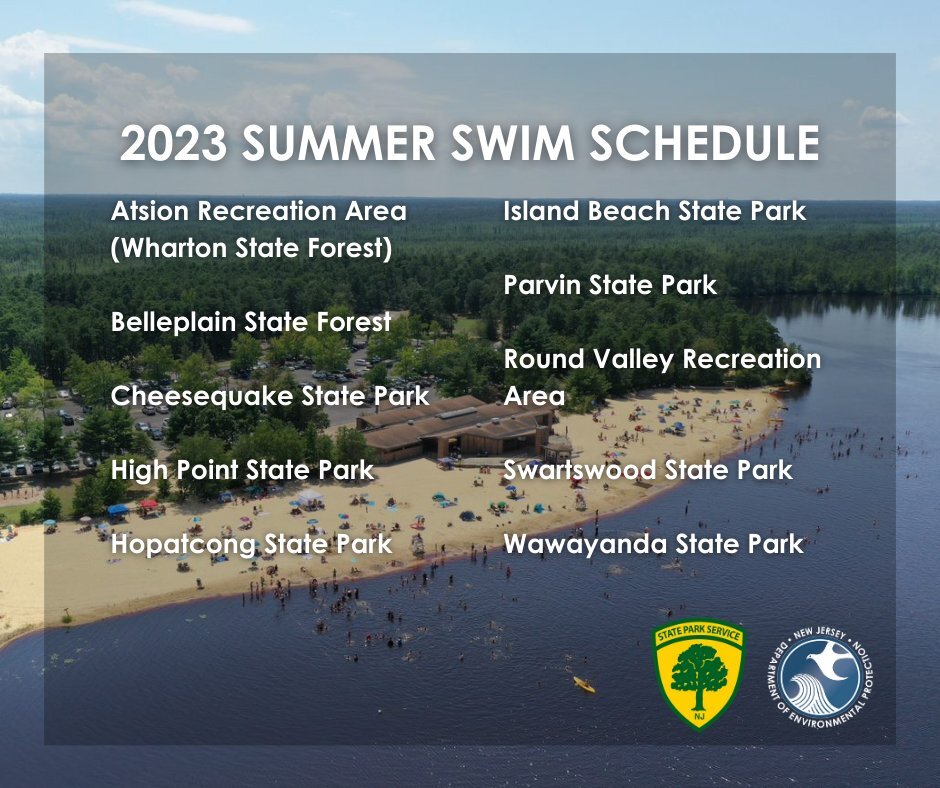 To advance affordability and opportunity in New Jersey, park fees were waived as part of Governor Phil Murphy’s budget for the 2024 fiscal year, which began on July 1, 2023. DEP has launched a social media campaign to encourage the public to beat the heat this summer and enjoy one of New Jersey’s swimming spots free of charge. See more information about state park fees here.
Participation Opportunities
Upcoming Environmental Justice Law Public Hearings
August 22 - Transco LNG Station 240 - Title V Modification - Carlstadt (virtual) (español)
Facilities subject to the Environmental Justice Law must facilitate meaningful opportunities for overburdened communities to engage in permitting decisions for pollution-generating facilities through an enhanced public participation process. Subscribe to EJ Law notices by County
EPA Launches Nationwide Series of
Community Lead Awareness Sessions
As part of the Biden-Harris Administration’s efforts to protect communities from childhood lead exposure and advance environmental justice, the U.S. Environmental Protection Agency (EPA) is announcing a series of free educational sessions on the dangers of lead and ways to reduce and prevent lead exposure. These sessions are based on the Lead Awareness Curriculum, an adaptable resource to protect communities from potential lead exposure, and will be held in English and Spanish.
The sessions will supplement EPA’s local lead training and outreach initiative, which has been implemented in 22 communities across the U.S. and Puerto Rico in 2021 and 2022. Learn more about EPA’s upcoming community lead awareness sessions.
Funding Opportunities
Environmental and Climate (ECJ) Grant Program
Design Webinar Series
EPA is hosting three informational webinars on August 3, 8, and 9 on the Notice of Funding Opportunity (NOFO) expected to be issued under the Inflation Reduction Act’s Environmental and Climate Justice (ECJ) Grant Program in 2023. These webinars will provide information on the NOFO and the ECJ Grant Program including who is eligible for the grants, eligible projects, and more. The NOFO will include approximately $2 billion for grants to eligible entities for a wide range of projects that benefit underserved communities including Tribal and Alaskan Native Village areas.
For questions about these webinars or to request reasonable accommodations for a disability, interpretation, and/or translation services in a language other than English, please email ECJRFI@epa.gov. Learn more about the ECJ program, funding and implementation.
US Army Corps of Engineers Funding Small Water Resource
Projects for Overburdened Communities
The U.S. Army Corps of Engineers (Corps) is launching a pilot program to fully fund the planning, design, and implementation of small water resources projects for economically disadvantaged communities. Project proposals are due by August 21, 2023.
Full details of the types of projects eligible for funding and the proposal requirements are available online.
EPA Clean School Bus Grant Funding and Webinars
The US EPA has announced its 2023 Clean School Bus Grant Program providing $400 million in grants for electric school buses. The EPA has designated 54 New Jersey school districts, most in overburdened communities, as priority. Applications are due by Tuesday, August 22, 2023, at 11:59PM.
The deadline for submitting questions is Wednesday, August 9, 2023 at 11:59PM.
More information is available online.
Vehicle Electrification Projects Grant Funding and Webinars
In a continuing effort to reduce diesel emissions and mitigate climate change, the New Jersey Department of Environmental Protection (DEP) is offering another round of funding to replace medium- and heavy-duty diesel vehicles with electric. Leveraging proceeds from New Jersey’s participation in the Regional Greenhouse Gas Initiative (RGGI), this solicitation will spend $13 million on local government vehicle electrification projects with a focus on overburdened communities. Project proposals are due by 11:59 pm on September 4, 2023.
Two live informational webinars with DEP Bureau of Mobile Sources staff will be held on August 9 and 16 to go over the solicitation and answer questions. More information on project eligibility and webinar registration are available online.
Brownfields Redevelopment Incentive Program
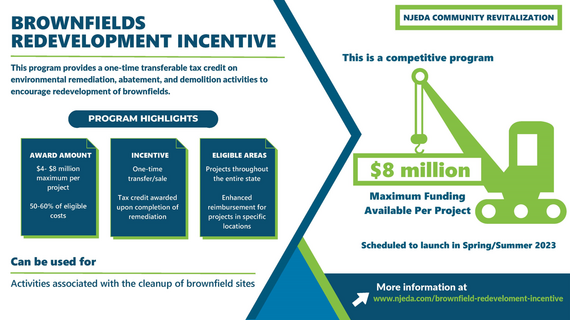
The New Jersey Economic Development Authority (NJEDA) is NOW accepting applications for the Brownfields Redevelopment Incentive Program. This $300 million competitive program offers up to $8 million in tax credits per project for environmental investigation, remediation, abatement, and demolition activities to allow for the redevelopment of brownfield sites in New Jersey. The overarching goal of this program is to redevelop blighted properties into community assets. This is a competitive program which is well funded. Applications are due by 5 pm on Thursday September 21, 2023.
A 2-minute survey is available at eligibility assessment tool to find out if your organization and site may qualify for the program.
Learn more and prepare to apply at Brownfields Redevelopment Incentive Program. If you have questions, please reach out to the NJEDA Brownfields Team at bftaxcredit@njeda.gov.
 Murphy Administration Offering $19 Million in Grants to Assist Municipalities with New Stormwater Permitting Requirements
The Murphy Administration announced the availability of $19 million in grants to help municipalities with the transition to new municipal stormwater permitting system requirements designed to better protect NJ's waterways from pollutants in stormwater. These permitting changes will also help mitigate localized flooding that is increasing due to climate change.
Full details of the Notice of Funds Availability (NOFA) are available online. Grants will be awarded on a rolling basis through December 31, 2023.
|
All New Jersey residents, regardless of income, race, ethnicity, color, or national origin, have a right to live, work, and recreate in a clean and healthy environment. Historically, New Jersey’s low-income communities and communities of color face a disproportionately high number of environmental and public health stressors and, as a result, suffer from increased adverse health effects. New Jersey seeks to correct these outcomes by furthering the promise of environmental justice.
DEP’s Office of Environmental Justice (OEJ) aims to improve the quality of life in New Jersey’s most vulnerable communities by educating and empowering communities who are often outside of government decision-making processes and guiding DEP’s programs and other state departments and agencies in implementing environmental justice.
|
|