|
|
WMHP Mission: Ensure Nebraska women and men have access to cancer
screening and prevention resources.
WMHP Vision: Nebraska Women and Men Living Healthy and Cancer Free Lives
|
|
WMHP QUICK READS
Provider Updates, Highlights, & Prevention Insights
Issue 5: September 2025
|
|
Women's & Men's Health Programs
Every Woman Matters (EWM) is a federally funded program that pays for office visits associated with Pap tests, pelvic exams, clinical breast exams and lab fees for women aged 21-64. Age-appropriate mammography is covered as well as diagnostic tests. EWM provides screening and diagnostic tests, public education, and quality assurance activities.
The program also provides preventive services related to cardiovascular disease and diabetes for eligible women. Women aged 35-64 receive screening services for cardiovascular risk factors and diabetes. Based upon the clients screening results and on her readiness to make lifestyle behavior changes, the program provides lifestyle interventions that are tailored to each women's heart disease and stroke risk factors.
Nebraska women and men who are 45-74, who meet eligibility guidelines, can enroll in the Nebraska Colon Cancer Screening Program (NCP) to receive an at-home testing kit and/or colonoscopy. All screenings are based upon family and personal history. Want a quick one pager about the program?
|
|
October is Breast Cancer Awareness Month
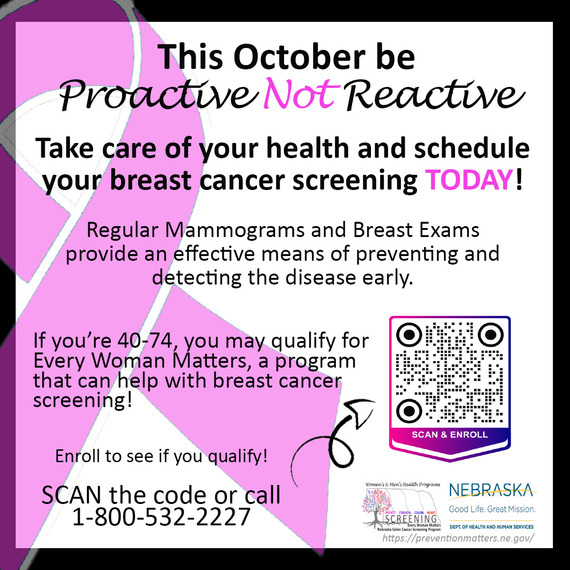
This October encourage your patients that are 40-74 to schedule their mammograms and be sure that they are doing their monthly self-breast exams. Preventive health screenings are important. They matter because they allow us to be proactive vs. reactive with health concerns and help us to recognize early stages of disease. Screening programs and resources are available for your patients and their loved ones.
Encourage your patients to enroll TODAY!
Do you have patients in your office for another reason but they are in need of preventive care?
If so, enroll them and screen them the same day! If you are an approved Presumptive Eligibility Provider, you can offer Presumptive Enrollment to your patients. In order to become a Presumptive Eligibility Provider you must complete a training (in person or self-directed) and complete and return a Clinic Intent to Enroll Clients Presumptively form. For more information about Presumptive Enrollment go to the Provider Information and Forms webpage and scroll down to Presumptive Enrollment to learn more. You can also contact your Technical Assistance Representative listed below.
|
|
Does Your Clinic Need Training?
If you are interested in finding out more about program training for your clinic (to review processes, procedures, and policies), please contact us !
|
|
Need Technical Assistance?
Contact your Clinic Technical Assistance Representative if you have any questions. Clinics A-M: Lynn Jones, BSN, RN || lynn.jones@nebraska.gov || 402-471-0561
Clinics N-Z: Tina Goodwin, BSN, RN || tina.goodwin@nebraska.gov || 531-530-7264
|
|
Referral for Additional Services Should Be Easy
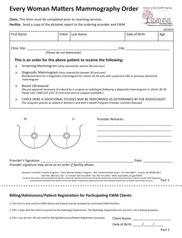
When clients need to be referred to a different provider for screening or diagnostic services, please make sure the provider knows that the client is enrolled in the EWM program. The initial provider can send the Mammography Order Form to the Radiologist, hospital or clinic.
The order form can be found on the WMHP Provider Information & Forms website.
|
|
 |
|
|
Screening Colonoscopy Post Positive Non-Invasive Stool Test Enrollment
The Nebraska Colon Cancer Screening Program now has a Screening Colonoscopy Post Positive Non-Invasive Stool Test Enrollment available.
The enrollment can be filled out if:
- Client is 45-74 years of age
- Client is a citizen or legal resident of Nebraska
- Client meets program income guidelines
- Client does not have health insurance that would pay for preventive health services
- Client had a positive home based stool test such as FOBT, FIT or Cologuard
Stool based test results from the lab are required to be submitted with the enrollment form.
|
|
NEW: 2025 American Cancer Society Cancer Atlas
The American Cancer Society released The Cancer Atlas, 4th Edition, a collaborative effort to uncover global cancer patterns and stark inequalities in addressing the burden of the disease. The Cancer Atlas presents the most up-to-date scientific data and evidence-based consensus across the entire cancer continuum.
Global reports show nearly half of cancer mortality worldwide is attributable to potentially modifiable risk factors. Read more here.
|
|
|
UPDATE: Statewide Breast & Cervical Cancer Engagement Meetings
Over the Summer months the Women’s and Men’s Health Program started the process of holding 6 different meetings within areas of the state that have a high breast and cervical cancer burden and a low screening rates.
The goals of the meetings are to see patterns across counties, review county specific priorities, navigate system level gaps, discuss outreach and communication strategies and to build partnerships. The groups brainstorm promising approaches and opportunities around ways to increase screening compliance and raise awareness about the importance of screening.
To date, 3 sessions have taken place:
-
Northeast NE: Counties of Dakota, Colfax, Madison, Saunders, Platte, Washington, Dodge || Meeting Date: 6/12/25
-
Lancaster County: County of Lancaster || Meeting Date: 8/14/25
Upcoming Fall Meetings (TBA):
-
Eastern NE: Counties of Douglas, Sarpy, Cass || Meeting Date: 9/18/25
-
Western NE: Counties of Box Butte and Scotts Bluff
-
Central NE: Counties of Dawson, Lincoln, Buffalo, Hall, Adams
-
Southeast NE: Counties of Gage, Saline, Otoe
Stay tuned to future newsletters about the progress of the project. If you'd like to be involved in these sessions, please let us know.
|
|
Women’s and Men’s Health Programs (WMHP) just released a new website page centered around healthy behavior support resources and educational resources for women and men. The page is titled Healthy Behavior Support Services Resources and Education. We hope that the site will be a clearinghouse of resources that people can go to and trust the content that is available. If you think we need to add additional resources, click here to let us know. |
|
|
Conferences:
37th Annual MOCONS Conference
Join the Metro Omaha Chapter of the Oncology Nursing Society in Omaha on October 17, 7 AM - 4 PM for the 37th Annual MOCONS Conference. The event will feature expert speakers discussing the latest advancements in oncology, including bispecific antibodies, pancreatic cancer, and CAR T-cell therapy.
20th Annual Thoracic and GI Oncology Conference
Advance your expertise in treating thoracic and GI cancers! The University of Nebraska Medical Center is hosting a continuing education activity on October 30-31 at the UNO Scott Conference Center. This event, Midwest Thoracic and GI Oncology Conference, is designed for a wide range of healthcare professionals, including oncologists, primary care providers, advanced practice providers, and nurses.
Research Articles:
Cancer Risk Concerns and Communication Gaps Regarding GLP-1 Medications (JAMA Network, July 2025) This study analyzed social media discussions to understand patient concerns about a potential link between GLP-1 medications and cancer risks, a topic not widely studied despite the drugs' popularity. Researchers found that while patients frequently discussed cancer risks, particularly thyroid and breast cancer, only a small percentage of posts mentioned discussing these concerns with a physician.
Rural and Urban Differences in Prostate Cancer Recurrence (JAMA Network, August 2025) This study found that rural prostate cancer patients were more likely to have a biochemical recurrence of their cancer, suggesting that geographical disparities contribute to poorer cancer control in these populations. The reasons for this disparity likely involve limited access to quality care, including lower rates of treatment, inadequate biopsies, and nonadherence to treatment schedules, with socioeconomic factors like unemployment also playing a role.
Evaluating Intersectional Variation of HPV-Associated Cancers in Rural America (BMC Public Health, August 2025) A study on HPV-associated cancers in rural communities found that while the overall incidence was 11.8 cases per 100,000 people from 2010 to 2019, there was significant variation among different racial and ethnic groups. The highest rates were seen in non-Hispanic American Indian/Alaska Native and non-Hispanic Black females, as well as non-Hispanic White males, highlighting the need for targeted public health interventions that address the unique disparities within these populations.
|
|
|
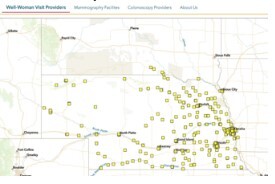
NEW: Provider Map Listing
|
|
|
|
|