|
 Volume 89 ∙ Issue 4 ∙ November 22, 2023
Library Vision Strategic Plan Task Force
The North Dakota Library Coordinating Council (NDLCC) is seeking volunteers to serve on a focus group to review and revise the Library Vision Strategic Plan. If you are interested in being on the task force and are from an academic, school, special, or tribal library, please send an e-mail to ndsladmn@nd.gov by December 6.
It is anticipated that there will be a virtual meeting in January and February as well as some work via e-mail with the goal to have the document ready to present to the NDLCC in April with a public comment period in May and adoption of the document in July. There may be an additional meeting of the task force in June to respond to the feedback.
|
|
Adventures Begin at Your Library
Submitted by Lexi Whitehorn

The time has come to get registered for the 2024 Adventures Begin at Your Library summer reading trainings. These trainings will be held in five libraries across the state and will provide time for collaboration and brainstorming for your 2024 summer reading programs. A HUGE thank you to our trainers for volunteering to host these trainings.
The locations and dates are:
- New Town - February 6 at 11:00 AM (lunch provided)
- Minot – February 8 at 10:00 AM
- Mandan – February 9 at 12:00 PM
- Valley City – February 9 at 9:00 AM
- Grand Forks – February 12 at 9:00 AM
For questions on the trainings, please contact Lexi Whitehorn at awhitehorn@nd.gov.
|
|
|
2023 Public Library Technology Survey
Submitted by Monica Struck
There is still time to participate in the 2023 Public Library Technology Survey by December 16th! The survey gathers powerful and actionable data to inform elected officials, the media, and other stakeholders about the valuable services libraries provide. Your input is critical at this time as more than $1.4 billion in federal funding will be distributed to support digital equity work in 2024.
The survey is easy to complete, with five sections containing mostly multiple choice and check-all-that-apply questions. It should only take about 30 minutes and it doesn’t require any annual output data. The unique, nationwide results will support planning and advocacy at the local, regional, and national level. Your participation helps PLA provide data for libraries to understand how they compare to their peers, and for funders, media, and stakeholders to see the scope of valuable services libraries provide to their communities.
The survey is open through December 16, 2023. Login to your library’s free Benchmark account at https://librarybenchmark.org. Your login ID is your library’s FSCSkey. One person should plan to submit on behalf of your library. Questions about the survey or gaining access to your Benchmark account should be directed to plabenchmark@ala.org.
|
|

Thanksgiving Menus
Every family in America seems to have different traditions for Thanksgiving, and there are many variations on what is served for Thanksgiving. But we can likely agree on the holiday’s principle: food, family, togetherness, and thankfulness.
Ever wonder what was served on past Thanksgivings or have you ever wondered what people may have been thankful for in the past? What was served at the first Thanksgiving meal is up for debate, but thanks to generous contributions to the digital collections of the North Dakota State Library, we know what was on the menu for more modern Thanksgivings in 1918, 1936, and 1945. Also, looking at the times and the events surrounding these three Thanksgivings, we can also speculate on what the attendees were probably thankful of.
|
|

Health and Human Services LIHEAP Program
If you have patrons struggling to pay their heating bills on top of all their other bills, the Department of Health and Human Services can help out.
The Low-Income Home Energy Assistance Program (LIHEAP) is a federally funded program offered through the state that provides financial help with heating costs for qualifying households. The assistance amount varies based on the number of people living in the household, total household income, heat source, and other factors.
LIHEAP helps pay part of the heating bills (meter read dates/deliveries) from October through May for the home you live in if…
-
You are a homeowner or renter, and you pay your own heat bills.
-
Your rent payment includes your cost of heat and you are not receiving housing assistance.
Applications are accepted from October 1 through May 31 (end of business day) or until program funds are used up, whichever comes first. If May 31 falls on a weekend or holiday, the deadline for signed applications will be the end of the first workday following May 31.
Applications received June 1-September 30 are limited to Cooling (if available) or Emergency Home Energy Services only as the regular heating season has ended.
|
|
|
Slideshow Carousel and Featured Areas
(Note: We have not overlooked the Navigation Bar - Talking Book. It is currently in the process of being revamped and will be showcased once the renovation is complete.)
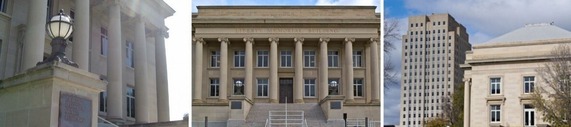
For the past few weeks, our focus has been on the navigation bar, making it easy to identify. Directly beneath this bar, you will find three static photos of the State Library.
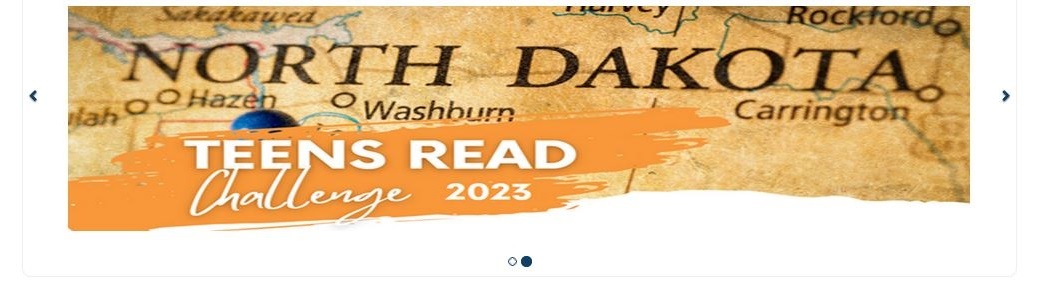
Moving further down the page, you will encounter the slideshow carousel. Within this carousel, you will find 2-3 slides featuring current noteworthy items. Each slide can be clicked on to access further information about the item.
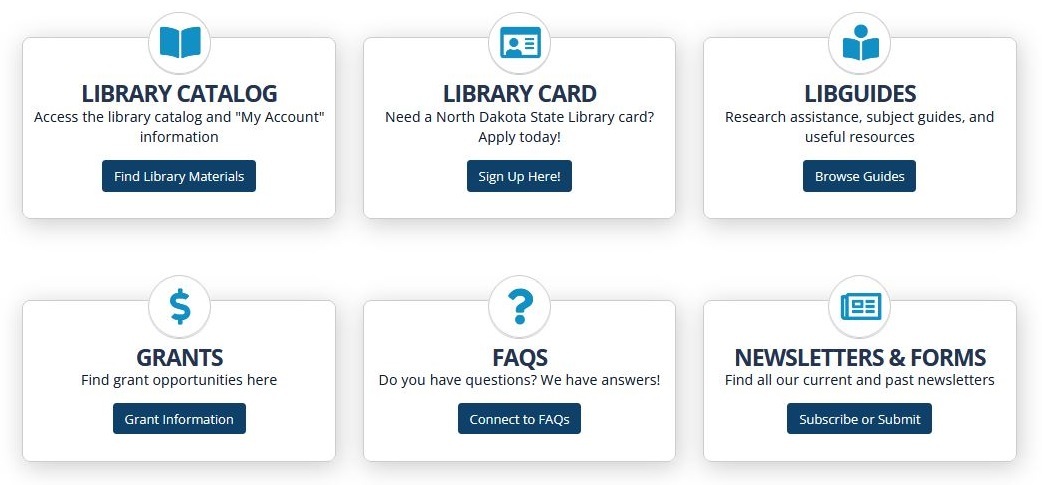
Beneath the slideshow carousel, you will discover the featured areas. These are the sections we consider to be the most relevant, and they are arranged in two rows, with three in each row.
The initial row of featured areas consists of the same three items that can also be found in the right section of the header:
-
Library Catalog – When chosen, you will be directed to the search screen of the catalog
-
Library Card – This link will direct you to the application forms and allow you to update your library card information
-
LibGuides – Here, you can access resources designed specifically for libraries which cover a wide range of subjects
The second row of featured areas includes an additional three items that have been emphasized:
-
Grants – Through this link, you will find information pertaining to grants, including the guidelines for current grants and the requisite application forms. Additionally, you can also locate the NDLCC Standards Levels within this resource.
-
FAQs – These commonly asked questions are categorized into the following sections: "Book Vending Machine," "Kits," and "ListServ” FAQ’s.
-
Newsletters & Forms – At this location, you will discover the latest edition of our newsletters along with their archived versions. Additionally, a comprehensive list of all the forms available on our website is also provided here.
Next week: News and Social Media
|
|

National Parfait Day
November 25th marks National Parfait Day! This week’s Teaching Tidbit dives into this sweet treat.
What is a Parfait?
Parfait is a French word that means perfect (Hopkins, n.d.). There are two main types of parfaits: French and American. (Japanese parfaits, often made with green tea, are also available in certain restaurants.) French parfaits are frozen desserts made of egg, whipped cream, sugar, and flavoring (Parfait, n.d.). While it is not always the case, French parfaits are known to be served on plates (see Schmitz 2019 image). American parfaits are an ice cream or yogurt dessert with layers of fruit, flavored syrup, and whipped cream. It is common for American parfaits to be topped with nuts or granola, as well as maraschino cherries (Parfait, n.d.). This variation of parfaits is served in a dish or cup (as shown by Chandler 2015). The first known written-down recipe for a parfait comes from an 1869 French cookbook. This recipe was for a coffee-flavored treat (Hopkins, n.d.).
|
|
Book Club Kit:
"Mrs. Kennedy and Me" by Clint Hill

In the four years Clint Hill was the Secret Service agent assigned to guard the glamorous and intensely private Jacqueline Bouvier Kennedy, he went from being a reluctant guardian to a fiercely loyal watchdog and, in many ways, her closest friend. Looking back fifty years, Hill tells his story for the first time -- a tender, enthralling, and tragic portrayal of how a Secret Service agent who started life in a North Dakota orphanage became the most trusted man in the life of the First Lady who captivated the nation and the world.
This kit includes ten books, a discussion guide, and a sign-in sheet.
|
|
|

Marketing Plan: An Introduction
You’ve probably created strategic plans, technology plans, or disaster plans for your library, but have you created a marketing plan? For the next several weeks, this column will be focused on how to create a quick marketing plan for your library starting with what a marketing plan is, why you should consider creating one, and then, moving on to the different aspects and content that you may want to include.
A marketing plan is a living document (edited and updated throughout the year) that lays out what you want to do during the upcoming year. It is a roadmap that includes all your programs, campaigns, and branding that will help you move toward a predetermined goal and guides you when marketing your services and resources. In other words, just like the other plans your library probably already has, this plan gives you a framework that will help guide you throughout the year, so you stay on track.
In the following weeks, we will discuss:
-
Target Audiences
-
SWOT Analysis
-
SMART Goals
-
Calendar and Budgets
-
Assessment/Feedback
-
Examples and Templates
If you have any questions or want to discuss your marketing strategies/plans, please contact BreAnne at ndslpa@nd.gov.
|
|
|
|
|