| |

Volume 89 ∙ Issue 3 ∙ November 16, 2023
NDLCC News
By State Librarian Mary Soucie
The North Dakota Library Coordinating Council (NDLCC) met in October. The Council reviewed proposed grant guidelines for the January round of grants, discussed the grant rubric, and considered future grant rounds. Beginning in the 2025-27 biennium, which will start on July 1, 2025, the Library Vision grants will become an open grant rather than category grants. A library will have an opportunity to apply for grant funds to support projects identified by the library. Libraries will need to make sure they are clearly articulating what the grant funds will be used for, how much money is needed for the grant, and how the library will evaluate the project. The maximum amount for grants will increase as well allowing libraries to dream bigger. If there are funds remaining in the second half of the second year of the biennium, the grants will be category grants as those are easier to complete in a shorter grant period.
To prepare for this change and also because it is time to review the guidelines, the NDSL is seeking volunteers to serve on a focus group to review and revise the Library Vision strategic plan. Council member Michele Seil from Carrington City Library will chair the task force. Council member Andrea Placher from the Williston Community Library will serve on the task force as well. We are looking for volunteers from academic, school, special and tribal libraries to serve on the task force to ensure that needs for all library types are being reflected in the document. If you are willing to serve on the task force, please email ndsladmn@nd.gov by December 6. We anticipate a virtual meeting in January and February as well as some work via email. The goal is to have the document ready to present to the NDLCC in April with a public comment period in May and adoption of the document in July. There may be an additional meeting of the task force in June to respond to the feedback.
|
|
|
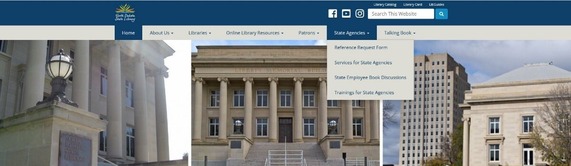
The current week's featured item on the navigation bar is centered on the State Agencies section.
Upon hovering over this section, you will come across several subcategories.
Reference Request Form: This form is for the purpose of submitting reference requests.
Services for State Agencies: Within this section, you can access information pertaining to reference services for state agencies, alongside state agency cataloging details.
State Employee Book Discussions: Provided here is the information regarding the book discussions available to state employees.
Training for State Agencies: We offer state employees tours of the State Library, as well as hands-on training for Online Library Resources. Additionally, a wide range of training materials is accessible through the State Employee Niche Academy.
Next week: Slideshow Carousel and Featured Areas
|
|
Broadband Access for All and
Digital Equity Plan in North Dakota
Submitted by Al Peterson
The North Dakota Information Technology Department (NDIT) has taken on a vision to make North Dakota a state-of-the-art place to live and work. That vision is a future where all public sector anchor tenet locations, including county court houses, school districts, all higher education, all state government buildings, and all public libraries have access to 1G broadband service.
Broadband access is seen as important in the 21st century as rural electrification was in the 20th century. Consumers need reliable and fast broadband services for communications, education, entertainment, remote access to work, and many more services. North Dakota businesses rely on broadband services for online retail, telehealth, system monitoring and reporting, financial transactions, marketing, supply chain management, and other day-to-day business needs. The public sector uses broadband for everything from public safety to education to communications and community engagement to running today’s Federal, State, County, and Municipal infrastructure.
By going to https://www.ndit.nd.gov/about-us/broadband, you have an opportunity to comment on the drafts for the Broadband and Digital Equity plans. In addition, North Dakotans can be part of the conversation by responding to a survey, also accessible by clicking on the link. The North Dakota Information Technology Department still has a long way to go to meet these needs, but with the federal grant programs and the money that NDIT received, they can make progress in providing top-notch, high-speed broadband services for the 21st century and beyond.
|
|

Fargo Library to Host Panel Discussion on ChatGPT and AI (Fargo Underground)
"Discover the captivating world of Generative Artificial Intelligence (AI), where systems like ChatGPT and other chatbots respond to questions using text and images. To help understand how generative AI works, the Fargo Public Library is offering an event titled “ChatGPT for All: How Generative Artificial Intelligence Impacts Our Daily Lives.” The informational discussion is scheduled for Thursday, Nov. 16, at 6 p.m. at the downtown Main Library..."
|
|
|
Dakota Memories Oral History Project

The “Dakota Memories Oral History Project” collection contains over 150 oral histories and associated materials. The project’s mission is to preserve the history and heritage of second- and third-generation Germans from Russia. Interviews focusing on childhood memories and family relationships were conducted in North Dakota, South Dakota, and southern Saskatchewan from 2005 to 2009. In short, they chronicle what it was like growing up German-Russian on the Northern Plains. This digital collection is provided by the NDSU Libraries Germans from Russia Heritage Collection (GHRC), and it’s available on Digital Horizons.
|
|
|
Gayle Larson Schuck

Gayle Larson Schuck is a North Dakota author who is known for her Prairie Pastor series, which is set in North Dakota.
The North Dakota State Library has the following books available for check out:
|
-
Amber’s Choice (Prairie Pastor Series; 2)
-
By the Banks of Cottonwood Creek (Prairie Pastor Series; 1)
-
Cottonwood Dreams (Prairie Pastor Series; 3)
-
Secrets of the Dark Closet
|
|
Want to Better Prepare Yourself for the 2024 Eclipse? Join Eclipse Ambassadors!
Space Science Institute
NASA Eclipse Ambassador Partners, led by STAR Net Partner Astronomical Society of the Pacific, has opened their applications for library staff!
Who can apply? Any library staff or volunteer who wants to learn more about the upcoming eclipse, and wants to be partnered with a student or amateur to conduct programs at YOUR LIBRARY!
What is the time commitment? Approximately 8 hours of training, plus time to conduct your programs.
|
|
2024 Public Library Grant for Science Kits
The Institute of Electrical and Electronics Engineers (IEEE)
The Institute of Electrical and Electronics Engineers (IEEE) - Region 4’s Science Kits for Public Libraries (SKPL) Grant program is offering up to $2,000 in funding to public libraries to establish a circulating science kits collection. Libraries must be located within Region 4, which includes all of Iowa, Michigan, Minnesota, North Dakota, Wisconsin, and northerly portions of Indiana, Illinois, Ohio, Nebraska, and South Dakota.
The application form is available now, on the SKPL website, and library submissions will be accepted until January 16, 2024. Those libraries which have previously applied for the grant but did not receive funding are invited to submit again.
Public Libraries have a long tradition of building stronger communities by providing life-long learning opportunities for children and teens. The SKPL Team is honored to have the opportunity to enrich the services that public libraries offer. SKPL enables children, parents, and teachers the chance to borrow library kits for hands-on STEM (Science, Technology, Engineering, and Mathematics) learning at home or in classroom.
Region 4, Science Kits for Public Libraries (SKPL) organization is a volunteer-based organization affiliated with the Institute of Electrical and Electronics Engineers (IEEE). SKPL believes all children – regardless of race, gender, financial condition, or home environment – should have access to high-quality, hands-on STEM learning experiences. By making catalyst grants available to public libraries, we empower them to start their own science kit collections that are free and accessible to the public.
|
|

Using G.L.A.D. to Evaluate Sources
Last week, edWeb hosted a webinar called “Share or Beware, the STEM Edition: Sorting Science Fact from Fiction.” A recording can be requested at https://media.edweb.net/edWebinar/?view=20231107edweb24. While various tips and tidbits were shared, my biggest takeaway is using the acronym of G.L.A.D. to evaluate sources.
G.L.A.D. stands for:
Get past clickbait,
Look for crazy claims,
Analyze sources, and
Determine outside expert opinions
|
|
Website Accessibility: Fonts
A very important part of your website is the font that you use. You will want to make sure any fonts you use are accessible to those with vision impairments or who are dyslexic.
According to accessiBe, W3C, and Google Fonts, the fonts that conform with Web Content Accessibility Guidelines (WCAG) have the following characteristics:
|
|

“Smart Brevity: The Power of Saying More With Less”
by Jim VandeHei, Mike Allen, and Roy Schwartz
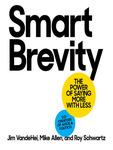
“Smart Brevity” is a very quick read, which makes sense since the whole point of the book is about brevity. Built by Axios journalists, Smart Brevity is a communication formula aimed to prioritize essential news and information, explain its impact, and deliver it in a concise and visual format.
For people who write articles for the local newspaper, newsletters, or blogs, it may seem like you should write long narratives that provide detailed descriptions of everything. Instead, this book suggests being concise and using regular, everyday words. According to the authors, articles should be less than 200 words with links that readers can click on to delve deeper. Using bullet points to break up clumps of data or long paragraphs are also recommended.
With chapters on how to use Smart Brevity in your e-mail correspondence, at meetings, when presenting/giving speeches, for social media posts, and articles, you may find this book useful for work and personal life.
This title is available through Libby as an audiobook and e-book.
|
|
|
Dash and Dot
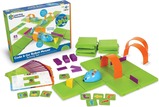
Code & Go Robot Mouse Activity Sets introduce coding concepts through Colby, a programmable mouse with colorful buttons. Kids can design and build their own mazes and then use analytic thinking, problem solving skills, and step-by-step programming to get Colby to his cheese.
This kit includes three packs, each containing one activity guide, ten activity cards, one robot mouse, three tunnels, one cheese wedge, 22 maze walls, 30 coding cards, and 16 grid pieces.
Intended for ages 5+
|
|
|
|
|
|