Addison Myers, Environmental Health Specialist

"My name is Addison, and I have been with Union County Environmental Health for nearly two years. My background is in food science and food safety. I enjoy reading, playing video games, cooking, and searching for the perfect cup of coffee. I want to be the bridge between food operators and food scientists, giving each an equal voice in finding solutions to provide safe, quality food."
|
Using Sanitizers to Reduce Bad Bugs on Food-Contact Surfaces
Bacteria, viruses and other pathogens, or what the Food and Drug Administration (FDA) has dubbed “bad bugs,” will not announce their presence. They cling to hands, cutting boards, utensils, and even food, where they can easily transfer to our bodies and cause illness. Part of the work of Environmental Health Specialists is to equip foodservice operators with the knowledge to prevent such illness. The FDA Food Code is an excellent tool to guide both Environmental Health Specialists and operators in producing safer food for our community.
Each new edition of the FDA Food Code is built on decades of work done by experienced scientists, regulatory professionals, retail professionals, and consumers. Every two years, a conference of these individuals meets to develop the latest edition. Attendees may debate a single line of the Food Code for over an hour before recommending that it be included in the newest edition. These additions are not arbitrary, as they have been well-researched and designed to keep food safe while considering the daily challenges faced by food service workers.
When you implement the NC Food Code, you’re standing on the shoulders of giants.
The Goldilocks Rule of Sanitizing
Not too little. Not too much. Just right.
That’s the rule when it comes to sanitizer use in your kitchen.

To stop the spread of “bad bugs” on food-contact surfaces, the NC Food Code outlines best practices for sanitizing. Like many other sections of the Food Code, the citations related to sanitizers are backed by rigorous testing.
Sanitizers must be tested for each pathogen they claim to reduce or destroy on their labels. Two common sanitizers mentioned in Section 4-501.114 of the North Carolina Food Code Manual are chlorine and quaternary ammonium compounds.
|
Chlorine (aka bleach)
|
Quaternary Ammonium Compounds (QACs or Quats)
|
-
Effective against most bacteria, viruses, fungi, and bacterial spores.
-
Destroys bacterial membranes and causes lysis (cell destruction).
-
Efficacy depends on water temperature, concentration, contact time, and pH.
- Becomes less effective as water pH increases.
A handy table for these combinations can be found in Section 4-501.114 of the NC Food Code Manual.
Pro tip: The presence of food and grease reduces the concentration of active chlorine. Replace your chlorine sanitizer when it becomes soiled or greasy.
|
- Effective against most vegetative bacteria (not spores), viruses, and some fungi.
-
Tears holes in bacterial membranes, causing cell contents to leak out.
-
Effective across a wide pH range.
-
Less affected by food and grease buildup than chlorine.
-
Most accurate when tested between 65°F and 75°F.
-
Recommended to be used with non-cotton (nonwoven) towels to avoid "quat binding," which reduces QAC concentration.
Pro tip: While chlorine and QACs are both effective on their own, they make a terrible team. Do not mix them, as they could create fumes that are harmful.
|
How Much Is Enough? (Concentration Matters)
Sanitizers must hit the “just right” level—too little won’t kill pathogens, too much can leave behind harmful residues.
How do you make sure your dishes are sanitized when you dunk them in your three-compartment sink or run them through your dish machine? How do you know your food-contact surfaces are safe after sanitizing them?
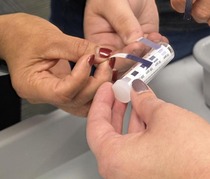
The solution is one that Goldilocks would love: test strips!
 |
|
Test your sanitizer with the appropriate test kit and check it against the label on the sanitizer container. The color of the strip will not only tell you when the concentration is too much or too little, but also when it’s just right.
If you’re picturing 50 parts per million (ppm), think of 50 drops of sanitizer in a million drops of water—small, but mighty.
|
Give It Time (Contact Time)
Remember: test, dunk, time, repeat.
Now that you have your sanitizer at the correct concentration, refer to the contact time on the manufacturer's label to ensure the food-contact surface is exposed to the sanitizer for enough time to be effective. Some sanitizers are effective in 60 seconds, while others may need a few minutes. Test your sanitizer, dunk your dish, time the dip, and you are on your way to safer food-contact surfaces.
When used properly, these sanitizers are a fantastic tool to add to your food safety toolbelt! They are strong enough to reduce bad bugs in your kitchen and safe to use on food-contact surfaces. Make sure to refer to the label instructions for concentration, contact time, and other instructions.
Thanks for taking the time to learn more about the science of sanitizing. If you have questions, your Union County health inspector is here to help.
|