|
A clean food service establishment not only protects the health and safety of customers, but also helps promote a positive work environment for staff. A sanitary kitchen can encourage safe food handling practices by motivating employees to take pride in their work. Management can empower their staff to maintain a high cleanliness standard by training employees to effectively clean and sanitize surfaces to reduce the risk of cross-contamination.
Cleaning vs. Sanitizing
Cleaning and sanitizing have different purposes and must be done in succession to be effective. Cleaning removes food, grease and other types of soil from a surface but does not remove all pathogens. Sanitizing reduces the number of pathogens on a clean surface to safe levels. Food and grease left on food-contact surfaces can weaken the sanitizer's strength, leaving a harmful amount of pathogens that could cause cross-contamination issues.
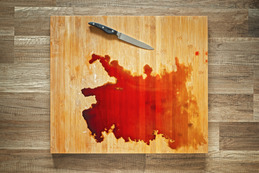
Pathogens can spread to food when:
- Equipment is not washed, rinsed and sanitized between uses.
- Food-contact surfaces are wiped clean instead of being washed, rinsed and sanitized.
- In-use wiping cloths are not stored in a sanitizer solution between uses.
- Sanitizing solutions are not at the required strength.
- In-use wiping cloths used to clean/sanitize raw food preparation surfaces are used on other food-contact surfaces.
|
When to Clean and Sanitize
An equipment or utensil surface that comes into contact with food is considered a food-contact surface and must be cleaned and sanitized to prevent cross-contamination. However, not all food-contact surfaces must be submerged in a sanitizer solution after cleaning. For example, pots and pans used for cooking are subjected to high heat, destroying any pathogens left after cleaning.
Sections 4-6 and 4-7 of the NC Food Code Manual address when and how often equipment food-contact surfaces and utensils must be cleaned and sanitized, including:
- Before each use with a different type of raw animal food such as beef, fish, lamb, pork, or poultry.
- Each time there is a change from working with raw foods to working with ready-to-eat foods.
- Between uses with raw fruits and vegetables and with foods that require temperature/time control.
- Before using or storing a food temperature measuring device.
- Any time during the operation when contamination may have occurred.
- At least every 4 hours; less frequently if food is prepared in a refrigerated room maintained at less than 55°F.
Sanitizing vs. Disinfecting
Understanding the difference between sanitizing and disinfecting is essential, as using these terms interchangeably is a common error.
Sanitizing kills bacteria and other microorganisms on surfaces but is not intended to kill viruses. When properly made, sanitizers are intended to be used on clean food-contact surfaces such as deli slicers, cutting boards, reusable eating and drinking utensils, and food preparation sinks and tables.
Disinfecting is different from sanitizing because it eliminates viruses, bacteria and fungi. A product that makes disinfection claims must be registered with the Environmental Protection Agency (EPA). To ensure safe and effective uses, it’s essential to follow the intended use and instructions on the product label. High-touch surfaces such as toilets, sinks, faucet handles, door knobs, menus, high chairs, and condiment containers often have the most germs in a food establishment and should be regularly cleaned and disinfected. Responding to vomit and diarrhea events and norovirus outbreaks are situations where using a disinfectant would be more effective at stopping the spread of pathogens.
Cleaning and Sanitizing Methods
Manual and Mechanical:
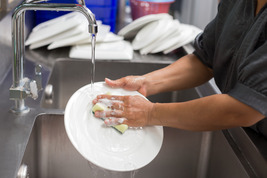
Equipment and utensil surfaces must be washed, rinsed and sanitized manually using a three-compartment sink or mechanically using a commercial dish machine.
Sections 4-6 and 4-9 of the NC Food Code Manual describe a five-step procedure for both manual and mechanical methods:
-
Precleaning - Food debris and residues on equipment and utensils must be removed by scraping, soaking or pre-rinsing before washing.
-
Washing - Manual and mechanical cleaning must involve a combination of hot water and detergent or an approved cleaning agent to remove food particles and other contaminants.
-
Rinsing - Utensils and equipment must be rinsed using clean potable water to remove detergent and loosened food particles.
-
Sanitizing - Food-contact surfaces must be sanitized immediately after cleaning using hot water or chemical sanitization.
-
Air drying - Equipment and utensils must be air-dried or used after adequate draining before contacting food and may not be towel-dried.
Clean-in-place:
Stationary equipment and utensils too large to wash, rinse and sanitize in a three-compartment sink or dish machine, such as deli slicers, meat saws, and food preparation sinks/tables, may be cleaned and sanitized in place using alternative procedures. When detergent and sanitizer buckets are used, wiping cloths must be:
- Stored completely submerged in an approved sanitizer at the required concentration when not in use.
- Laundered or discarded daily.
- Stored in a sanitizer solution free of food debris and visible soil.
- Used in a manner to prevent contamination of food and utensils.
- Sanitizer buckets must be stored off the floor.
|
Employee Training Tips
Training employees to use proper cleaning techniques is necessary for the safety and health of both staff and customers.
To encourage employees, management should:
- Include cleaning as part of training for all restaurant workers.
- Test workers on proper methods and procedures before they can begin working.
- Make cleaning procedures easy to access.
- Use a cleaning checklist.
- Recognize employees for their hard work and motivate them to keep the restaurant clean.
- Regularly audit cleaning practices and test employees on their knowledge.
- Review health department inspection reports with employees and quickly address cleaning issues.
- Offer incentives to employees who obtain Certified Food Protection Manager Certification.
|