Year-End Literacy Assessment Shows Strong Gains in Early Grades, Superintendent Truitt Reports
Students in early elementary grades in North Carolina public schools made strong gains in their literacy skills during the 2022-23 school year, according to assessment results presented by State Superintendent of Public Instruction Catherine Truitt to State Board of Education members during their August meeting.
“We can say with certainty that the post-pandemic rebound began last year for our kindergartner through third graders,” Truitt told the board. “North Carolina continues to close gaps. We’re continuing to see improvement for all grade levels. We’re continuing to see improvement across all subgroups. Overall, it’s incredibly good news for all students in our state.”
The results of the final assessment of the year showed marked improvements from the start of the year, with the percentage of students who measured “on track” more than doubling in kindergarten, increasing by 22 percentage points in first grade and by 13 points in second grade.
The gains by North Carolina students were achieved by the end of the second full year of a far-reaching statewide initiative to support elementary school teachers with extensive training in instruction based on the “science of reading,” a phonics-based approach with strong evidence of effectiveness.
Truitt said the assessment outcomes were the “fruits of the labor our educators,” who have been at the center of the state’s full-court press effort to improve reading skills among all students through the two-year professional development program, Language Essentials for Teachers of Reading and Spelling, or LETRS.
Additionally, North Carolina’s statewide results show that fewer students at the end of the year were well below assessment benchmarks and in need of intensive intervention. Kindergartners, in particular, saw a steep decline in the percentage of students considered at risk of requiring such intervention, falling 38 percentage points, from 53% at the start of the year to 15% by year’s end.
Jill Camnitz, chair of the board’s Student Learning and Achievement Committee, also praised the efforts of teachers to master an approach to reading instruction that was unfamiliar to many.
“I have to celebrate the data that was just presented and congratulate every teacher in the state, who’ve been working so hard on this incredibly difficult” task,” Camnitz said. “I hope that this confirms to all of them that that work was worth it because these are students who are going to go forward into their education with the kind of base that they have to have to be successful.”
North Carolina’s gains in all three grades and nearly all student subgroups outpaced those of other states and districts that use the same early literacy screener, known as the DIBELS 8 (Dynamic Indicators of Basic Early Literacy Skills), an updated version of the previous DIBELS assessment from mCLASS. The 6-point gain by North Carolina’s third graders was about on par with the comparison group, with a 5-point increase from the beginning of the school year. While Hispanic students in North Carolina saw a 22 percentage point gain between the beginning and end of the school year – better than the 16-point gain elsewhere in the nation – their on-track percentage on the year-end assessment was 1 point below that of the national comparison group.
Truitt called attention to gaps that remain between white students and Black, Hispanic and Native American students, also reflected nationally, noting that continuing efforts to improve early literacy for all students will reduce disproportionate referrals and placements in special education.
“We have students of color getting referred more often for services that they in fact don’t need,” Truitt said. “They just need to be taught how to read properly.”
|
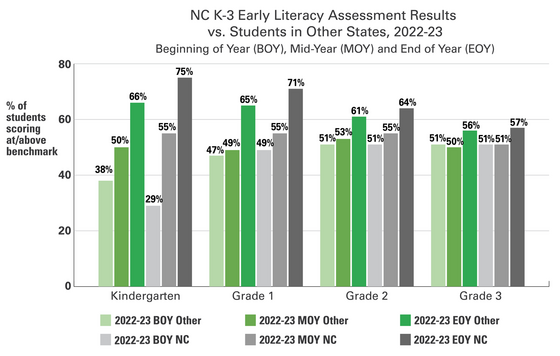 Amplify reported increases in percentages of North Carolina students in grades K-3 at or above benchmarks on year-end DIBELS 8 assessments in 2022-23 compared to assessments at the beginning of the school year. In all four grades, the gains were greater than a data set representing students in other states where the same assessment is used.
The early literacy screener, DIBELS 8, is based on the science of reading and measures students’ risk level on component skills involved in reading such as phonemic awareness and phonics. The tool was used with all kindergarten through third grade students in North Carolina for the first time in the 2021-22 school year. The measures increase in complexity from grade level to grade level and increase in complexity throughout the year within a grade level.
Truitt said students in kindergarten and first grade have benefitted the most so far from the state’s shift to instruction based on the “science of reading,” and their gains in 2022-23 bear that out. Students in second and third grades, however, didn’t have the same exposure when they were in the earliest grades, she said. In addition, many of last year’s third graders were handicapped by remote instruction for a year or more when they were in kindergarten and first grades.
North Carolina’s assessment results were compared with those of 1.6 million K-3 students elsewhere in the nation whose literacy skills are measured with the same assessment, according to Amplify.
The assessment results are not comparable to the state’s end-of-grade reading tests, which are administered beginning in the third grade. Those exams measure whether a student has mastered grade-level standards, from a basic level to more rigorous comprehension, while the DIBELS 8 assessment measures the essential, foundational skills that students need to become successful readers.
Teachers administer the DIBELS 8 assessment with students individually at the beginning, middle and end of the school year, and are encouraged to use it between established benchmarks to monitor student progress. In addition to student progress monitoring data, the various component skills that are measured also help guide teachers in their literacy instruction and interventions.

Board Calls for Closer Look at Successful Restart Schools
North Carolina’s “restart” model for helping turn around recurring low-performing schools is showing success, according to two reports presented to the State Board of Education this month, and board members called for a closer look at those schools with strong results.
Low-performing schools that are allowed by the state board to operate under the restart model are granted the same kind of flexibilities with statutes and rules as the state’s charter schools. Eligible schools are those that have been designated as “recurring low performing,” meaning that they received a school performance grade of D or F and didn’t exceed growth targets under the state’s accountability system in two of three consecutive years.
The initial and largest cohort of restart schools, which began with the model during the 2017-18 school years, demonstrated the most success through the 2021-22 school year, with 13 of those 55 schools no longer identified as recurring low performing and 35 additional schools meeting expectations for academic gain. Among 148 schools in the first five cohorts of schools, which had adopted the restart model through the 2021-22 school year, 109 of them, or 74%, had either met or exceeded their growth goals under the state’s accountability measures.
Still, because of disruptions to teaching and learning caused by the COVID-19 pandemic, a larger percentage of the 148 schools in the five cohorts were considered recurring low performing after the 2021-22 school year than of the 102 schools in the first two cohorts after the 2018-19 school year.
In terms of the kinds of flexibilities that restart schools chose to employ, 95% of the schools took advantage of leeway allowed in budgeting, primarily for additional staffing or flexibility in the use of staff.
Board Chair Eric Davis said he wanted more detailed information about how schools are using their flexibility from rules and policies, which also include areas such as employment requirements, calendar, Standard Course of Study and curriculum, assessment, and class size.
“It’s not just whether they used flexibilities, but how are they using them,” Davis said, “and how is that having the greatest impact on students? How are school leaders who are taking advantage of these flexibilities turning them into positive impacts for our students, and how are those schools that aren’t able to raise performance using those flexibilities?”
|
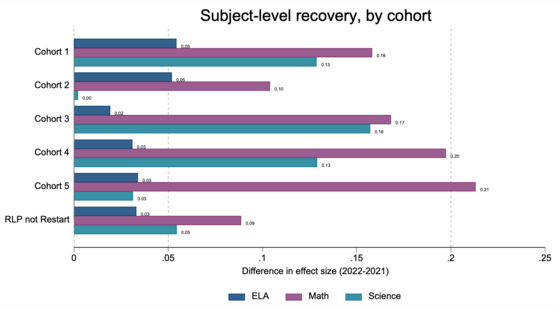 Restart schools (Cohorts 1-5) experienced slightly more recovery than those in recurring low-performing schools (RLP not Restart)
The board also heard the results of analysis of learning loss and recovery from the Office of Learning Recovery and Acceleration, comparing outcomes from restart schools to nearly 300 other recurring low-performing schools. The summary results were these:
- Students in restart schools experienced slightly less learning loss during the 2020-2021 school year than students in recurring low-performing schools.
- Restart students were also close to their pre-pandemic expected scores in 2021-22 than students in recurring low-performing schools.
- Comparing performance within the same subject between 2021-22 and 2020-21, restart schools experienced slightly more recover than those in recurring low-performing schools, with greater recovery in science and math than English language arts.
- Comparing students to their own performance in the previous year, restart students experienced slightly more recovery than those in recurring low-performing schools, with greater recover in math than ELA.
Board member Jill Camnitz noted that many recurring low-performing schools, 297, have not adopted the restart model.
“Perhaps we could reach out to those folks and see if we could identify what is keeping them from being interested in this program,” Camnitz said.
Davis agreed and said, “we’re only reaching one-third of the number of schools we need to reach. We’re only talking about 5% of our schools, so for all the progress, we’re not reaching enough kids. What is it that the most successful restart schools are doing and how does that compare of everybody else?”
State Superintendent Catherine Truitt suggested a broader examination, since funds from the federal CARES Act [Coronavirus Aid, Relief, and Economic Security Act] are being used provide intensive support to many other low-performing schools.
“Not enough schools are getting the support that they need,” Truitt said, “but there are myriad ways low-performing schools are getting support in addition [to restart schools]. We’re talking about a broader study here.”
Davis added: “We need, clearly, is a rapid expansion of whichever models are most effective.”
Truitt also noted that the state’s aggressive effort to boost literacy teaching and learning in the early grades with instruction grounded in the science of reading will help low-performing schools.
“With LETRS, we have bitten off a big part of the elephant,” Truitt said. “Now we need to look at adolescent literacy and how are going to support those students who are not illiterate but are not able to do the kind of reading that one needs to do to be successful in high school and beyond.”
Board Approves Temporary Rule, Policy Amendment for Paid Parental Leave
State Board members this month approved the adoption of a temporary rule and policy amendment entitling teachers and other school staff to paid parental leave.
The approved rule and policy amendment includes several revisions added since the board reviewed the paid parental leave provision during its July session. They include:
- Eligibility now includes employees in probationary, or time limited positions.
- Temporary employees or independent contractors are not eligible.
- Charter schools may opt-in to providing the benefits, and those that do will receive their share of the state funds allocated for substitute teachers.
- The rule applies to all qualifying events, not just births, occurring after July 1, 2023. Other qualifying events are adoptions or becoming a foster parent.
The State Human Resources Commission is required under the law to adopt rules and policies, and the State Board of Education to do the same, providing that permanent, probationary, and time-limited full-time state employees may take the following paid parental leave: up to eight weeks after giving birth to a child; up to four weeks after other qualifying events such as paternity leave, adoption, fostering a child or becoming a legal guardian.
The leave entitlement extends to the parent of a newborn biological child; a newly placed adopted child; a newly-place foster child; or a child under the age of 18 otherwise legally placed with the parent, such as through guardianship.
Part-time permanent, probationary, or time-limited state employees also may take a prorated amount of paid leave – up to eight weeks after giving birth, or – up to four weeks for one of the other qualifying events.
School employees previously could take 12 weeks of parental leave under the federal Family and Medical Leave Act (FMLA), but without a provision for pay, they needed to use accrued personal or sick leave during their time away from work.
Eligible school employees must be employed by a public school unit (district, charter or other public school) for the immediate 12 months without a break in service preceding the qualifying event, including at least 1,040 hours in payroll in that 12-month period. Each public school unit is separate employer for meeting 12-month employment requirement.
Temporary employees and independent contractors are not eligible for paid parental leave.
The law also allocates $10 million in state funds annually to cover the costs of substitute teacher pay for teachers using paid parental leave. Charter schools that opt into the leave provision are eligible to share the allocation for substitute pay.
|
|